Have you ever noticed how chairs in a classroom, windows on a building, or cupcakes in a tray often line up in neat rows? That neat pattern helps us count quickly. When objects are arranged in straight rows and columns, we can use addition in a smart way instead of counting one by one.
An array is a group of objects arranged in rows and columns. Rows go across, and columns go down. Arrays are helpful because they show equal groups, as shown in [Figure 1]. In an array, each row has the same number of objects, or each column has the same number of objects.
When groups are equal, addition becomes easier. Instead of counting every object one at a time, we can add the same number again and again. This is called repeated addition.
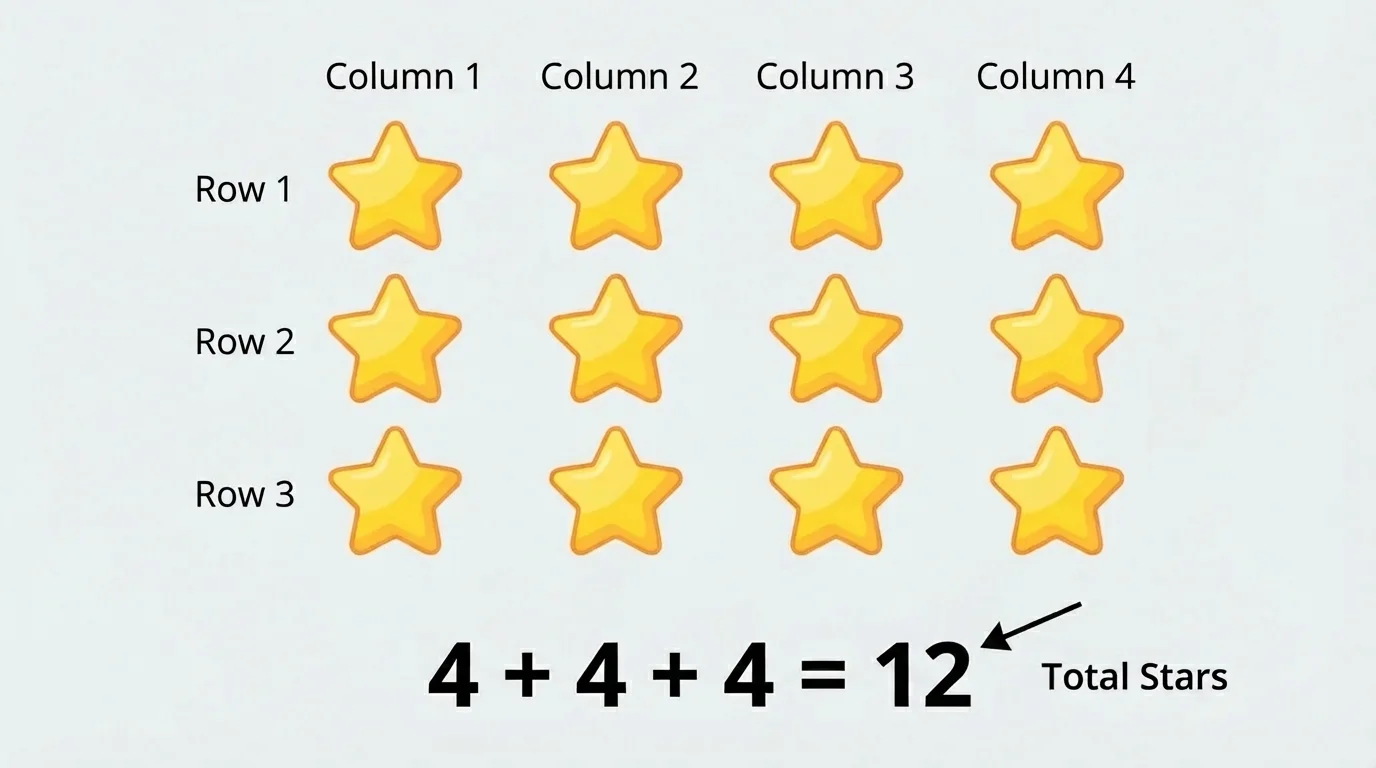
Row means objects that go across.
Column means objects that go down.
Total means how many objects there are altogether.
If we see an array arranged in rows, we can count by rows. If we see columns, we can count by columns. Both ways help us find the total.
Look at an array with 3 rows and 4 objects in each row. We can add the rows:
\[4 + 4 + 4 = 12\]
There are 12 objects altogether.
We can also think about the same array by columns. There are 4 columns with 3 objects in each column:
\[3 + 3 + 3 + 3 = 12\]
The total is still 12. The array does not change; only the way we count it changes.
You already know how to add equal numbers, such as \(2 + 2 + 2\) or \(5 + 5\). Arrays help you see those equal addends in a picture.
When you find the total in an array, ask two questions: How many rows are there? and How many objects are in each row? Then write an addition equation.
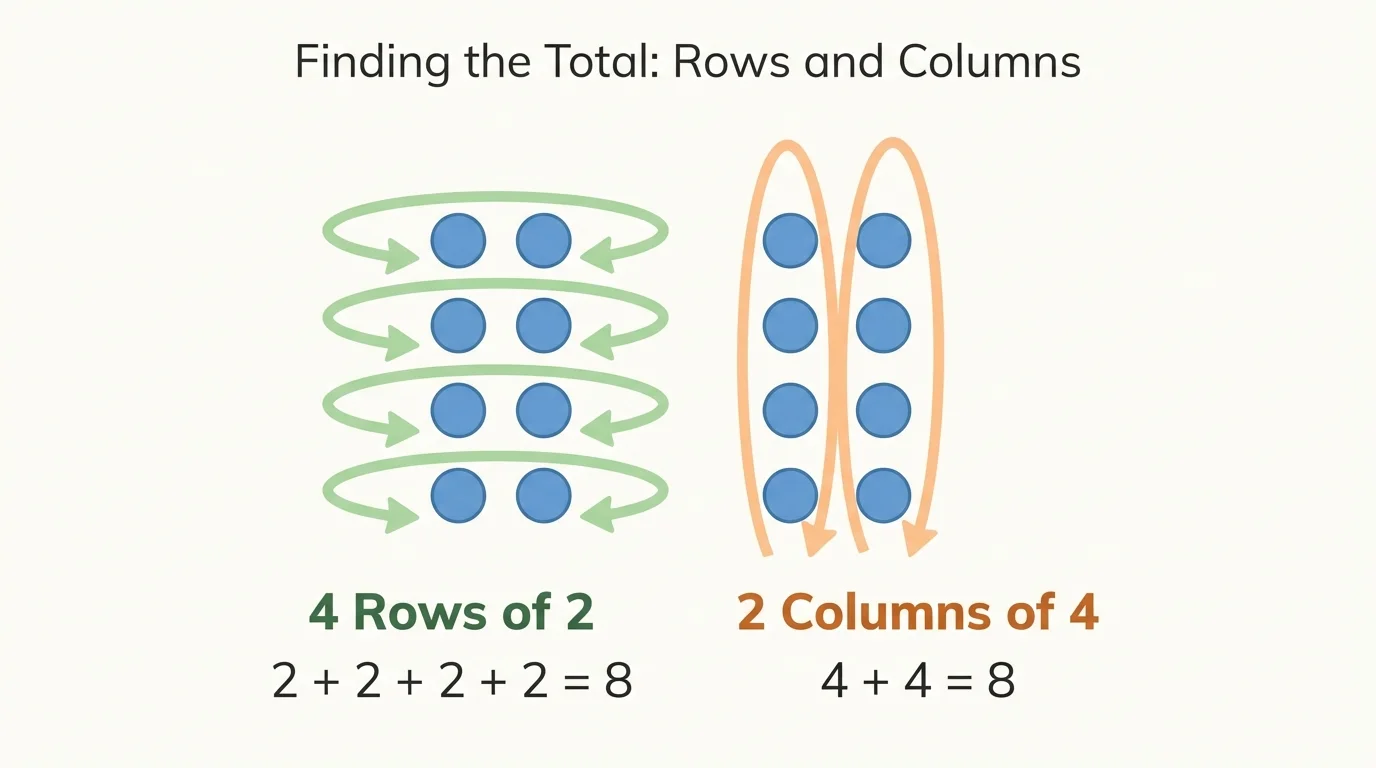
An equation is a math sentence that shows two amounts are equal. For arrays, we write an equation to show the total as a sum of equal addends. The same array can be grouped by rows or by columns, as shown in [Figure 2].
If an array has 4 rows with 2 objects in each row, the equation by rows is:
\[2 + 2 + 2 + 2 = 8\]
If we count the same array by columns, there are 2 columns with 4 objects in each column:
\(4 + 4 = 8\)
Both equations are correct because both describe the same array.
When we say sum of equal addends, we mean we are adding the same number more than once. In \(2 + 2 + 2 + 2\), all the addends are equal to \(2\). In \(4 + 4\), the addends are equal to \(4\).
One array, two ways to add
A rectangular array can often be described by rows or by columns. That means one picture can match two repeated-addition equations. This helps you notice patterns and prepares you for multiplication later.
It is important that the array stays within small sizes here. We will work only with arrays up to 5 rows and up to 5 columns. That means the largest array in this lesson is 5 by 5.
Example: Find the total number of objects in an array with 2 rows and 5 objects in each row.
Step 1: Look at the equal groups.
There are 2 equal groups because there are 2 rows.
Step 2: Write the addition equation.
Each row has 5 objects, so we add \(5 + 5\).
Step 3: Find the total.
\(5 + 5 = 10\)
\(5 + 5 = 10\)
The array has 10 objects.
This example uses rows, but we could also think of it as 5 columns with 2 in each column. Then the equation would be \(2 + 2 + 2 + 2 + 2 = 10\).
Example: Find the total number of objects in an array with 3 columns and 4 objects in each column.
Step 1: Count the columns.
There are 3 equal groups because there are 3 columns.
Step 2: Write the repeated addition equation.
Each column has 4 objects, so write \(4 + 4 + 4\).
Step 3: Add to find the total.
\(4 + 4 + 4 = 12\)
\[4 + 4 + 4 = 12\]
The total number of objects is 12.
Notice how helpful equal groups are. Since each column has the same number, we do not need to count one object at a time.
Example: An array has 5 rows and 2 columns. Find the total in two ways.
Step 1: Count by rows.
There are 5 rows with 2 in each row, so write \(2 + 2 + 2 + 2 + 2\).
Step 2: Add by rows.
\(2 + 2 + 2 + 2 + 2 = 10\)
Step 3: Count by columns.
There are 2 columns with 5 in each column, so write \(5 + 5\).
Step 4: Add by columns.
\(5 + 5 = 10\)
\[2 + 2 + 2 + 2 + 2 = 10\]
\(5 + 5 = 10\)
Both equations show the same total: 10.
This is the same idea we saw earlier in [Figure 2]: the arrangement stays the same, but the equal addends can come from rows or from columns.
Arrays help us see patterns in addition. If there are 4 rows of 3, we write \(3 + 3 + 3 + 3\). If there are 5 rows of 5, we write \(5 + 5 + 5 + 5 + 5\).
Here are some small arrays and their row equations:
| Rows | Objects in each row | Addition equation | Total |
|---|---|---|---|
| \(2\) | \(3\) | \(3 + 3\) | \(6\) |
| \(3\) | \(2\) | \(2 + 2 + 2\) | \(6\) |
| \(4\) | \(5\) | \(5 + 5 + 5 + 5\) | \(20\) |
| \(5\) | \(5\) | \(5 + 5 + 5 + 5 + 5\) | \(25\) |
Table 1. Small rectangular arrays up to 5 by 5, with repeated-addition equations and totals.
The table shows that even when two arrays have the same total, the addends may look different. For example, \(3 + 3\) and \(2 + 2 + 2\) both equal \(6\), but they describe different arrays.
Egg cartons and muffin pans are often arranged in arrays because neat rows and columns make counting fast and easy.
When objects are lined up evenly, our eyes can quickly spot the groups. That is one reason arrays are so useful in math.
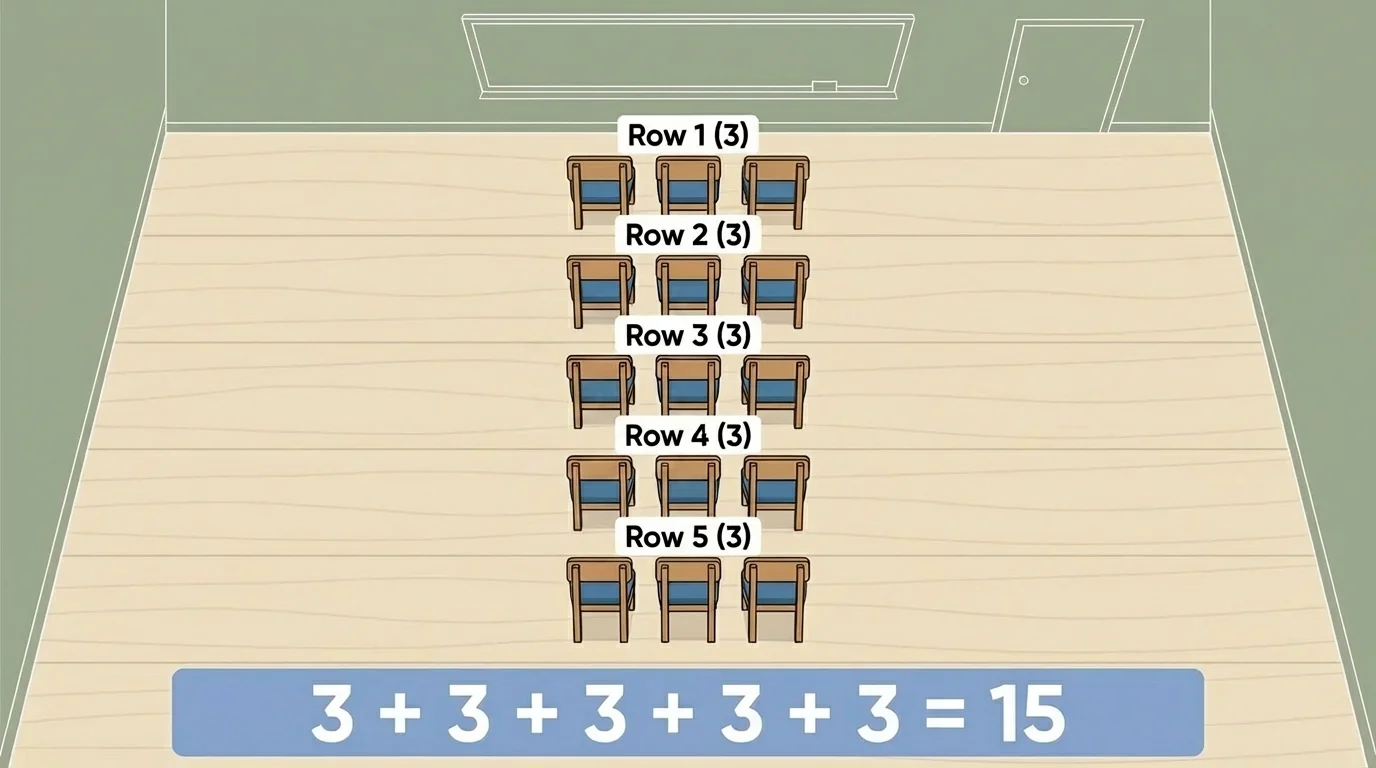
Rectangular arrays are everywhere, as shown in [Figure 3]. A room with chairs arranged in 5 rows of 3 chairs has a total of \(3 + 3 + 3 + 3 + 3 = 15\). A baker might place cookies in 4 rows of 4 on a tray and count them with \(4 + 4 + 4 + 4 = 16\).
A window with 2 rows and 4 panes can be counted with \(4 + 4 = 8\). A garden with 3 rows of 5 plants can be counted with \(5 + 5 + 5 = 15\). These are all arrays because the objects are arranged in rows and columns.
Tile floors also form arrays. If a small floor section has 5 rows of 2 square tiles, we can count the tiles with \(2 + 2 + 2 + 2 + 2 = 10\). Later, when students study multiplication, these same arrays will help them understand facts more easily.
The chair arrangement is a good reminder that arrays are not just pictures in a math book. They are useful for counting real objects in everyday life.
One common mistake is mixing up rows and columns. Remember: rows go across, and columns go down.
Another mistake is forgetting that the groups must be equal. If one row has 4 objects and another row has 5 objects, the arrangement is not showing equal addends in the same way.
Some students count the spaces between objects instead of the objects themselves. Always count the objects.
It is also important to write the full equation carefully. If an array has 3 rows of 2, the row equation is \(2 + 2 + 2 = 6\). Writing only \(2 + 3 = 5\) does not show the equal groups in the array.
Arrays help us organize objects, see equal groups, and use addition efficiently. They build strong number sense because they connect pictures, counting, and equations.
When you look at a rectangular array, you can ask: How many rows? How many in each row? Then you can write a repeated-addition equation to find the total. You can also ask the same questions about columns.
