Have you ever noticed that the same digit can mean different amounts? In the number \(222\), each \(2\) looks the same, but they do not mean the same thing. One \(2\) means \(200\), one means \(20\), and one means \(2\). That is the magic of place value, and it helps us read, write, and understand big numbers all the way to \(1{,}000\).
Our number system uses place value. This means a digit has a value based on where it is in the number, as shown in [Figure 1]. For numbers to \(1{,}000\), we use three main places: ones, tens, and hundreds.
The ones place tells how many single units there are. The tens place tells how many groups of \(10\) there are. The hundreds place tells how many groups of \(100\) there are.
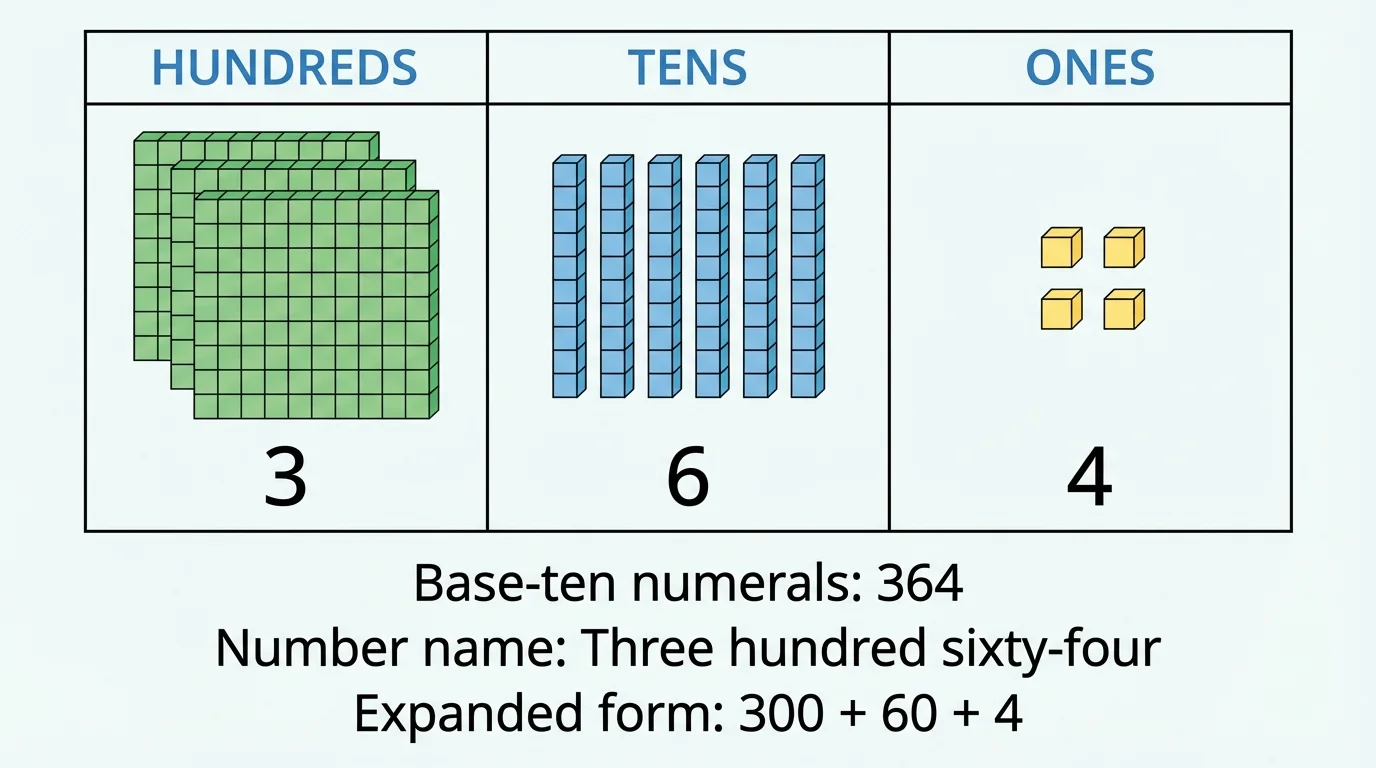
Look at the number \(364\). The digit \(3\) is in the hundreds place, so it means \(300\). The digit \(6\) is in the tens place, so it means \(60\). The digit \(4\) is in the ones place, so it means \(4\).
Ones are single units. Tens are groups of \(10\). Hundreds are groups of \(100\).
A digit is any numeral from \(0\) to \(9\).
You can think of place value like shelves. A digit on one shelf means a different amount than the same digit on another shelf. That is why \(5\) in \(500\) is much bigger than \(5\) in \(50\) or \(5\) in \(5\).
A base-ten numeral is a number written with digits. We use digits to write numbers such as \(7\), \(43\), \(215\), and \(999\).
To read a \(3\)-digit number, start with the hundreds place, then the tens place, then the ones place. For example, \(426\) is read as four hundred twenty-six. The number \(981\) is read as nine hundred eighty-one.
When there are only hundreds and ones, or hundreds and tens, we still read the number in order. For example, \(507\) is five hundred seven, and \(640\) is six hundred forty.
You already know how to count by ones and tens. Now you are using that same idea to read bigger numbers by looking at hundreds, tens, and ones together.
The greatest \(3\)-digit number is \(999\). After that comes \(1{,}000\), which is one thousand.
A number name is a number written in words. Number names help us read numbers aloud and write them clearly.
Here are some examples:
The teen numbers in the tens-and-ones part have special names. For example, \(316\) is three hundred sixteen, not three hundred ten-six. The tens words also matter: \(20\) is twenty, \(30\) is thirty, \(40\) is forty, \(50\) is fifty, and so on.
| Numeral | Number name |
|---|---|
| \(208\) | two hundred eight |
| \(450\) | four hundred fifty |
| \(672\) | six hundred seventy-two |
| \(900\) | nine hundred |
Table 1. Examples of numerals matched with their number names.
As you write number names, say the number slowly and listen for the hundreds part and the tens-and-ones part.
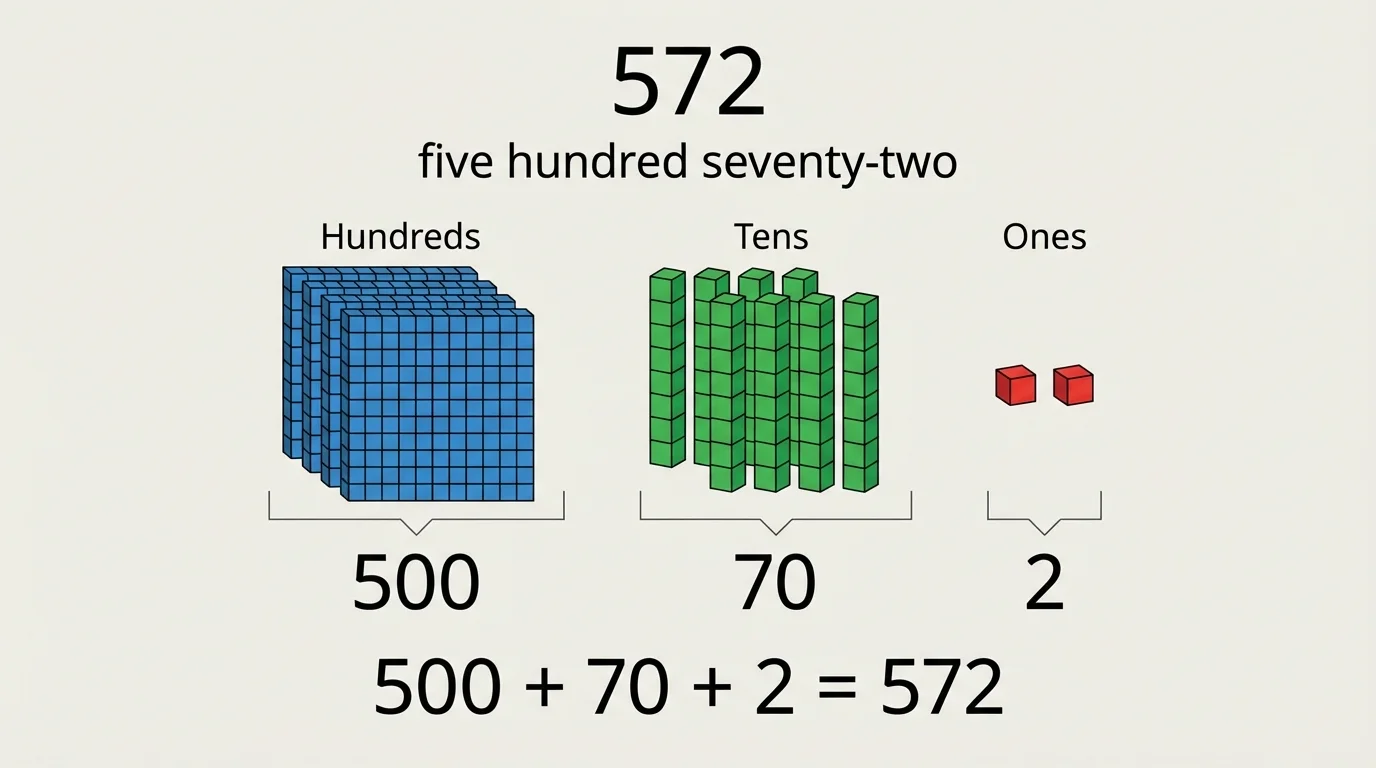
Expanded form shows the value of each digit in a number, as shown in [Figure 2]. It helps us see how a number is built from hundreds, tens, and ones.
For example, the number \(572\) has \(5\) hundreds, \(7\) tens, and \(2\) ones. In expanded form, we write:
\[572 = 500 + 70 + 2\]
Here are more examples:
Notice that sometimes one part is missing. If a number has \(0\) tens, we do not need to write \(+ 0\) in expanded form unless we want to show every place. The important idea is that expanded form shows the value of each digit.
One number, three ways
The same number can be written in different ways and still mean the same amount. For example, \(256\), two hundred fifty-six, and \(200 + 50 + 6\) all name the same number. A strong math thinker can move easily from one form to another.
When you look back at the place value chart in [Figure 1], you can see why expanded form works. Each digit tells how many hundreds, tens, or ones to write.
Sometimes a number has no tens or no ones. The digit \(0\) is called a placeholder because it holds an empty place so the number keeps its correct value.
As shown in [Figure 3], look at \(406\). The \(4\) means \(400\), the \(0\) means there are no tens, and the \(6\) means \(6\) ones. So \(406\) is four hundred six.
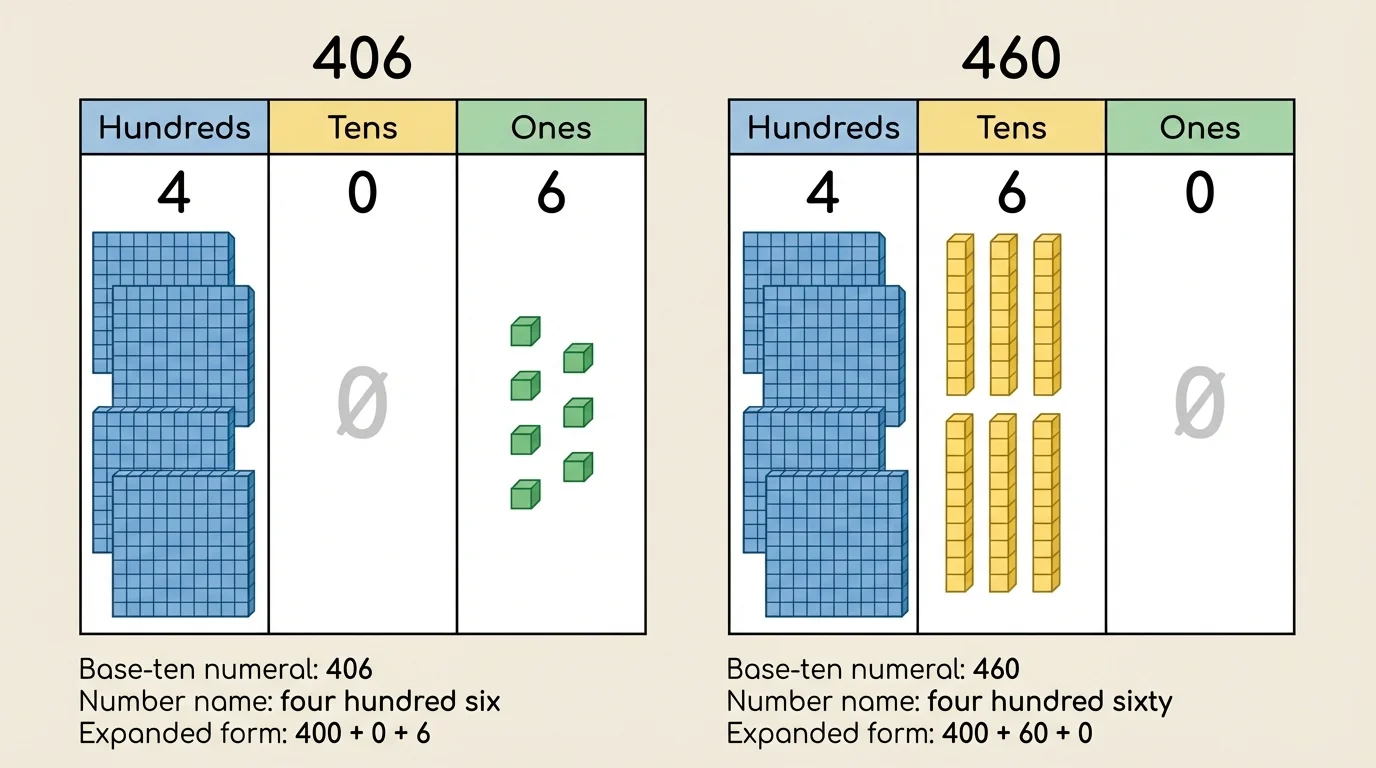
Now look at \(460\). The \(4\) still means \(400\), but the \(6\) is now in the tens place, so it means \(60\). The \(0\) is in the ones place, so there are no ones. The number is four hundred sixty.
Zero is very important. Without it, \(406\) and \(46\) would look too similar, but they are very different numbers.
The digit \(0\) is one of the most powerful digits in math. By itself it means nothing, but in the right place it changes the value of a whole number.
You can compare \(406\) and \(460\) again using [Figure 3]. The digits are the same, but their places are different, so the numbers are different.
Now let's practice changing numbers from one form to another by following place value carefully.
Worked example 1
Write \(348\) in number name and expanded form.
Step 1: Find the value of each digit.
The \(3\) is in the hundreds place, so it means \(300\). The \(4\) is in the tens place, so it means \(40\). The \(8\) is in the ones place, so it means \(8\).
Step 2: Write the number name.
\(348\) is three hundred forty-eight.
Step 3: Write the expanded form.
\[348 = 300 + 40 + 8\]
The numeral, number name, and expanded form all describe the same number.
Each time, start by asking what each digit is worth. That keeps the forms connected.
Worked example 2
Write six hundred two as a numeral and expanded form.
Step 1: Identify the hundreds, tens, and ones.
Six hundred means \(600\). There are no tens, so that place is \(0\). Two means \(2\) ones.
Step 2: Write the numeral.
The numeral is \(602\).
Step 3: Write the expanded form.
\[602 = 600 + 2\]
We use \(0\) in the tens place to show there are no tens.
This example shows why zero matters. Without the \(0\), the numeral would become \(62\), which is a different number.
Worked example 3
Write \(930\) in number name and expanded form.
Step 1: Find each place value.
The \(9\) is \(900\), the \(3\) is \(30\), and the \(0\) means no ones.
Step 2: Write the number name.
\(930\) is nine hundred thirty.
Step 3: Write the expanded form.
\[930 = 900 + 30\]
There is no ones part to add because the ones digit is \(0\).
Another way to check your work is to read the expanded form aloud. If \(900 + 30\) sounds like nine hundred thirty, you are on the right track.
Worked example 4
Write \(481\) as a number name.
Step 1: Read the hundreds digit.
The \(4\) in the hundreds place is four hundred.
Step 2: Read the tens and ones.
The \(8\) in the tens place is eighty, and the \(1\) in the ones place is one.
Step 3: Put the parts together.
\(481\) is four hundred eighty-one.
Reading by place helps you say the number correctly.
Place value is useful every day. If a class collects \(325\) cans for a food drive, you can write that as three hundred twenty-five or \(300 + 20 + 5\). A store may have \(408\) toy cars in stock. A book might begin on page \(157\). A scoreboard might show \(240\) points over several games.
When adults read addresses, prices, scores, and counts, they are using these same skills. If a shelf holds \(700\) notebooks and then gets \(40\) more and \(3\) extra, that total can be seen as \(743\). Place value helps people organize numbers quickly.
Expanded form is especially helpful when counting large groups. If you know a collection has \(6\) hundreds, \(2\) tens, and \(9\) ones, you can write \(629\) right away. That is the same idea we saw earlier in [Figure 2], where a number is built from its place-value parts.
One common mistake is mixing up the tens and ones places. For example, \(54\) and \(45\) use the same digits, but they are not the same number. In \(54\), the \(5\) means \(50\). In \(45\), the \(5\) means \(5\).
Another mistake is forgetting zero. The numbers \(307\) and \(37\) are very different. In \(307\), the zero keeps the tens place empty while the \(3\) stays in the hundreds place.
A third mistake is writing the expanded form incorrectly. For \(286\), the correct expanded form is \(200 + 80 + 6\), not \(20 + 8 + 6\). Each digit must match its place value.
When you feel unsure, go back to hundreds, tens, and ones. That simple idea helps with reading numerals, writing number names, and making expanded form.
