Suppose two players are collecting points in a game. One player has \(428\) points, and the other has \(416\) points. They both have more than \(400\), so who is ahead? The answer comes from looking carefully at the digits and what they mean. When we compare three-digit numbers, we do not just look at the numbers as a string of digits. We think about hundreds, tens, and ones.
As [Figure 1] shows, a place value system tells us that the value of a digit depends on where it is in the number. The number \(374\) means \(3\) hundreds, \(7\) tens, and \(4\) ones. That is the same as \(300 + 70 + 4\).
Each place has a job. The hundreds digit tells how many groups of \(100\) there are. The tens digit tells how many groups of \(10\) there are. The ones digit tells how many single units there are. So \(582\) means \(5\) hundreds, \(8\) tens, and \(2\) ones, or \(500 + 80 + 2\).
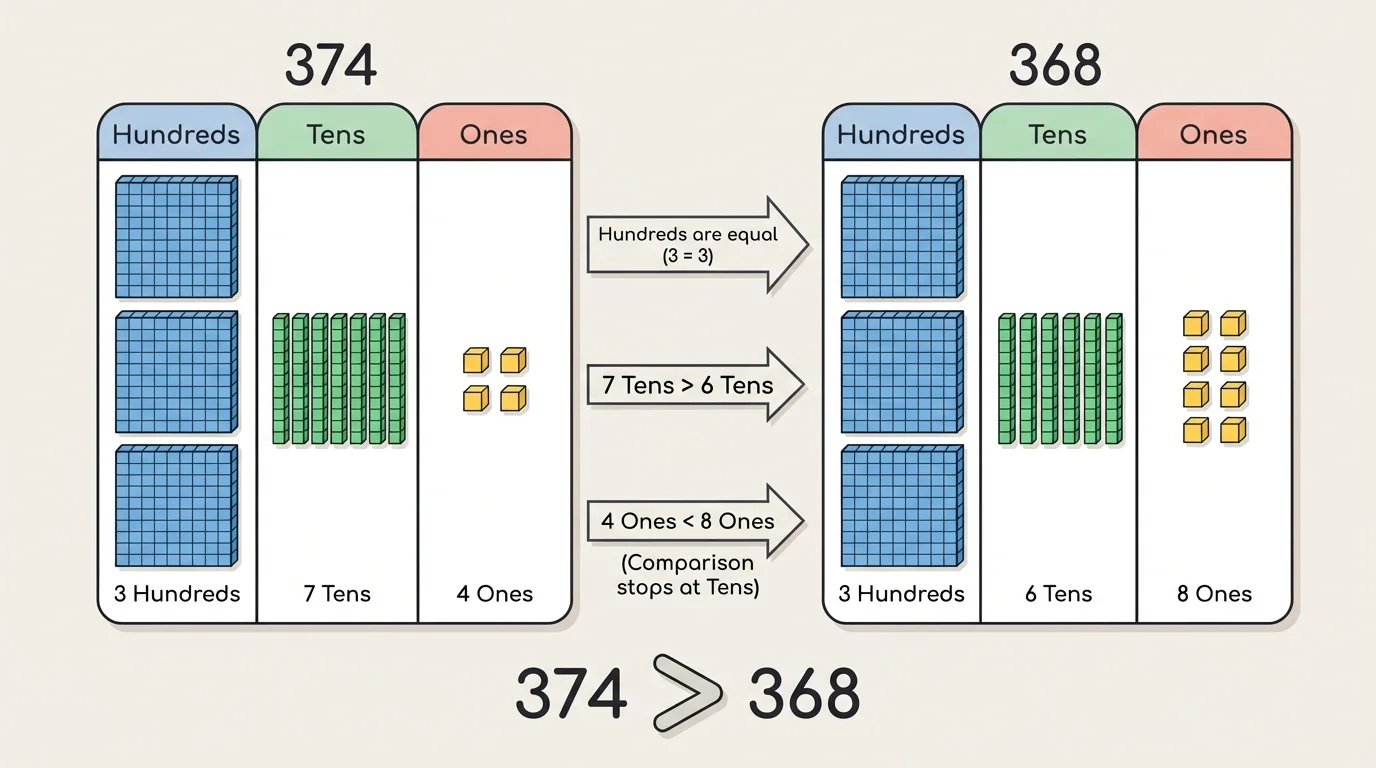
Because \(100\) is much bigger than \(10\), and \(10\) is bigger than \(1\), the hundreds place matters most when comparing three-digit numbers. If one number has more hundreds, it is greater, even if the other number has more tens or ones.
Hundreds, tens, and ones are the place values in a three-digit number. The digit in each place tells how much that part is worth. A number like \(246\) means \(2\) hundreds, \(4\) tens, and \(6\) ones.
It helps to think from left to right. Start with the greatest place value. If the numbers are still tied there, move to the next place. This is like a race where the greatest place value gives the clearest clue first.
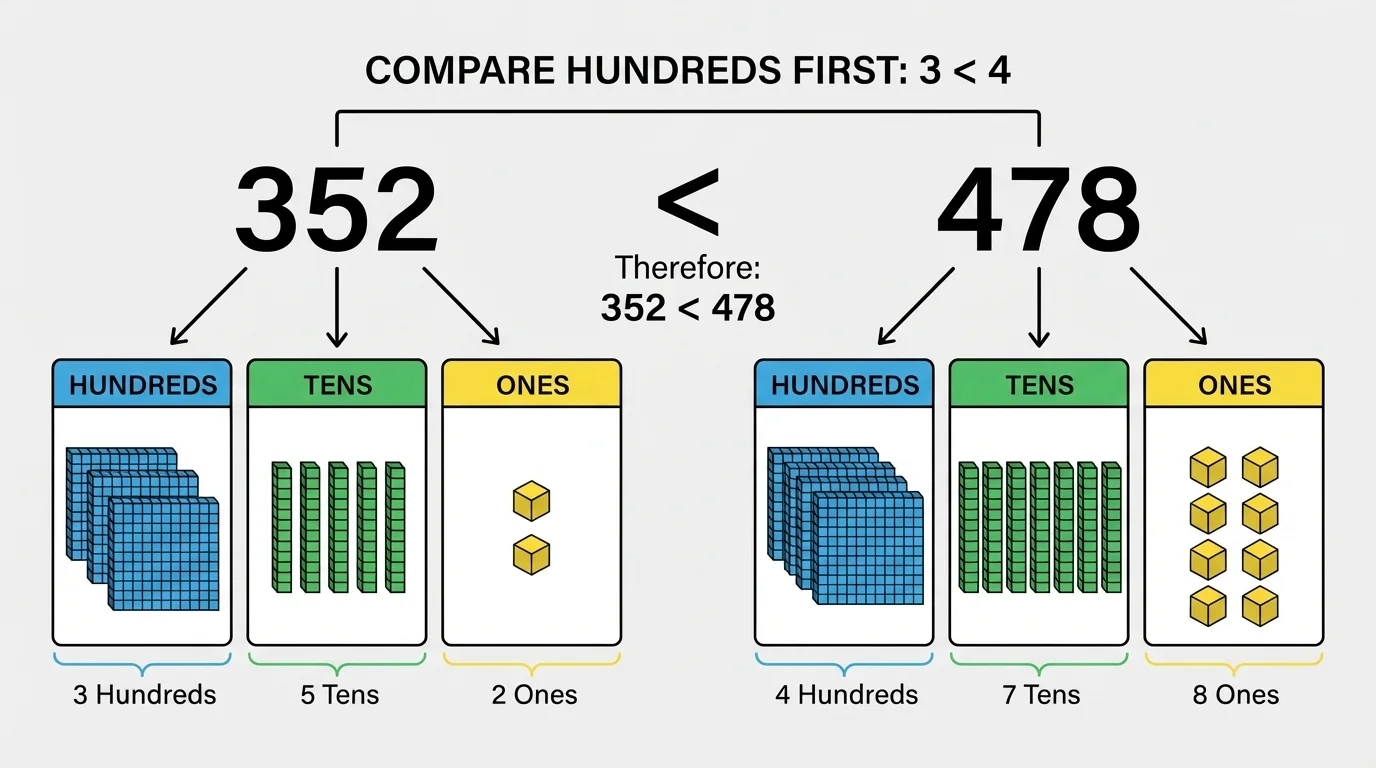
As [Figure 2] illustrates, when two three-digit numbers have different hundreds digits, the comparison is decided right away. If we compare \(352\) and \(478\), we look first at the hundreds digits: \(3\) and \(4\). Since \(4\) hundreds is more than \(3\) hundreds, \(478\) is greater than \(352\).
We write that comparison like this: \(352 < 478\) We can also write \(478 > 352\). Both statements mean the same thing.
Here are more examples. Compare \(615\) and \(589\). The hundreds digits are \(6\) and \(5\). Since \(6 > 5\), we know \(615 > 589\) We do not need to compare the tens or ones because the hundreds place already tells us the answer.
This idea is very important. A number with more hundreds is always greater than a number with fewer hundreds.
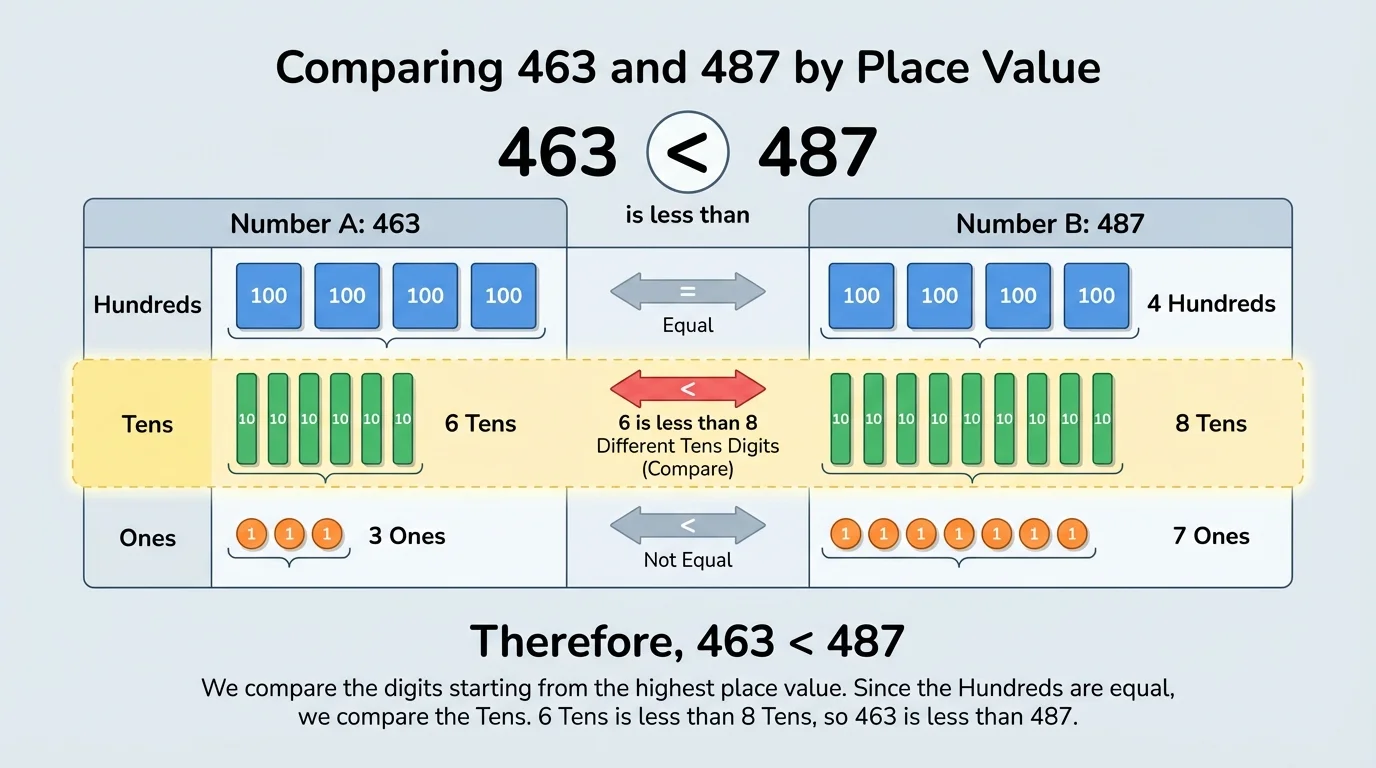
As [Figure 3] shows, sometimes the hundreds digits are the same. Then we move to the tens place. When comparing \(463\) and \(487\), both numbers have \(4\) hundreds. So we check the tens digits: \(6\) tens and \(8\) tens. Since \(8\) tens is more than \(6\) tens, \(487\) is greater.
We record it this way: \(463 < 487\) The hundreds were equal, so the tens place decided the comparison.
Look at another pair: \(721\) and \(734\). Both have \(7\) hundreds. Now compare the tens digits: \(2\) and \(3\). Since \(2 < 3\), we know \(721 < 734\)
We still do not need the ones place here. Once we find a place that is different, that place decides which number is greater.
Compare from greatest place to least place. Start with hundreds. If the hundreds are the same, compare tens. If the tens are also the same, compare ones. This works because each place to the left is worth more than the places to the right.
This is why comparing numbers is not the same as comparing single digits in any order. The position of each digit matters.
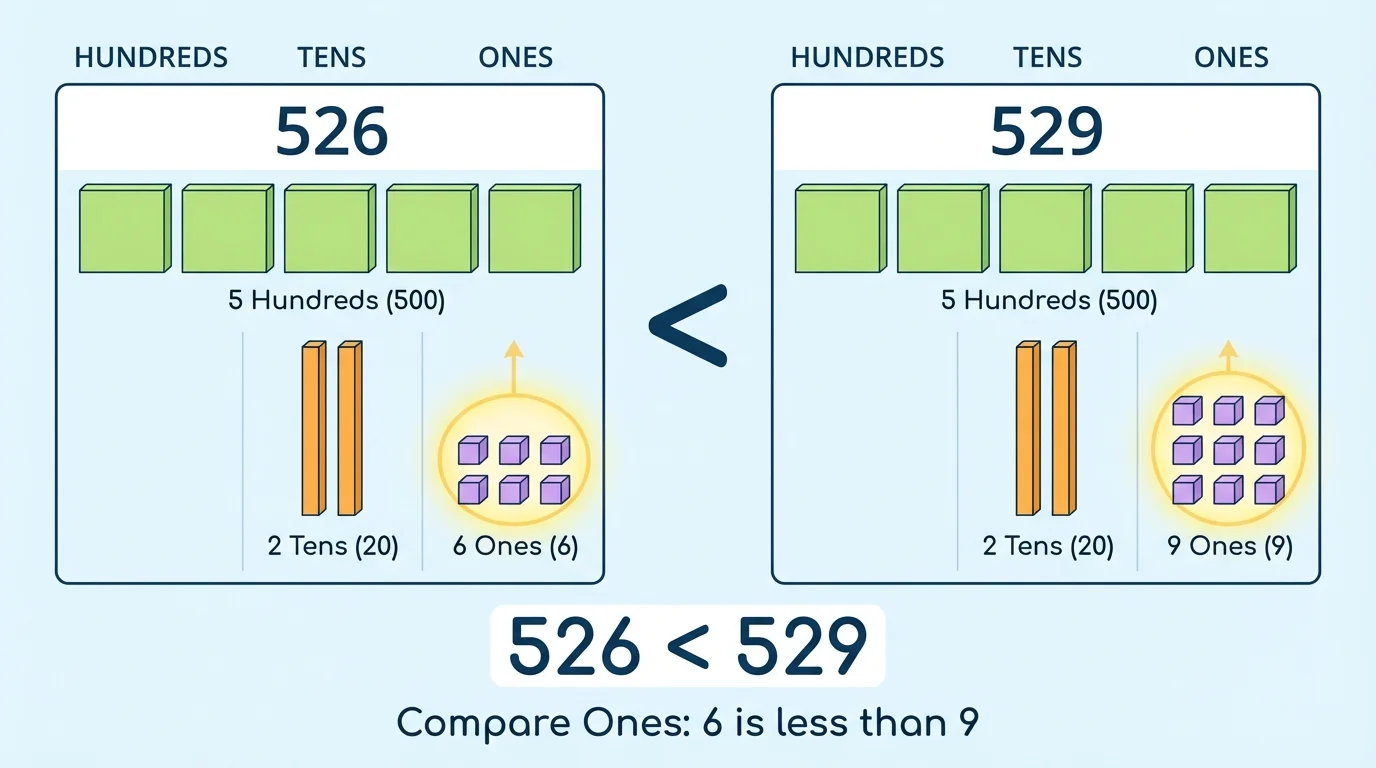
As [Figure 4] shows, sometimes the hundreds digits match and the tens digits match too. Then the ones place decides. Compare \(526\) and \(529\). Both have \(5\) hundreds. Both have \(2\) tens. Now compare the ones digits: \(6\) and \(9\). Since \(6 < 9\), we know \(526 < 529\)
This is the last step because ones is the smallest place in these numbers.
Another example is \(840\) and \(847\). Hundreds: both are \(8\). Tens: both are \(4\). Ones: \(0\) and \(7\). Since \(0 < 7\), we write \(840 < 847\)
Later, when you compare other numbers, you can remember the pattern from [Figure 4]: look for the first place where the digits are different.
If the hundreds, tens, and ones digits all match, then the numbers are equal. The equal symbol is \(=\).
For example, compare \(603\) and \(603\). Hundreds: \(6 = 6\). Tens: \(0 = 0\). Ones: \(3 = 3\). Every place matches, so we write \(603 = 603\)
Equal means the numbers have exactly the same value.
You already know how to compare smaller numbers such as \(8\) and \(5\), or \(42\) and \(39\). Comparing three-digit numbers uses the same idea, but now you pay attention to hundreds, tens, and ones in order.
It is helpful to say the numbers aloud. For example, \(603\) is "six hundred three." Hearing the hundreds first can remind you to compare that place first.
We use three symbols when comparing numbers. The symbol \(>\) means greater than. The symbol \(<\) means less than. The symbol \(=\) means equal to.
Here is a quick comparison table.
| Comparison | Meaning |
|---|---|
| \(458 > 451\) | \(458\) is greater than \(451\) |
| \(302 < 320\) | \(302\) is less than \(320\) |
| \(777 = 777\) | The two numbers are equal |
Table 1. Examples of the symbols used to compare three-digit numbers.
The opening of \(>\) and \(<\) faces the larger number. Another way to remember is to read the whole comparison as a sentence. For example, \(583 > 412\) means "\(583\) is greater than \(412\)."
People compare numbers all the time without even noticing it. Scores in games, pages in books, and numbers on buildings all use the same idea of deciding which number is greater, less, or equal.
You can also compare using words before writing symbols. For example, say "\(691\) is greater than \(689\)," then write \(691 > 689\).
Worked example 1
Compare \(247\) and \(315\).
Step 1: Compare the hundreds digits.
The hundreds digits are \(2\) and \(3\).
Step 2: Decide which hundreds digit is greater.
Since \(2 < 3\), \(2\) hundreds is less than \(3\) hundreds.
Step 3: Write the comparison.
\(247 < 315\)
The number \(315\) is greater because it has more hundreds.
In this first example, the hundreds place answered the question right away. We did not need to check tens or ones.
Worked example 2
Compare \(562\) and \(589\).
Step 1: Compare the hundreds digits.
Both numbers have \(5\) hundreds.
Step 2: Compare the tens digits.
The tens digits are \(6\) and \(8\).
Step 3: Decide which tens digit is greater.
Since \(6 < 8\), \(6\) tens is less than \(8\) tens.
Step 4: Write the comparison.
\(562 < 589\)
The number \(589\) is greater because the hundreds are the same, but it has more tens.
This matches the pattern we saw earlier in [Figure 3]: when the hundreds are equal, the tens place decides.
Worked example 3
Compare \(431\) and \(438\).
Step 1: Compare the hundreds digits.
Both numbers have \(4\) hundreds.
Step 2: Compare the tens digits.
Both numbers have \(3\) tens.
Step 3: Compare the ones digits.
The ones digits are \(1\) and \(8\).
Step 4: Write the comparison.
Since \(1 < 8\), we write \(431 < 438\)
The number \(438\) is greater because the ones place is the first place that is different.
That "first different place" idea is very powerful. It works in every example, just as [Figure 2] and [Figure 4] help show with different place-value comparisons.
Worked example 4
Compare \(700\) and \(700\).
Step 1: Compare the hundreds digits.
Both are \(7\).
Step 2: Compare the tens digits.
Both are \(0\).
Step 3: Compare the ones digits.
Both are \(0\).
Step 4: Write the comparison.
\(700 = 700\)
The numbers are equal because every place matches.
Equality is important too. Sometimes two amounts are exactly the same.
Comparing three-digit numbers helps in everyday life. A class may read \(184\) pages one month and \(196\) pages the next month. Since the hundreds are the same and \(8 < 9\) in the tens place, \(184 < 196\). That means the class read more pages in the second month.
You might compare scores in sports, sticker collections, or the number of blocks in two towers. If one team scores \(502\) points in a season and another scores \(498\), then \(502 > 498\). Even though \(498\) has a larger tens digit than \(502\), the hundreds digit comes first, and \(5\) hundreds is greater than \(4\) hundreds.
House numbers, library book numbers, and even numbers on classroom charts can be compared this way. Understanding place value makes these comparisons quick and accurate.
One mistake is looking only at a later digit instead of starting with the hundreds place. For example, someone might think \(398 > 402\) because \(9 > 0\) in the tens place. But that is incorrect. We compare hundreds first: \(3 < 4\), so \(398 < 402\)
Another mistake is forgetting what digits mean. In \(451\), the digit \(4\) means \(4\) hundreds, not just \(4\). In \(451\), the value is \(400 + 50 + 1\).
A helpful check is to ask, "What is the first place where the numbers are different?" That place tells which number is greater.
