A tiny change can make a big difference in a number. If you change \(245\) by just \(10\), it becomes \(255\). If you change it by \(100\), it becomes \(345\). That is the power of place value: one digit can change, and the whole number changes in a quick, easy way.
[Figure 1] Our number system is built in groups of ten. A number like \(346\) has \(3\) hundreds, \(4\) tens, and \(6\) ones. This makes it easy to see why mental math works so well here: when we add or subtract \(10\), we are changing the tens. When we add or subtract \(100\), we are changing the hundreds.
Think about \(346\). If we add \(10\), we add one more ten. The hundreds stay \(3\), the tens change from \(4\) to \(5\), and the ones stay \(6\). So \(346 + 10 = 356\).
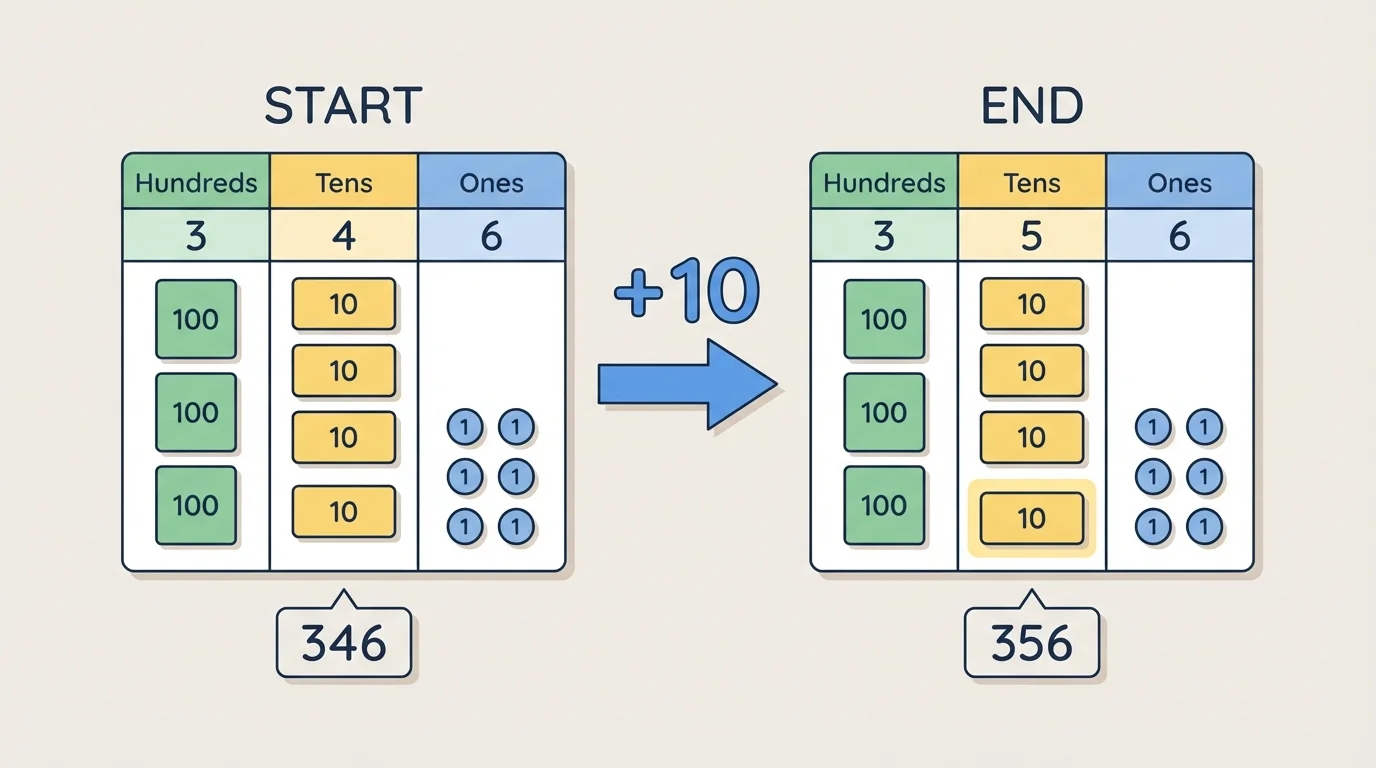
This idea helps you work quickly in your head. You do not need to count by ones. You only look at the place that changes.
You already know that \(10\) is one group of ten and \(100\) is ten groups of ten. That means adding \(10\) changes the tens place, and adding \(100\) changes the hundreds place.
For numbers from \(100\) to \(900\), this pattern appears again and again. The more you notice the pattern, the faster your mental math becomes.
When you add \(10\), you add one ten. Usually, the tens place goes up by \(1\). The hundreds place and the ones place stay the same.
Here are some examples: \(230 + 10 = 240\), \(451 + 10 = 461\), and \(678 + 10 = 688\). In each number, only the tens changed.
Place value tells what value a digit has because of where it is in a number. In \(572\), the \(5\) means \(500\), the \(7\) means \(70\), and the \(2\) means \(2\).
You can also think, "One more ten." For \(514 + 10\), the number \(514\) has \(1\) ten. One more ten makes \(2\) tens, so the answer is \(524\).
If the tens digit is \(9\), adding \(10\) makes a new hundred. For example, \(190 + 10 = 200\). The tens do not become \(10\) tens and stay written that way. Instead, \(10\) tens become \(1\) hundred.
When you subtract \(10\), you take away one ten. Usually, the tens digit goes down by \(1\). The hundreds and ones usually stay the same.
Examples: \(560 - 10 = 550\), \(483 - 10 = 473\), and \(721 - 10 = 711\). Only the tens changed.
You can think, "One less ten." For \(364 - 10\), the number has \(6\) tens. One less ten leaves \(5\) tens, so \(364 - 10 = 354\).
Sometimes subtracting \(10\) crosses a hundred. For example, \(200 - 10 = 190\). The number \(200\) has \(20\) tens. Taking away one ten leaves \(19\) tens, which is \(190\).
[Figure 2] When you add \(100\), you add one hundred. The hundreds place goes up by \(1\), and the tens and ones stay the same. On a number line, this looks like one big jump of \(100\) to the right.
Look at these examples: \(245 + 100 = 345\), \(580 + 100 = 680\), and \(799 + 100 = 899\). The tens and ones do not change.
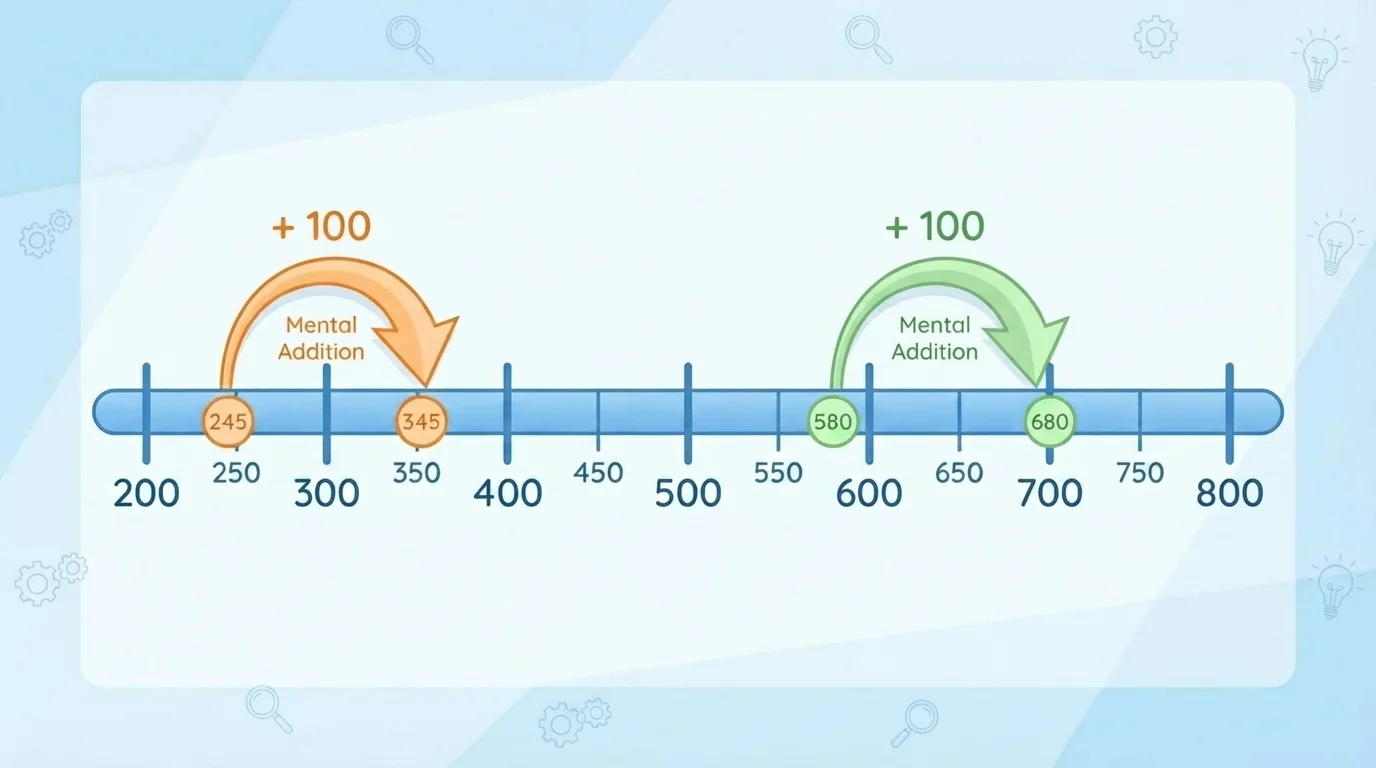
This is often even easier than adding \(10\), because you can look mostly at the hundreds digit. In \(412 + 100\), the \(4\) hundreds become \(5\) hundreds, so the answer is \(512\).
Changing just one place
Adding \(10\) or \(100\) works so quickly because you are not changing every digit. You are changing one place value at a time. That is why mental math can be fast and accurate.
As you saw in [Figure 1], place value keeps the number organized, and that same idea helps with \(100\) too.
When you subtract \(100\), you take away one hundred. The hundreds digit goes down by \(1\), and the tens and ones stay the same.
Examples: \(654 - 100 = 554\), \(800 - 100 = 700\), and \(329 - 100 = 229\). Again, only the hundreds changed.
Think about \(731 - 100\). The number has \(7\) hundreds. One less hundred leaves \(6\) hundreds, so \(731 - 100 = 631\).
The number line in [Figure 2] also helps here. Subtracting \(100\) is a jump of \(100\) to the left.
[Figure 3] Some problems look tricky at first, but place value still works. The important idea is to regroup in your mind. Numbers can cross into a new hundred and still follow the same pattern.
For example, \(190 + 10 = 200\). The \(9\) tens plus \(1\) more ten make \(10\) tens, and \(10\) tens are the same as \(1\) hundred.
Also, \(200 - 10 = 190\). Starting with \(2\) hundreds means \(20\) tens. Taking away \(1\) ten leaves \(19\) tens.
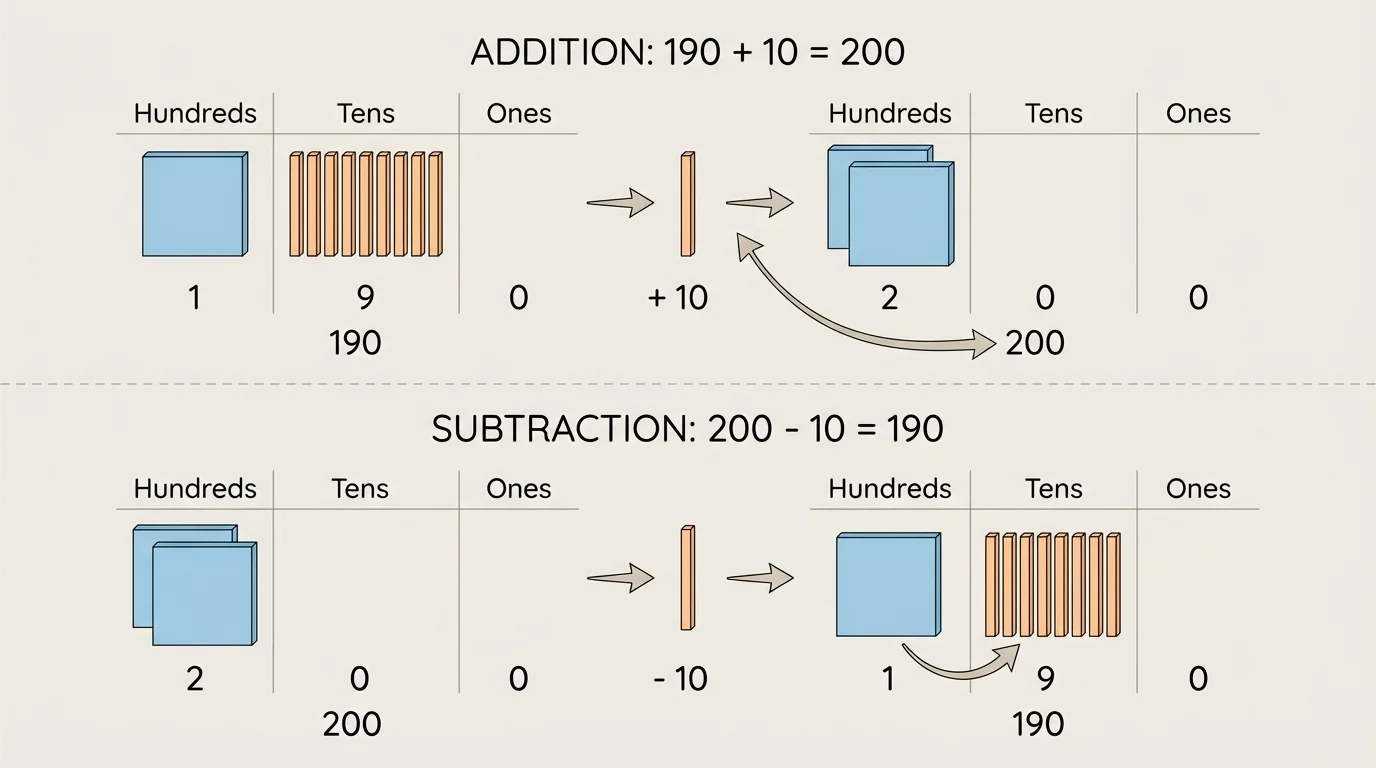
Here are more crossing examples: \(290 + 10 = 300\), \(300 - 10 = 290\), \(199 + 100 = 299\), and \(400 - 100 = 300\).
Even when the number changes into a new hundred, the rule is still about place value. The crossing examples in [Figure 3] are good reminders that \(10\) tens can become \(1\) hundred.
Now let's look at some step-by-step examples.
Worked example 1
Find \(468 + 10\).
Step 1: Look at the tens digit.
In \(468\), the tens digit is \(6\).
Step 2: Add one ten.
\(6\) tens plus \(1\) ten equals \(7\) tens.
Step 3: Keep the other digits the same.
The hundreds digit stays \(4\), and the ones digit stays \(8\).
So, \[468 + 10 = 478\]
The answer is quick because only one place changes.
Worked example 2
Find \(532 - 100\).
Step 1: Look at the hundreds digit.
In \(532\), the hundreds digit is \(5\).
Step 2: Subtract one hundred.
\(5\) hundreds minus \(1\) hundred equals \(4\) hundreds.
Step 3: Keep the tens and ones the same.
The tens digit stays \(3\), and the ones digit stays \(2\).
So, \[532 - 100 = 432\]
This pattern works for many numbers between \(100\) and \(900\).
Worked example 3
Find \(190 + 10\).
Step 1: Look at the tens.
\(190\) has \(9\) tens and \(1\) hundred.
Step 2: Add one more ten.
\(9\) tens plus \(1\) ten equals \(10\) tens.
Step 3: Regroup.
\(10\) tens equals \(1\) hundred, so the total becomes \(2\) hundreds.
So, \[190 + 10 = 200\]
This is a great example of a number crossing into a new hundred.
Worked example 4
Find \(700 - 10\).
Step 1: Think of \(700\) as tens.
\(700\) is the same as \(70\) tens.
Step 2: Take away one ten.
\(70\) tens minus \(1\) ten equals \(69\) tens.
Step 3: Rewrite the number.
\(69\) tens equals \(690\).
So, \[700 - 10 = 690\]
Thinking flexibly about tens and hundreds makes mental subtraction stronger.
Mental math with \(10\) and \(100\) is useful every day. If a library has \(320\) books on a shelf and gets \(100\) more, the new total is \(420\). If a class has counted \(560\) stickers and gives away \(10\), then \(560 - 10 = 550\).
In sports, a team score might go from \(390\) points to \(400\) points after \(10\) more are added. In reading, if you are on page \(215\) and read \(10\) more pages, you reach page \(225\).
Mental math is what many shoppers, cashiers, and athletes use all the time. Quick changes by \(10\) and \(100\) help people estimate and check answers fast.
These number changes are also useful for checking your work. If someone says \(645 + 100 = 655\), you can tell right away that it is not correct because adding \(100\) changes the hundreds, not just the tens.
Here are helpful patterns:
| Operation | What Changes | Example |
|---|---|---|
| \( + 10\) | Tens increase by \(1\) | \(341 + 10 = 351\) |
| \( - 10\) | Tens decrease by \(1\) | \(341 - 10 = 331\) |
| \( + 100\) | Hundreds increase by \(1\) | \(341 + 100 = 441\) |
| \( - 100\) | Hundreds decrease by \(1\) | \(341 - 100 = 241\) |
Table 1. A comparison of how adding or subtracting \(10\) or \(100\) changes a number.
Notice that the ones digit usually stays the same in all these examples. The tens digit changes when working with \(10\), and the hundreds digit changes when working with \(100\).
That is the big idea: look at the value of the digit, not just the digit itself. A \(1\) in the tens place means \(10\), and a \(1\) in the hundreds place means \(100\).
