Have you ever noticed that big numbers are not really "big" when you look inside them? The number \(47\) is really just \(4\) tens and \(7\) ones. That is the secret behind many smart math strategies. When we add or subtract, we are not guessing. We are using the way our number system is built.
Our number system uses place value. That means the value of a digit depends on where it is. In the number \(34\), the \(3\) means \(3\) tens, or \(30\), and the \(4\) means \(4\) ones. As [Figure 1] shows, we can picture \(34\) as \(3\) tens and \(4\) ones.
This is important because tens and ones can be taken apart and put back together. We can write \(34\) as \(30 + 4\). We can write \(58\) as \(50 + 8\). When we do this, addition and subtraction become easier to understand.
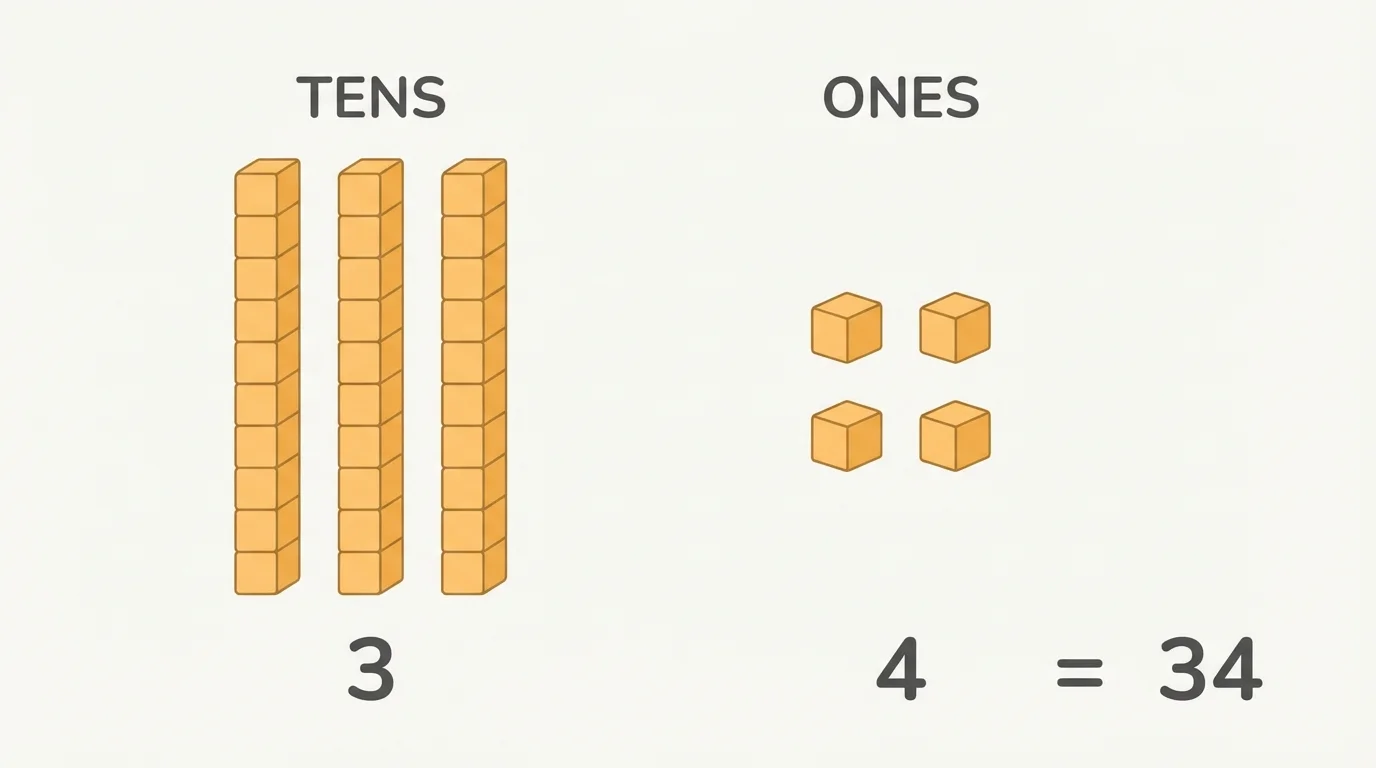
Place value tells how much a digit is worth because of its place in a number. In a two-digit number, one digit shows tens and the other digit shows ones.
Think of bundles of straws. One bundle can stand for \(10\) straws, and one loose straw can stand for \(1\). Then \(26\) means \(2\) bundles of \(10\) and \(6\) loose straws. Math strategies work because we can count bundles and loose straws separately.
Addition works well with different strategies because numbers can be broken apart into tens and ones and then put together again. As [Figure 2] illustrates, when we add \(23 + 14\), we can think of \(23\) as \(20 + 3\) and \(14\) as \(10 + 4\).
Then we add tens to tens and ones to ones: \(20 + 10 = 30\) and \(3 + 4 = 7\). Put them together, and \(30 + 7 = 37\). So \(23 + 14 = 37\). This works because tens are tens and ones are ones.
Another addition strategy is to make a ten. If you add \(8 + 6\), you can move \(2\) from \(6\) to \(8\). Then \(8 + 2 = 10\), and \(10 + 4 = 14\). You did not change the total. You only changed how the number was grouped.
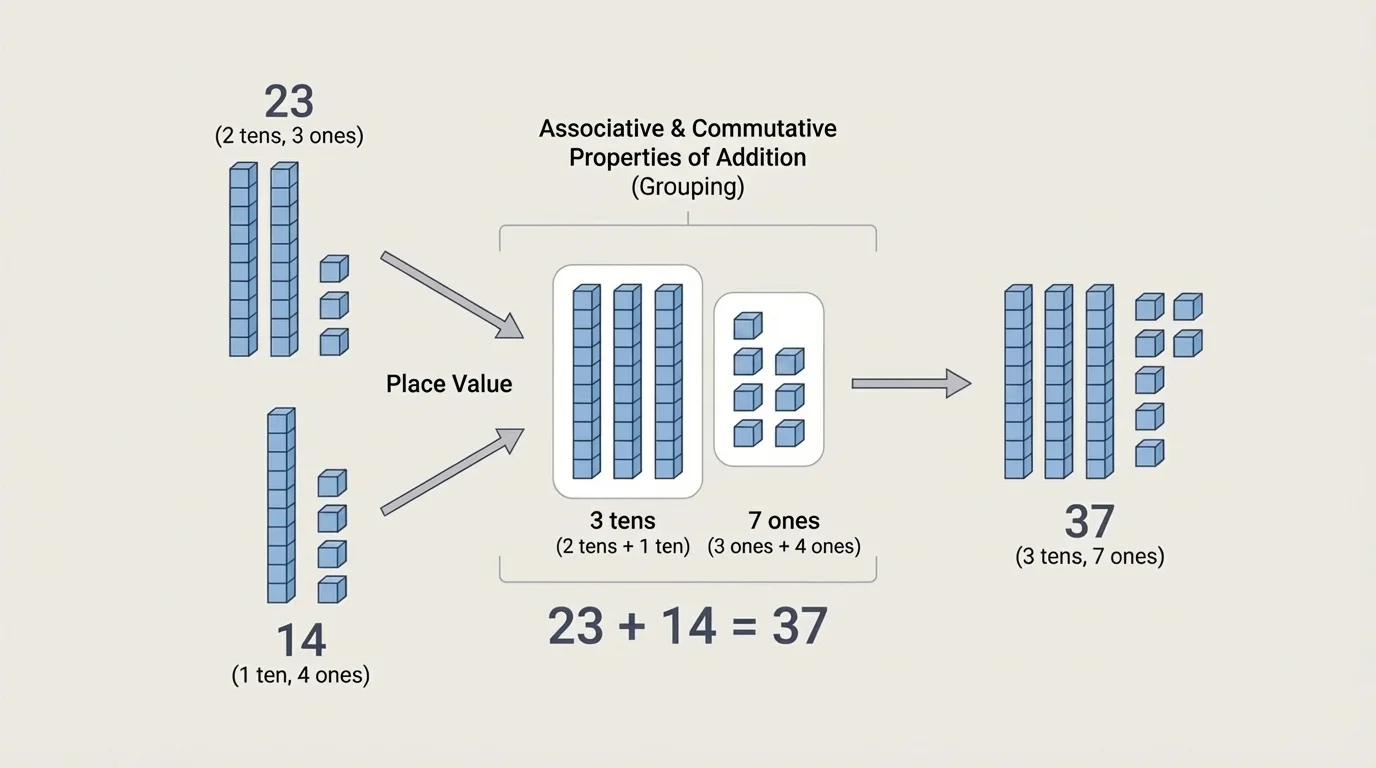
Breaking apart and regrouping in addition
When we break numbers into parts, we can choose easier parts to add. We can add tens first, ones first, or make a friendly number like \(10\). The total stays the same because we are using the same amount, just in a different way.
Addition also has a helpful rule: the order of the addends can change. For example, \(9 + 5 = 14\) and \(5 + 9 = 14\). This helps when one order feels easier. Many students like \(5 + 9\) because they can count on from \(9\), or they may like \(9 + 5\) because they can make \(10\).
We can also group addends in helpful ways. For example, in \(6 + 4 + 3\), it is smart to add \(6 + 4\) first because \(10 + 3 = 13\). The numbers are the same, but the grouping makes the work easier.
Worked example 1
Find \(35 + 22\).
Step 1: Break apart the numbers by tens and ones.
\(35 = 30 + 5\)
\(22 = 20 + 2\)
Step 2: Add the tens and add the ones.
\(30 + 20 = 50\)
\(5 + 2 = 7\)
Step 3: Put the parts together.
\(50 + 7 = 57\)
So, \[35 + 22 = 57\]
This works because \(3\) tens plus \(2\) tens makes \(5\) tens, and \(5\) ones plus \(2\) ones makes \(7\) ones.
Worked example 2
Find \(28 + 7\) by making a ten.
Step 1: Look for how many more are needed to make the next ten.
\(28\) needs \(2\) more to make \(30\).
Step 2: Break apart \(7\) into \(2 + 5\).
Now add \(28 + 2 = 30\).
Step 3: Add the rest.
\(30 + 5 = 35\)
So, \(28 + 7 = 35\)
Nothing magical happened. The \(7\) was still \(7\). We just used \(2\) of it first to make a friendly ten.
Worked example 3
Find \(6 + 4 + 8\).
Step 1: Choose a helpful pair.
\(6 + 4 = 10\)
Step 2: Add the last number.
\(10 + 8 = 18\)
So, \[6 + 4 + 8 = 18\]
This works because changing the grouping in addition does not change the total.
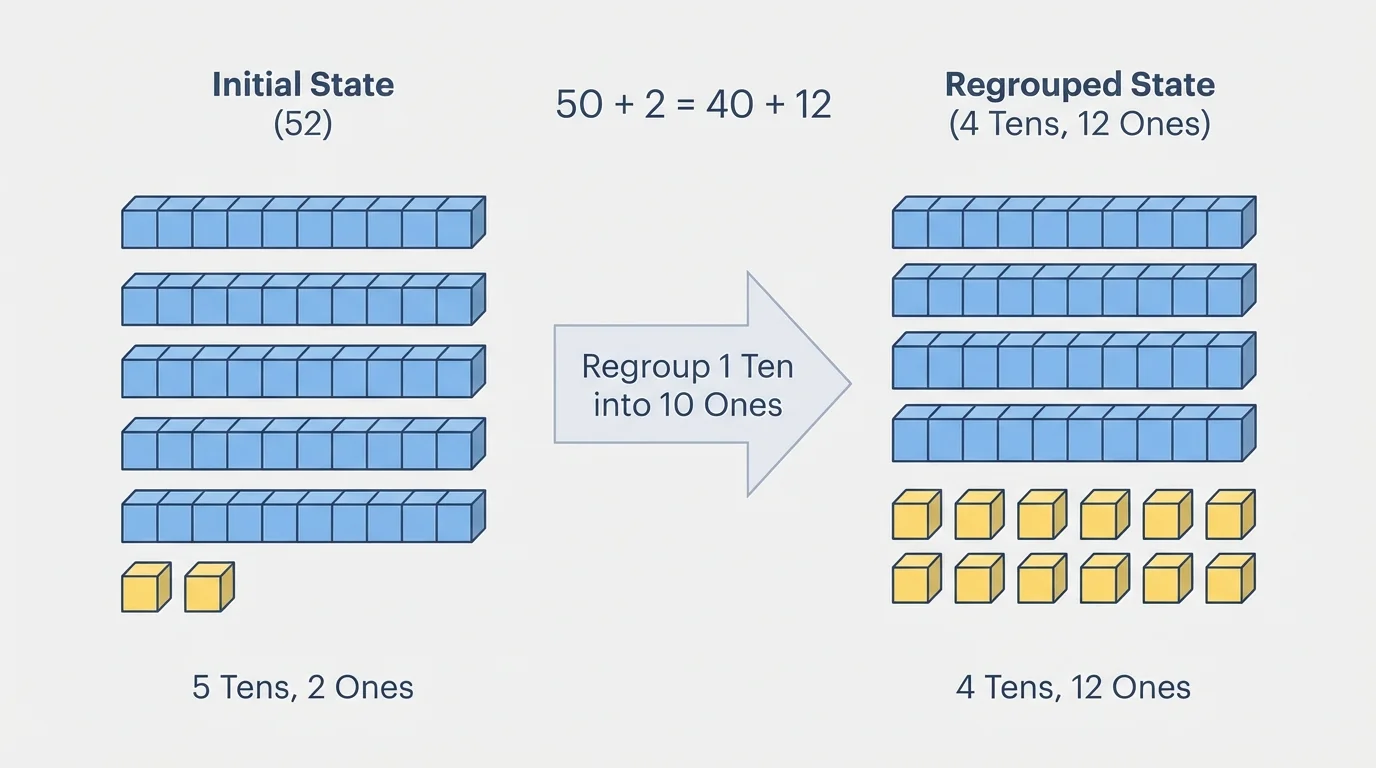
Subtraction also uses tens and ones. Sometimes we can subtract tens and ones separately. Sometimes we need to trade one ten for \(10\) ones. As [Figure 3] shows, this trade helps when there are not enough ones to subtract.
For example, in \(52 - 28\), the number \(52\) means \(5\) tens and \(2\) ones. We cannot subtract \(8\) ones from \(2\) ones, so we decompose one ten. That means \(5\) tens and \(2\) ones becomes \(4\) tens and \(12\) ones.
Now we can subtract: \(12 - 8 = 4\) ones, and \(4\) tens minus \(2\) tens is \(2\) tens. So the answer is \(24\). This works because one ten is equal to \(10\) ones. We did not change the amount. We only changed how it was written.
Remember that subtraction can mean take away or find the difference. Both ideas help. For \(15 - 7\), you can take \(7\) away from \(15\), or you can ask, "What number added to \(7\) makes \(15\)?"
Sometimes counting up is easier than taking away. To solve \(41 - 38\), it may be faster to think: from \(38\) to \(40\) is \(2\), and from \(40\) to \(41\) is \(1\). Then \(2 + 1 = 3\), so \(41 - 38 = 3\).
We can also subtract by parts. For \(67 - 24\), subtract the tens and ones: \(60 - 20 = 40\) and \(7 - 4 = 3\). Then \(40 + 3 = 43\). This works because both numbers were broken into tens and ones.
Worked example 4
Find \(46 - 13\).
Step 1: Break apart the numbers.
\(46 = 40 + 6\)
\(13 = 10 + 3\)
Step 2: Subtract tens and ones.
\(40 - 10 = 30\)
\(6 - 3 = 3\)
Step 3: Put the parts together.
\(30 + 3 = 33\)
So, \[46 - 13 = 33\]
Because there were enough ones, no regrouping was needed.
Worked example 5
Find \(52 - 28\).
Step 1: Notice the ones.
There are \(2\) ones in \(52\), but we need to subtract \(8\) ones.
Step 2: Decompose one ten.
\(52 = 4\) tens and \(12\) ones.
Step 3: Subtract ones and tens.
\(12 - 8 = 4\)
\(4\) tens minus \(2\) tens is \(2\) tens.
So, \[52 - 28 = 24\]
This is the same idea shown earlier in [Figure 3]. One ten can become \(10\) ones, so the value stays the same.
Worked example 6
Find \(41 - 38\) by finding the difference.
Step 1: Count up from \(38\) to \(41\).
\(38 \rightarrow 40\) is \(2\)
\(40 \rightarrow 41\) is \(1\)
Step 2: Add the jumps.
\(2 + 1 = 3\)
So, \(41 - 38 = 3\)
This strategy is helpful when the numbers are close together.
A property is a rule that is always true. Some properties help us explain why strategies work.
The commutative property of addition says that numbers can change order and still have the same sum. For example, \(12 + 7 = 7 + 12\). That is why you can choose the order that feels easier.
The associative property of addition says that addends can be grouped in different ways. For example, \((5 + 5) + 3 = 5 + (5 + 3)\). Both sides equal \(13\). That is why making a ten works so well.
Subtraction is different. The order matters. For example, \(9 - 4 = 5\), but \(4 - 9\) is not the same. So we must think carefully when subtracting. We can break apart numbers, but we cannot just switch them around.
| Operation idea | Example | What stays true |
|---|---|---|
| Add in any order | \(8 + 3 = 3 + 8\) | The sum stays \(11\) |
| Group addends differently | \((6 + 4) + 2 = 6 + (4 + 2)\) | The sum stays \(12\) |
| Subtract by decomposing | \(52 = 4\) tens and \(12\) ones | The value stays \(52\) |
Table 1. A comparison of helpful addition properties and a subtraction regrouping idea.
These strategies are useful every day. Suppose there are \(24\) crayons in one box and \(15\) crayons in another box. You can add \(20 + 10 = 30\) and \(4 + 5 = 9\). Then \(30 + 9 = 39\). So there are \(39\) crayons altogether.
At a store, if you have \(63\) stickers and give away \(27\), you can think in tens and ones. Change \(63\) into \(5\) tens and \(13\) ones. Then subtract \(13 - 7 = 6\) and \(5\) tens minus \(2\) tens is \(3\) tens. You have \(36\) stickers left.
On a number line, making jumps can show the same thinking. For close numbers, finding the difference is quick. If a game score changes from \(48\) to \(52\), the change is \(4\). You can count \(48, 49, 50, 51, 52\), or think of jumps from \(48\) to \(50\) and then to \(52\).
People use place value every time they read large numbers. Without tens, hundreds, and thousands, adding and subtracting would take much longer.
The picture of tens and ones from [Figure 1] still helps here. Whether you are counting crayons, stickers, or points, numbers are made of parts that can be combined or separated.
One common mistake is forgetting what each digit means. In \(43\), the \(4\) means \(40\), not \(4\). If you forget place value, the strategy will not make sense.
Another mistake is in regrouping. In \(52 - 28\), some students write \(52\) as \(4\) tens and \(2\) ones after taking away a ten. But one ten must turn into \(10\) ones, so it becomes \(4\) tens and \(12\) ones. That is why the model in [Figure 3] matters.
Students also sometimes try to use addition properties for subtraction. Remember: changing the order helps in addition, but not in subtraction. For example, \(14 - 6\) is not the same as \(6 - 14\).
When you understand why a strategy works, you can choose the best one. You might add tens and ones, make a ten, count on, count back, or find the difference. Good math thinkers do not just get answers. They understand the numbers inside the answers.
