Have you ever noticed that a desk can be measured as about \(4\) feet long, but the very same desk can also be about \(120\) centimeters long? That sounds strange at first, because the desk did not grow or shrink. The number changed because the unit changed. Learning how this works helps us become careful and accurate at measuring.
When we measure, we are asking, "How many units long is this object?" If we use a small unit, we need more of those units. If we use a large unit, we need fewer of those units. The object stays the same size. Only the counting unit changes.
A paper strip might be \(12\) inches long, but it could also be about \(30\) centimeters long. Both answers can be correct because inches and centimeters are not the same size. An inch is larger than a centimeter, so fewer inches fit along the strip, and more centimeters fit along the same strip.
Length tells how long something is from one end to the other.
Unit is the size we use to measure, such as inches, feet, centimeters, or meters.
Standard unit is a unit that everyone agrees on, so measurements are fair and can be compared.
Measure means to find how many units long an object is.
Standard units are useful because they help people share clear information. If one student says a book is \(9\) inches long, another student using the same kind of ruler should get the same measurement.
Careful measuring begins with making sure the object starts at the zero mark, as [Figure 1] shows. The object should be straight, and the unit marks on the ruler should be followed from one end of the object to the other end.
If the object does not start at zero, the answer can be wrong. If there are gaps between units, the measured length will look too long. If units overlap, the measured length will look too short. Good measuring means placing units end to end exactly.
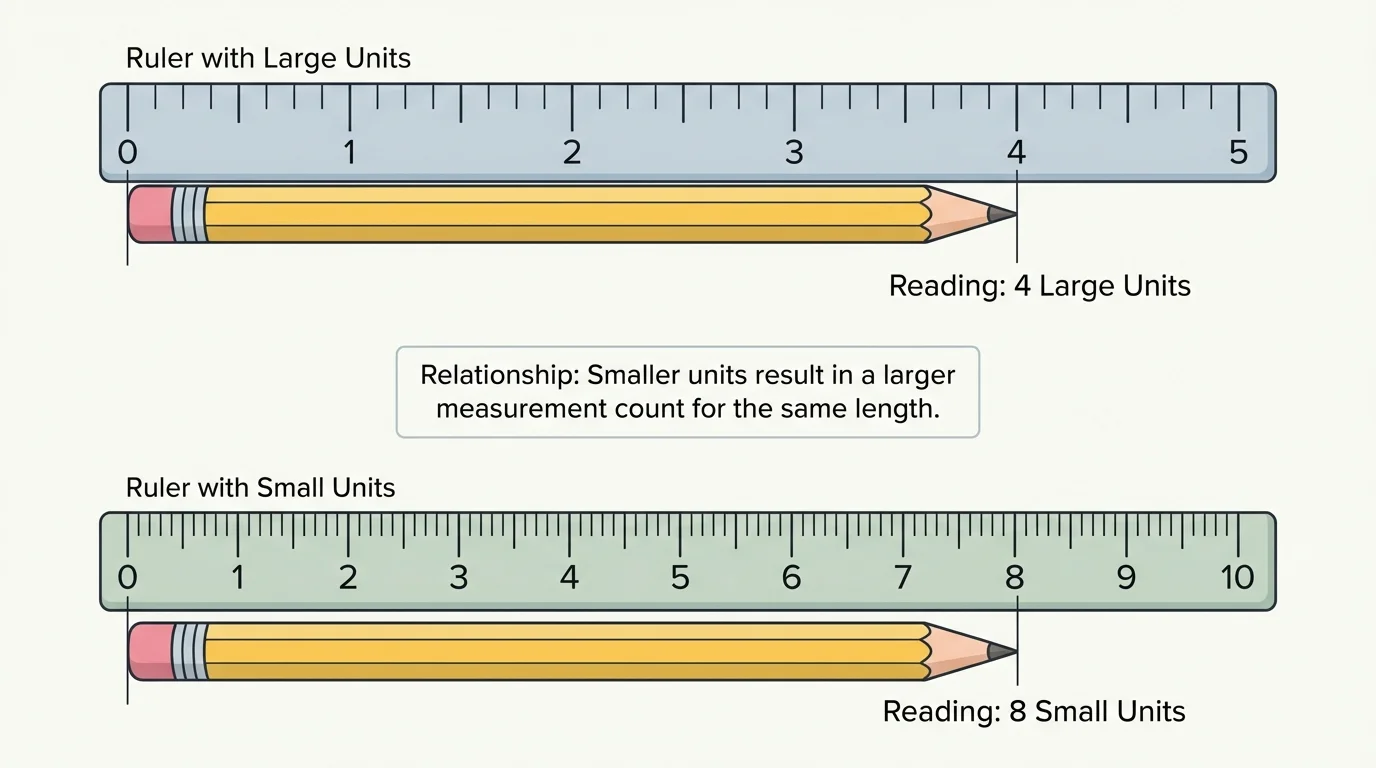
Sometimes we use a ruler with inches. Sometimes we use a ruler with centimeters. For longer objects, we may use feet or meters. A foot is a larger unit than an inch. A meter is a larger unit than a centimeter.
You already know how to count lengths along a ruler. Now the new idea is to compare what happens when the unit size changes. The object stays the same, but the number of units changes.
For example, if a bookshelf is measured in feet, the number may be small, such as \(3\) feet. If the same bookshelf is measured in inches, the number will be much larger because inches are smaller than feet.
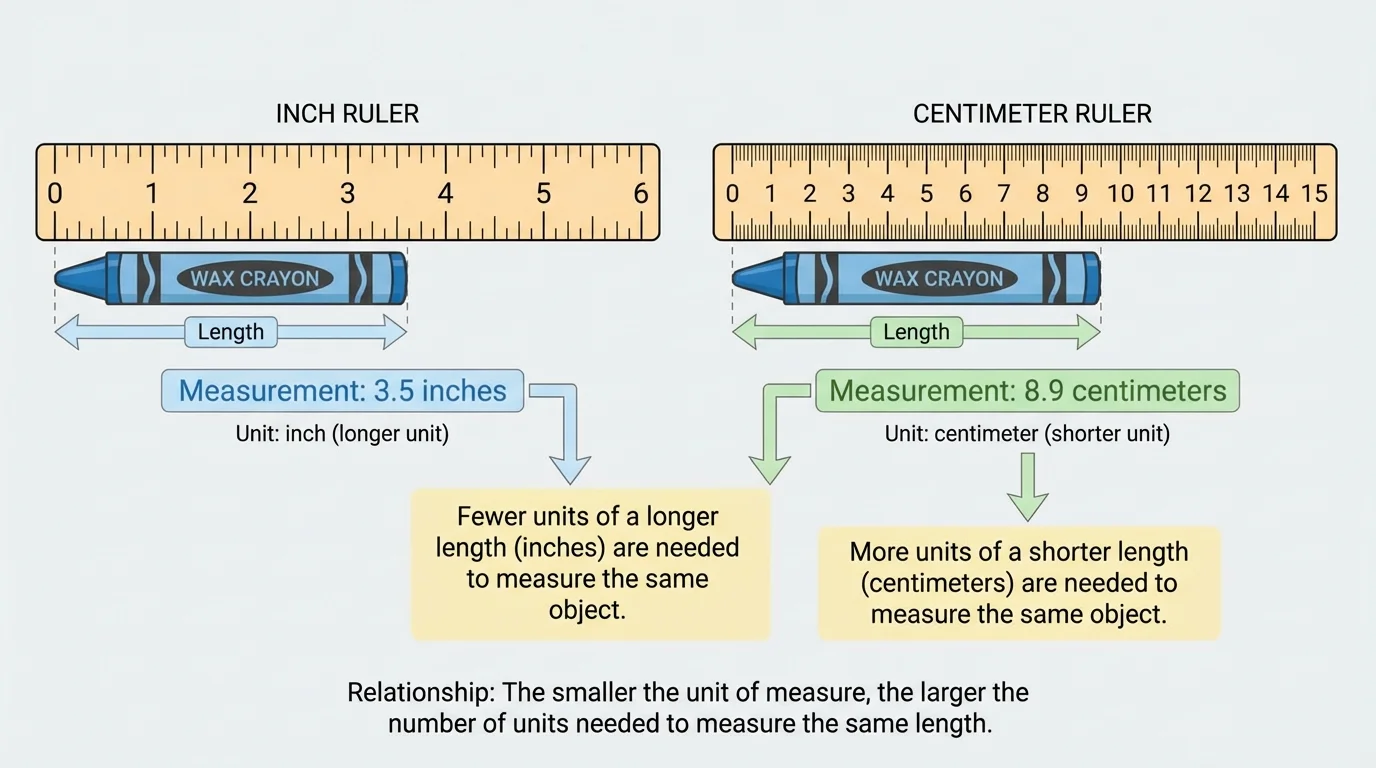
One object can have two correct measurements, as [Figure 2] illustrates. Suppose a crayon is measured with an inch ruler and then with a centimeter ruler. The crayon might be about \(4\) inches long and also about \(10\) centimeters long.
These two measurements do not disagree. They describe the same crayon using units of different sizes. Since centimeters are smaller than inches, more centimeters fit along the crayon than inches do.
We can say the relationship like this:
When the unit is smaller, the measurement number is larger.
When the unit is larger, the measurement number is smaller.
A meter is a much longer unit than a centimeter. That means a classroom door might be about \(2\) meters tall, but the same door could be about \(200\) centimeters tall.
This same idea works with feet and inches too. Because a foot is larger than an inch, an object measured in feet will usually have a smaller number than when it is measured in inches.
Now let us look at some examples step by step.
Worked Example 1
A marker is measured as \(5\) inches long. The same marker is also measured in centimeters. Which measurement number should be greater?
Step 1: Compare the unit sizes.
Inches are larger than centimeters.
Step 2: Decide what happens with a smaller unit.
Smaller units fit more times along the same object.
Step 3: State the relationship.
The centimeter measurement must be greater than \(5\).
The measurement in centimeters is the larger number because centimeters are smaller units.
This example shows that we do not always need to know the exact second measurement to know which number will be greater.
Worked Example 2
A ribbon is measured in two units. It is \(2\) feet long and \(24\) inches long. Why is \(24\) greater than \(2\)?
Step 1: Notice that the object is the same ribbon.
The ribbon did not change size.
Step 2: Compare the units.
Feet are larger units than inches.
Step 3: Explain the numbers.
Because inches are smaller, more inches are needed to cover the ribbon.
So \(24\) is greater than \(2\) because inches are smaller than feet.
As we saw earlier with the ruler in [Figure 1], careful measuring matters too. Even when we understand unit sizes, we still need to line up the object correctly.
Worked Example 3
A table is measured as \(1\) meter long. A student then measures the same table in centimeters. Should the new number be less than \(1\), equal to \(1\), or greater than \(1\)?
Step 1: Compare the meter and the centimeter.
A meter is a larger unit than a centimeter.
Step 2: Think about the smaller unit.
Smaller units make a larger count.
Step 3: Choose the correct comparison.
The centimeter measurement must be greater than \(1\).
The new number is greater than \(1\) because centimeters are smaller than meters.
Here is a quick comparison table.
| Object | Larger Unit | Smaller Unit | Which Number Is Greater? |
|---|---|---|---|
| Ribbon | feet | inches | inches |
| Crayon | inches | centimeters | centimeters |
| Table | meters | centimeters | centimeters |
Table 1. Examples showing that smaller units give greater measurement numbers.
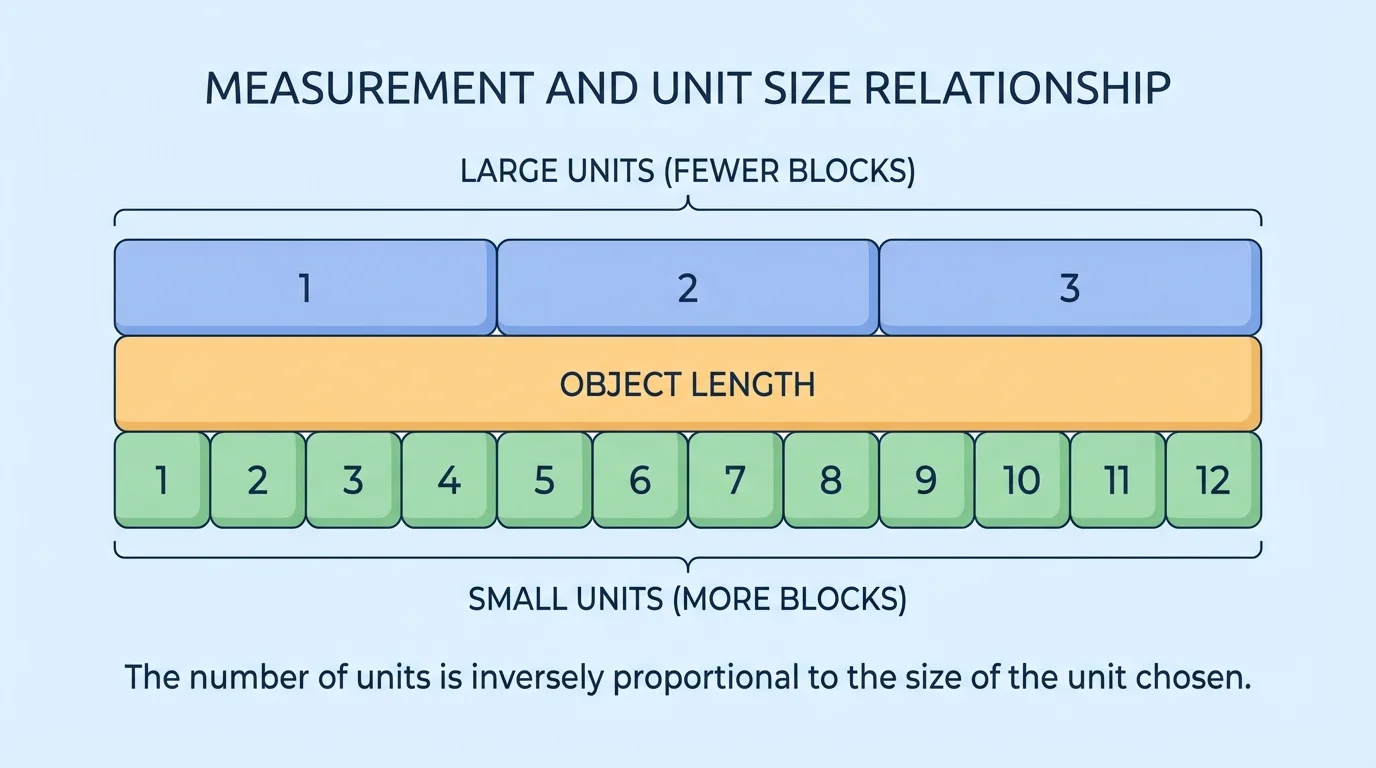
Smaller units fit more times along the same length, as [Figure 3] shows. If you cover a strip with large blocks, you may need only a few blocks. If you cover the same strip with small blocks, you may need many more blocks.
This is the big relationship to remember: the size of the unit and the number of units move in opposite ways. When the unit gets smaller, the number gets bigger. When the unit gets bigger, the number gets smaller.
Think about walking across a room. If your steps are giant, you need fewer steps. If your steps are tiny, you need more steps. Measuring with units works the same way.
Using [Figure 2], we can return to the crayon example and see why the centimeter count is larger. The crayon does not change; only the unit size changes.
People measure objects in different units all the time. A pencil might be measured in inches or centimeters. The length of a room might be measured in feet or meters. A poster might be measured in inches in one place and centimeters in another place.
Builders, teachers, doctors, and designers all need careful measurement. A builder may measure a board in feet and inches. A science class may measure a plant in centimeters. The height of a room or doorway may be measured in meters.
Why standard units matter
Standard units help everyone understand the same measurement. If one person says a rope is \(3\) feet long and another says it is \(36\) inches long, both people can still describe the same rope clearly because feet and inches are standard units.
When you shop for furniture, read the size of a backpack, or check the length of a table for a classroom, measurements help you decide if something will fit.
One common mistake is starting at the end of the ruler instead of the zero mark. Another mistake is letting the object tilt or bend while measuring. A third mistake is forgetting that different units have different sizes.
For example, a student might think that \(8\) centimeters means an object is longer than \(6\) inches just because \(8\) is greater than \(6\). But the units are different, so we must think about unit size too. A bigger number does not always mean a longer object unless the units are the same.
Another mistake is thinking one measurement must be wrong if the numbers are different. But different numbers can both be correct when different standard units are used. The rule from [Figure 3] helps explain why.
Now you know an important measurement idea: the same object can be measured twice with different standard units, and both measurements can be correct. What changes is not the object's length, but the size of the unit used to measure it.
