Have you ever looked at a table and thought, "Is it longer than I am tall?" or looked at a pencil and guessed how long it might be? That is called estimating. Estimating means making a smart guess. We do not always need the exact measurement first. Sometimes we want a quick idea of how long something is before we measure it carefully.
Length tells how long something is from one end to the other. We can estimate the length of a book, the height of a chair, or the width of a door. Estimating helps us think about size. It also helps us choose the right tool and the right unit before we measure.
For example, if you want to know how long a crayon is, you would not use meters first. A crayon is small, so a smaller unit makes more sense. If you want to think about the length of a classroom, a very tiny unit would be hard to use. A bigger unit is better. Good estimators choose a unit that matches the object.
Estimate means a close guess. Length means how long something is. A unit is the size we use to measure, such as an inch, a foot, a centimeter, or a meter.
When you estimate, you are not picking a random number. You are using what you already know. You may compare the object to a ruler, your shoe, your desk, or something else whose length you know.
[Figure 1] We use four common units in this lesson: inches, feet, centimeters, and meters. These units help us describe lengths in standard ways. An inch and a centimeter are smaller units. A foot and a meter are larger units.
An inch is a small unit often used for objects like a marker, a spoon, or a toy car. A foot is larger. It can be useful for objects like a rug, a bed, or the height of a small table.
A centimeter is a small metric unit. It is often used for objects like an eraser, a leaf, or a button. A meter is a much larger metric unit. It works well for objects like a door, a couch, or part of a room.
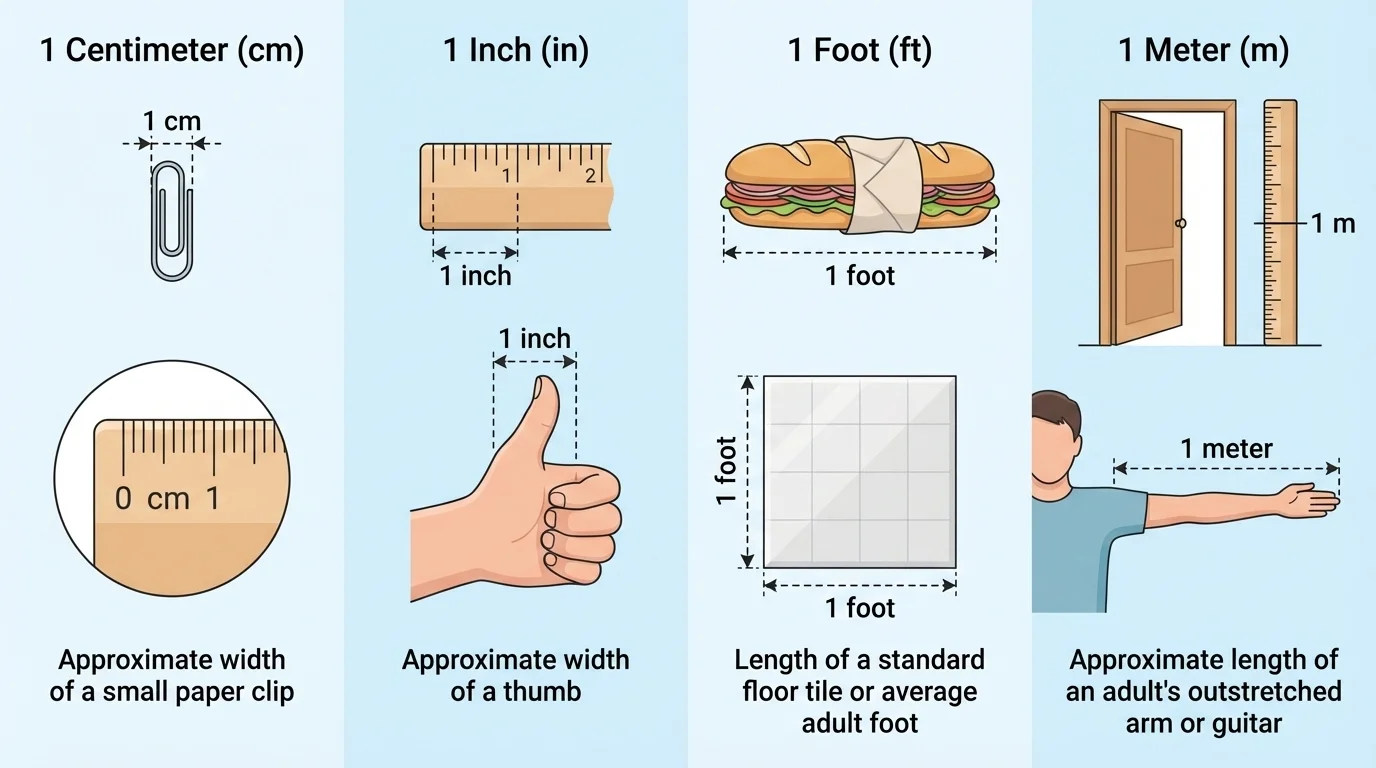
These units belong to two measurement systems. Inches and feet are in one system often used in the United States. Centimeters and meters are in the metric system, which is used in many places around the world. You do not need to change one system into the other to estimate well. You do need to know which unit fits the object.
| Unit | Size | Good for |
|---|---|---|
| inch | small | pencil, crayon, fork |
| foot | larger | chair, bed, small table |
| centimeter | small | button, paper clip, shell |
| meter | larger | door, room, sofa |
Table 1. Common length units and examples of objects that match each unit.
[Figure 2] Choosing a good unit is an important part of estimating. If the object is small, choose a small unit. If the object is large, choose a large unit. This makes your estimate easier to think about.
Suppose you want to estimate the length of a glue stick. Inches or centimeters would make sense because a glue stick is small. Now suppose you want to estimate the length of a hallway. Feet or meters would make more sense because a hallway is long.
Here is a smart way to think about it: if using the unit would take only a few of them, the unit may fit well. If it would take a huge number of tiny units, the unit is probably too small. If it would take less than one large unit for a tiny object, the unit is probably too large.
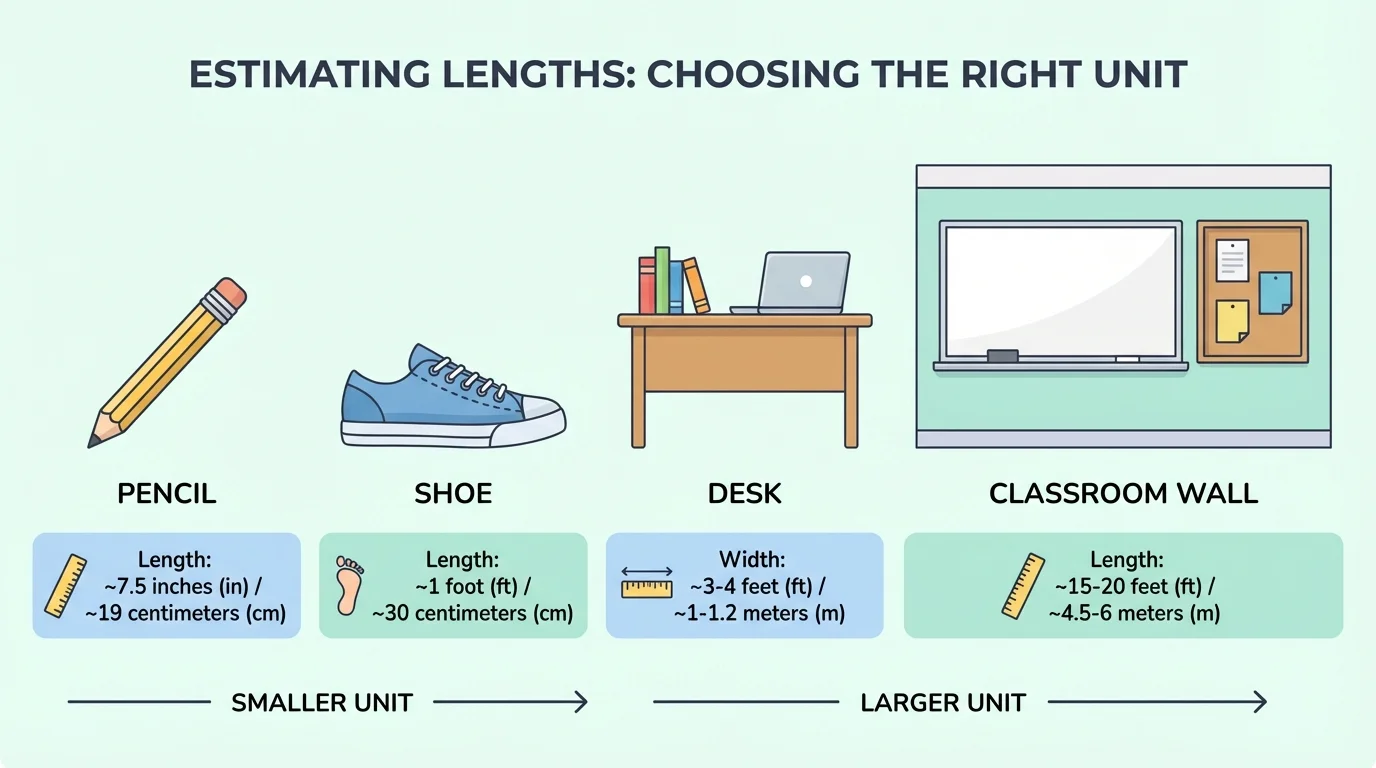
For example, saying a book is about \(10\) centimeters long may make sense, but saying a classroom is about \(10\) centimeters long does not. A classroom is much longer than that. As we saw earlier in [Figure 1], the larger units match larger objects better.
You already know how to compare sizes using words like shorter, longer, taller, and smaller. Estimating uses those same ideas, but now you connect them to standard units.
Sometimes more than one unit can work. A desk might be described in feet or in meters, depending on where you are and which system you are using. The important idea is to choose a unit that gives a sensible estimate.
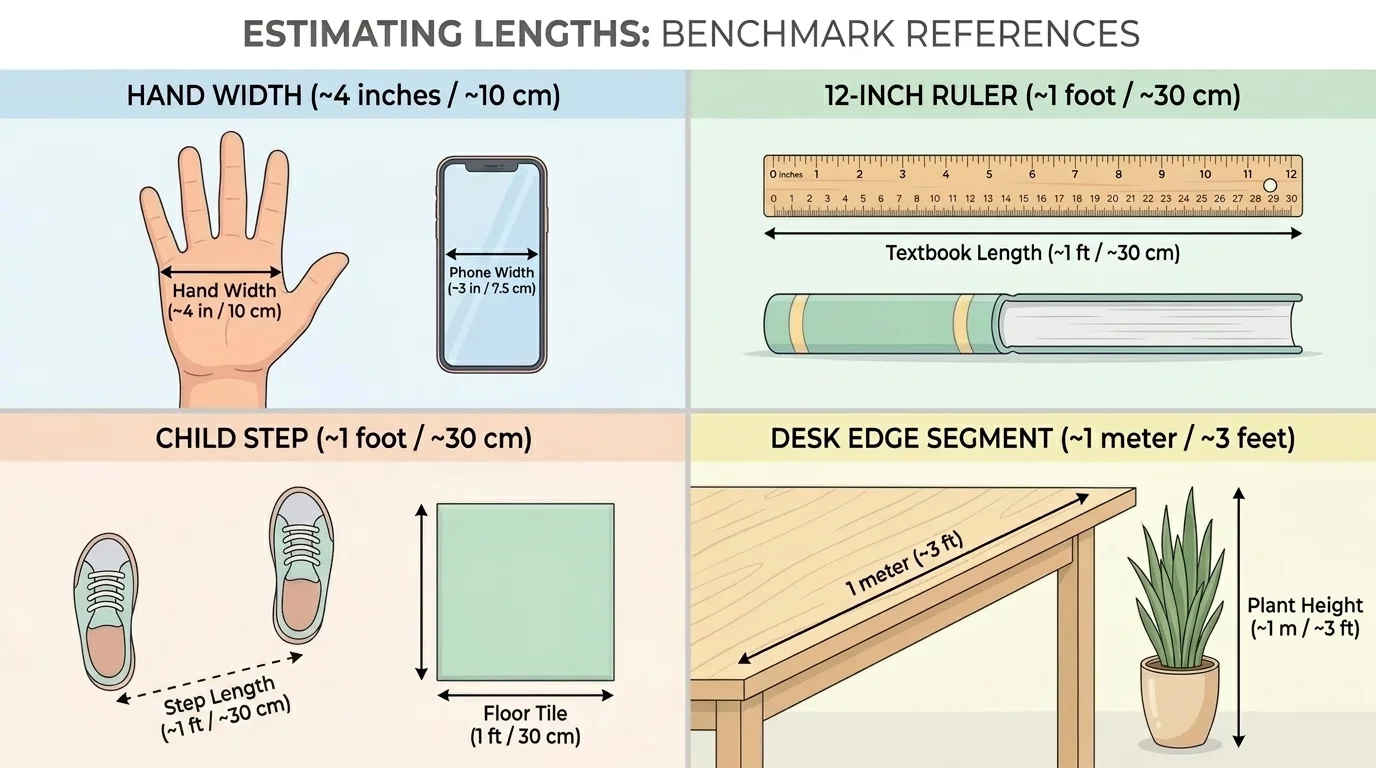
[Figure 3] A good estimate is based on something you already know. One helpful idea is a benchmark length. A benchmark length is a known length you can remember and use for comparison. This figure shows a few simple benchmark ideas using body parts and classroom objects.
For example, maybe you know a classroom ruler is about \(12\) inches long. If a book looks a little shorter than the ruler, you might estimate that the book is about \(10\) inches long. Maybe you know a door is about \(2\) meters tall. If a cabinet looks about half as tall as the door, you might estimate the cabinet is about \(1\) meter tall.
Another way to estimate is to line up the object in your mind with repeated units. If a pencil looks about as long as \(6\) little inch spaces on a ruler, then \(6\) inches is a reasonable estimate. If a rug looks about \(5\) shoes long and each shoe is about \(1\) foot, then the rug may be about \(5\) feet long.
After you estimate, always ask, "Does my answer make sense?" That is called checking whether an estimate is reasonable. If you estimate that a spoon is \(4\) meters long, that is not reasonable. A spoon is much smaller than that.
Small units for small objects, large units for large objects
This idea helps almost every time you estimate. If the object fits in your hand, think first about inches or centimeters. If the object is as big as furniture or part of a room, think first about feet or meters. Estimating gets easier when the unit matches the size of the object.
Good estimators also compare. They might think, "This notebook is longer than my hand but shorter than my ruler." That comparison helps them pick a smart estimate between those known lengths.
Let's look at some step-by-step examples. Each one uses thinking, comparison, and a check for reasonableness.
Worked example 1
Estimate the length of a crayon using inches.
Step 1: Think about the object size.
A crayon is a small object, so inches are a good unit.
Step 2: Compare it to something known.
A small ruler shows \(12\) inches. A crayon looks about half as long as that ruler.
Step 3: Estimate.
Half of \(12\) is \(6\), so a good estimate is \(6\) inches.
The crayon is about \(6\) inches long.
This estimate makes sense because crayons are much shorter than a full ruler, but they are not tiny like a button.
Worked example 2
Estimate the length of a desk using feet.
Step 1: Choose a sensible unit.
A desk is much bigger than a pencil, so feet are a good unit.
Step 2: Use a benchmark.
Suppose one large step or one shoe length you know is about \(1\) foot.
Step 3: Compare along the desk.
If the desk looks about \(3\) of those foot-lengths long, then the estimate is \(3\) feet.
The desk is about \(3\) feet long.
That estimate is reasonable because a desk is usually a few feet long, not just \(3\) inches long and not \(3\) meters long.
Worked example 3
Estimate the length of a leaf using centimeters.
Step 1: Pick the unit.
A leaf is small, so centimeters are a good choice.
Step 2: Compare it to a known length.
If the leaf looks about as long as \(8\) little centimeter spaces on a ruler, use that as the estimate.
Step 3: Check the answer.
\(8\) centimeters is a sensible small length for a leaf.
The leaf is about \(8\) centimeters long.
Centimeters are useful here because they help describe small lengths clearly.
Worked example 4
Estimate the height of a door using meters.
Step 1: Think about size.
A door is tall, so meters make more sense than centimeters.
Step 2: Use what you know.
If an adult is a little less than \(2\) meters tall and the door is a bit taller than the adult's shoulders, then \(2\) meters is a strong estimate.
Step 3: State the estimate.
The door is about \(2\) meters tall.
This is reasonable because doors are much taller than \(2\) centimeters and much shorter than \(20\) meters.
Notice that each example begins with the same thinking: choose a good unit, compare to something known, and check whether the answer makes sense. The benchmark ideas in [Figure 3] help with every one of these examples.
Estimating length is useful in many places. At school, you might estimate whether a poster will fit on a wall. At home, you might estimate if a toy will fit on a shelf. In sports, people estimate distances on fields and courts. Builders and designers often estimate lengths before doing exact measurements.
Artists also estimate. If they want to draw a house on paper, they think about how tall and wide each part should be. Gardeners estimate how far apart to place plants. Even when exact measuring comes later, estimating is often the first smart step.
Many people estimate without even noticing. When someone checks whether a box will fit through a doorway, that person is using length estimation before measuring exactly.
Estimation saves time. It helps us make quick decisions. It also helps us catch mistakes. If someone measures a pencil and says it is about \(50\) feet long, an estimate tells us right away that something is wrong.
One common mistake is using a unit that is too big or too small. For example, centimeters for a classroom floor would give a very large number, while meters for a paper clip would give a tiny part of a meter. Choose the unit that fits the size of the object best.
Another mistake is forgetting what the unit means. A foot is larger than an inch. A meter is larger than a centimeter. As shown earlier in [Figure 2], larger objects usually match feet or meters, while smaller objects usually match inches or centimeters.
You can also make sure your estimate is reasonable by comparing it with nearby objects. If your notebook is shorter than a ruler, it should not have a length greater than the ruler's \(12\) inches. If your chair is shorter than a door, it should not have a height greater than about \(2\) meters.
Here are some smart check questions: Is my unit a good match for the object? Is my estimate too big or too small? Did I compare to something I know? If the answers sound right, your estimate is probably strong.
"A good estimate is a smart guess, not a wild guess."
Estimating gets better with practice because your eyes and brain learn to notice size. The more you compare objects to known lengths, the stronger your estimates become.
