Have you ever noticed that two pencils can look almost the same length, but one is still a little longer? That tiny extra part matters. It can matter when you pack crayons in a box, cut ribbon for a gift, or choose which stick is longest for a building project. Measuring helps us find out exactly how much longer one object is than another.
We compare lengths all the time. A bookmark may be longer than a glue stick. A jump rope may be much longer than a shoelace. When we compare carefully, we do not just say "longer" or "shorter." We can tell how much longer by using numbers and units.
Length tells how long something is from one end to the other. If one object is longer than another, the extra part is called the difference in length. We find that difference by measuring both objects and then subtracting.
Length is how long an object is from end to end.
Standard unit is a unit everyone uses the same way, such as inches, feet, centimeters, or meters.
Difference is how much more one amount is than another amount.
When we compare lengths, we must use the same unit. We should not compare one object measured in inches with another object measured in centimeters unless we change them to the same unit first. The most important idea is to measure both objects with the same kind of unit.
To measure an object means to find out its length using a unit. A standard unit is helpful because everyone understands it. If one student says a ribbon is \(8\) inches long, other people know exactly what that means.
A ruler is a tool with equal spaces marked on it. Each space shows a unit. On one side of a ruler, you may see inches. On the other side, you may see centimeters. When you measure, start at \(0\), not at the edge of the ruler if the edge comes before \(0\).
When you subtract, you find how much more or how much less. That same subtraction idea helps when you compare lengths.
If a marker is \(7\) inches long and a pen is \(5\) inches long, the marker is longer. To find how much longer, subtract:
\(7 - 5 = 2\)
The marker is \(2\) inches longer than the pen.
One good way to compare lengths is to measure each object using the same unit and then subtract the smaller length from the larger length. This tells the exact difference between the two lengths.
Suppose one crayon is \(9\) inches long and another crayon is \(6\) inches long. We find the difference by subtracting:
\(9 - 6 = 3\)
This means the longer crayon is \(3\) inches longer than the shorter crayon.
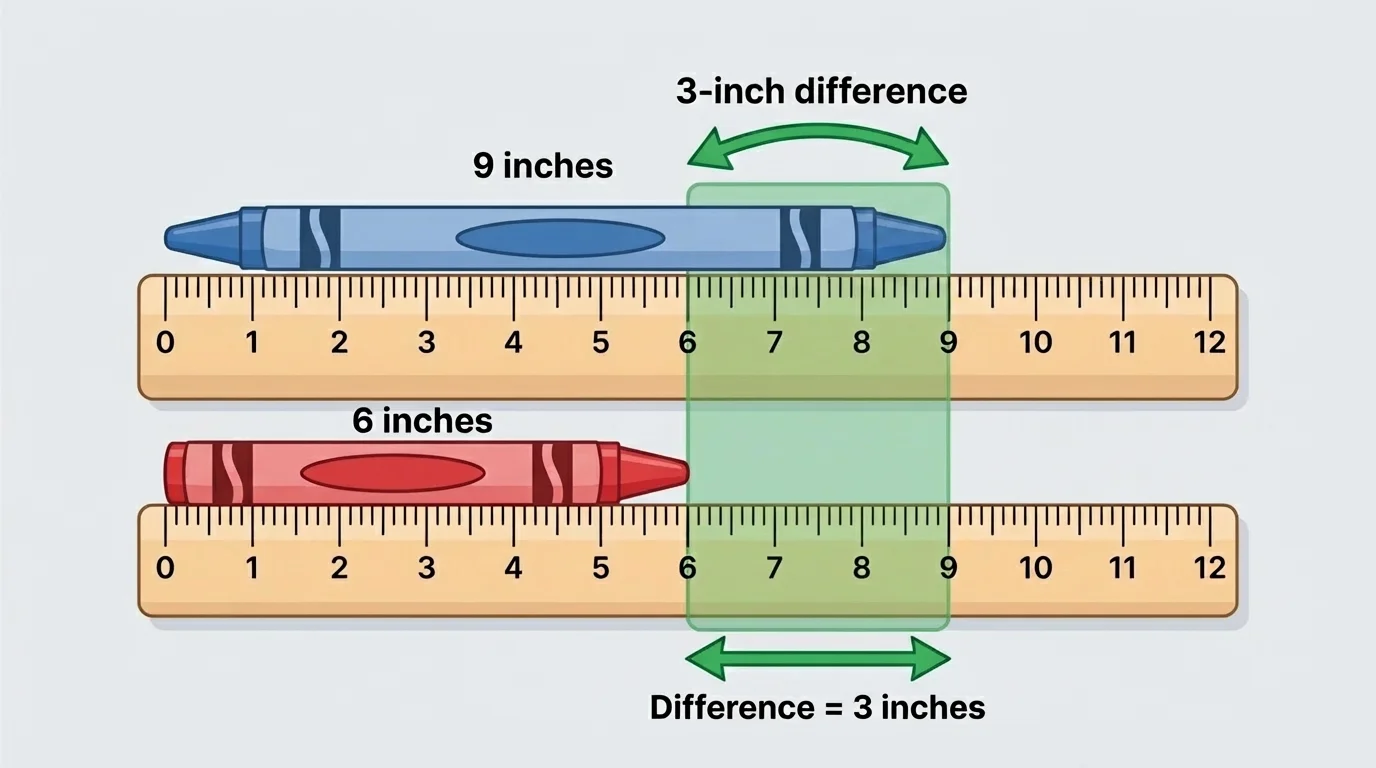
You can think of the difference as the "extra length." If you placed the shorter object next to the longer object, the part sticking out would be the difference.
Sometimes the numbers are close together. For example, if a spoon is \(12\) centimeters long and a fork is \(10\) centimeters long, the spoon is only a little longer:
\(12 - 10 = 2\)
The spoon is \(2\) centimeters longer than the fork.
When you compare objects directly, you must line up one end of both objects at the same starting point. If the ends do not match, the comparison will not be fair.
For example, imagine two strips of paper. If one strip starts farther over than the other, it may look longer or shorter than it really is. To compare correctly, place both left ends together. Then look at the right ends to see which goes farther.
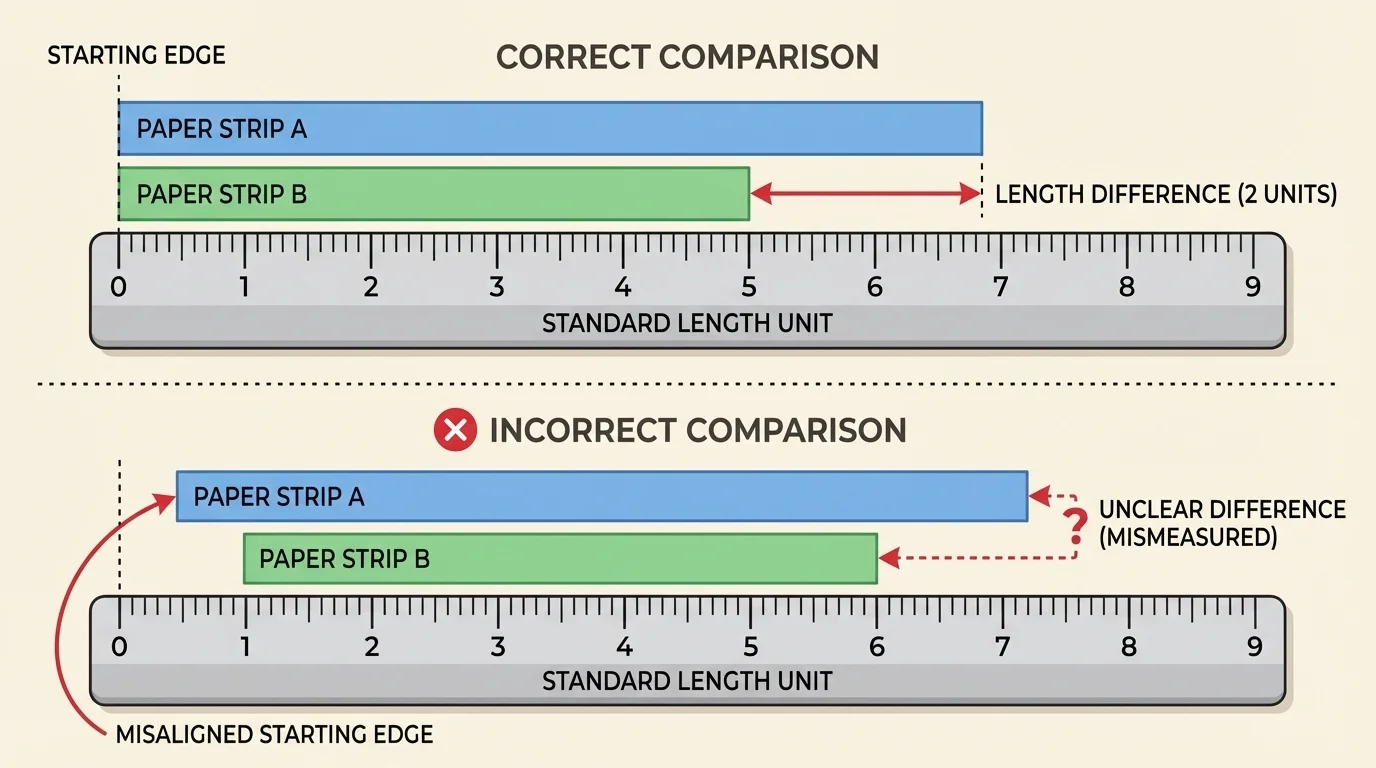
The same careful idea works with a ruler. Put one end of the object at \(0\). Then read the number at the other end. If you start at the wrong place, your measurement will be off.
Careful measuring is important because even a small mistake can change the answer. If a book is really \(8\) inches long but you start at \(1\) instead of \(0\), you might think it is \(9\) inches long. That would make your comparison wrong.
Some rulers have a broken edge, so the object cannot start exactly at the end. In that case, starting at the \(0\) mark is extra important.
Later, when you compare measured lengths again, the careful lining-up in [Figure 2] still matters. Good measuring habits help you get correct differences every time.
Let's work through some examples step by step.
Worked example 1
A blue ribbon is \(8\) inches long. A red ribbon is \(5\) inches long. How much longer is the blue ribbon?
Step 1: Find the two lengths.
The blue ribbon is \(8\) inches. The red ribbon is \(5\) inches.
Step 2: Subtract the shorter length from the longer length.
\(8 - 5 = 3\)
Step 3: Write the answer with the unit.
The blue ribbon is \(3\) inches longer.
Final answer: \[3 \textrm{ inches}\]
This example shows that the word "how much longer" tells us to find the difference.
Worked example 2
A toy car is \(11\) centimeters long. A small block is \(7\) centimeters long. How much longer is the toy car?
Step 1: Measure or read the lengths.
Toy car: \(11\) centimeters. Block: \(7\) centimeters.
Step 2: Subtract.
\(11 - 7 = 4\)
Step 3: State the comparison.
The toy car is \(4\) centimeters longer than the block.
Final answer: \[4 \textrm{ centimeters}\]
Notice that both lengths are in centimeters. That makes the subtraction easy and correct.
Worked example 3
A pencil is \(9\) inches long. An eraser is \(3\) inches long. How much longer is the pencil?
Step 1: Identify the longer and shorter objects.
Longer object: pencil, \(9\) inches. Shorter object: eraser, \(3\) inches.
Step 2: Subtract the shorter length.
\(9 - 3 = 6\)
Step 3: Write a complete answer.
The pencil is \(6\) inches longer than the eraser.
Final answer: \[6 \textrm{ inches}\]
Here is another way to check Worked example 3: if the eraser is \(3\) inches and the extra part is \(6\) inches, then \(3 + 6 = 9\). The lengths make sense.
Sometimes a number line helps you see the space between two lengths. The jumps on the number line show the difference from the smaller number to the larger number.
If one object is \(5\) inches long and another is \(11\) inches long, you can count on from \(5\) to \(11\). From \(5\) to \(8\) is \(3\), and from \(8\) to \(11\) is \(3\) more. So the total difference is \(6\).
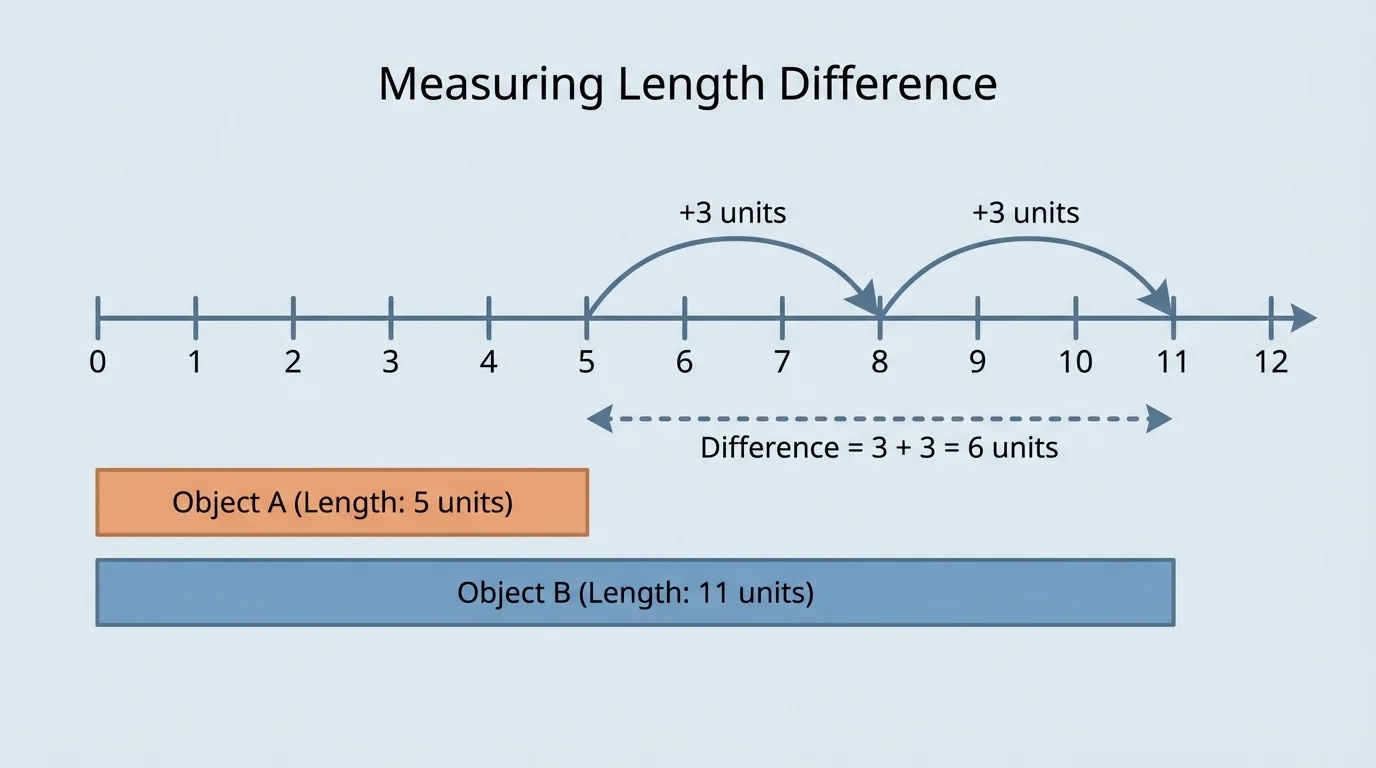
You can also solve it with subtraction:
\(11 - 5 = 6\)
Both ways give the same answer. The number line is useful when you want to see the distance between numbers.
As you continue learning, [Figure 3] reminds you that a length difference is like the space between two numbers. That idea helps in both measuring and subtraction.
Comparing lengths is useful in everyday life. A teacher may need to know how much longer one piece of paper is than another. Someone building with blocks may need two pieces that are the same length, or may need to trim one piece because it is \(2\) inches too long.
In art class, you might cut two pieces of yarn. One piece may be \(14\) centimeters and another may be \(9\) centimeters. The difference is:
\(14 - 9 = 5\)
So one piece is \(5\) centimeters longer.
In sports, two jumps can be compared. If one jump is \(90\) centimeters and another jump is \(85\) centimeters, the first jump is \(5\) centimeters longer. In nature, you might compare leaves, shells, or twigs to see which is longer and by how much.
| Object A | Length | Object B | Length | Difference |
|---|---|---|---|---|
| Pencil | \(9\) inches | Crayon | \(6\) inches | \(3\) inches |
| Book | \(12\) centimeters | Notebook | \(10\) centimeters | \(2\) centimeters |
| Ribbon | \(8\) inches | String | \(5\) inches | \(3\) inches |
Table 1. Examples of pairs of objects, their lengths, and the difference in the same unit.
One common mistake is using different units. If one object is \(8\) inches and another is \(8\) centimeters, those are not equal lengths. We should not compare them by just looking at the numbers.
Another mistake is subtracting in the wrong order and forgetting what the answer means. To find how much longer one object is, subtract the shorter length from the longer length. For example, if the lengths are \(13\) centimeters and \(9\) centimeters, then:
\(13 - 9 = 4\)
The longer object is \(4\) centimeters longer.
You can check your answer with addition. If the shorter object plus the difference equals the longer object, your answer is correct. For example, if you found a difference of \(4\), check whether \(9 + 4 = 13\). It does, so the answer makes sense.
Comparing length is really finding the distance between two measurements. When you measure two objects and subtract, you are finding the distance between their lengths. That is why subtraction, counting on, and number lines all work for this skill.
When you speak or write your answer, always include the unit. Saying "\(4\)" is not enough. Saying "\(4\) inches longer" or "\(4\) centimeters longer" is clear and complete.
