A hop, a skip, and a jump can help you do math. A number line is like a path of numbers. When you stand at \(0\) and move along the path, each number shows how far you are from the start. That means numbers are not just names to count with. They can also show length.
A number line is a line with points marked in order. Each point matches a number. On a number line showing whole numbers, the points must be equally spaced. That means the space from \(0\) to \(1\) is the same as the space from \(1\) to \(2\), and the same as the space from \(2\) to \(3\). As [Figure 1] shows, each whole number tells a distance from \(0\).
If a point is at \(5\), that means it is \(5\) units from \(0\). If a point is at \(9\), that point is \(9\) units from \(0\). So we can think of whole numbers as lengths measured from the starting point, \(0\).
Whole numbers are the counting numbers and zero: \(0, 1, 2, 3, 4, ...\).
Unit means one equal step on the number line.
Point means the exact place on the number line for a number.
Suppose you see the numbers \(0, 1, 2, 3, 4, 5\) on a line. The point for \(3\) is not just the third mark you see. It means a length of \(3\) units from \(0\). That is why number lines are connected to measurement.
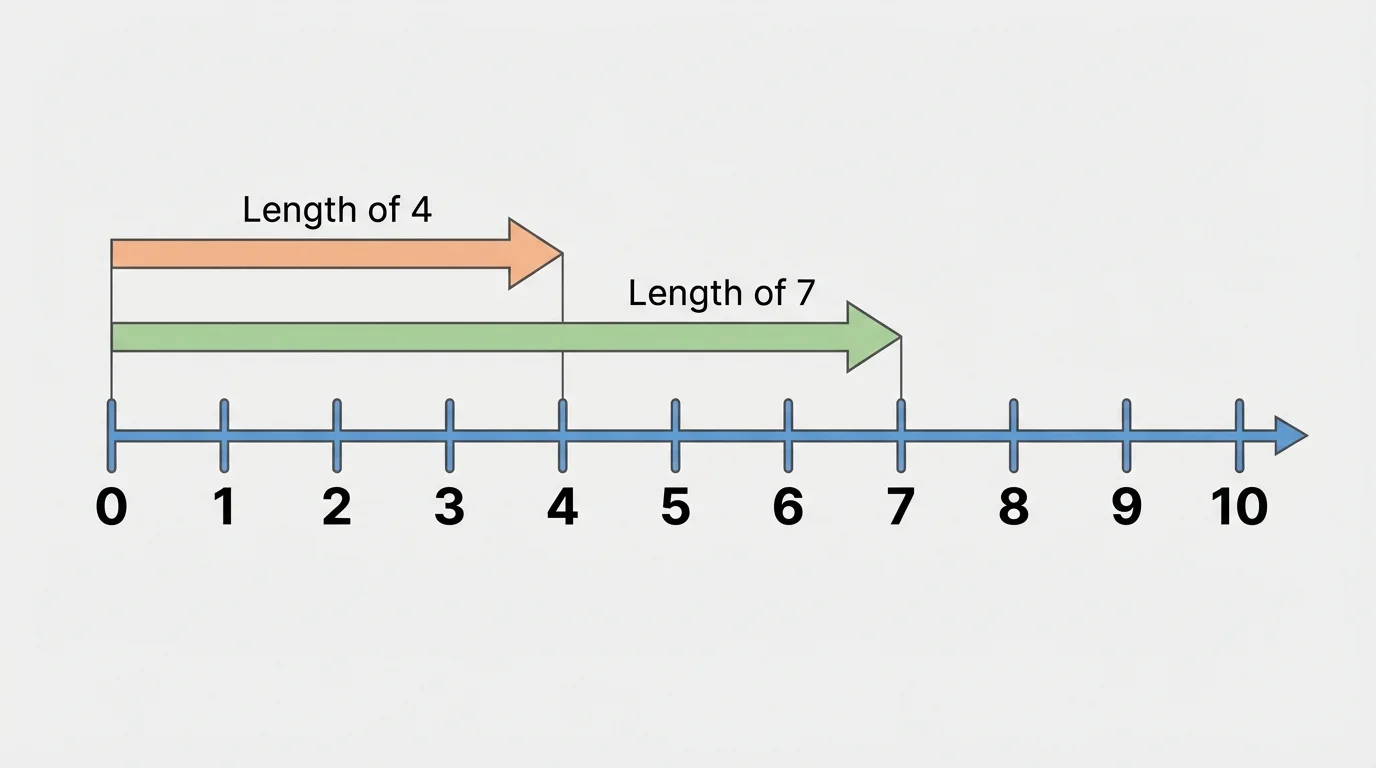
A ruler works in a similar way. When you measure an object, you begin at \(0\) and look at how far the object reaches. If it reaches to \(8\), its length is \(8\) units. The same idea appears on a number line.
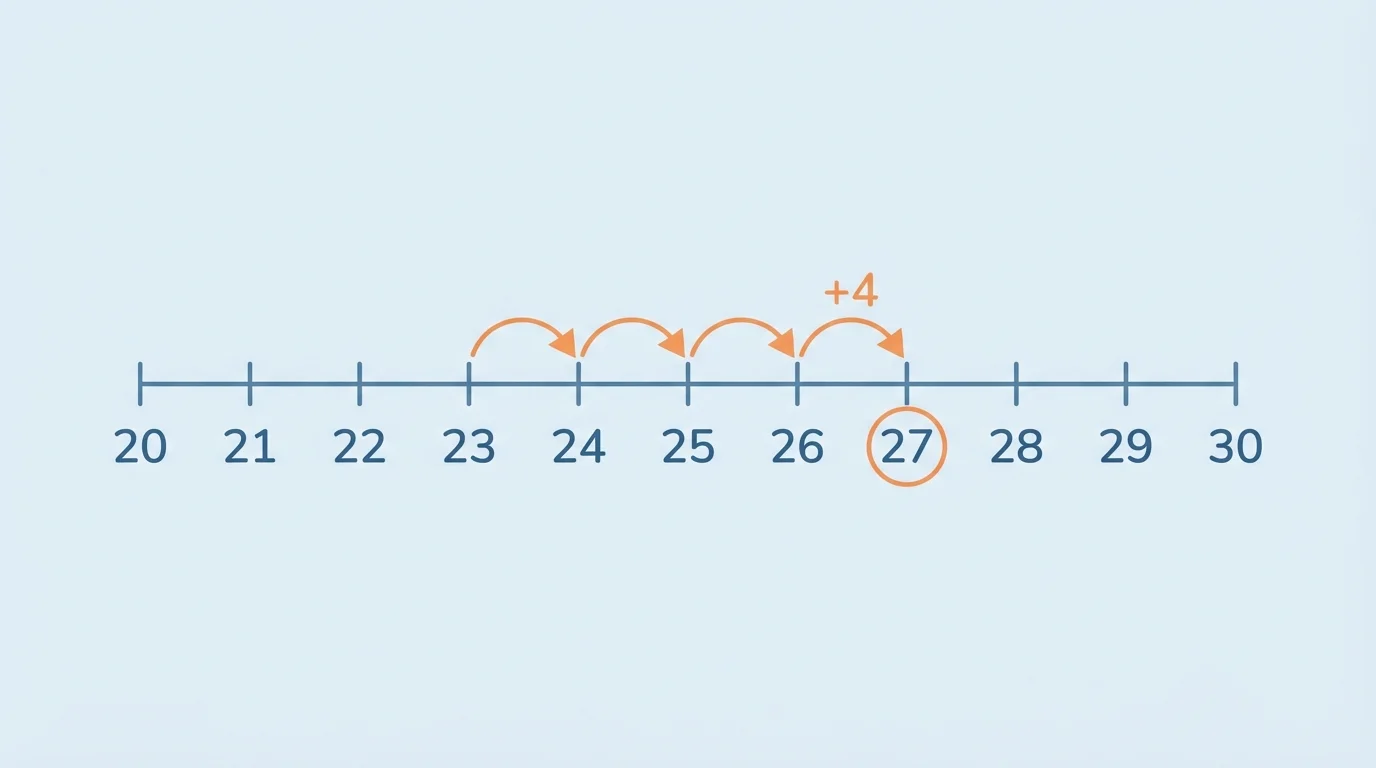
Addition means putting together or moving forward by some amount. On a number line, addition is shown by jumps to the right, as [Figure 2] illustrates. Each jump of \(1\) moves one unit farther from \(0\).
If you start at \(6\) and add \(3\), you make \(3\) jumps to the right: \(7\), \(8\), \(9\). So \(6 + 3 = 9\).
You can also think of this as length. Start with a length of \(6\) units. Then add another length of \(3\) units. Together, the total length is \(9\) units.
When the jumps are shown clearly, the number line helps you see why the answer gets bigger in addition. Moving right means going to greater numbers.
Solved example 1
Show \(8 + 5\) on a number line.
Step 1: Start at the first number.
Begin at \(8\).
Step 2: Move right \(5\) times.
The landing numbers are \(9, 10, 11, 12, 13\).
Step 3: Name the landing number.
You land on \(13\).
\(8 + 5 = 13\)
Sometimes students count the starting number as the first jump. Be careful. If you start at \(8\), you are already standing on \(8\). The first jump takes you to \(9\).
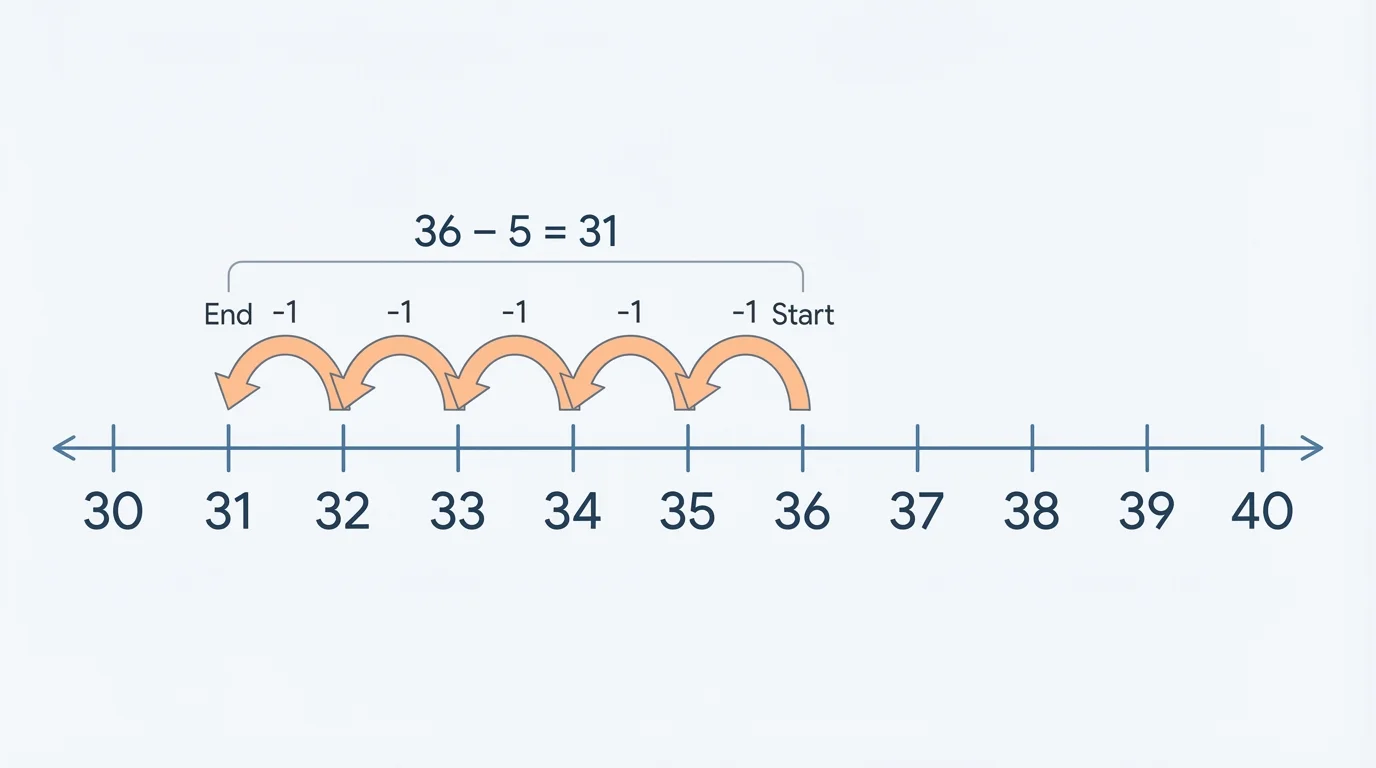
Subtraction can mean taking away or finding how much less. On a number line, subtraction is shown by moving left, as [Figure 3] shows. Each jump left moves one unit closer to \(0\).
If you start at \(12\) and subtract \(4\), you make \(4\) jumps to the left: \(11\), \(10\), \(9\), \(8\). So \(12 - 4 = 8\).
Subtraction can also be seen as shortening a length. A length of \(12\) units becomes \(8\) units after taking away \(4\) units.
Moving left helps you see why the answer gets smaller in subtraction. Numbers on the left are less than numbers on the right.
Solved example 2
Show \(15 - 6\) on a number line.
Step 1: Start at \(15\).
Find the point for \(15\) on the number line.
Step 2: Move left \(6\) times.
The landing numbers are \(14, 13, 12, 11, 10, 9\).
Step 3: Name the landing number.
You land on \(9\).
\(15 - 6 = 9\)
A number line can also help you compare two numbers. If you want to know how far apart \(18\) and \(25\) are, count the distance between them. From \(18\) to \(25\) is \(7\) units, so the difference is \(7\).
Now let's use number lines for numbers a little farther from \(0\). The same ideas still work. Equal spaces still matter, and each jump still means \(1\) unless we say otherwise.
Solved example 3
Show \(23 + 4\) on a number line.
Step 1: Start at \(23\).
Locate \(23\) on the number line.
Step 2: Jump right \(4\) times.
The landing numbers are \(24, 25, 26, 27\).
Step 3: State the sum.
You land on \(27\).
\(23 + 4 = 27\)
Notice that this is the same kind of movement we saw earlier in [Figure 2]. Even when the numbers are larger, addition still means moving right.
Solved example 4
Show \(36 - 5\) on a number line.
Step 1: Start at \(36\).
Find \(36\) on the number line.
Step 2: Jump left \(5\) times.
The landing numbers are \(35, 34, 33, 32, 31\).
Step 3: State the difference.
You land on \(31\).
\(36 - 5 = 31\)
This matches the leftward movement seen earlier in [Figure 3]. Subtraction means moving left on the number line.
Solved example 5
Find the difference between \(41\) and \(47\).
Step 1: Place both numbers on the number line.
Mark \(41\) and \(47\).
Step 2: Count the distance between them.
From \(41\) to \(47\) is a distance of \(6\) units: \(42, 43, 44, 45, 46, 47\).
Step 3: Write the difference.
The numbers are \(6\) units apart.
\(47 - 41 = 6\)
So subtraction can mean taking away, and it can also mean finding the distance between two numbers on the line.
Number lines do not stop at small numbers. You can place whole numbers all the way to \(100\). When numbers get bigger, it helps to use landmarks such as \(0, 10, 20, 30, 40\), and so on. As [Figure 4] shows, a number like \(58\) belongs between \(50\) and \(60\).
If the line is marked by ones, then \(58\) is \(8\) units to the right of \(50\). If the line is marked by tens, you can still think about where the number belongs between the two nearest tens.
Using landmarks on a long number line
On a longer number line, look for numbers you know well first. Tens are helpful landmarks. For example, \(34\) is between \(30\) and \(40\), and \(72\) is between \(70\) and \(80\). This makes it easier to find the correct point.
Equal spacing is still important on long number lines. The distance from \(20\) to \(21\) must match the distance from \(67\) to \(68\). If the spaces are uneven, the line does not represent the numbers correctly.
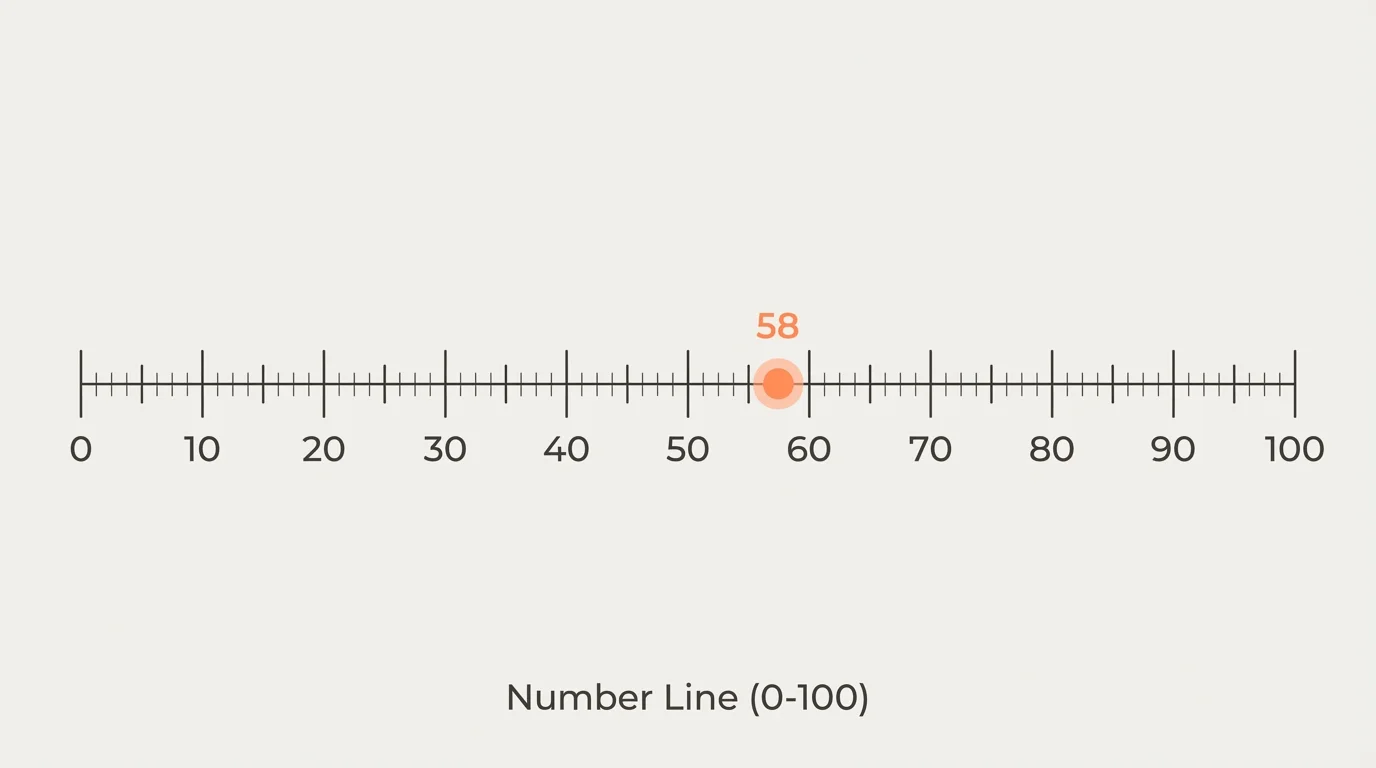
You can also add and subtract within \(100\) on a number line. For example, starting at \(58\) and adding \(3\) means three jumps right to \(61\). Starting at \(58\) and subtracting \(3\) means three jumps left to \(55\).
Number lines are useful because they connect numbers to real measurements. A ruler is really a number line. If a pencil starts at \(0\) and ends at \(9\), then the pencil is \(9\) units long.
Suppose a caterpillar crawls \(12\) centimeters and then crawls \(5\) more centimeters. You can model that on a number line by starting at \(12\) and jumping right \(5\) to get \(17\). That means the total distance is \(17\) centimeters.
A track with lanes, a measuring tape, and even game score bars all use the same idea as a number line: position shows how much.
Subtraction works in real life too. If a toy car moves \(20\) centimeters and then rolls back \(7\) centimeters, you can start at \(20\) and jump left \(7\) to find \(13\). The car is now \(13\) centimeters from the start.
When you read a thermometer or a measuring stick later in school, the same big idea stays true: numbers tell position and distance from a starting point.
One common mistake is making jumps that are not all the same size. On a correct number line, each unit is one equal step. That is why [Figure 1] is so important: the points are evenly placed.
Another mistake is moving the wrong way. For addition, move right. For subtraction, move left. If your answer to \(19 + 2\) is smaller than \(19\), check your direction.
You already know how to count forward and backward by ones. A number line turns that counting into a picture you can see.
You can also check your work by asking whether the answer makes sense. For \(27 - 4\), the answer should be less than \(27\). For \(27 + 4\), the answer should be greater than \(27\).
Here is a quick comparison:
| Math action | Direction on the number line | What happens |
|---|---|---|
| \(a + b\) | Right | The number gets larger |
| \(a - b\) | Left | The number gets smaller |
Table 1. Directions and meanings for addition and subtraction on a number line.
With practice, you will see that number lines help numbers make sense. They show order, distance, and movement all at the same time.
