A clock can tell you when school starts, when lunch is ready, and when it is time to go to bed. Every day, people use time to plan what they do. When you can read both kinds of clocks, you can understand a bus schedule, know when a game begins, or make sure you are not late. Time is everywhere, and learning to read it carefully is an important skill.
We use time to organize our day. If class starts at \(8{:}30\) a.m., you need to know that means morning. If soccer practice starts at \(4{:}15\) p.m., you know it happens later in the day. Reading time helps us be ready at the right moment.
There are two common ways to show time. An analog clock has hands that move around a circle. A digital clock shows numbers, such as \(7{:}05\) or \(2{:}45\). We can read the same time on both kinds of clocks.
An analog clock has a face with the numbers \(1\) through \(12\). It has a short hand and a long hand, as shown in [Figure 1]. The short hand is the hour hand. It tells the hour. The long hand is the minute hand. It tells the minutes.
The hour hand moves slowly. The minute hand moves faster. When we tell time to the nearest five minutes, we look closely at where the minute hand points. Then we decide which hour the short hand has reached or passed.
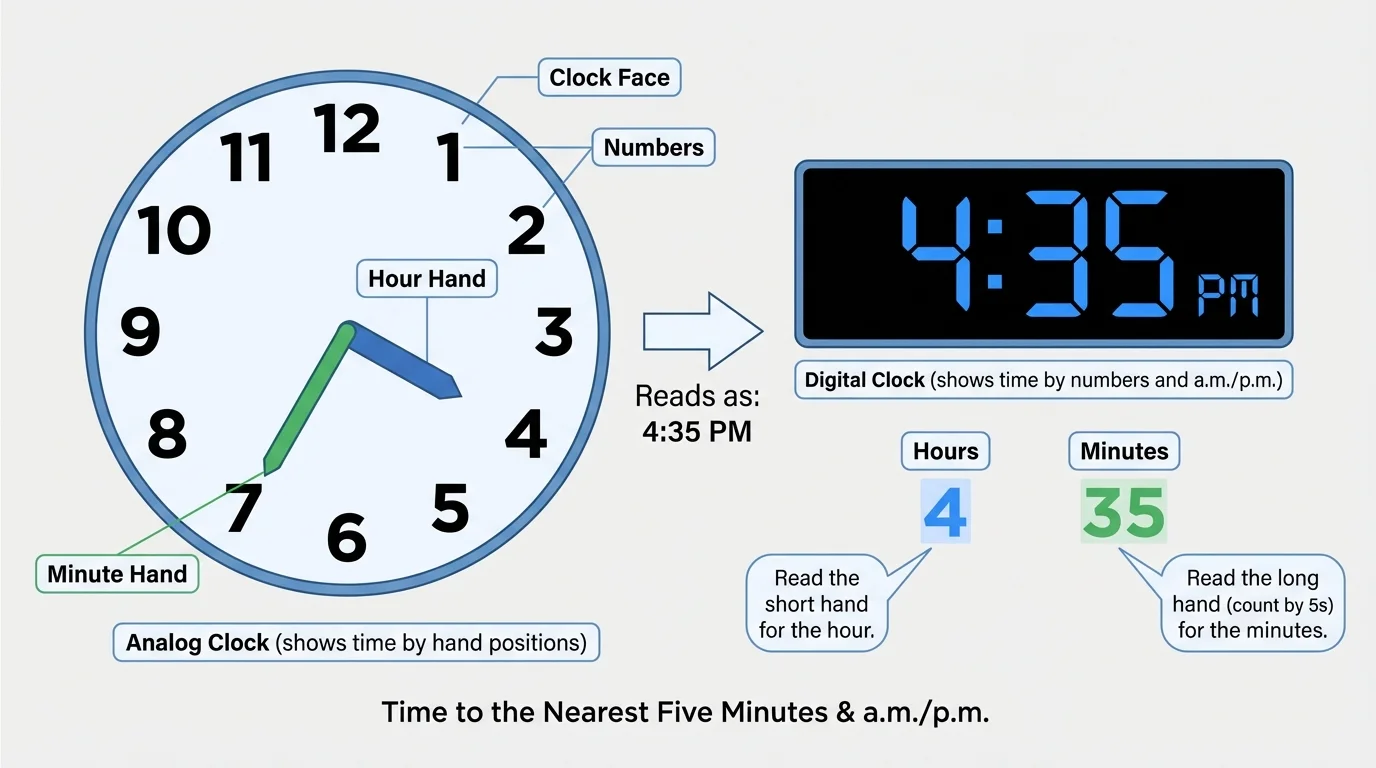
A digital clock uses numbers. The first number or numbers show the hour. The numbers after the colon show the minutes. For example, in \(3{:}25\), the hour is \(3\) and the minutes are \(25\).
Analog clock means a clock with hands that move around a clock face.
Digital clock means a clock that shows time using numbers.
Hour hand is the short hand that tells the hour.
Minute hand is the long hand that tells the minutes.
When the minute hand points exactly to a number, it tells a multiple of \(5\) minutes. That is why skip-counting by \(5\) helps us read time.
Each number on the clock stands for \(5\) minutes when you read the minute hand. This pattern is easy to see on the clock in [Figure 2]. The number \(1\) means \(5\) minutes, \(2\) means \(10\) minutes, \(3\) means \(15\) minutes, and so on.
Here is the pattern around the clock:
| Clock Number | Minutes |
|---|---|
| \(1\) | \(5\) |
| \(2\) | \(10\) |
| \(3\) | \(15\) |
| \(4\) | \(20\) |
| \(5\) | \(25\) |
| \(6\) | \(30\) |
| \(7\) | \(35\) |
| \(8\) | \(40\) |
| \(9\) | \(45\) |
| \(10\) | \(50\) |
| \(11\) | \(55\) |
| \(12\) | \(60\) or \(0\) |
Table 1. The clock numbers matched to minutes counted by fives.
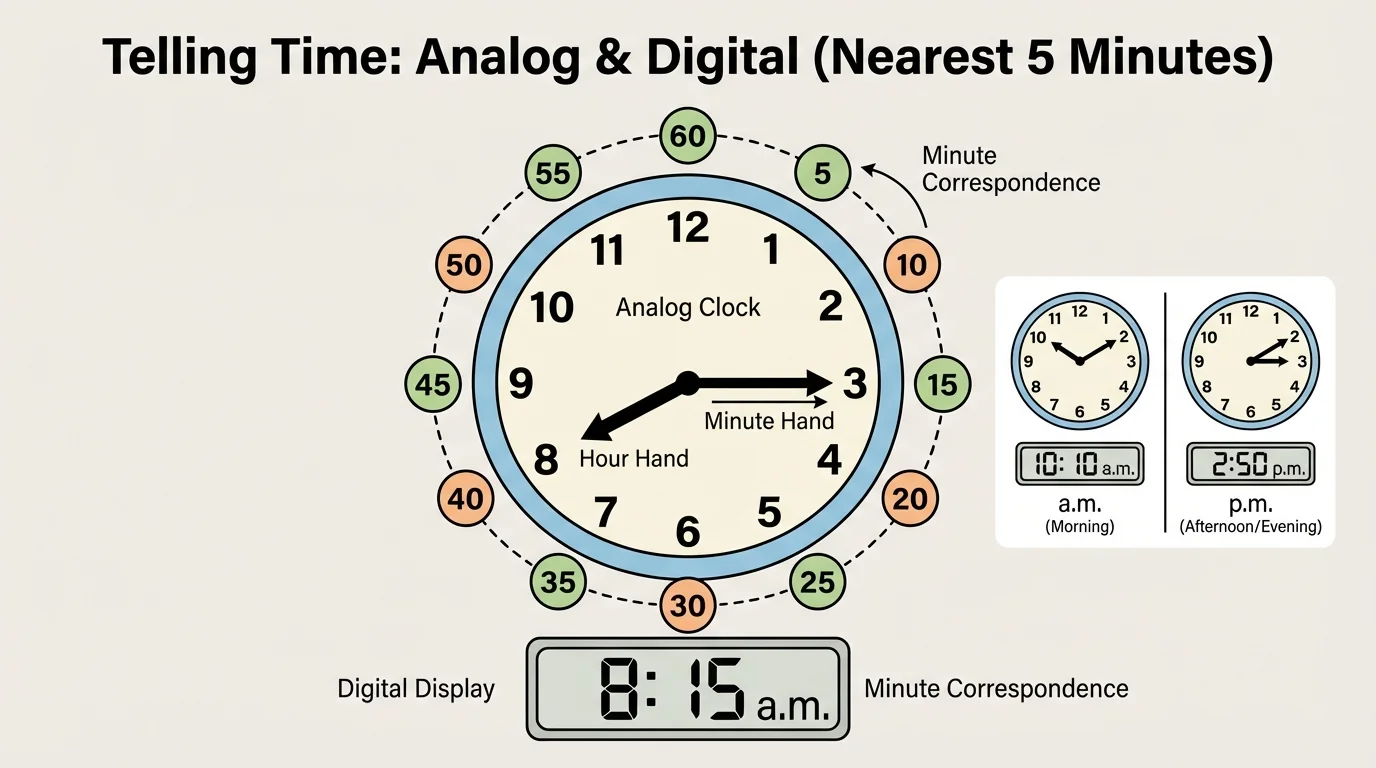
If the minute hand points to \(4\), the minutes are \(20\). If the minute hand points to \(9\), the minutes are \(45\). If it points to \(12\), the minutes are \(0\), so it is exactly on the hour.
Remember how to skip-count: \(5, 10, 15, 20, 25, 30, 35, 40, 45, 50, 55, 60\). That same counting pattern helps you read the minute hand.
Many students say the clock number instead of the minute number. For example, if the minute hand points to \(8\), the minutes are not \(8\). They are \(40\), because \(8 \times 5 = 40\).
To read an analog clock to the nearest five minutes, use two steps. First, look at the hour hand. Second, look at the minute hand. The hour hand tells the hour that has already started. The minute hand tells how many minutes have passed since that hour began.
If the hour hand is between \(2\) and \(3\), the hour is \(2\), not \(3\), unless it is exactly at \(3\). Then use the minute hand to find the minutes. For example, if the minute hand points to \(6\), the time is \(2{:}30\).
You can also say times in words. Here are some common ways:
When we say past, we are talking about minutes after the hour. When we say to, we are talking about minutes before the next hour. For example, \(3{:}50\) can be read as fifty minutes past three or ten minutes to four.
The same time can be shown on an analog clock, in digital form, and in words. If the hour hand is just past \(7\) and the minute hand points to \(5\), the digital time is \(7{:}25\). In words, we can write twenty-five past seven.
Digital clocks always use two digits for the minutes. So we write \(6{:}05\), not \(6{:}5\). The zero is important because it shows there are \(5\) minutes, not \(50\) minutes.
Three ways to show one time
A single time can be shown by clock hands, by numbers, or by words. Being able to move between these forms helps you understand schedules and written times. For example, an analog clock might show \(9{:}15\), a digital clock writes \(9{:}15\), and in words we say quarter past nine.
As we saw with the minute pattern in [Figure 2], every jump to the next number adds \(5\) more minutes. That is why \(2\) means \(10\) minutes and \(11\) means \(55\) minutes.
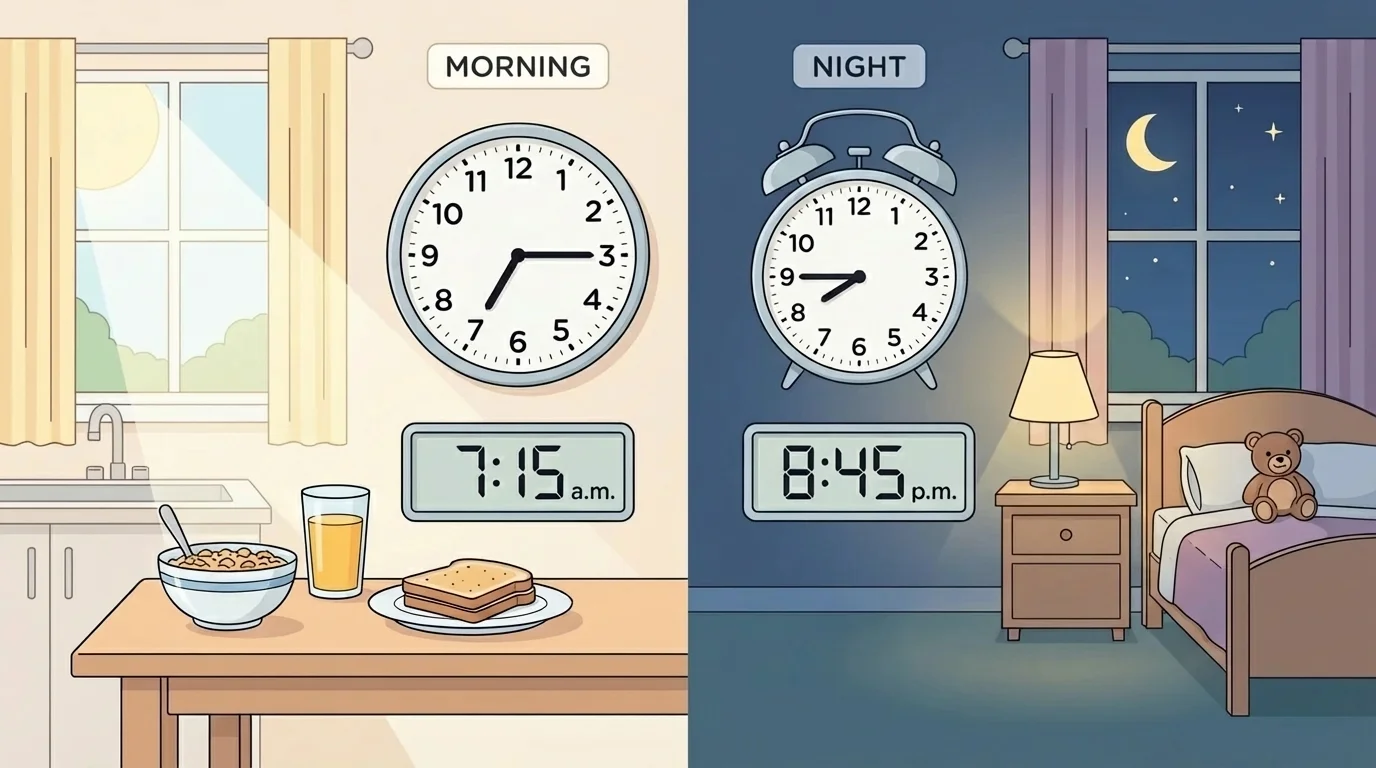
A full day has morning, afternoon, evening, and night. We use [Figure 3] to help think about when events happen during the day. a.m. means the time from midnight to noon. Morning times, like \(7{:}00\) in the morning, are a.m. p.m. means the time from noon to midnight. Afternoon and evening times, like \(3{:}30\) in the afternoon, are p.m.
Here are examples: waking up at \(6{:}45\) is usually a.m. Eating lunch at \(12{:}15\) is p.m. Going to bed at \(8{:}00\) is usually p.m. The same clock numbers can mean different parts of the day, so the a.m. or p.m. label is important.
Noon is \(12{:}00\) p.m. Midnight is \(12{:}00\) a.m. These two special times can be tricky, so it helps to remember: noon is in the middle of the day, and midnight is in the middle of the night.
Many digital clocks at home, in cars, and on microwaves use the same hour and minute ideas as analog clocks. Even though they look different, both kinds of clocks tell the same time.
Later, when you read a daily schedule, the scenes in [Figure 3] help you choose whether a time belongs in the morning or later in the day.
Let us work through some examples step by step.
Example 1
An analog clock has the hour hand between \(4\) and \(5\). The minute hand points to \(3\). What time is it?
Step 1: Find the hour.
The hour hand is between \(4\) and \(5\), so the hour is \(4\).
Step 2: Find the minutes.
The minute hand points to \(3\). Counting by fives gives \(15\) minutes.
Step 3: Write the time.
The time is \(4{:}15\).
In words, this is quarter past four.
This example shows why we read the hour hand first. Even when the minute hand moves farther around the clock, the hour is still the number the short hand has passed.
Example 2
A digital clock shows \(7{:}35\). How can you describe this time on an analog clock and in words?
Step 1: Read the hour.
The hour is \(7\).
Step 2: Read the minutes.
The minutes are \(35\). On an analog clock, the minute hand points to \(7\) because \(7 \times 5 = 35\).
Step 3: Write it in words.
\(7{:}35\) is thirty-five past seven. It can also be called twenty-five to eight.
The analog clock would have the hour hand between \(7\) and \(8\), and the minute hand on \(7\).
Notice that the minute hand on \(7\) does not mean \(7\) minutes. It means \(35\) minutes. That skip-counting idea keeps coming back.
Example 3
You eat breakfast at \(8{:}05\). Should the time be labeled a.m. or p.m.?
Step 1: Think about the event.
Breakfast usually happens in the morning.
Step 2: Choose the correct label.
Morning times use a.m.
Step 3: Write the full time.
The full time is \(8{:}05\) a.m.
This is five past eight in the morning.
Choosing between a.m. and p.m. depends on what is happening and what part of the day it is.
Example 4
The minute hand points to \(11\), and the hour hand is between \(1\) and \(2\). What time is it?
Step 1: Read the hour.
The hour hand is between \(1\) and \(2\), so the hour is \(1\).
Step 2: Read the minutes.
The minute hand points to \(11\), which means \(55\) minutes.
Step 3: Write the answer.
The time is \(1{:}55\).
In words, this can be said as five to two.
Time helps people follow schedules. School might begin at \(8{:}00\) a.m., recess might be at \(10{:}30\) a.m., and dinner might be at \(6{:}00\) p.m. When you read time correctly, you can understand what happens next in your day.
Cooks use time when baking. Athletes use time during games and practice. Doctors use time for appointments. Families use time for alarms, bedtime, and travel. A digital clock on an oven and an analog clock on a wall both help people stay on track.
One common mistake is mixing up the hour hand and the minute hand. Remember, the short hand tells the hour and the long hand tells the minutes, as shown earlier in [Figure 1].
Another mistake is reading the hour as the number the hour hand is going toward instead of the number it has passed. If the hour hand is between \(5\) and \(6\), the hour is still \(5\).
A third mistake is forgetting the zero in times like \(2{:}05\). The zero matters. It tells you there are only \(5\) minutes after the hour.
A fourth mistake is choosing the wrong a.m. or p.m. Think about the event: is it in the morning, afternoon, or evening? That clue helps you decide.
