Have you ever held a few coins in your hand and wondered, "Do I have enough to buy this?" That is a math question people answer every day. When you buy a snack, save coins in a jar, or count money at a store, you use money math. Learning how to solve word problems with money helps you make good choices and understand what amounts mean.
In the United States, we use bills and coins. A dollar bill is worth $1. A quarter is worth 25¢. A dime is worth 10¢. A nickel is worth 5¢. A penny is worth 1¢.
[Figure 1] Money can be counted in cents or in dollars. One dollar is the same as 100 cents. That means if you have coins with a total value of 100 cents, you have one dollar.
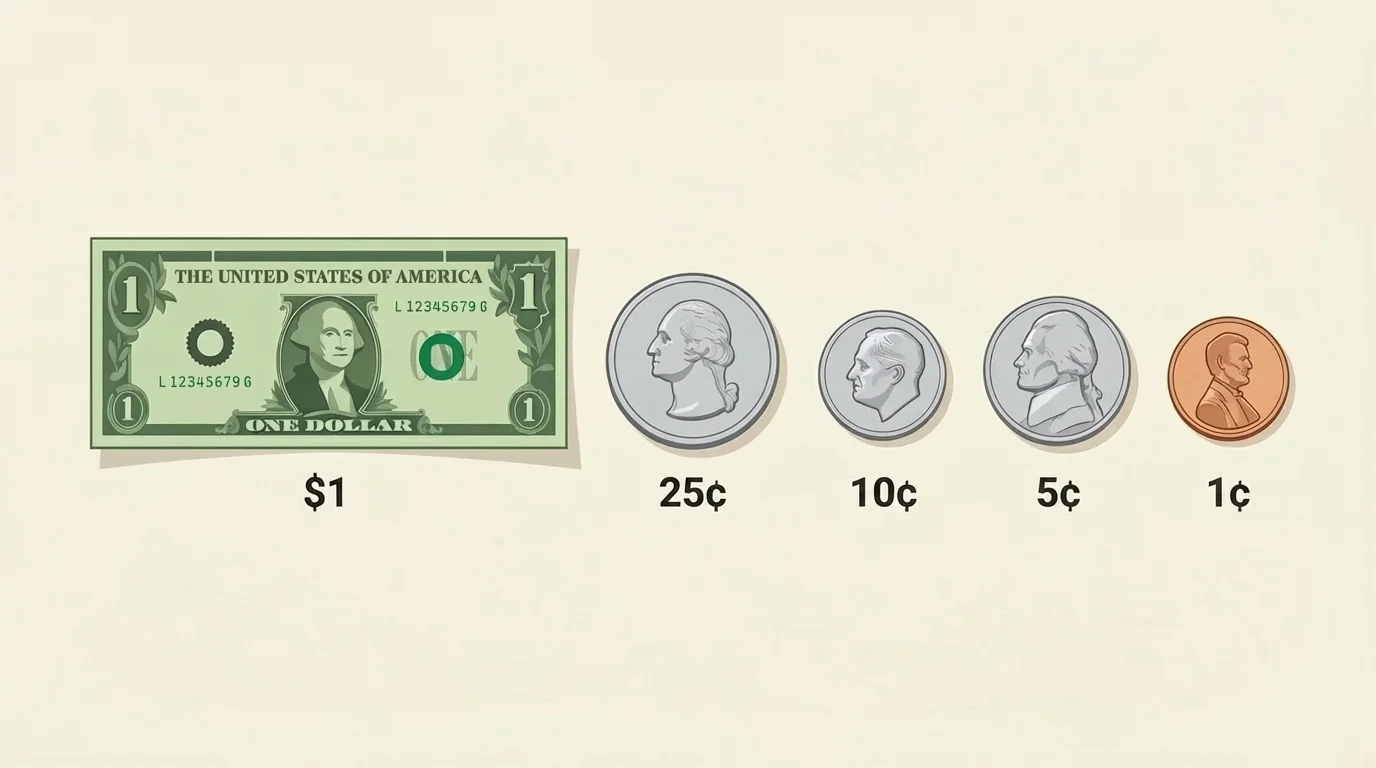
It is helpful to remember coin values by heart. A quarter has the greatest value among the coins in this lesson, even though it is not the largest coin in size. A dime is small, but it is worth 10¢. That can feel surprising at first.
You already know how to add and subtract whole numbers. Money problems use those same skills. The new part is paying attention to what each coin or bill is worth.
When you count the same kind of coin, you can skip count. For example, skip-count by quarters: 25, 50, 75, 100. That means 4 quarters make $1.
Money has special symbols. The cent sign is used for amounts less than one dollar, like 7¢ or 45¢. The dollar sign is used for one dollar or more, like $1 or $3.
[Figure 2] Sometimes money is written with dollars and cents together. We write the amount using a decimal point. For example, one dollar and twenty-five cents is written as $1.25. Two dollars and seven cents is written as $2.07. The two digits after the decimal point show the cents.
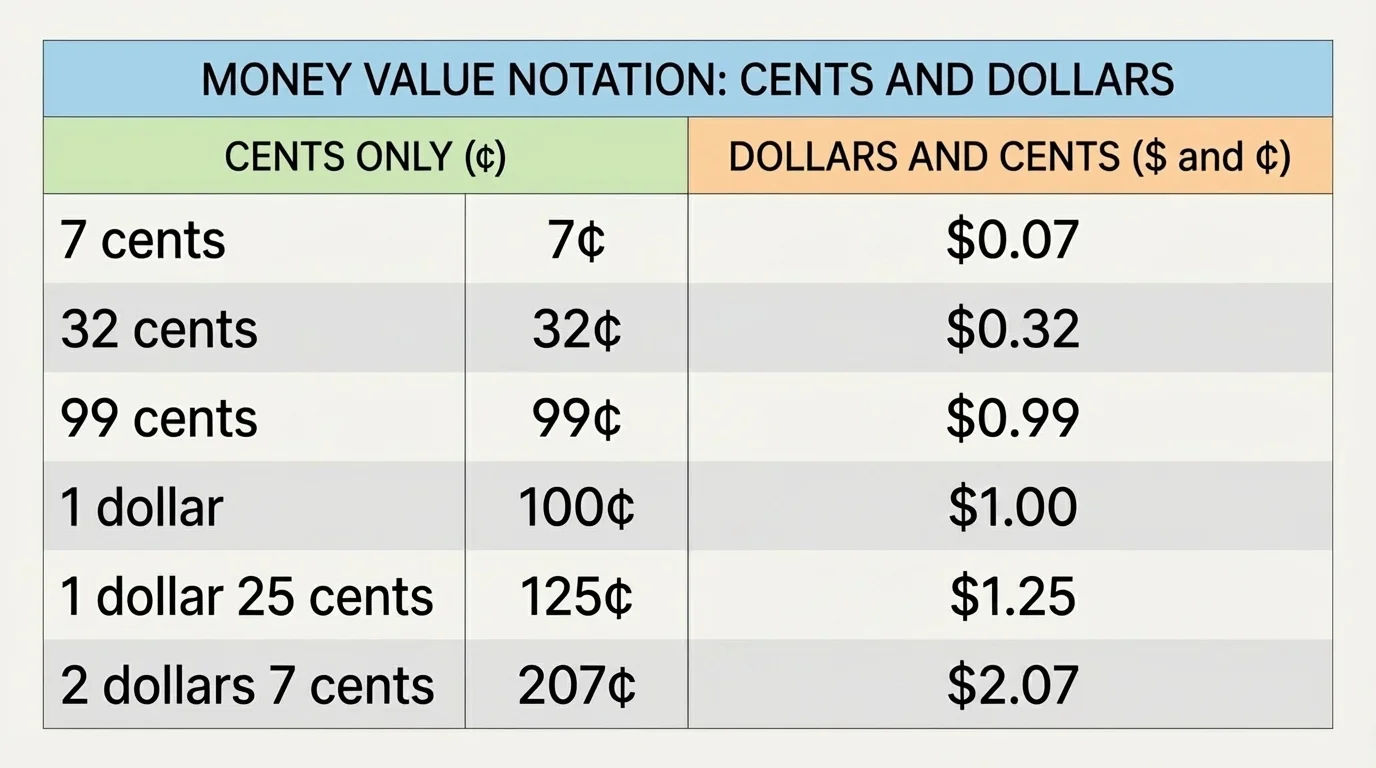
Be careful when writing cents. We do not write $25 when we mean 25¢. $25 means twenty-five dollars, which is much more money. The symbol matters.
Money amount means how much money there is. It can be written in cents, in dollars, or in dollars and cents together.
Total means the whole amount after you add everything together.
When you read a word problem, look closely at the label. If the amount is less than one dollar, you may answer in cents. If a problem uses dollars and cents together, write the answer the same way.
You can count coins in groups. Start with the coins that are worth the most. Then add the smaller values. This helps you stay organized and avoid mistakes.
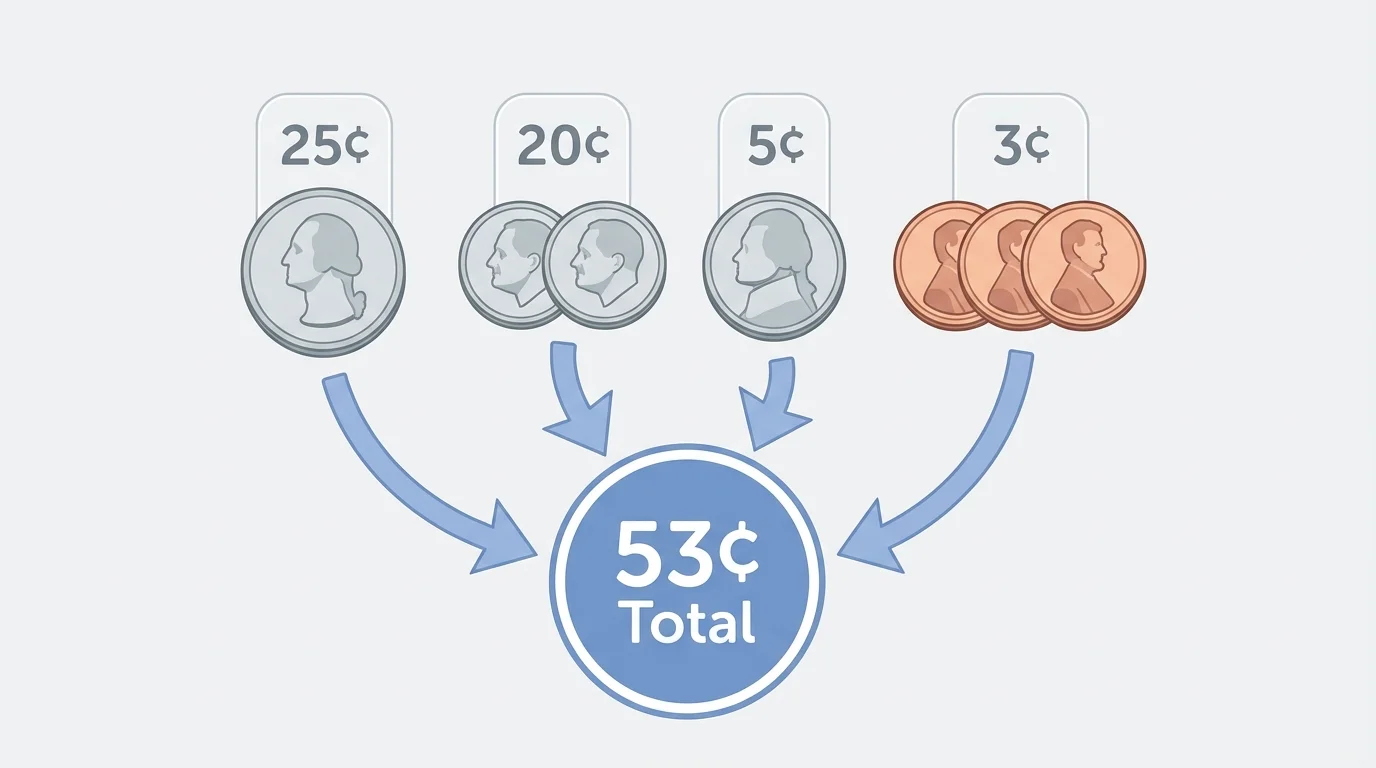
[Figure 3] Suppose you have one quarter, two dimes, one nickel, and three pennies. Count them like this: 25¢ for the quarter, then add 20¢ for the two dimes, then 5¢, then 3¢. The total is 53¢ because \(25 + 20 + 5 + 3 = 53\).
You can also combine bills and coins. If you have one dollar bill and two quarters, you have $1.50. The dollar bill is worth $1, and the two quarters are worth 50¢. Together that is one dollar and fifty cents.
Start with the greatest value
When counting mixed coins, begin with the coin or bill worth the most. This keeps your work neat. For example, count quarters first, then dimes, then nickels, then pennies.
Later, when you solve longer word problems, the same idea from [Figure 3] still helps: break the money into parts, find the value of each part, and then put the parts together.
Money word problems usually ask you to find a total, find how much more is needed, or find how much is left. A simple plan works well.
Step 1: Read the problem carefully.
Step 2: Find the money amounts in the story.
Step 3: Decide whether to add or subtract.
Step 4: Solve and write the answer with the correct symbol.
If the story asks, "How much altogether?" you usually add. If it asks, "How much left?" or "How much more?" you usually subtract.
Many cashiers and shoppers use mental math with money all day long. Fast money math helps people check prices and make sure they get the right change.
Always think about what the question is asking. Sometimes students add when they should subtract just because they see many numbers. The words in the story tell you what to do.
Now let's solve some money word problems step by step.
Example 1
Mia has 2 quarters and 3 dimes. How much money does she have?
Step 1: Find the value of each group.
2 quarters are worth \(25 + 25 = 50\) cents.
3 dimes are worth \(10 + 10 + 10 = 30\) cents.
Step 2: Add the amounts.
\(50 + 30 = 80\)
Step 3: Write the answer with the correct symbol.
She has 80¢.
This answer is written in cents because the total is less than one dollar.
Example 2
Leo has a one-dollar bill and one quarter. He wants to buy a toy that costs 95¢. Does he have enough money?
Step 1: Find how much money Leo has.
A one-dollar bill is $1. One quarter is 25¢.
Together he has $1.25.
Step 2: Compare his money to the cost.
$1.25 is more than 95¢.
Step 3: Answer the question.
Yes, he has enough money.
You can also think of this problem in cents. $1.25 is the same as 125¢, and \(125 > 95\).
Example 3
A sticker costs 67¢. Nora has 75¢. How much money will she have left after she buys the sticker?
Step 1: Decide which operation to use.
The words "have left" tell us to subtract.
Step 2: Subtract the cost from the amount she has.
\(75 - 67 = 8\)
Step 3: Write the answer with the correct symbol.
She will have 8¢ left.
This makes sense because 67¢ is close to 70¢, and 75¢ minus about 70¢ is about 5¢. An answer of 8¢ is reasonable.
Example 4
Sam buys a juice for 45¢ and a pencil for 30¢. How much does he spend altogether?
Step 1: Find what the question asks.
The words "in all" tell us to add.
Step 2: Add the amounts.
\(45 + 30 = 75\)
Step 3: Label the answer.
Sam spends 75¢.
When two prices are both in cents, add the cents and keep the answer in cents if the total is less than one dollar.
It is smart to check whether your answer makes sense. You can estimate by using friendly numbers. For example, 67¢ is close to 70¢, and 45¢ is close to 50¢. Estimates help you notice mistakes.
If a toy costs 32¢ and a student says the total for two toys is 90¢, that should sound too high. Since \(32 + 32 = 64\), the answer should be close to 64¢, not 90¢.
Reasonable answers
A reasonable answer is an answer that makes sense for the problem. If your answer is much too big or much too small, go back and check your work.
You can also check by reading the story again. Ask yourself, "Did I answer the question?" and "Did I use $ or ¢ correctly?"
Money math is part of everyday life. People use it when buying lunch, shopping for school supplies, saving allowance, or counting change after a purchase.
Suppose you have $2 and want to buy an eraser for 35¢ and a notebook for $1.20. First find the total cost. The notebook costs one dollar and twenty cents, and the eraser costs thirty-five cents. Together, the cost is $1.55. Since $2 is more than $1.55, you have enough money.
The same ideas from [Figure 1] and [Figure 3] help in real stores: know each coin's value, count carefully, and combine amounts step by step.
| Coin or bill | Value | How to write it |
|---|---|---|
| Dollar bill | 1 dollar | $1 |
| Quarter | 25 cents | 25¢ |
| Dime | 10 cents | 10¢ |
| Nickel | 5 cents | 5¢ |
| Penny | 1 cent | 1¢ |
Table 1. Values and symbols for the money pieces used in this lesson.
As you become more confident with money word problems, you will get faster at deciding whether to add or subtract. You will also get better at writing money correctly.
