Have you ever noticed that a window, a slice of pizza, a floor tile, and a toy block can all teach you geometry? Shapes are everywhere. Some shapes are flat, like a drawing on paper. Some shapes are solid, like a box you can hold. When we study shapes, we look for special clues called attributes. These clues help us tell one shape from another.
A shape is a figure with parts we can describe. Flat shapes have sides and corners. A side is a straight line part. A corner is where two sides meet. In geometry, a corner is also called an angle.
Side means a straight edge of a flat shape. Angle means the corner made where two sides meet. Face means a flat surface on a solid shape.
When we count sides and angles, we can name many flat shapes. For these shapes, the number of sides and the number of angles are the same. A shape with \(3\) sides also has \(3\) angles. A shape with \(4\) sides also has \(4\) angles.
Some shapes are flat, like a triangle drawn on paper. Some shapes are solid, like a cube made from blocks. Flat shapes are also called polygons when they are closed and made only of straight sides. A solid shape takes up space.
A closed shape has no gaps. If the lines do not connect all the way around, it is not a closed shape. To name the shapes in this lesson, we look for closed shapes with straight sides.
Curved shapes, like circles, are important too, but this lesson focuses on shapes with straight sides and on cubes. As [Figure 1] shows, we will pay close attention to the number of sides, angles, and faces.
One smart way to sort shapes is to count their corners. If a shape has \(3\) angles, it belongs in one group. If it has \(4\) angles, it belongs in another. This works because the number of angles tells us what kind of shape it is.
A shape with \(3\) sides and \(3\) angles is a triangle. A shape with \(4\) sides and \(4\) angles is a quadrilateral. A shape with \(5\) sides and \(5\) angles is a pentagon. A shape with \(6\) sides and \(6\) angles is a hexagon.
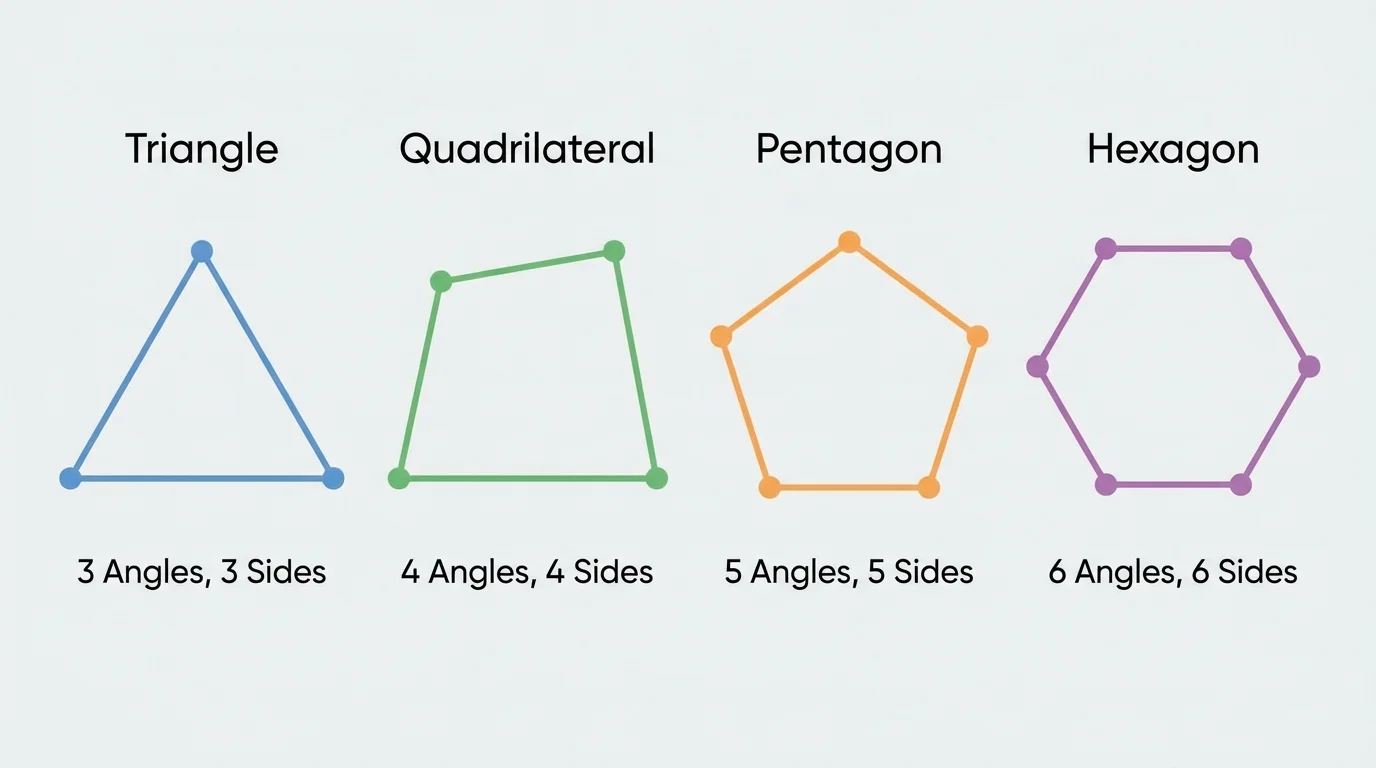
You do not have to memorize a shape by how it "usually" looks. A triangle can be tall, wide, or slanted. A quadrilateral can look like a square, a rectangle, or another four-sided shape. What matters most is the attributes you can count.
| Shape name | Number of sides | Number of angles |
|---|---|---|
| Triangle | \(3\) | \(3\) |
| Quadrilateral | \(4\) | \(4\) |
| Pentagon | \(5\) | \(5\) |
| Hexagon | \(6\) | \(6\) |
Table 1. This table compares common flat shapes by their number of sides and angles.
A triangle is a closed flat shape with exactly \(3\) sides and \(3\) angles. If a shape has even one more side, it is not a triangle.
Some triangles look very different from each other. One triangle may have all sides the same length. Another may have sides of different lengths. One may point up. Another may lean to the side. They are all triangles if they have \(3\) straight sides and \(3\) angles.
Same family, different look
Shapes can belong to the same family even when they do not look exactly alike. Geometry uses attributes, not just appearance. If two shapes both have \(3\) sides and \(3\) angles, both are triangles.
A slice of pizza is often shaped like a triangle. A yield sign is also a triangle. Roofs and flags may also have triangle parts.
A quadrilateral is a closed flat shape with \(4\) sides and \(4\) angles. Squares and rectangles are special kinds of quadrilaterals. So are many slanted four-sided shapes.
A pentagon has \(5\) sides and \(5\) angles. A hexagon has \(6\) sides and \(6\) angles. A honeycomb cell often looks like a hexagon. Many school pattern blocks include hexagons too.
As we saw earlier in [Figure 1], counting carefully helps you avoid guessing by shape appearance. If you count \(4\) corners, the shape is a quadrilateral even if it is tilted. If you count \(6\) corners, the shape is a hexagon even if it is stretched.
Honeybees often build wax cells that look like hexagons. The \(6\)-sided shape fits together with other hexagons without leaving gaps.
As [Figure 2] shows, a cube is different from the flat shapes above because it is a solid shape you can hold. A cube has faces instead of just sides. Each face of a cube is a square, and all of its faces are equal in size.
A cube has \(6\) faces, \(12\) edges, and \(8\) corners. In this lesson, one very important attribute is that a cube has \(6\) equal square faces. A toy block, a small gift box, or a number cube can look like a cube.
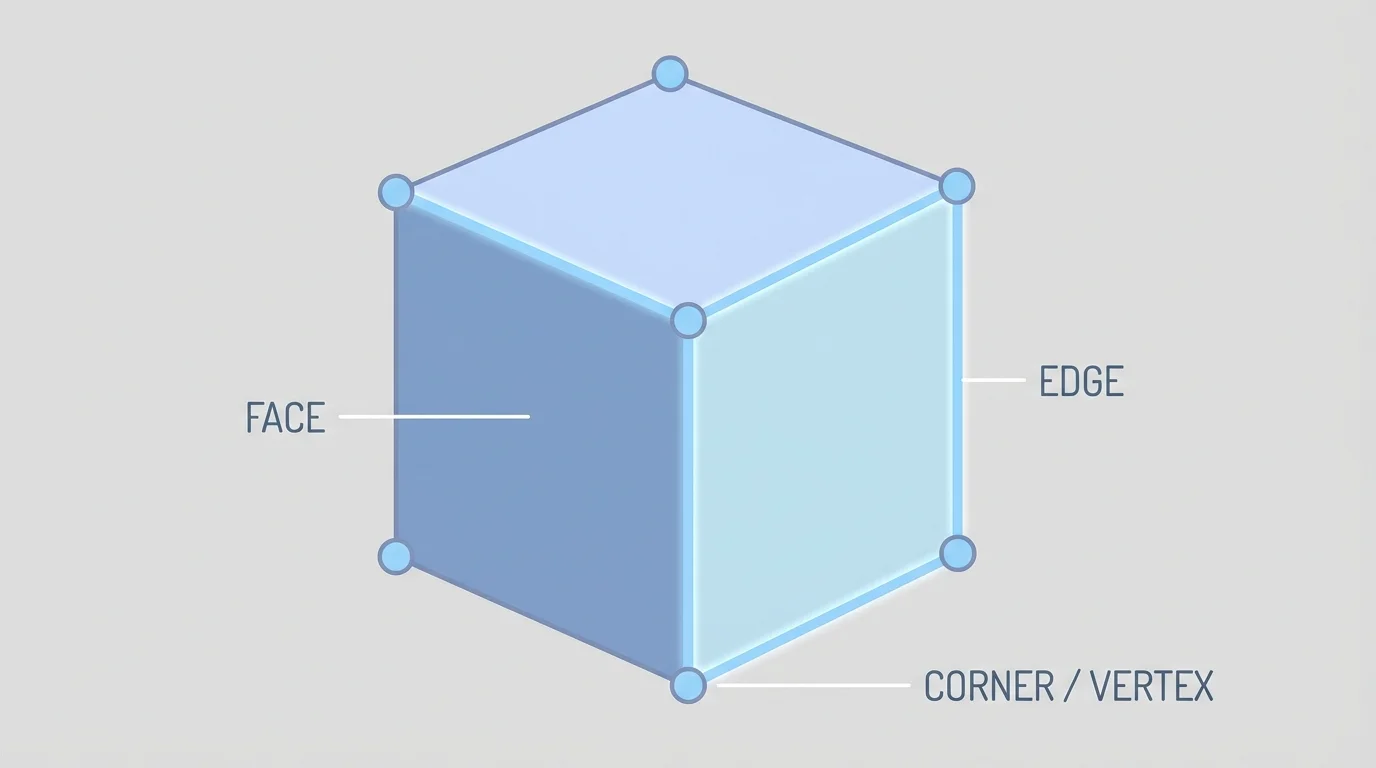
Faces are flat surfaces on solid shapes. Edges are where two faces meet. Corners are where edges meet. Cubes are special because every face matches every other face.
Flat shapes and solid shapes
Flat shapes, such as triangles and hexagons, lie on a flat surface. Solid shapes, such as cubes, have length, width, and height. That is why a cube has faces, while a triangle has sides.
Later, when you sort shapes by attributes, a clue like "has \(6\) equal faces" tells you to think about a cube, not a flat polygon.
As [Figure 3] illustrates, an attribute is a feature you can notice and describe. Shapes can be recognized by clues such as "has \(3\) angles," "has \(5\) sides," or "has \(6\) equal square faces."
When you are given an attribute, do not guess right away. First, ask what to count. If the clue is about angles, count corners. If the clue is about faces, think about a solid shape. Then match the count to the shape name.
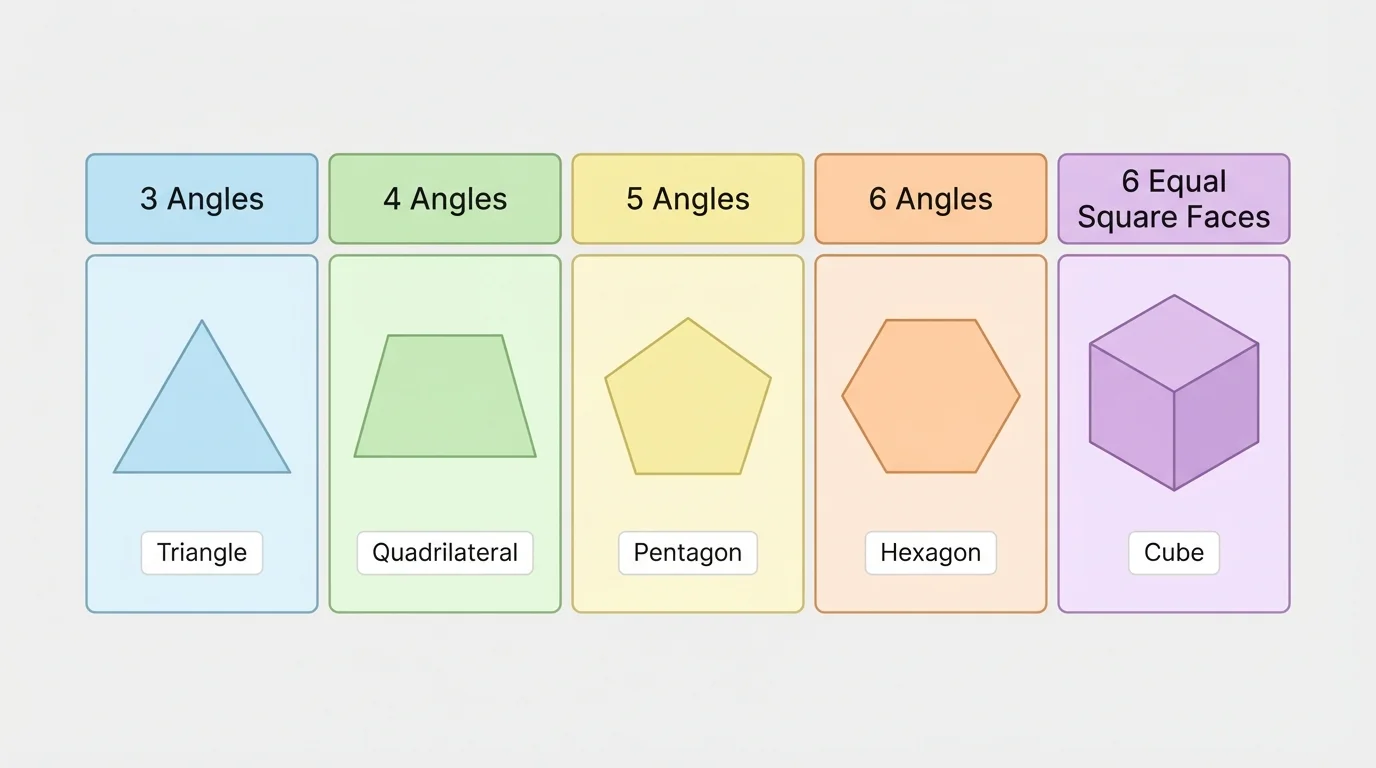
For example, if a shape has \(3\) angles, it is a triangle. If a shape has \(4\) angles, it is a quadrilateral. If a shape has \(5\) angles, it is a pentagon. If a shape has \(6\) angles, it is a hexagon. If a solid has \(6\) equal square faces, it is a cube.
This kind of thinking helps when you draw shapes too. If someone says, "Draw a shape with \(5\) angles," you know you need to draw a pentagon. If someone says, "Draw a shape with \(4\) angles," you can draw any quadrilateral that closes all the way.
Let's use shape attributes step by step.
Worked example 1
A shape has \(3\) sides and \(3\) angles. What shape is it?
Step 1: Look at the attribute.
The shape has \(3\) sides and \(3\) angles.
Step 2: Match the number to the shape family.
Shapes with \(3\) sides and \(3\) angles are triangles.
Step 3: State the answer.
The shape is a triangle.
Notice that we did not need to know whether the triangle was tall, short, or slanted. The count of \(3\) told us the answer.
Worked example 2
Draw a shape with \(4\) angles.
Step 1: Find the shape name from the attribute.
A shape with \(4\) angles is a quadrilateral.
Step 2: Choose one quadrilateral to draw.
You could draw a square, a rectangle, or another closed shape with \(4\) straight sides.
Step 3: Check the drawing.
Count the angles: \(1, 2, 3, 4\). Count the sides: \(1, 2, 3, 4\).
A correct drawing is any closed four-sided shape.
This is why geometry has more than one correct picture sometimes. Different drawings can have the same attributes.
Worked example 3
Which shape has \(6\) equal square faces: a hexagon or a cube?
Step 1: Notice the clue word faces.
Faces belong to solid shapes, not flat shapes.
Step 2: Compare the choices.
A hexagon is a flat shape with \(6\) sides. A cube is a solid shape.
Step 3: Use the full attribute.
A cube has \(6\) equal square faces.
The correct shape is a cube.
The sorting idea helps here because it separates flat shapes with angles from solid shapes with faces.
Worked example 4
A student says, "This shape is a pentagon because it looks like a house." When we count, it has \(5\) sides. Is the student correct?
Step 1: Use counting, not just appearance.
We count the sides of the shape.
Step 2: Match the count.
A shape with \(5\) sides is a pentagon.
Step 3: Decide.
Because the shape has \(5\) sides, the student is correct.
Yes, it is a pentagon.
Geometry is not only in math class. Builders notice quadrilaterals in doors and windows. Gardeners may see hexagons in honeycombs. Artists use triangles and pentagons in designs. Children stack cube-shaped blocks when they build.
A floor made of square tiles shows many quadrilaterals. A soccer ball pattern may include shapes with different numbers of sides. A box of tissues or a gift box may remind you of solid shapes. Looking for attributes in real life makes shape names easier to remember.
When you look at a boxy toy after studying [Figure 2], you can ask whether it really is a cube. Are all \(6\) faces squares? Are they equal? If yes, it is a cube. If not, it may be a different solid shape.
One common mistake is counting a curved shape as a polygon. If a shape has a curved side, it does not belong with triangles, quadrilaterals, pentagons, or hexagons in this lesson.
Another mistake is forgetting that the shape must be closed. If the lines do not connect, the figure is open, not a polygon. Also, a student may count the same corner twice or miss a corner on a slanted shape. Counting carefully matters.
As shown earlier in [Figure 1], shape families are based on attributes. A stretched hexagon is still a hexagon if it has \(6\) sides and \(6\) angles. A tilted quadrilateral is still a quadrilateral if it has \(4\) sides and \(4\) angles.
