Have you ever looked at a tiled floor and noticed that it is like a giant counting puzzle? A big rectangle can be split into small equal squares, and instead of counting one square at a time very slowly, we can use rows and columns to count faster. This is a smart geometry idea because it helps us see how shapes are organized.
A rectangle is a two-dimensional shape with four sides and four corners. A rectangle has opposite sides that are equal in length. A square is a special rectangle with four equal sides. In this lesson, we take a rectangle and break it into smaller squares that are all the same size.
A rectangle can be split into equal squares to make a neat pattern. The little squares line up in rows and columns. A row goes across. A column goes up and down. If the squares are all the same size, the rectangle looks like a grid.
Row means a line of squares going across.
Column means a line of squares going up and down.
Partition means to split a shape into parts.
Equal squares means all the little squares are the same size.
We do not want random pieces. We want the rectangle divided carefully so every little part is a square, and every square matches the others. That is what makes counting by rows and columns work so well.
When we partition a rectangle into same-size squares, we draw straight lines to make equal rows and equal columns. If one square is bigger or smaller than the others, the pattern is not made of same-size squares anymore.
Suppose a rectangle is split into \(3\) rows and \(4\) columns. That means there are \(3\) rows, and each row has \(4\) squares. Each space where a row and a column meet is one square.
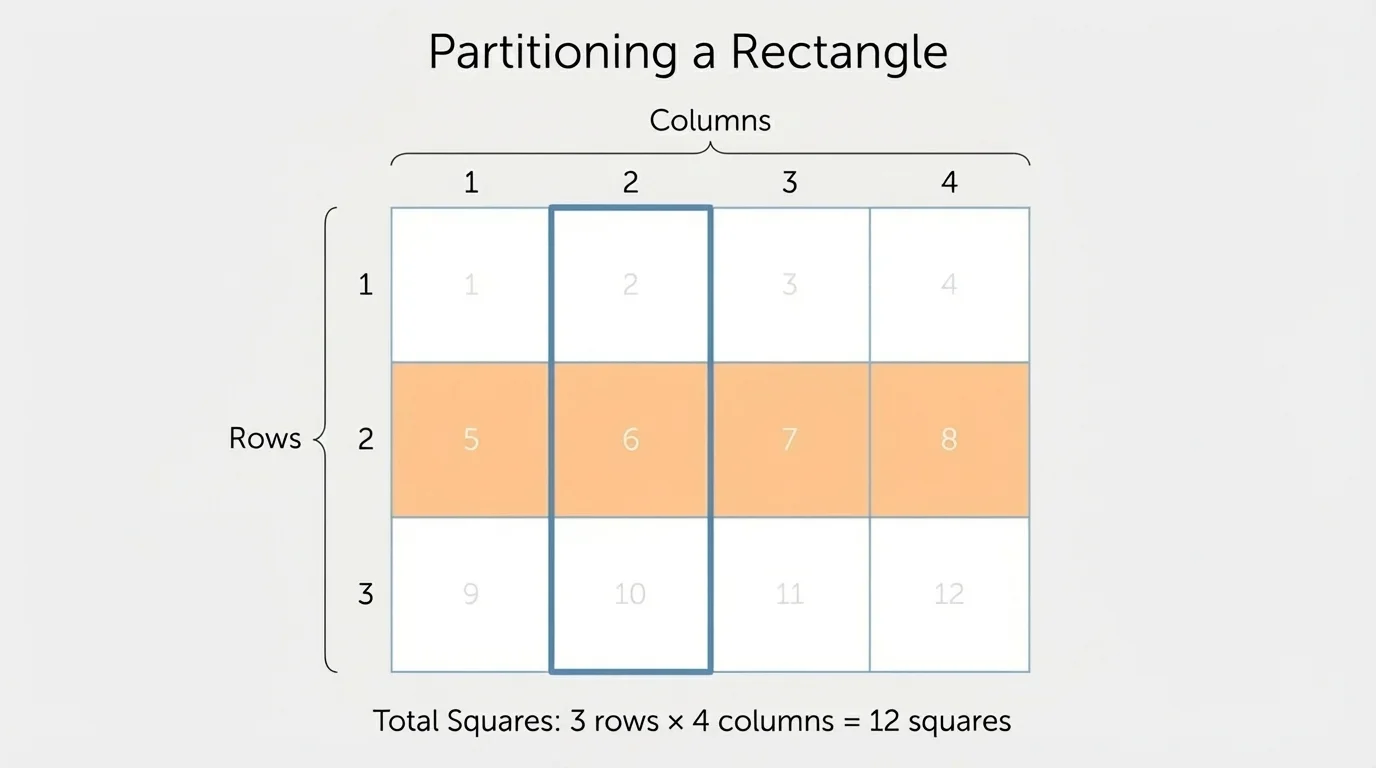
You can think of the rectangle as an array of squares. Arrays are neat arrangements in rows and columns. If the rectangle has equal squares, then each row has the same number of squares, and each column has the same number of squares.
To count objects in equal groups, you may already know how to skip-count or use repeated addition. Rows and columns help us use those same ideas with shapes.
For example, if every row has 4 squares and there are 3 rows, we can count 4, 8, 12. So the total is 12 squares. Written in math, that is \(4 + 4 + 4 = 12\).
One rectangle can be counted in more than one way. We can count by rows or count by columns, and both ways give the same total number of squares.
If a rectangle has \(2\) rows and \(5\) columns, then each row has \(5\) squares. Counting by rows gives \(5 + 5 = 10\). We can also count by columns. Each column has \(2\) squares, and there are \(5\) columns, so \(2 + 2 + 2 + 2 + 2 = 10\).
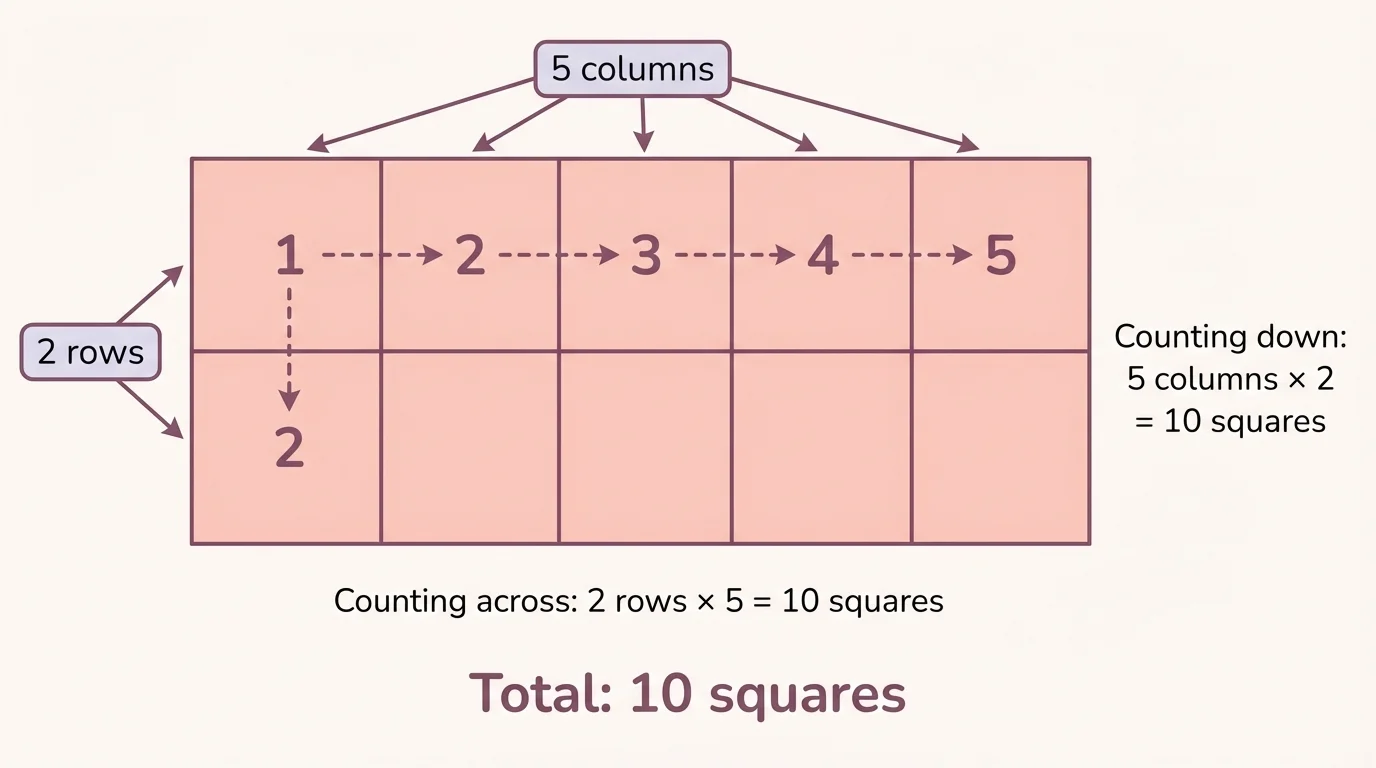
This is useful because sometimes one way is easier to see than the other. If there are only a few rows, counting by rows may be easier. If there are only a few columns, counting by columns may be easier.
We can write the total number of squares as:
\[\textrm{number of rows} \times \textrm{number of columns} = \textrm{total number of squares}\]
You can think of this as equal groups. Rows tell us how many groups there are, and columns tell us how many squares are in each group.
Why rows and columns help
Counting one square at a time works, but it can be slow. Rows and columns organize the squares into equal groups. Equal groups are easier to count because we can use repeated addition such as \(3 + 3 + 3 + 3\) instead of counting every square one by one.
Look back at [Figure 1]. The equal spacing is what makes the counting trustworthy. Every small square stands for one square unit in the grid, so none should be stretched or squished.
Now let us solve some examples step by step.
Example 1
A rectangle is split into 2 rows and 3 columns. How many same-size squares are there?
Step 1: Find the number of squares in one row.
Each row has \(3\) squares.
Step 2: Count the rows.
There are \(2\) rows.
Step 3: Add the squares in the rows.
\(3 + 3 = 6\)
The rectangle has \(6\) same-size squares.
This means the whole rectangle is made of 6 equal little squares.
Example 2
A rectangle is split into 4 rows and 2 columns. How many same-size squares are there?
Step 1: Look at one row.
Each row has \(2\) squares.
Step 2: Count how many rows there are.
There are \(4\) rows.
Step 3: Use repeated addition.
\(2 + 2 + 2 + 2 = 8\)
The rectangle has \(8\) same-size squares.
We can also count Example 2 by columns. There are 2 columns, and each column has 4 squares, so \(4 + 4 = 8\). The total stays the same.
Example 3
A rectangle is split into 3 rows and 5 columns. How many same-size squares are there?
Step 1: Count the columns in one row.
One row has \(5\) squares.
Step 2: Count the rows.
There are \(3\) rows.
Step 3: Add equal groups.
\(5 + 5 + 5 = 15\)
The rectangle has \(15\) same-size squares.
That is a lot faster than pointing to all 15 squares one by one.
Example 4
A rectangle has 5 rows and 5 columns. How many same-size squares are there?
Step 1: Find how many squares are in each row.
Each row has \(5\) squares.
Step 2: Count the rows.
There are \(5\) rows.
Step 3: Add the equal groups.
\(5 + 5 + 5 + 5 + 5 = 25\)
The rectangle has \(25\) same-size squares.
A 5-by-5 arrangement makes a larger square. It is still arranged in rows and columns, so the same thinking works.
Suppose you turn a paper sideways. The rectangle may look different, but the total number of equal squares does not change. A rectangle with 4 rows and 3 columns has the same total as one with 3 rows and 4 columns. In both cases, \(3 + 3 + 3 + 3 = 12\) or \(4 + 4 + 4 = 12\).
This is an important idea: rows and columns can switch places, but the whole rectangle still has the same number of little squares. Looking again at [Figure 2], counting across or down gives the same answer because the grid has not changed.
| Rows | Columns | Repeated Addition | Total Squares |
|---|---|---|---|
| \(2\) | \(3\) | \(3 + 3\) | \(6\) |
| \(3\) | \(2\) | \(2 + 2 + 2\) | \(6\) |
| \(3\) | \(4\) | \(4 + 4 + 4\) | \(12\) |
| \(4\) | \(3\) | \(3 + 3 + 3 + 3\) | \(12\) |
Table 1. Examples showing that counting by rows or columns gives the same total number of squares.
Tables like this help us notice patterns. When rows increase, the total often increases. When columns increase, the total also increases. More rows or more columns mean more squares.
Window panes, checkerboards, and graph paper all use rows and columns. They are everyday examples of rectangles split into smaller parts.
If you ever get confused, cover one row with your finger and count how many squares are in it. Then count how many rows there are. That helps you see the equal groups clearly.
Rows and columns are not just for math class. They appear in real life all around us with floor tiles. When a floor is covered with equal square tiles, the floor is a rectangle partitioned into same-size squares.
Suppose a small floor has 4 rows of tiles and 6 columns of tiles. We can find the total number of tiles by adding \(6 + 6 + 6 + 6 = 24\). So the floor uses \(24\) square tiles.
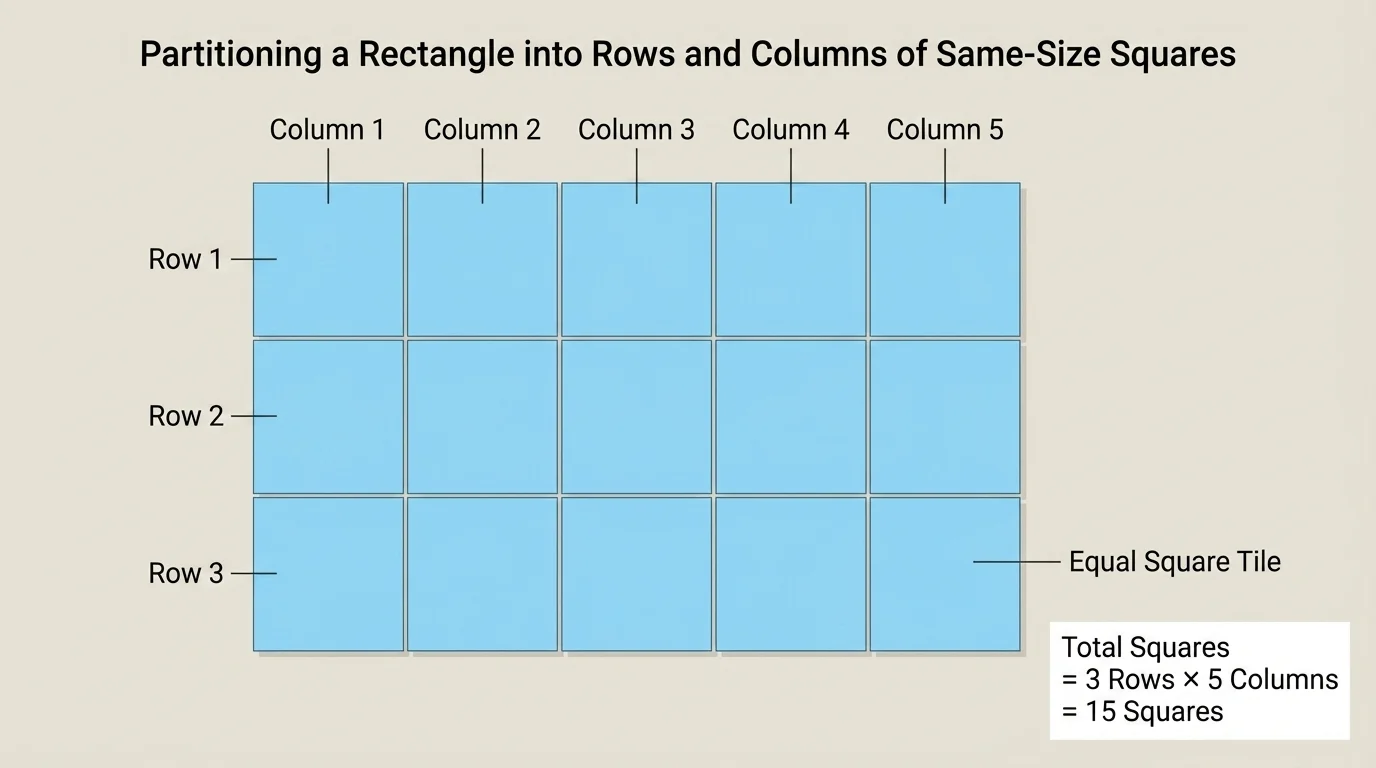
A garden bed can be marked into square sections for planting. A bulletin board can have square note spaces. A chocolate bar can be broken into square pieces lined up in rows and columns. This geometry idea helps us count quickly and accurately.
Later, when students learn more about area, these square grids become even more important. The little squares help measure how much space a rectangle covers.
One mistake is counting rows when you really mean columns. Remember: rows go across, columns go up and down.
Another mistake is using parts that are not all the same size. If the rectangle is not partitioned into equal squares, then it does not fit this lesson idea. Figure [Figure 1] stays useful here because it shows neat, equal squares lined up carefully.
A third mistake is skipping a square while counting. Touch each row or each column in order. Slow, careful counting helps.
"When shapes are organized, counting becomes easier."
That idea is exactly why rows and columns matter so much.
When a rectangle is split into same-size squares, the squares form equal rows and equal columns. To find the total number of squares, count how many are in one row and how many rows there are. You can also count how many are in one column and how many columns there are.
For example, a rectangle with 3 rows and 7 columns has \(7 + 7 + 7 = 21\) squares. A rectangle with 6 rows and 2 columns has \(2 + 2 + 2 + 2 + 2 + 2 = 12\) squares. The grid tells the story.
The more you notice rows and columns in shapes around you, the easier this becomes. Geometry helps us see order, and that order helps us count.
