Have you ever noticed that two children can share the same sandwich fairly even when the cuts look different? That is a big geometry idea. In math, we learn how to split shapes into parts that are fair and equal. Today we will look at circles and rectangles and learn how to partition them into equal shares, name the parts, and describe the whole shape using those parts.
When we talk about sharing in geometry, we are talking about a shape called a whole. A whole is one complete shape before it is split into parts. If we split that whole into parts that are the same size, we call those parts equal shares.
A equal share is one part of a shape when all the parts are the same size, as shown in [Figure 1]. The parts do not have to look exactly the same in every way, but they must be equal in amount. If one part is bigger and one part is smaller, they are not equal shares.
For example, if a rectangle is cut into two pieces and each piece covers the same amount of space, then each piece is an equal share. But if one piece is wide and the other piece is narrow, the shares are not equal. In geometry, fair sharing means equal sharing.
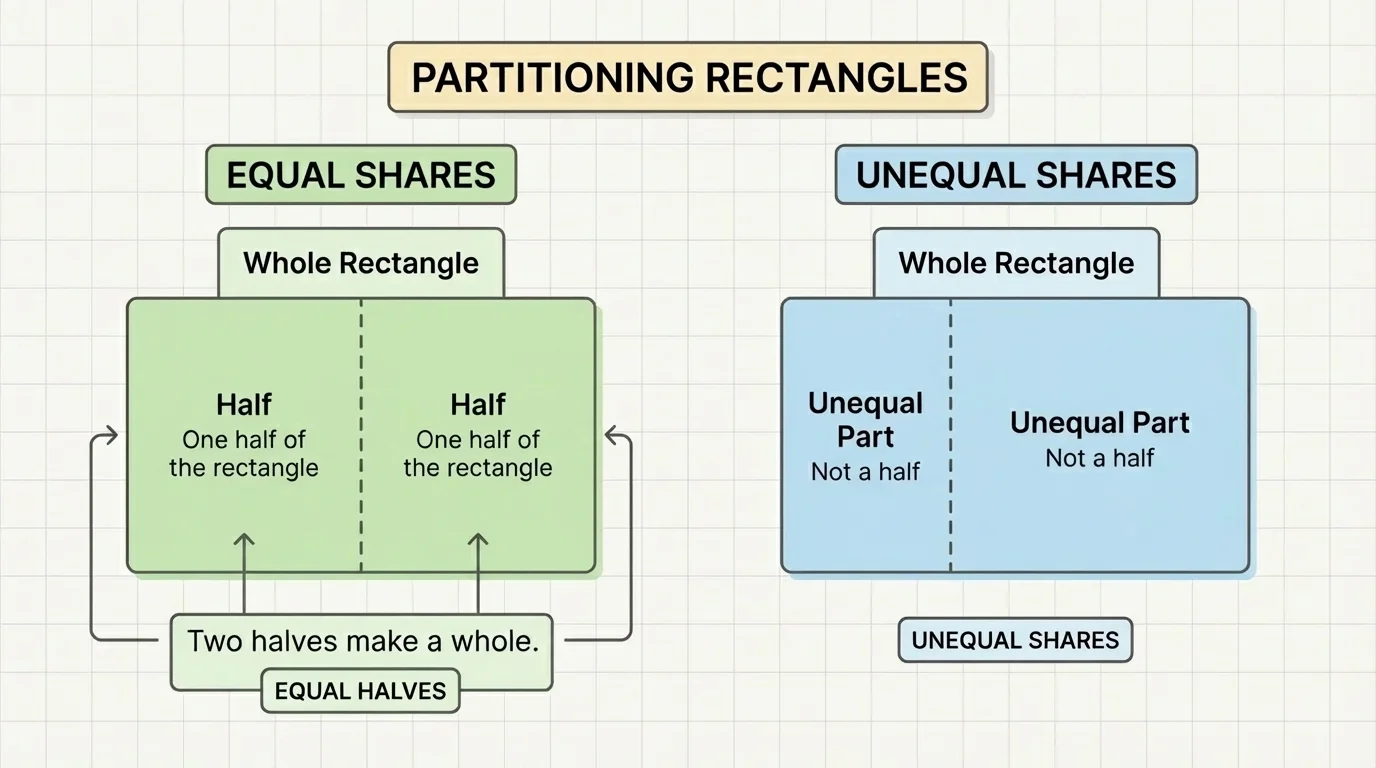
Whole means one complete shape. Equal shares are parts of a whole that are the same size. When shares are equal, each part takes up the same amount of the shape.
You can check equal shares by thinking, "Do these parts match in size?" Sometimes students only count the number of pieces. But counting pieces is not enough. A shape split into three pieces is only split into thirds if all three pieces are equal.
When one whole shape is split into two equal shares, each share is called a half. We can also say each part is one half of the whole. When one whole is split into three equal shares, each share is a third, or one third of the whole. When one whole is split into four equal shares, each share is a fourth, or one fourth of the whole, as illustrated in [Figure 2].
These names tell us how many equal parts the whole has. If there are exactly \(2\) equal parts, we say halves. If there are \(3\) equal parts, we say thirds. If there are \(4\) equal parts, we say fourths.
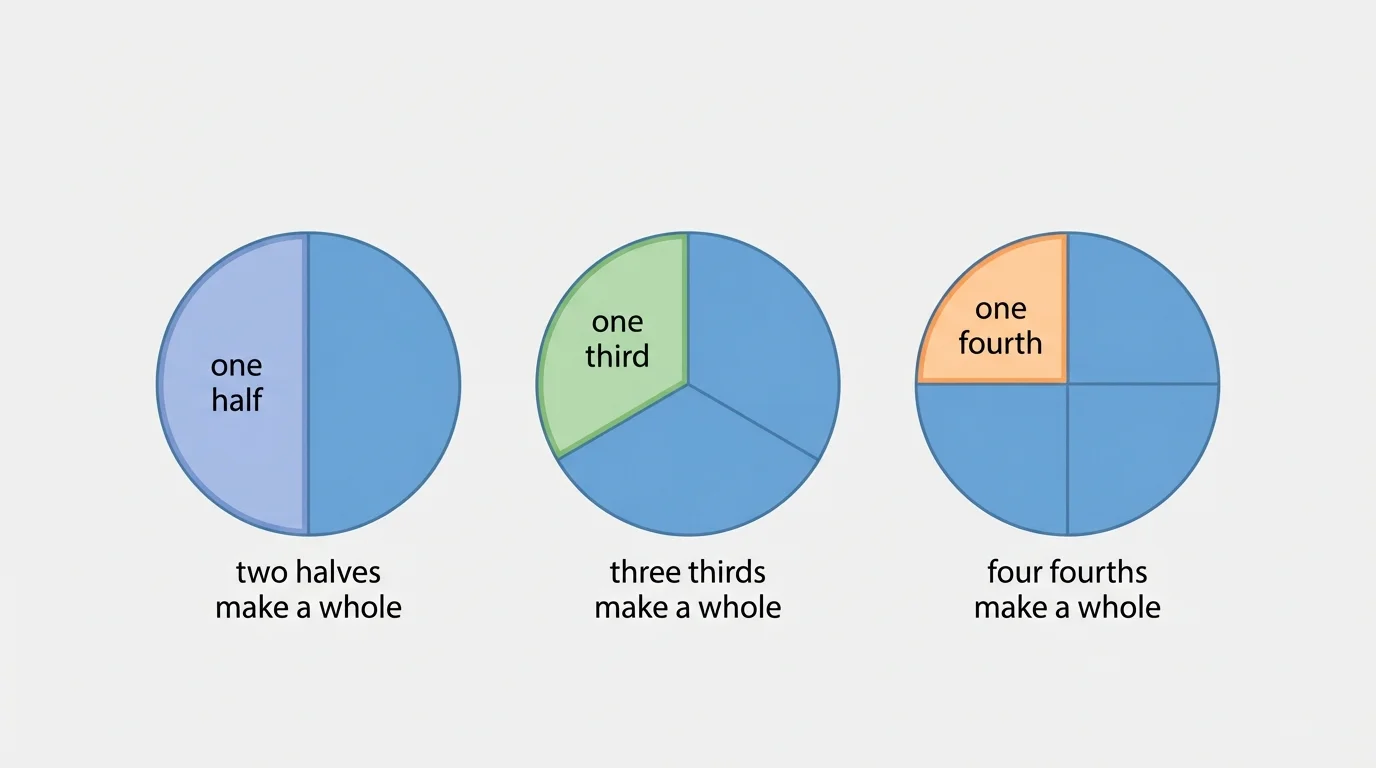
We can also use these words to describe the whole. One whole can be made of \(2\) halves. One whole can be made of \(3\) thirds. One whole can be made of \(4\) fourths. That means all the equal parts together make the complete shape again.
For example, if a circle is split into \(2\) equal parts, then the entire circle is two halves. If a rectangle is split into \(4\) equal parts, the entire rectangle is four fourths. The parts and the whole are connected.
Names of equal shares
The name of a share depends on how many equal parts make the whole. Two equal parts make halves, three equal parts make thirds, and four equal parts make fourths. If the parts are not equal, we do not use these names.
We also use these names in sentences. We might say, "This shaded part is half of the rectangle," or "This slice is a third of the pizza." The math words help us explain exactly how much of the whole we mean.
Here is an important idea: equal shares of identical wholes do not always have the same shape, as [Figure 3] shows. Two rectangles can be the same size and each can be split into four equal shares, but the shares might look different.
One rectangle might be split into four long strips. Another rectangle of the same size might be split with one vertical line and one horizontal line. In both cases, each part can still be one fourth of the whole if all four parts are equal in size.
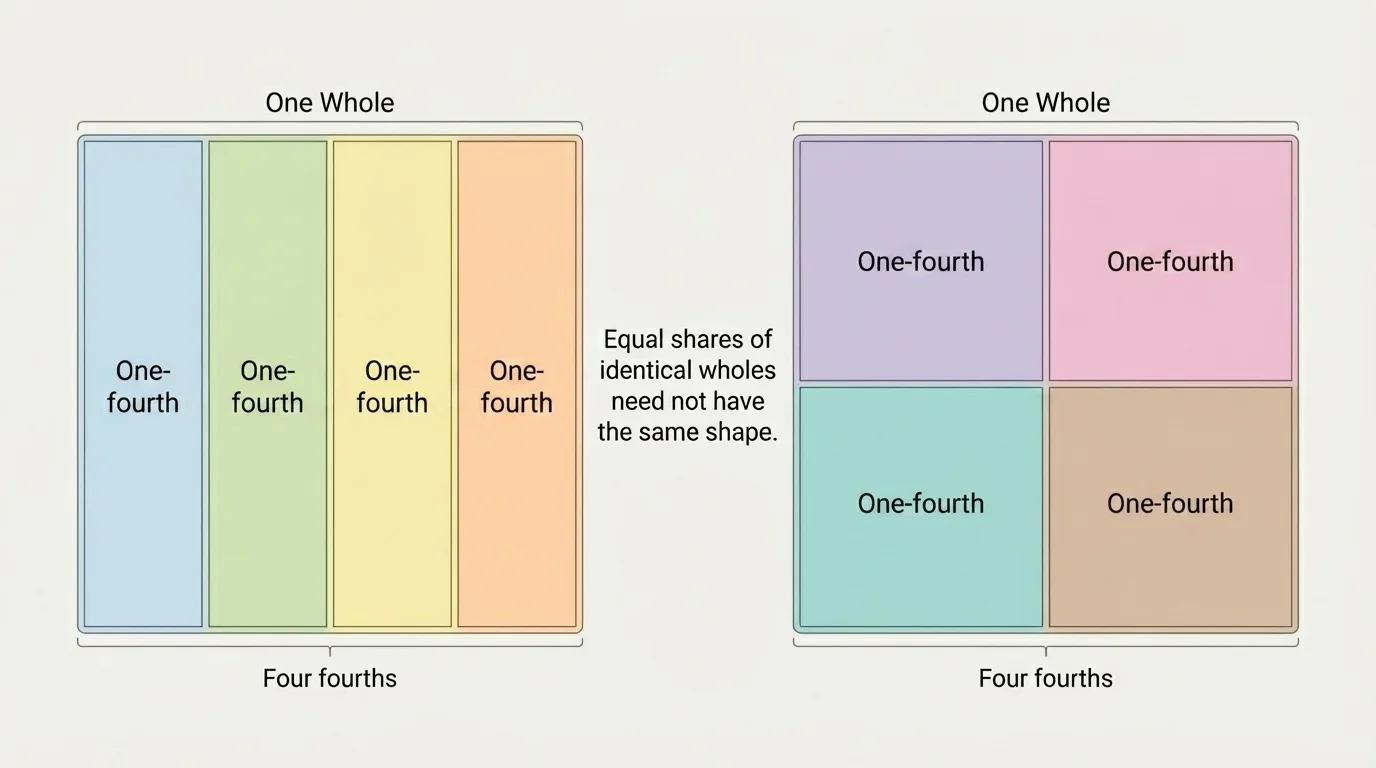
This is true for circles too. A circle can be split into two equal parts with a line down the middle, or with a line across the middle. The parts may face different directions, but if they are the same size, they are still halves.
So when you look at shares, do not ask only, "Do they have the same shape?" Ask, "Are they equal parts of the whole?" Size is what matters most.
A brownie pan, a sandwich, and a paper rectangle can all be cut into fourths in more than one way. Different-looking pieces can still be fair if each piece is the same size.
That idea is powerful because it helps us think carefully. In geometry, shapes can change form, but equal shares stay equal in amount.
There are several ways to decide if shares are equal. First, look at the whole shape. Next, count how many parts there are. Then ask if every part covers the same amount of space. If one part is larger or smaller, the shares are not equal.
Folding can help with rectangles. If a paper rectangle folds exactly so that one side matches the other side, the fold may make halves. For circles, you can think about whether each piece takes the same amount of the circle.
It also helps to use careful words. We say two equal shares, three equal shares, or four equal shares. If the shares are uneven, we should not call them halves, thirds, or fourths.
You already know that shapes can have different sizes and different sides. In this lesson, the new idea is not just naming shapes, but splitting them fairly into equal parts.
Sometimes a shape is cut into \(4\) parts, but one part is bigger than the others. Even though there are \(4\) pieces, they are not fourths. Equal number of pieces does not always mean equal shares.
Worked examples help connect the words to the pictures. In the examples below, the drawings match language like a third of and four fourths.
Example 1
A circle is split into \(2\) equal parts. What is each part called?
Step 1: Count the equal parts.
There are \(2\) equal parts.
Step 2: Match the number of equal parts to the name.
\(2\) equal parts are called halves.
Step 3: Name one part.
Each part is one half of the circle.
The answer is: each part is a half.
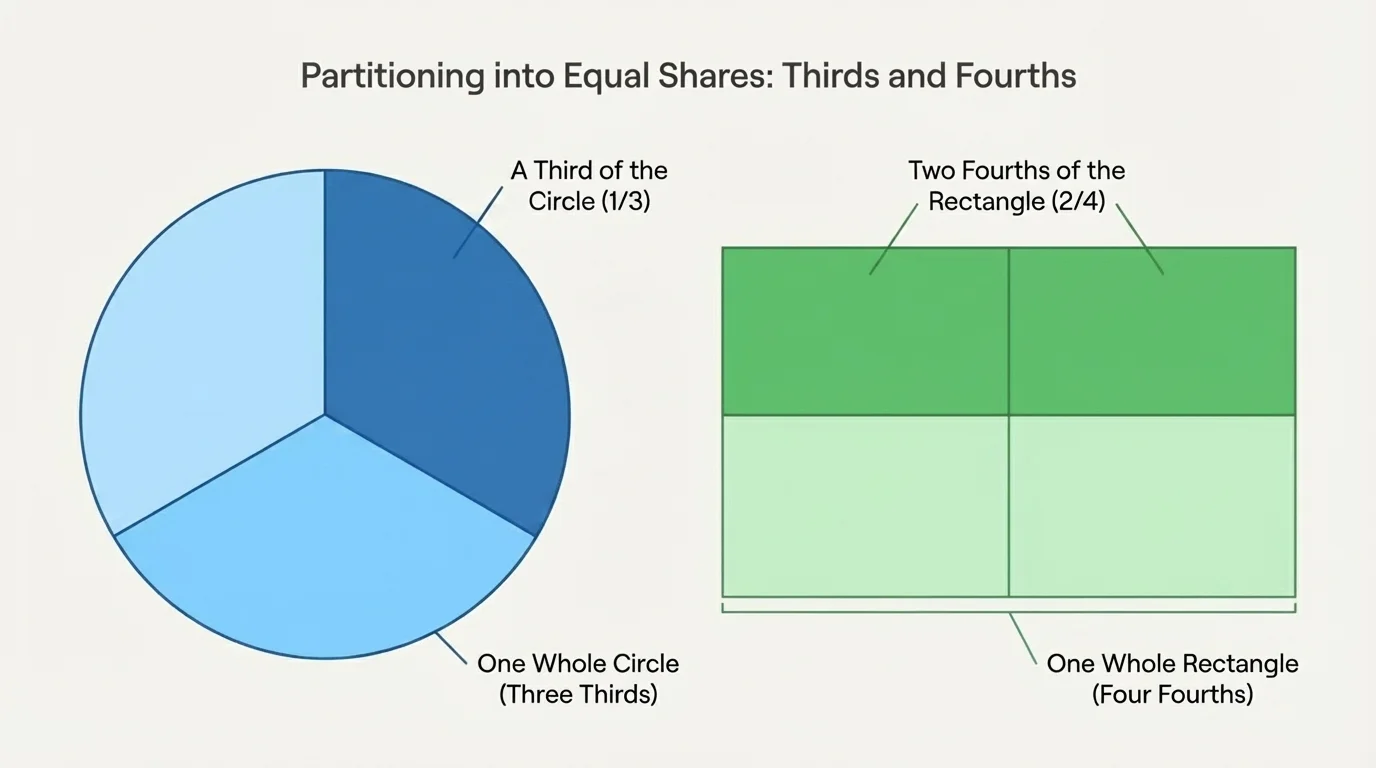
Notice that one of the circle pieces in the diagram is just one part of the whole. Naming that one part depends on how many equal parts the whole has altogether.
Example 2
A rectangle is split into \(3\) equal parts. One part is shaded. How much of the rectangle is shaded?
Step 1: Count the total equal parts.
The whole rectangle has \(3\) equal parts.
Step 2: Name one part.
One of \(3\) equal parts is a third.
Step 3: State the amount shaded.
The shaded part is a third of the rectangle.
The answer is: a third of the rectangle is shaded.
When students say "one piece is shaded," that is not quite enough. Math uses more exact words. We want to say a third because the whole is split into \(3\) equal parts.
Example 3
A rectangle is split into \(4\) equal parts. All \(4\) parts are shaded. How can you describe the whole rectangle?
Step 1: Count the equal parts.
There are \(4\) equal parts.
Step 2: Name the parts.
\(4\) equal parts are called fourths.
Step 3: Describe the whole.
If all \(4\) fourths are together, they make one whole rectangle.
The answer is: the whole rectangle is four fourths.
This example shows an important pattern: all the equal shares together make the whole shape again.
Example 4
Two same-size rectangles are each split into \(4\) equal parts. In one rectangle, the parts are long strips. In the other rectangle, the parts are arranged differently. Are the shares still fourths?
Step 1: Check that the wholes are the same size.
The rectangles are identical wholes.
Step 2: Check the number of equal parts.
Each rectangle has \(4\) equal parts.
Step 3: Decide whether shape changes the name.
The shapes of the parts may look different, but the parts are still equal in size.
The answer is: yes, the shares are still fourths.
This matches what we saw earlier in [Figure 3]. Different-looking pieces can still be equal shares when they come from identical wholes and have the same size.
Geometry is not only on paper. It appears in everyday life. A pizza cut into \(2\) equal slices gives halves. A sandwich cut into \(4\) equal pieces gives fourths. A round cookie split fairly among \(3\) children gives thirds.
Artists and builders also think about equal parts. A window can be divided into equal rectangles. A garden bed can be split into equal sections. A round sign can be designed with equal parts for decoration.
Paper folding is another great example. If you fold a rectangle in half, each side can be one half of the paper. If you fold again carefully, the paper can show fourths. These ideas help with symmetry and shape reasoning too.
One common mistake is thinking that any \(2\) pieces make halves. That is not true. The \(2\) pieces must be equal. Another mistake is calling \(3\) unequal pieces thirds. Thirds must be equal shares.
A different mistake is thinking equal shares must always have the same shape. But as we learned, equal shares of identical wholes can look different and still be equal in amount.
Careful geometry means checking both the number of parts and the size of the parts.
Here are strong math sentences you can say: "This is half of the circle." "This piece is a third of the rectangle." "The whole is two halves." "The whole is three thirds." "The whole is four fourths."
Using exact words helps you explain your thinking clearly. Geometry is not just about seeing shapes. It is also about describing them with correct math language.
