Have you ever noticed that numbers can march like a parade? Sometimes they go one by one: \(1, 2, 3, 4\). Sometimes they hop in a pattern: \(5, 10, 15, 20\). Sometimes they make giant jumps: \(100, 200, 300\)! Learning how to count within \(1000\) helps you read big numbers, spot patterns, and solve real-life problems faster.
[Figure 1] shows that a \(3\)-digit number is built from hundreds, tens, and ones. Each place has a value. In the number \(342\), the \(3\) means \(3\) hundreds, the \(4\) means \(4\) tens, and the \(2\) means \(2\) ones.
We can write that number in expanded form like this: \(342 = 300 + 40 + 2\). Place value helps us understand what each digit is really worth. The same digit can mean different amounts in different places. In \(222\), the first \(2\) means \(200\), the second \(2\) means \(20\), and the last \(2\) means \(2\).
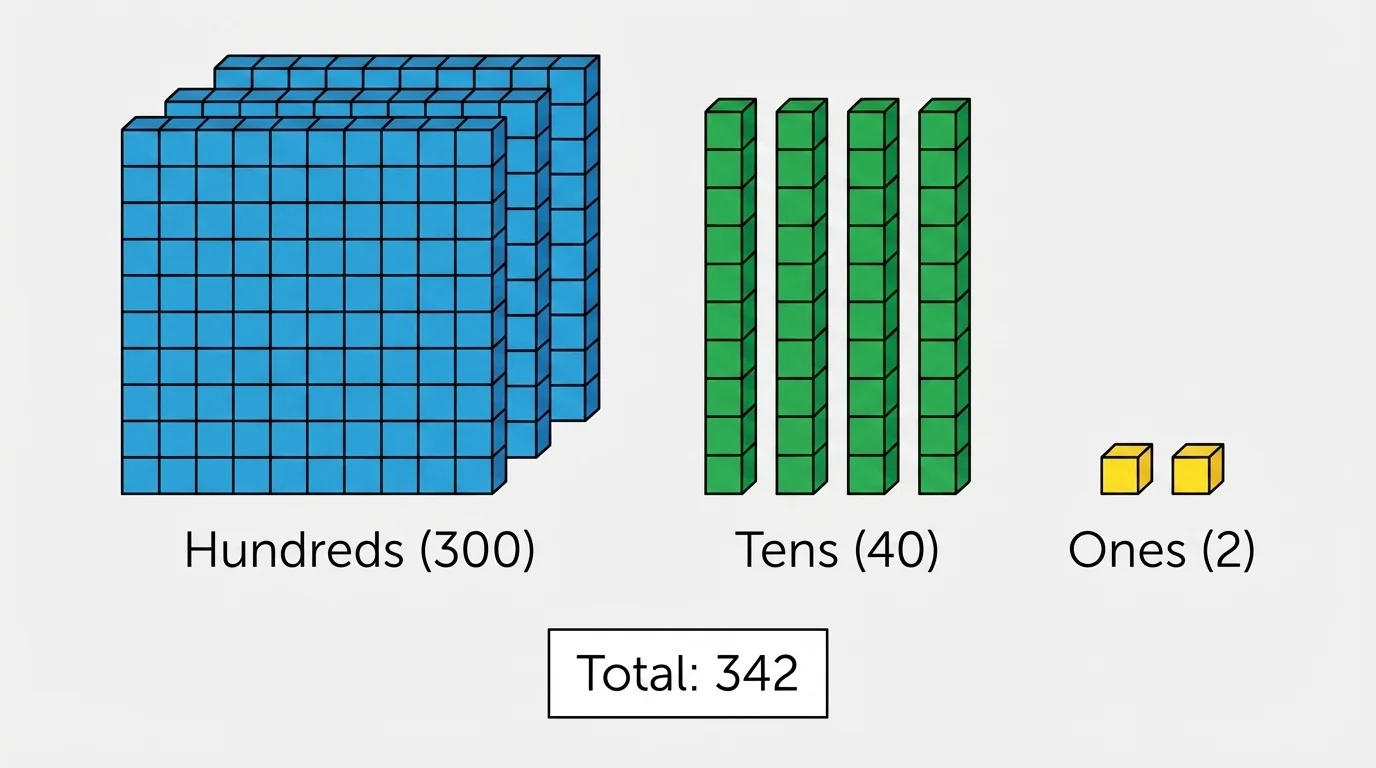
Place value means the value of a digit depends on where it is in a number. In numbers within \(1000\), the main places are ones, tens, and hundreds.
When we count, we move through these places in order. After \(9\) ones, we make \(1\) ten. After \(9\) tens, we make \(1\) hundred. After \(9\) hundreds, we can reach \(1000\), which is \(10\) hundreds.
Counting forward means adding \(1\) each time. Counting backward means subtracting \(1\) each time. Many numbers are easy to count, like \(451, 452, 453\). But some numbers cross into a new ten or a new hundred, and that is where place value helps a lot.
For example, if you count forward from \(298\), the next numbers are \(299\), \(300\), \(301\). Notice what happened. After \(299\), there are no more ones left to add without making a new hundred, so the number becomes \(300\).
Counting backward works the same way in reverse. If you count back from \(400\), you get \(399\), then \(398\), then \(397\). The hundreds place changes because we moved back past a full hundred.
You already know how to count by ones within smaller numbers. Counting within \(1000\) uses the same idea, but now you must watch what happens when you cross a ten or a hundred.
These changes are easier when you think about groups. A ten is \(10\) ones. A hundred is \(10\) tens, or \(100\) ones. That is why counting is really about building and regrouping numbers.
Skip-counting means counting by the same amount each time. When you skip-count by \(5\)s, each jump is \(5\). A number line in [Figure 2] shows equal hops: \(0, 5, 10, 15, 20\), and so on.
When you skip-count by \(5\)s, the ones digit follows a pattern: \(0, 5, 0, 5, 0, 5\). That happens because adding \(5\) flips the ones digit back and forth between \(0\) and \(5\).
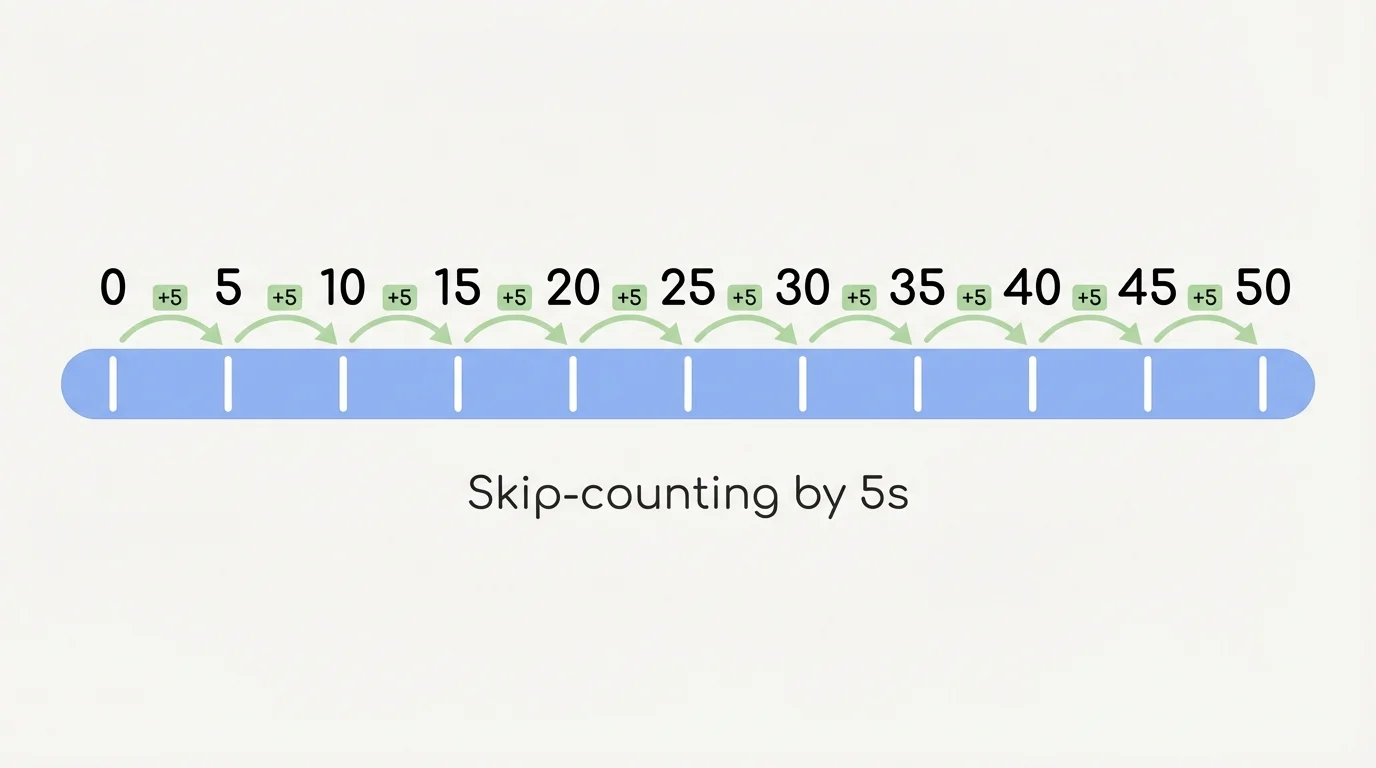
Here is a longer skip-counting pattern by \(5\)s: \(5, 10, 15, 20, 25, 30, 35, 40, 45, 50\). You can also start at a different number. If you start at \(7\) and add \(5\) each time, you get \(7, 12, 17, 22, 27\).
Clocks help us practice counting by \(5\)s. Each big space around a clock stands for \(5\) minutes, so the numbers go \(5, 10, 15, 20\), all the way to \(60\).
Skip-counting by \(5\)s is useful when objects come in groups of \(5\), like nickels or fingers on one hand. It is also a quick path toward learning multiplication facts.
Skip-counting by \(10\)s is often easier because the ones digit stays the same when you start at a number ending in \(0\). For example: \(10, 20, 30, 40, 50\). The tens place grows by \(1\) each time.
If you start from a different number, the pattern still works. Starting at \(3\), skip-counting by \(10\)s gives \(3, 13, 23, 33, 43\). The ones digit stays \(3\), and the tens place keeps changing.
Why skip-counting by \(10\)s works
Adding \(10\) means adding one full ten. So the tens place goes up by \(1\), while the ones place stays the same. That is why \(26, 36, 46, 56\) all end in \(6\).
You can use this idea to count money too. Ten dimes are worth \(\$1\). If you count by \(10\)s, you are grouping equal sets of ten.
[Figure 3] shows how adding \(100\) makes a big jump. The numbers show that the hundreds place changes while the tens and ones stay the same. For example, \(126, 226, 326, 426\) all have the same \(26\) at the end.
Here are numbers counted by \(100\)s from \(0\): \(100, 200, 300, 400, 500, 600, 700, 800, 900, 1000\). Each step adds one more hundred.
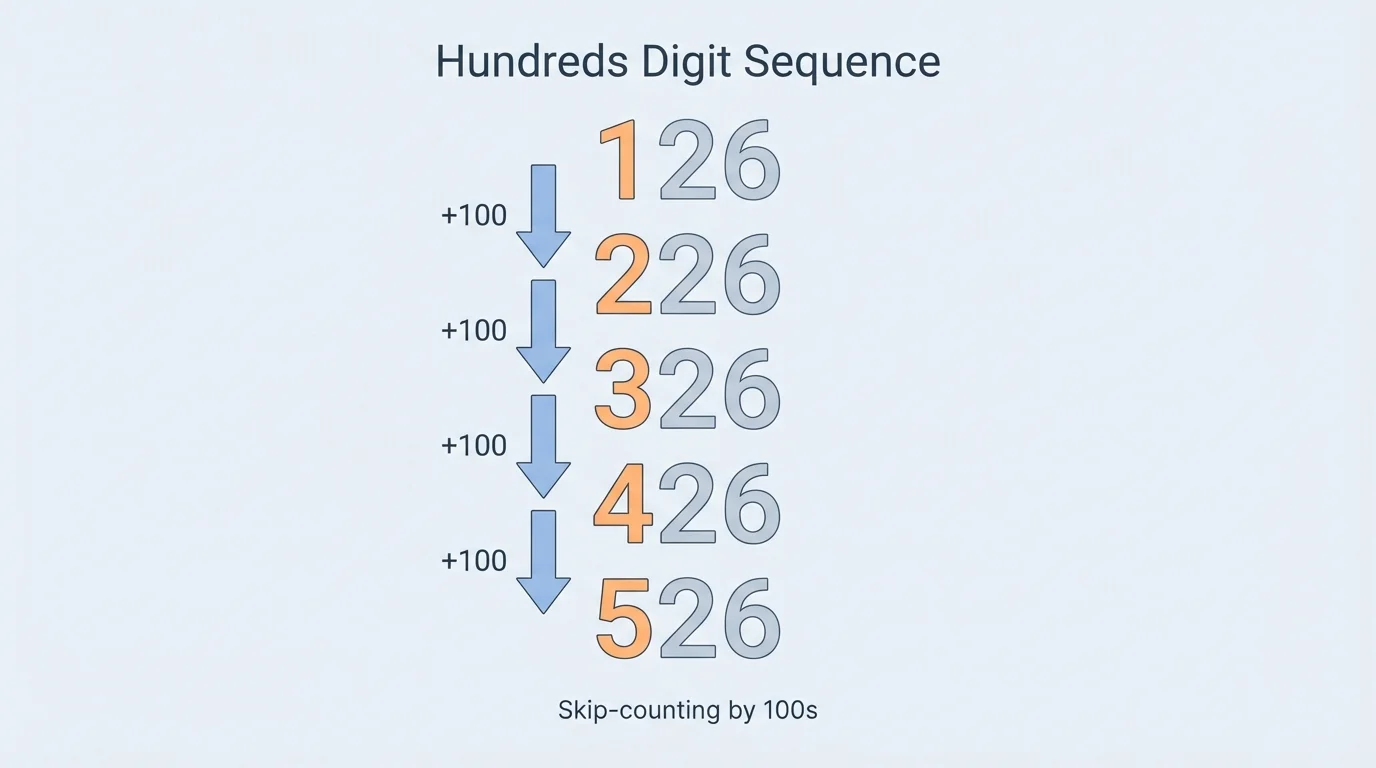
You do not have to start at \(0\). Starting at \(45\), skip-counting by \(100\)s gives \(45, 145, 245, 345, 445\). Starting at \(380\), the next numbers are \(480, 580, 680\).
Later, when you think again about [Figure 1], you can see why this works: adding \(100\) means adding one more hundred and keeping the tens and ones the same.
Sometimes students think skip-counting must start at \(0\) or a multiple of \(5\), \(10\), or \(100\). But it can start anywhere. The rule is simple: keep adding the same amount each time.
For example, by \(5\)s from \(18\): \(18, 23, 28, 33, 38\). By \(10\)s from \(54\): \(54, 64, 74, 84, 94\). By \(100\)s from \(207\): \(207, 307, 407, 507\).
This helps you look for what stays the same and what changes. In \(54, 64, 74, 84\), the ones digit stays \(4\). In \(207, 307, 407\), the tens and ones stay \(07\), while the hundreds change.
Worked example 1
Count forward by ones starting at \(397\). What are the next four numbers?
Step 1: Add \(1\) each time.
After \(397\) comes \(398\), then \(399\).
Step 2: Watch for the new hundred.
After \(399\), the next number is \(400\).
Step 3: Keep going.
After \(400\) comes \(401\).
The next four numbers are \(398, 399, 400, 401\).
Crossing a hundred is not scary when you remember that \(10\) tens make \(1\) hundred.
Worked example 2
Skip-count by \(5\)s starting at \(25\). Find the next five numbers.
Step 1: Start at \(25\).
The first jump adds \(5\): \(25 + 5 = 30\).
Step 2: Keep adding \(5\).
\(30 + 5 = 35\), \(35 + 5 = 40\).
Step 3: Finish the pattern.
\(40 + 5 = 45\), \(45 + 5 = 50\).
The next five numbers are \(30, 35, 40, 45, 50\).
Notice that the ones digit follows the same \(0, 5\) pattern we saw earlier with [Figure 2].
Worked example 3
Skip-count by \(10\)s starting at \(46\). What are the next four numbers?
Step 1: Add \(10\) once.
\(46 + 10 = 56\).
Step 2: Add \(10\) again and again.
\(56 + 10 = 66\), \(66 + 10 = 76\), \(76 + 10 = 86\).
Step 3: Check the pattern.
The ones digit stays \(6\), and the tens place grows each time.
The next four numbers are \(56, 66, 76, 86\).
That pattern helps you move quickly through numbers without counting one by one.
Worked example 4
Skip-count by \(100\)s starting at \(312\). Find the next three numbers.
Step 1: Add \(100\) once.
\(312 + 100 = 412\).
Step 2: Add \(100\) again.
\(412 + 100 = 512\).
Step 3: Add \(100\) one more time.
\(512 + 100 = 612\).
The next three numbers are \(412, 512, 612\).
This matches the pattern: the last two digits stay the same while the hundreds place changes.
Counting within \(1000\) and skip-counting help in many real situations. If a class is collecting bottle caps and has \(285\), then gets \(1\) more, the total is \(286\). If the class keeps collecting, students may count up through \(299\) to \(300\).
Money gives another great example. If you count nickels, you can skip-count by \(5\)s: \(5, 10, 15, 20\). If you count dimes, you can skip-count by \(10\)s. If a store has boxes with \(100\) stickers in each box, you can count boxes by \(100\)s: \(100, 200, 300\).
Sports and exercise use skip-counting too. A coach may ask a team to do \(10\) jumping jacks at a time and count \(10, 20, 30, 40\). A calendar also uses number order, so counting forward and backward helps students understand dates.
| Counting pattern | What changes | What may stay the same |
|---|---|---|
| By \(1\)s | Any place may change | Sometimes none |
| By \(5\)s | Number grows by \(5\) | Ones digit often follows \(0, 5\) |
| By \(10\)s | Tens place grows | Ones digit stays the same |
| By \(100\)s | Hundreds place grows | Tens and ones stay the same |
Table 1. Patterns to notice when counting by ones, fives, tens, and hundreds.
When you understand these patterns, numbers become easier to read, compare, and use. Counting is not just saying numbers in order. It is seeing how numbers are built and how they change.
