If you see \(5 \times 7\), you are looking at an efficient way to count many objects without listing them one by one. Instead of saying \(7 + 7 + 7 + 7 + 7\), multiplication helps us see a pattern: the same number is in each group. That is why multiplication is such a powerful math idea.
Multiplication helps us find a total when there are equal groups, as [Figure 1] shows. When we write \(5 \times 7\), it means there are \(5\) groups, and each group has \(7\) objects.
So \(5 \times 7\) means the total number of objects in \(5\) equal groups of \(7\) objects each. We can also write it as repeated addition:
\[5 \times 7 = 7 + 7 + 7 + 7 + 7\]
Then we add:
\[7 + 7 + 7 + 7 + 7 = 35\]
So:
\[5 \times 7 = 35\]
This means if you have \(5\) groups with \(7\) objects in each group, you have \(35\) objects altogether.
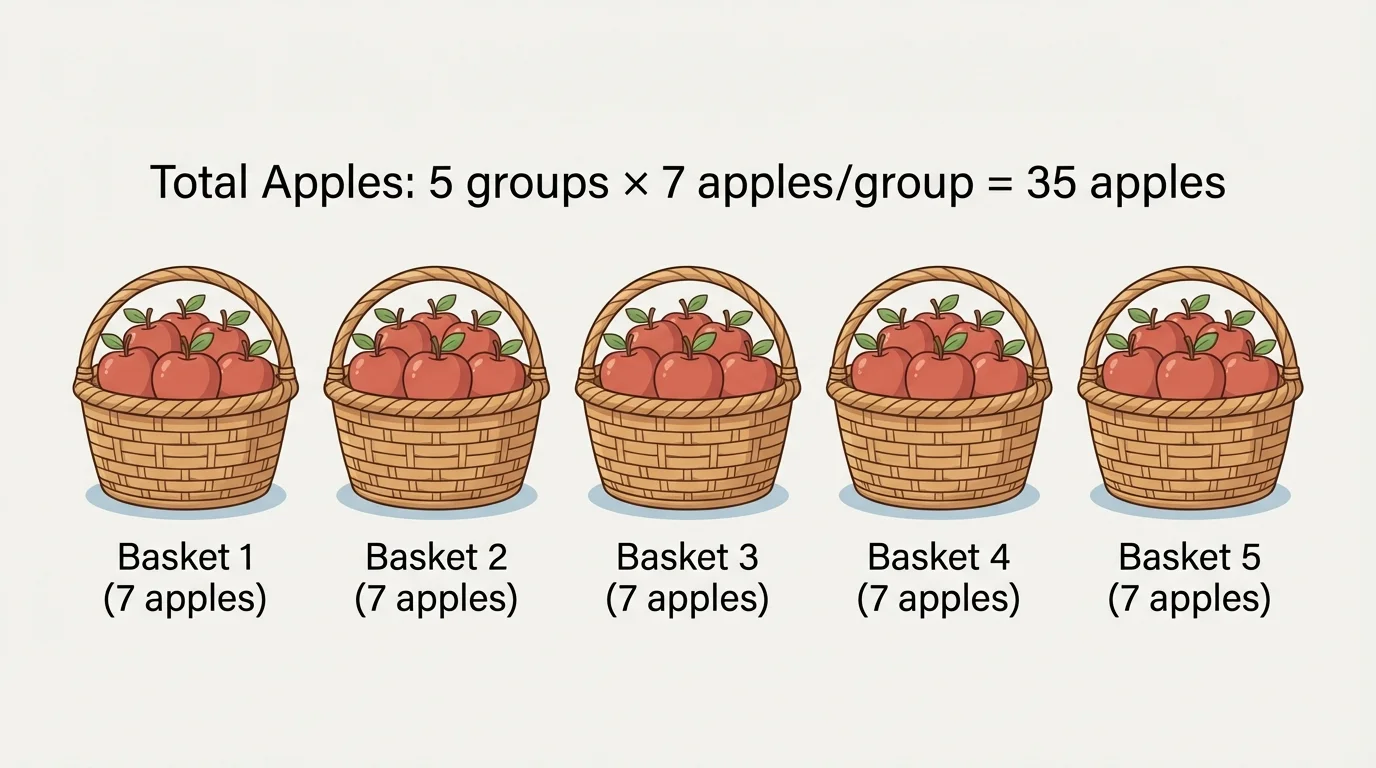
Equal groups are very important. If one group has \(7\), another has \(6\), and another has \(8\), then the groups are not equal. Multiplication for this lesson is about groups that all have the same number.
Equal groups are groups that each have the same number of objects.
Product is the answer to a multiplication problem.
Factor is a number being multiplied. In \(5 \times 7\), both \(5\) and \(7\) are factors.
When you hear "\(5\) groups of \(7\)," think of \(5\) sets that match exactly. Multiplication tells the total number of objects in all those groups together.
To understand a multiplication expression, it helps to read it in words. The expression \(5 \times 7\) can be read as "\(5\) times \(7\)" or "\(5\) groups of \(7\)."
The first factor often tells the number of groups. The second factor often tells how many are in each group. So in \(5 \times 7\):
We can describe it like this:
\[5 \times 7 = 35\]
This says, "\(5\) groups of \(7\) make \(35\) altogether."
Here is another example: \(3 \times 4 = 12\). This means \(3\) groups of \(4\) objects each, so there are \(12\) objects in all.
Addition helps us combine amounts. Repeated addition means adding the same number again and again, such as \(4 + 4 + 4\). Multiplication is a shorter way to show repeated addition when the groups are equal.
If you can say the repeated addition, you can often understand the multiplication. For example, \(6 \times 2\) means \(2 + 2 + 2 + 2 + 2 + 2 = 12\).
Another way to understand multiplication is to look at an array, as [Figure 2] illustrates. An array is an organized arrangement in rows and columns that helps us see equal groups clearly.
For \(5 \times 7\), we can make \(5\) rows with \(7\) dots in each row. That gives us \(35\) dots altogether.
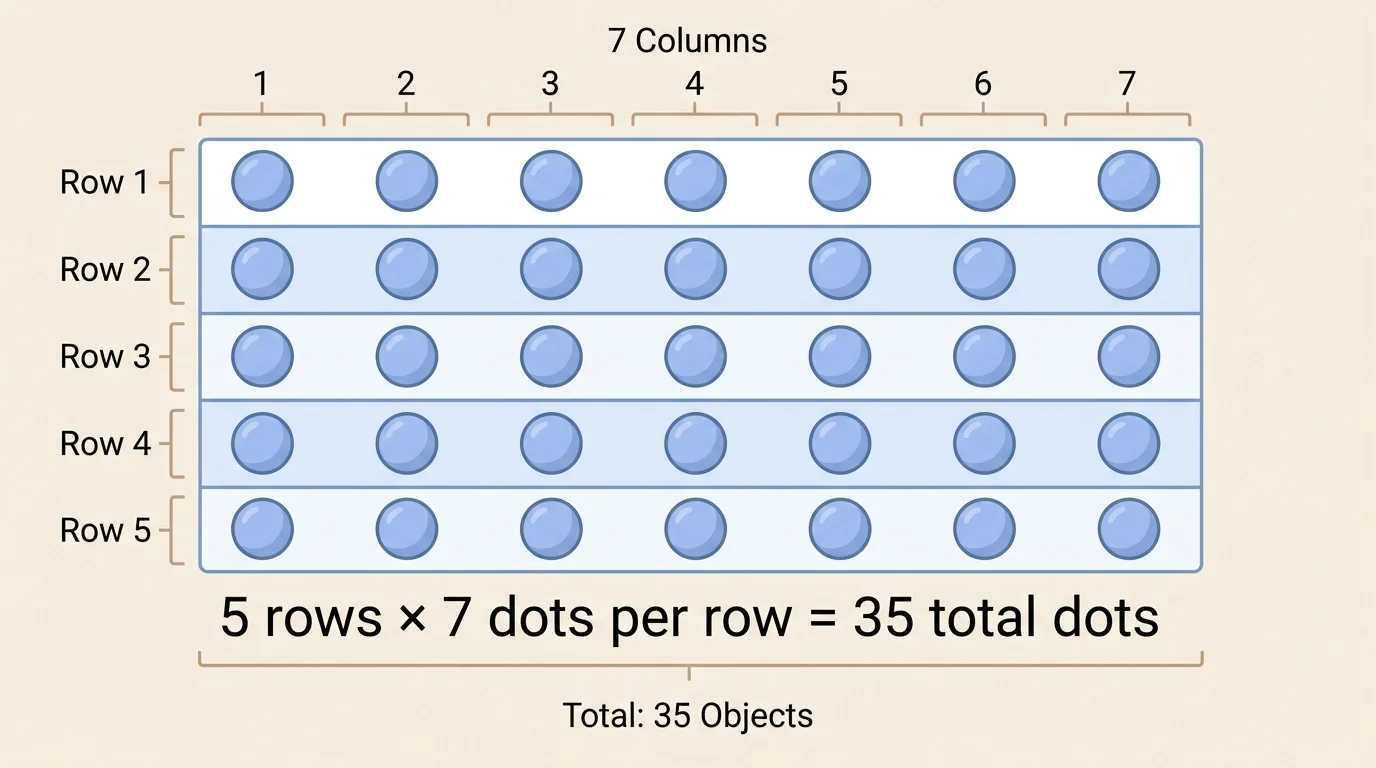
In an array, you can count by rows or by columns. If there are \(5\) rows of \(7\), that is \(5 \times 7\). If there are \(7\) columns of \(5\), that is \(7 \times 5\). Both have the same total of \(35\).
Arrays help because they make the groups easy to see. They also help students connect multiplication to area later on, when rectangles are measured in rows and columns of squares.
Pictures can also show multiplication without rows and columns. You might draw \(4\) bags with \(6\) marbles in each bag, or \(2\) nests with \(5\) eggs in each nest. In each case, multiplication tells the total.
Many things around you are arranged in equal groups. Egg cartons, muffin pans, windows in a building, and chairs in rows all help you see multiplication patterns.
This array also helps us notice that multiplication is a structured way of counting. Instead of counting each object one at a time, we count whole groups.
Now let's interpret multiplication expressions and connect them to real situations.
Worked example 1
There are \(5\) boxes, and each box has \(7\) crayons. How many crayons are there in all?
Step 1: Find the number of groups and the number in each group.
There are \(5\) groups, and each group has \(7\) crayons.
Step 2: Write the multiplication expression.
\(5 \times 7\)
Step 3: Find the total.
Repeated addition is \(7 + 7 + 7 + 7 + 7 = 35\).
So:
\[5 \times 7 = 35\]
There are \(35\) crayons in all.
This example shows that multiplication answers a "how many altogether" question when the groups are equal.
Worked example 2
A teacher places \(3\) stickers on each of \(8\) notebooks. How many stickers does the teacher use?
Step 1: Identify the groups.
There are \(8\) notebooks, so there are \(8\) groups. Each group has \(3\) stickers.
Step 2: Write the expression.
\(8 \times 3\)
Step 3: Add or multiply.
\(3 + 3 + 3 + 3 + 3 + 3 + 3 + 3 = 24\)
So:
\[8 \times 3 = 24\]
The teacher uses \(24\) stickers.
Notice that the story tells us what the factors mean: one factor is the number of groups, and the other factor is the number in each group.
Worked example 3
There are \(6\) bags with \(2\) oranges in each bag. What does \(6 \times 2\) mean, and what is the total?
Step 1: Interpret the expression.
\(6 \times 2\) means \(6\) groups of \(2\) oranges.
Step 2: Use repeated addition.
\(2 + 2 + 2 + 2 + 2 + 2 = 12\)
Step 3: State the total clearly.
There are \(12\) oranges in all.
So:
\[6 \times 2 = 12\]
This is what it means to interpret a multiplication expression: explain what the numbers stand for and what total they give.
Worked example 4
Describe a context for \(5 \times 7\).
Step 1: Read the expression.
\(5 \times 7\) means \(5\) groups of \(7\).
Step 2: Choose a real object.
Use pencils, chairs, apples, or toy cars.
Step 3: Write a matching story.
"There are \(5\) shelves, and each shelf has \(7\) books."
The total number of books is:
\[5 \times 7 = 35\]
A good multiplication story must match the numbers exactly. The groups must be equal, and the story must tell what is in each group.
Sometimes math asks you not just to solve, but to describe a situation. If the product is written as \(5 \times 7\), you can build a story around it.
Here are some correct contexts for \(5 \times 7\):
All of these stories match the same multiplication expression:
\[5 \times 7 = 35\]
Even though the objects are different, the structure is the same: \(5\) equal groups of \(7\).
One multiplication expression, many stories
The same product can fit many situations. What matters is not the kind of object, but the equal-group structure. If the story has the same number of groups and the same number in each group, it matches the multiplication expression.
You can also go the other way. If someone tells you, "There are \(4\) nests with \(3\) eggs in each nest," you can write \(4 \times 3\).
Multiplication facts can have the same total even when the order of the factors changes. For example:
\[5 \times 7 = 35\]
and
\[7 \times 5 = 35\]
Both products are \(35\), but they can describe different stories.
For \(5 \times 7\), the story is \(5\) groups of \(7\). For \(7 \times 5\), the story is \(7\) groups of \(5\). The total is the same, but the meaning of the factors changes.
This is easy to see in an array. The array in [Figure 2] can be counted as \(5\) rows of \(7\) or \(7\) columns of \(5\). The total stays \(35\), but the way we describe the grouping changes.
So when you interpret multiplication, pay attention to what each factor means in the story, not just the final answer.
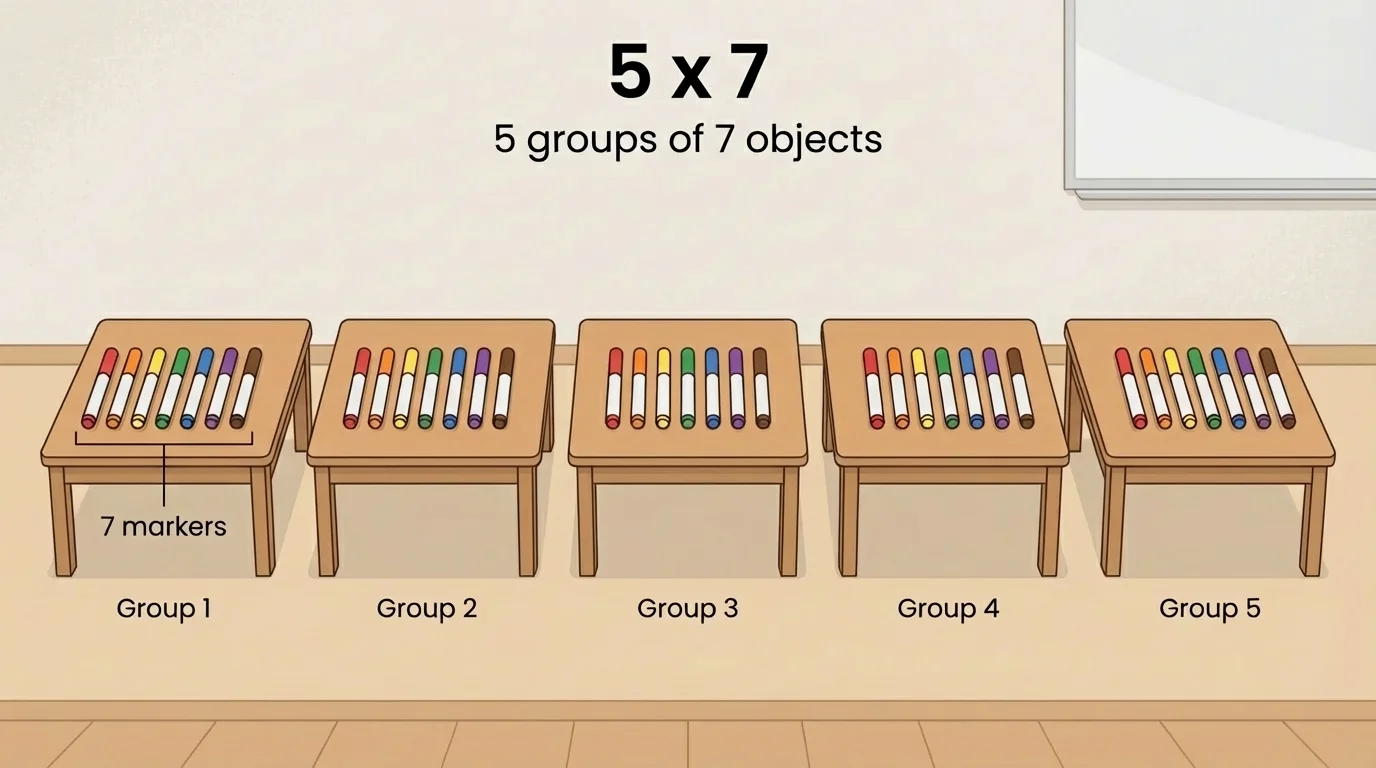
Multiplication appears in real life all the time, as [Figure 3] shows in a classroom setting. Whenever people organize objects into matching groups, multiplication can help find the total quickly.
In a classroom, there might be \(5\) tables with \(7\) markers on each table. That is \(5 \times 7 = 35\) markers. In sports, there might be \(4\) racks with \(6\) basketballs on each rack. That is \(4 \times 6 = 24\) basketballs.
At a store, juice boxes may be packed in equal trays. At a concert, chairs may be set in equal rows. In a garden, plants may be placed in equal lines. Multiplication helps count them all without starting over every time.
Equal groups are useful because they save time and help us see patterns. This classroom arrangement makes it easy to count groups instead of counting individual markers.
| Situation | Groups | In each group | Expression | Total |
|---|---|---|---|---|
| Tables with markers | \(5\) | \(7\) | \(5 \times 7\) | \(35\) |
| Bags with oranges | \(6\) | \(2\) | \(6 \times 2\) | \(12\) |
| Rows of chairs | \(3\) | \(8\) | \(3 \times 8\) | \(24\) |
| Boxes with crayons | \(5\) | \(7\) | \(5 \times 7\) | \(35\) |
Table 1. Examples of real-world equal-group situations written as multiplication expressions.
One common mistake is forgetting that multiplication here means equal groups. If the groups are not equal, the multiplication expression does not match the situation.
Another mistake is mixing up the factors and the product. In \(5 \times 7 = 35\), the factors are \(5\) and \(7\), and the product is \(35\). The product is the total, not the size of one group.
Some students also write the right answer but cannot explain the meaning. If you say \(5 \times 7 = 35\), you should also be able to say, "That means \(5\) groups of \(7\) objects each, with \(35\) objects altogether."
Be careful with stories too. A story about \(5\) shelves where one shelf has \(7\) books and the others are empty does not match \(5 \times 7\). Every shelf must have \(7\) books.
"Multiplication is a smart way to count equal groups."
When you understand multiplication this way, you are not just memorizing facts. You are making sense of what the numbers mean.
