You already know that division helps us split things fairly. Here is the important part: one division expression can tell two different stories. The expression \(56 \div 8\) can mean sharing \(56\) objects equally into \(8\) groups, or it can mean making groups of \(8\) from \(56\) objects. Both stories lead to the same answer, but they ask different questions.
When we divide whole numbers, we are finding a quotient. The quotient is the answer to a division problem. In this lesson, we will look closely at what the quotient means, not just how to calculate it.
[Figure 1] Division involves equal sharing or equal grouping. It can show equal shares or equal groups with the same total of \(56\) objects used in two different ways. This is why one division expression can match different word problems.
Suppose there are \(56\) stickers. If \(8\) students share them equally, \(56 \div 8\) tells how many stickers each student gets. But if we put the \(56\) stickers into groups of \(8\), then \(56 \div 8\) tells how many groups we can make.
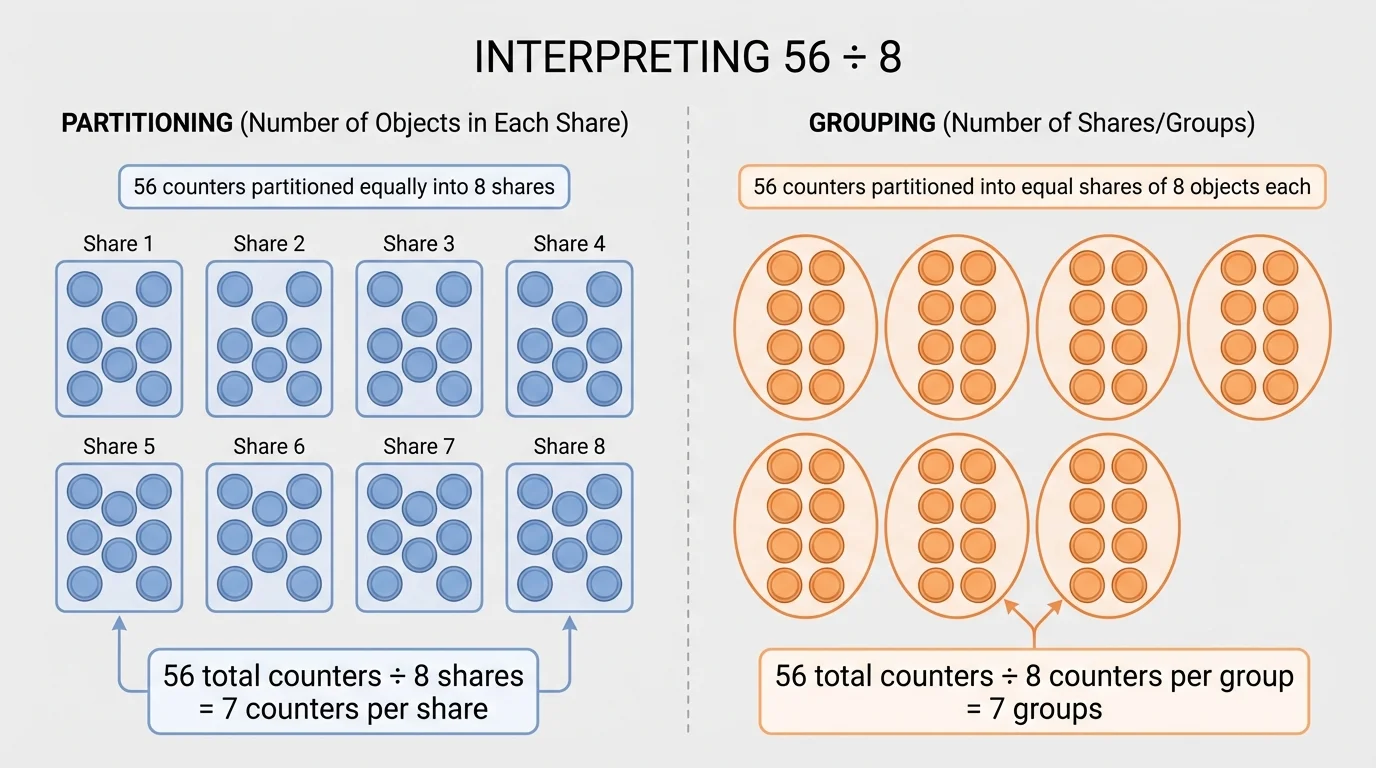
In both cases, the answer is \(7\). So we can write: \[56 \div 8 = 7\] The number \(7\) can mean \(7\) in each share or \(7\) groups, depending on the situation.
Division is an operation that can mean splitting a total into equal shares or finding how many equal groups can be made.
Equal shares means the total is split fairly among a certain number of groups.
Equal groups means the total is organized into groups that all have the same size.
To understand division well, always ask: What is the question asking me to find? Are you finding how many are in each group, or how many groups there are?
In an equal-shares story, you know the total amount and the number of groups. You need to find how many are in each group.
For example, \(56 \div 8\) can mean that \(56\) crayons are shared equally among \(8\) tables. The question is: how many crayons does each table get? Since \(56 \div 8 = 7\), each table gets \(7\) crayons.
This is sometimes called partitive division, because you are splitting a total into a known number of equal parts.
How to recognize an equal-shares problem
Look for words like shared among, split equally, each person gets, or divided into a certain number of groups. These clues mean you usually know the number of groups and need to find the amount in each group.
Here is another example. A teacher has \(56\) pencils and puts them equally into \(8\) cups. The cups are the groups. The pencils in each cup are what we want to find. So the quotient \(7\) means \(7\) pencils in each cup.
In an equal-groups story, you know the total amount and the size of each group. You need to find how many groups can be made.
For example, \(56 \div 8\) can mean that \(56\) apples are packed into bags with \(8\) apples in each bag. The question is: how many bags can be filled? Since \(56 \div 8 = 7\), you can make \(7\) bags.
This is sometimes called quotative division, because you are making groups of the same size from a total amount.
Notice the difference in the questions. In equal shares, we ask, "How many are in each group?" In equal groups, we ask, "How many groups are there?" The numbers may be the same, but the meaning of the answer changes.
You can think back to multiplication. If \(8 \times 7 = 56\), then division can undo that multiplication. Division asks about a missing factor.
That connection is very helpful. If you know \(8 \times 7 = 56\), then you also know \(56 \div 8 = 7\). The answer \(7\) might mean \(7\) objects in each share, or \(7\) shares, depending on the story.
[Figure 2] Multiplication and division are related operations. An array helps us see this relationship clearly. If \(56\) objects are arranged in \(8\) equal rows, there must be \(7\) in each row.
That means the multiplication fact \(8 \times 7 = 56\) matches the division fact \(56 \div 8 = 7\). The same numbers are connected in both directions.
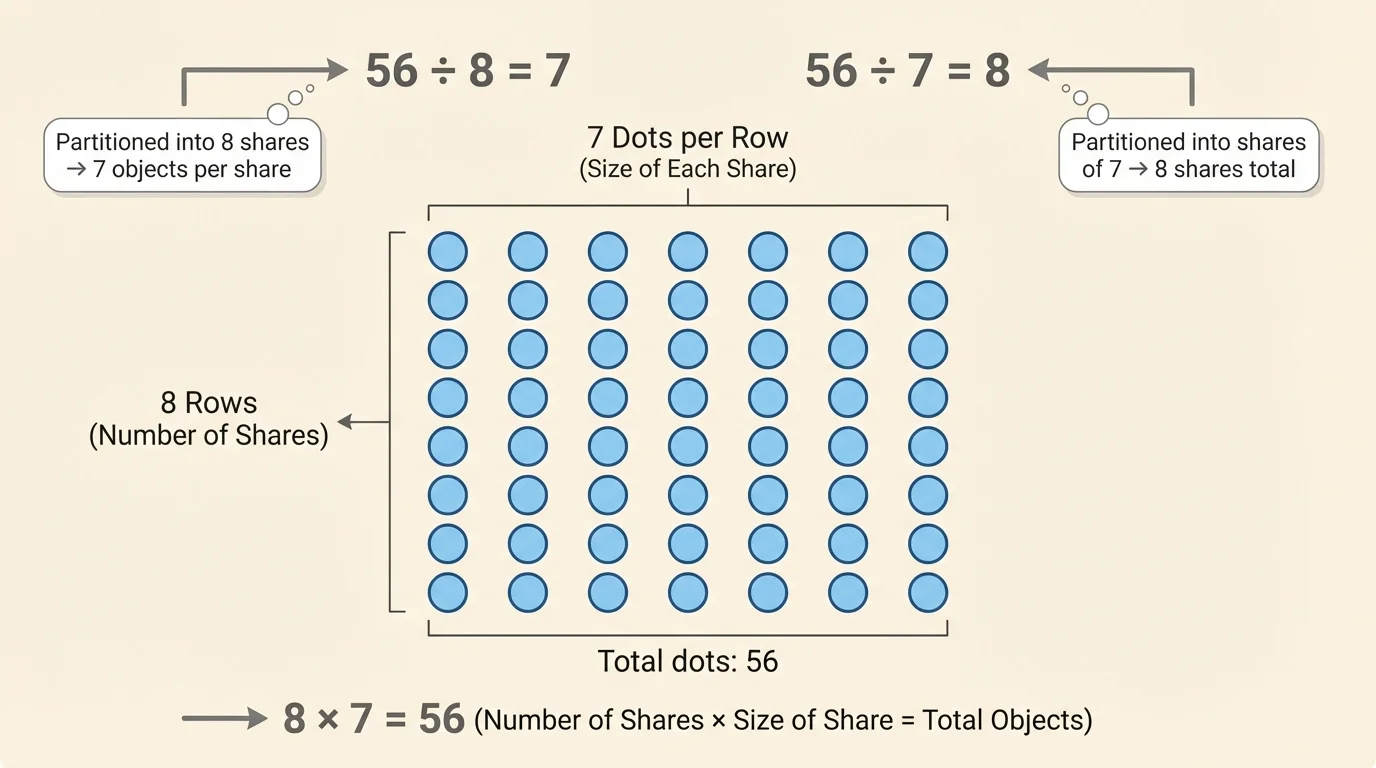
We can write a fact family:
\[8 \times 7 = 56\]
\[7 \times 8 = 56\]
\[56 \div 8 = 7\]
\[56 \div 7 = 8\]
These four facts belong together. If you know one, you can use it to help with the others. Later, when you see [Figure 2] again in your mind, remember that rows and columns can help you decide whether the quotient tells the size of a group or the number of groups.
Many students get faster at division when they first think of a multiplication fact they already know. Knowing facts like \(8 \times 7 = 56\) makes division much easier.
Another way to think about \(56 \div 8\) is through repeated subtraction. If you keep taking away groups of \(8\), how many times can you subtract before reaching \(0\)?
\(56 - 8 = 48\), then \(48 - 8 = 40\), then \(40 - 8 = 32\), then \(32 - 8 = 24\), then \(24 - 8 = 16\), then \(16 - 8 = 8\), then \(8 - 8 = 0\). We subtracted \(8\) a total of \(7\) times, so \(56 \div 8 = 7\).
Let's look at several division stories and decide what the quotient means.
Worked example 1
There are \(56\) cookies. They are shared equally among \(8\) children. How many cookies does each child get?
Step 1: Identify what is known.
The total number of cookies is \(56\), and the number of children is \(8\).
Step 2: Write the division expression.
\(56 \div 8\)
Step 3: Use a related multiplication fact.
Since \(8 \times 7 = 56\), we know \(56 \div 8 = 7\).
Step 4: Interpret the answer.
Because the cookies are shared among \(8\) children, the \(7\) means each child gets \(7\) cookies.
Final answer: \(56 \div 8 = 7\). Each child gets \(7\) cookies.
This is an equal-shares situation because the number of groups, \(8\) children, is already known.
Worked example 2
A store has \(56\) tennis balls. It packs them in cans with \(8\) tennis balls in each can. How many cans can the store fill?
Step 1: Identify what is known.
The total number of tennis balls is \(56\), and each can holds \(8\) balls.
Step 2: Write the division expression.
\(56 \div 8\)
Step 3: Solve using multiplication.
Since \(8 \times 7 = 56\), the quotient is \(7\).
Step 4: Interpret the answer.
Because each group has \(8\) tennis balls, the \(7\) means \(7\) cans can be filled.
Final answer: \(56 \div 8 = 7\). The store can fill \(7\) cans.
This is an equal-groups situation because the size of each group, \(8\) per can, is known.
Worked example 3
There are \(56\) students going on a field trip. They ride in \(8\) equal vans. How many students are in each van?
Step 1: Find the total and the number of groups.
There are \(56\) students and \(8\) vans.
Step 2: Divide.
\(56 \div 8 = 7\)
Step 3: Explain the quotient.
The quotient \(7\) means \(7\) students are in each van.
Final answer: \(56 \div 8 = 7\). Each van has \(7\) students.
Again, the quotient tells the amount in each share because we know there are \(8\) vans.
Worked example 4
A coach has \(56\) cones. She makes practice sets with \(8\) cones in each set. How many sets does she make?
Step 1: Identify the group size.
Each set has \(8\) cones.
Step 2: Divide the total by the group size.
\(56 \div 8 = 7\)
Step 3: Interpret the result.
The quotient \(7\) means \(7\) sets can be made.
Final answer: \(56 \div 8 = 7\). She makes \(7\) sets.
Even though examples \(3\) and \(4\) both use \(56 \div 8\), the meaning of \(7\) is different. In one case, it means students per van. In the other case, it means number of sets.
A division problem can be represented in several ways. Seeing the same idea in different forms helps build strong understanding.
You might see a quotient in a number sentence:
\[56 \div 8 = 7\]
You might say it with words: "\(56\) divided by \(8\) equals \(7\)."
You might describe a context: "\(56\) markers are placed equally into \(8\) boxes, so each box gets \(7\) markers."
You might also use a table to compare the two meanings of the same division expression.
| Division expression | Story type | What is known? | What does \(7\) mean? |
|---|---|---|---|
| \(56 \div 8\) | Equal shares | \(56\) total, \(8\) groups | \(7\) in each group |
| \(56 \div 8\) | Equal groups | \(56\) total, groups of \(8\) | \(7\) groups |
Table 1. Two different interpretations of the same quotient, \(56 \div 8 = 7\).
Reading the problem carefully matters. The numbers may stay the same, but the story tells you what the quotient means.
Division is everywhere in daily life. It helps with sharing snacks, organizing teams, packing supplies, arranging seats, and sorting objects into equal groups.
At school, \(56 \div 8\) might describe crayons shared by \(8\) art groups. In sports, it might describe \(56\) players divided equally onto \(8\) teams. In a kitchen, it might describe \(56\) strawberries placed equally on \(8\) plates or put into bowls with \(8\) in each bowl.
These situations are useful because they help you decide what division means in real life. Are you splitting into a known number of groups, or are you making groups of a known size?
Questions that help you choose the meaning
If the problem asks, "How many in each?" think about equal shares. If the problem asks, "How many groups?" think about equal groups. These question phrases are powerful clues.
A delivery worker might sort \(56\) packages into \(8\) trucks. Then the quotient tells how many packages go in each truck. But if the worker puts \(8\) packages on each cart, then the quotient tells how many carts are needed. The same expression can fit both situations.
One common mistake is to give the correct number but the wrong meaning. A student may say the answer is \(7\), but not explain whether that means \(7\) in each group or \(7\) groups.
Another mistake is to ignore the story. Numbers alone do not tell the whole meaning. The context tells what the quotient represents.
It also helps not to confuse multiplication with division. Multiplication combines equal groups to make a total. Division starts with the total and works backward to find a missing factor.
"The numbers tell part of the story, but the question tells what the answer means."
When you solve a division problem, always finish by saying what the quotient stands for. That makes your answer complete and clear.
[Figure 3] The comparison helps us focus on the two meanings of the same expression. In both situations, \(56 \div 8 = 7\), but the question changes what the \(7\) describes.
If \(56\) beads are shared equally into \(8\) boxes, the answer \(7\) means each box has \(7\) beads. If \(56\) beads are put into groups of \(8\), the answer \(7\) means there are \(7\) groups.
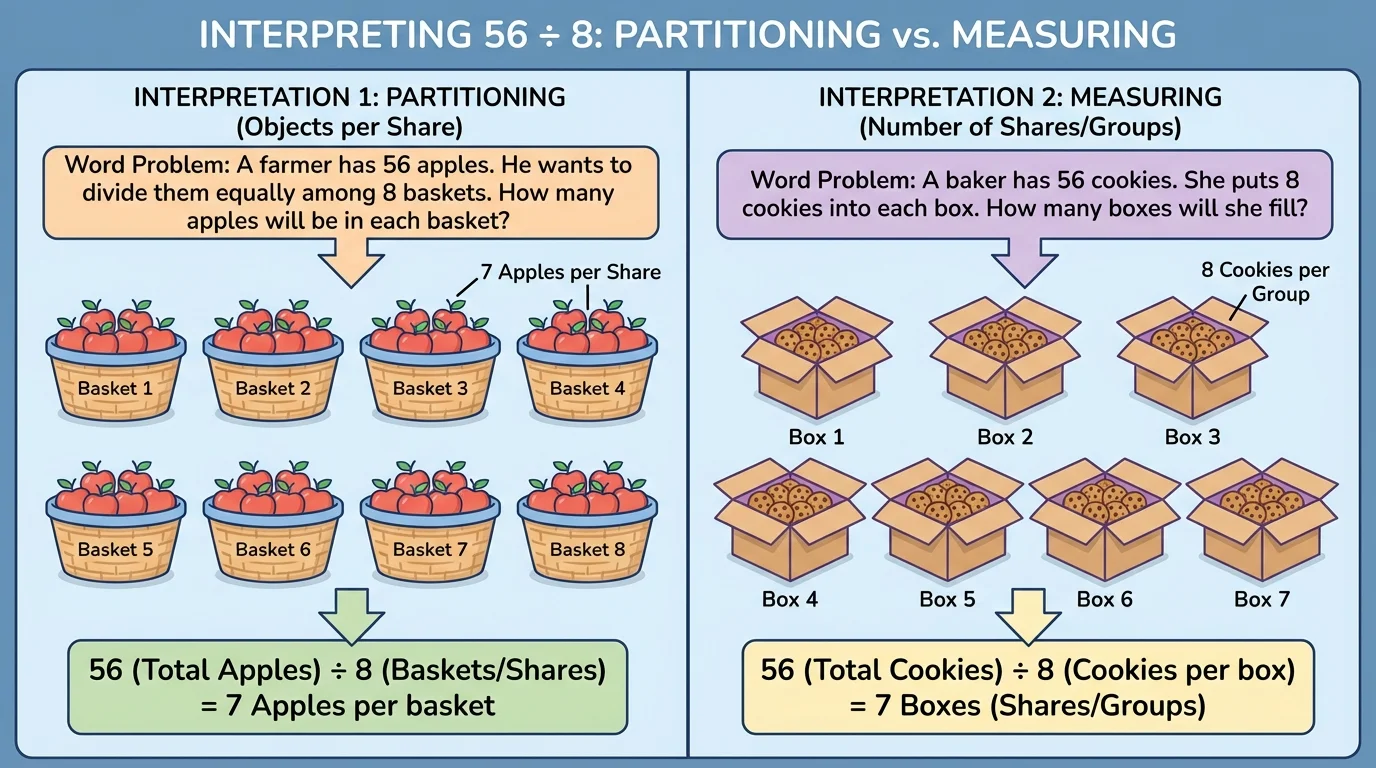
Notice that the numbers \(56\), \(8\), and \(7\) do not change. What changes is the role of the unknown. In one story, the unknown is the size of each share. In the other story, the unknown is the number of shares.
This is why understanding division is more than memorizing facts. It means knowing what the quotient tells you about a real situation. When you think back to [Figure 1], you can see the two stories side by side, and when you remember [Figure 2], you can use multiplication to check that both stories are true.
So when you see \(56 \div 8\), you should be able to say two correct things: it can mean the number in each share when \(56\) objects are partitioned equally into \(8\) shares, and it can mean the number of shares when \(56\) objects are partitioned into equal shares of \(8\) objects each.
