A basketball game, a bus ride, a baking timer, and the school day all depend on one powerful idea: time. Sometimes just one minute matters. If you miss the bus by 1 minute, it feels huge. If cookies bake 1 minute too long, they may burn. Learning to tell time to the nearest minute helps you understand what is happening now, what happens next, and how long things last.
We use time to plan, measure, and compare events. You might start reading at 3:12 and stop at 3:27. To know how long you read, you need to find the elapsed time. Elapsed time means the amount of time that passes from a starting time to an ending time.
People also use time when they cook, practice music, play sports, catch trains, and go to appointments. A doctor may say a visit lasts 20 minutes. A soccer coach may say practice begins at 4:35 and ends at 5:20. Time helps us stay organized.
You already know that \(1\) hour = \(60\) minutes. You may also remember that the clock face has \(12\) large numbers and that each space between the large numbers is divided into \(5\) small minute marks.
An analog clock has two main hands. The short hand tells the hour. The long hand tells the minutes. To tell time to the nearest minute, you read both hands carefully.
On an analog clock, the minute hand moves all the way around the clock in \(60\) minutes, as [Figure 1] shows. Each small tick mark stands for \(1\) minute. The long hand does not have to point to a large number. It can point to any small mark, and that tells the exact minute.
The hour hand moves more slowly. As time passes, it slides from one hour number toward the next. If the hour hand is a little past 3, then the hour is 3-something. If it is between 7 and 8, then the time is 7-something.
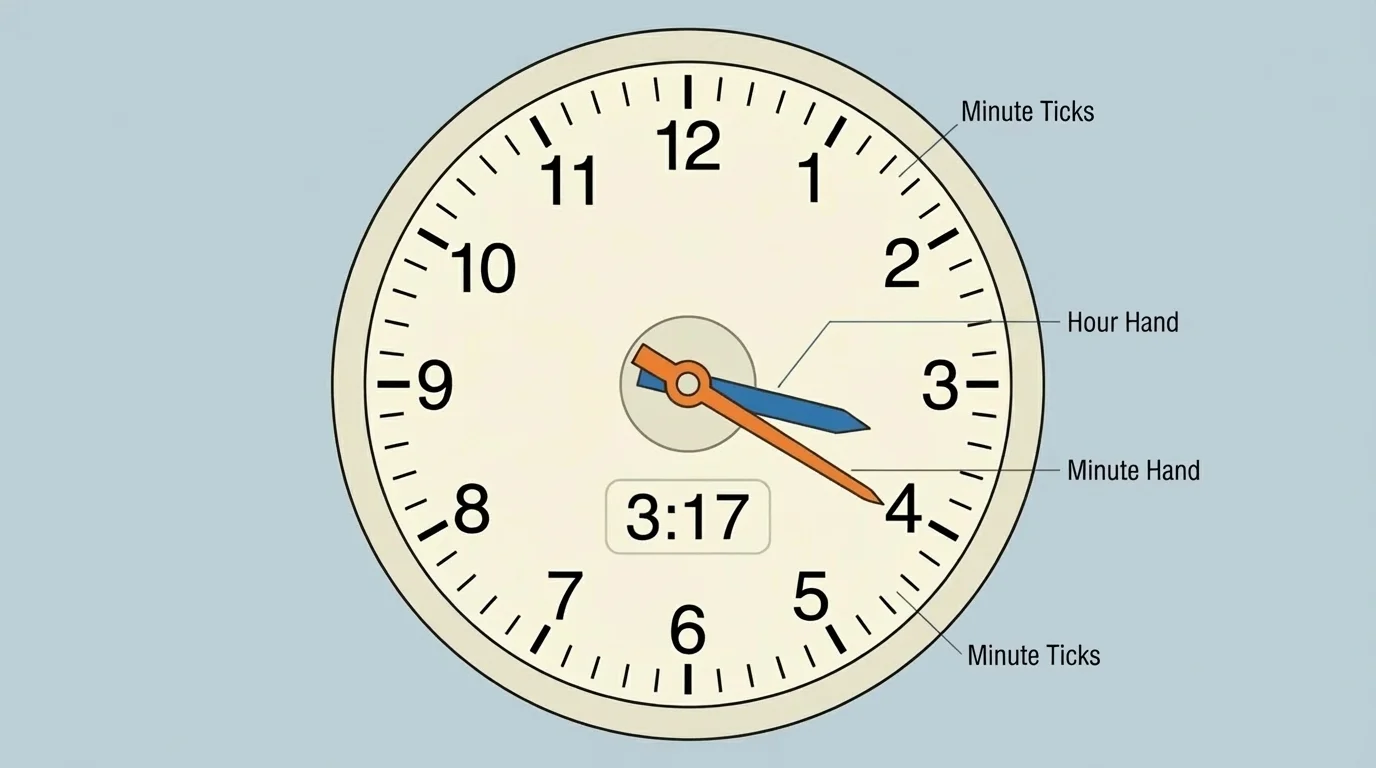
Here is how to read a clock to the nearest minute.
First, look at the hour hand. Decide which hour it has passed. Second, count the minute hand. You can count by 5s to each large number and then count extra small marks by 1s.
For example, if the minute hand points two small marks after the 4, then the minutes are 22. That is because the 4 stands for 20 minutes, and \(20 + 2 = 22\). If the hour hand is just past 6, the time is 6:22.
Nearest minute means telling time to the exact minute shown by the minute hand, not just to the nearest \(5\) minutes. Analog clock means a clock with hands that move around a clock face.
Sometimes the minute hand points exactly to a large number. Then the minutes are a multiple of 5. For example, if it points to the 9, the minutes are 45. If it points to the 12, the minutes are 00.
As you continue working, remember what [Figure 1] shows: the minute hand gives the exact minute, but the hour hand tells which hour you are in. Both hands matter.
Time can be written with numbers using a colon, like 8:06, 1:45, or 12:30. The hour is written first, then the minutes. If the minutes are less than 10, we write a zero before the digit. So six minutes after eight is written as 8:06, not 8:6.
Time can also be written in words. For example, 4:18 can be read as four eighteen. It can also be described as 18 minutes after 4. The time 7:52 can be described as 52 minutes after 7 or 8 minutes until 8.
Both ways are useful. Number form is common on clocks and schedules. Word form helps you describe how far a time is from the hour.
A time interval is the amount of time between two times. To find it, you can count on from the start time to the end time.
Suppose a game starts at 2:14 and ends at 2:39. Count on from 2:14 to 2:39. From 2:14 to 2:20 is 6 minutes. From 2:20 to 2:30 is 10 minutes. From 2:30 to 2:39 is 9 minutes. Then add: \(6 + 10 + 9 = 25\). The time interval is 25 minutes.
Sometimes you can also think of subtraction. Since \(39 - 14 = 25\), the interval from 2:14 to 2:39 is 25 minutes. This works easily when the hour stays the same.
Finding elapsed time by counting on
Counting on is often the clearest way to solve time problems. You start at the first time and make jumps to friendlier times, such as the next multiple of 5, the next 10, or the next hour. Then you add the jumps. This method helps when the minutes are awkward, such as 17 or 43.
When a problem crosses an hour, counting on is especially helpful. For example, from 5:48 to 6:12, you can count 12 minutes to 6:00 and then 12 more minutes to 6:12. So the interval is 24 minutes.
[Figure 2] A number line diagram helps you see elapsed time as a path of jumps. You place the start time on the left, the end time on the right, and then mark jumps between them.
A number line illustrates how you can use jumps to find the time from 2:18 to 2:47. One way is to jump 2 minutes to 2:20, then 10 minutes to 2:30, then 10 minutes to 2:40, then 7 minutes to 2:47. Add the jumps: \(2 + 10 + 10 + 7 = 29\).
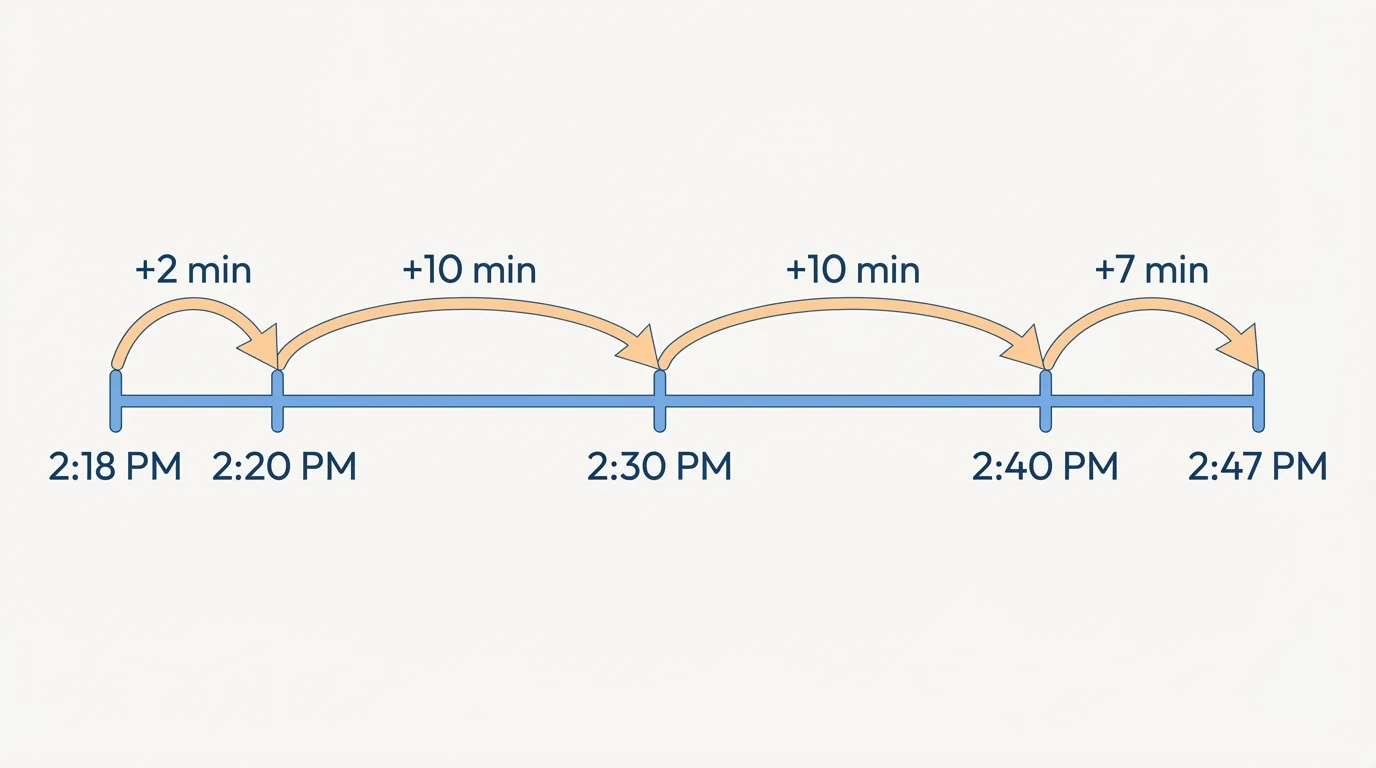
Number lines are useful because they show each part of the thinking. Instead of trying to do everything in your head at once, you can break the interval into smaller pieces.
You do not have to make the same size jumps every time. You can choose helpful jumps. For example, from 1:56 to 2:15, you might jump 4 minutes to 2:00 and then 15 minutes to 2:15. Since \(4 + 15 = 19\), the interval is 19 minutes.
Solved example 1
A movie preview starts at 6:23 and ends at 6:41. How long is the preview?
Step 1: Start at the beginning time.
Begin at 6:23.
Step 2: Count on to friendly times.
From 6:23 to 6:30 is 7 minutes. From 6:30 to 6:40 is 10 minutes. From 6:40 to 6:41 is 1 minute.
Step 3: Add the jumps.
\(7 + 10 + 1 = 18\)
The preview lasts 18 minutes.
Later, when you solve bigger word problems, the jump idea from [Figure 2] stays useful. You are measuring the distance between times, just like measuring the distance between numbers.
Sometimes a problem gives a start time and a number of minutes. Then you need to find the ending time.
Suppose art class starts at 9:27 and lasts 18 minutes. Add the minutes by counting on. From 9:27 to 9:30 is 3 minutes. Then \(18 - 3 = 15\) minutes are left. From 9:30, move 15 more minutes to 9:45. The ending time is 9:45.
Solved example 2
Recess begins at 10:38 and lasts 25 minutes. What time does recess end?
Step 1: Move to a friendly time.
From 10:38 to 10:40 is 2 minutes.
Step 2: Find how many minutes are left.
\(25 - 2 = 23\)
Step 3: Add the remaining minutes.
From 10:40, add 20 minutes to get 11:00. Then add 3 more minutes to get 11:03.
Recess ends at 11:03.
When adding minutes, crossing an hour needs extra care. Once the minutes reach 60, the hour changes by 1. For example, 4:50 plus 15 minutes is 5:05.
Other problems give an ending time and a number of minutes, and you must find the starting time. Then you subtract minutes or count backward.
Suppose choir ends at 3:16 after 22 minutes. To find the start time, go back 16 minutes to 3:00. There are still 6 minutes to go back. Move back 6 more minutes to 2:54. The choir started at 2:54.
Solved example 3
A student reads until 8:12. She read for 35 minutes. When did she start?
Step 1: Go back to the hour.
From 8:12, go back 12 minutes to 8:00.
Step 2: Find how many minutes still need to be subtracted.
\(35 - 12 = 23\)
Step 3: Go back the remaining minutes.
From 8:00, go back 23 minutes to 7:37.
She started reading at 7:37.
You can check by adding forward: from 7:37 to 8:00 is 23 minutes, and from 8:00 to 8:12 is 12 minutes. Since \(23 + 12 = 35\), the answer makes sense.
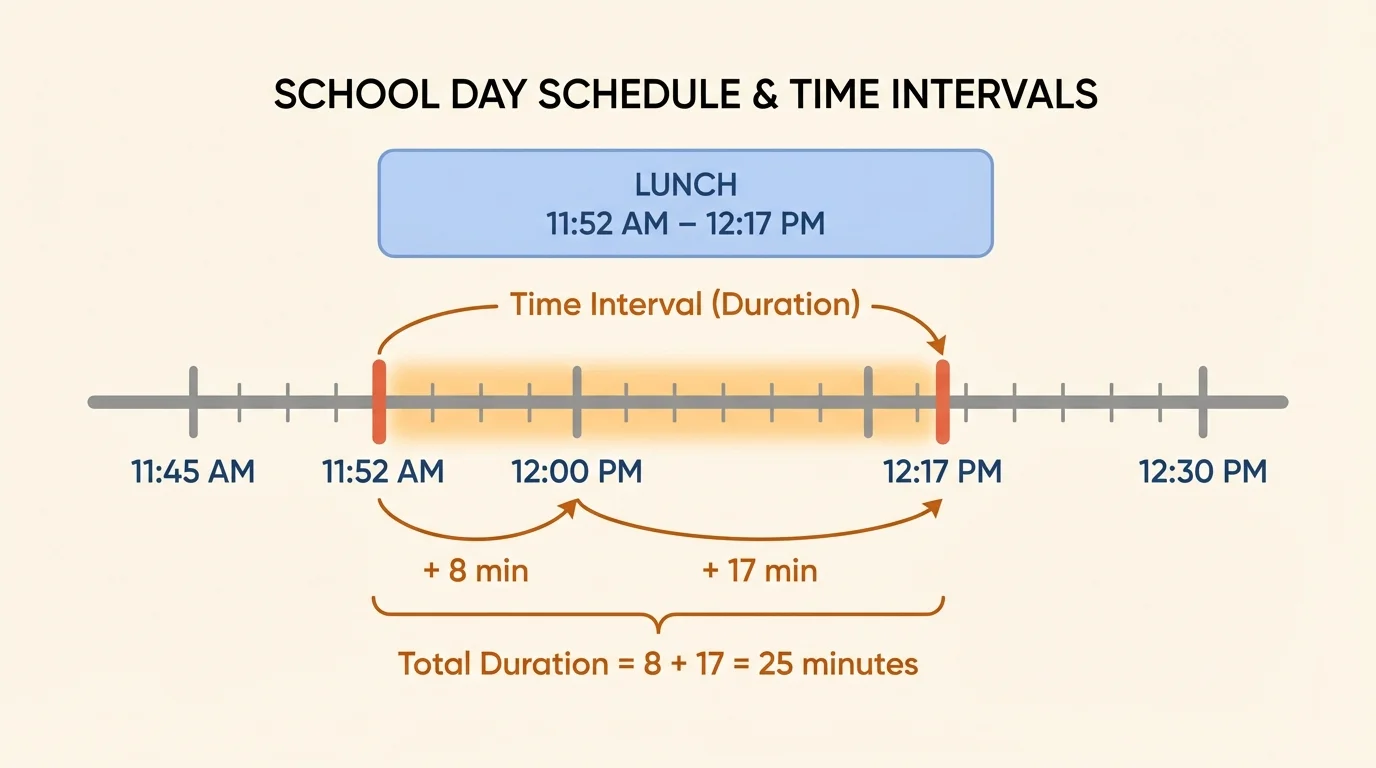
[Figure 3] Time problems become easier when you connect them to real life. Students and adults use time to manage lunch, practice, travel, homework, and rest.
A school schedule can show time intervals that appear in everyday routines.
Here are some common situations:
Cooking: Soup starts heating at 5:14 and cooks for 26 minutes. From 5:14 to 5:20 is 6 minutes. Then 20 minutes more brings the time to 5:40. The soup is ready at 5:40.
Sports: Practice starts at 4:47 and ends at 5:19. From 4:47 to 5:00 is 13 minutes, and from 5:00 to 5:19 is 19 minutes. Since \(13 + 19 = 32\), practice lasts 32 minutes.
School: Lunch begins at 11:52 and ends at 12:17. From 11:52 to 12:00 is 8 minutes, and from 12:00 to 12:17 is 17 minutes. The total is 25 minutes. The schedule highlights this kind of interval.
Travel: A bus leaves at 7:28 and arrives at 7:54. The ride lasts 26 minutes because \(54 - 28 = 26\).
Many digital devices, like microwaves and tablets, show time exactly to the minute, but analog clocks help you see how time moves. That is why learning both kinds of clocks is so useful.
One common mistake is mixing up the hour hand and the minute hand. The short hand is the hour hand. The long hand is the minute hand.
Another mistake is counting only by 5s and forgetting the extra small marks. If the minute hand is three small marks after the 8, the minutes are not just 40. They are 43 because \(40 + 3 = 43\).
A third mistake is forgetting to change the hour after passing \(:59\). For example, 2:58 plus 5 minutes is not 2:63. It is 3:03.
You can check your answer by asking whether it makes sense. If an activity lasts less than 10 minutes, the ending time should not be much later. If it lasts about half an hour, the time should move forward by about 30 minutes.
It also helps to estimate. For example, from 6:31 to 7:02 is a little more than 30 minutes. Counting exactly gives 29 minutes to 7:00 and then 2 more minutes to 7:02, for a total of 31 minutes. Estimating first can help catch mistakes like this.
| Situation | What You Know | What You Need to Find | Helpful Method |
|---|---|---|---|
| Start time and end time | Two clock times | Elapsed time | Count on or use a number line |
| Start time and minutes later | Beginning and duration | Ending time | Add minutes by counting on |
| End time and minutes before | Ending and duration | Starting time | Subtract minutes by counting back |
Table 1. Different types of time problems and helpful ways to solve them.
When you understand clocks, intervals, and number line jumps, time becomes something you can measure carefully. Minute by minute, you can solve everyday problems with confidence.
