Have you ever heard someone say there were about \(100\) people at a game, even if no one counted exactly? That is rounding. People round numbers all the time because rounded numbers are faster to say, easier to remember, and helpful when we only need a close answer. Rounding is not guessing wildly. It uses math rules and place value to find a number that is close and makes sense.
Rounding helps us work with big numbers more easily. A store worker may say a shelf holds about \(200\) books. A teacher may say the class read about \(50\) pages. A sports announcer may say a player ran nearly \(100\) yards in a game. In each case, the rounded number gives a quick, useful idea of the amount.
When we round, we do not change a number randomly. We look at where the number is on the number line and decide which ten or hundred it is closest to. That is why place value is so important.
You already know that in a two-digit number, the digit on the right is the ones digit and the digit to its left is the tens digit. In a three-digit number, the hundreds digit is to the left of the tens digit.
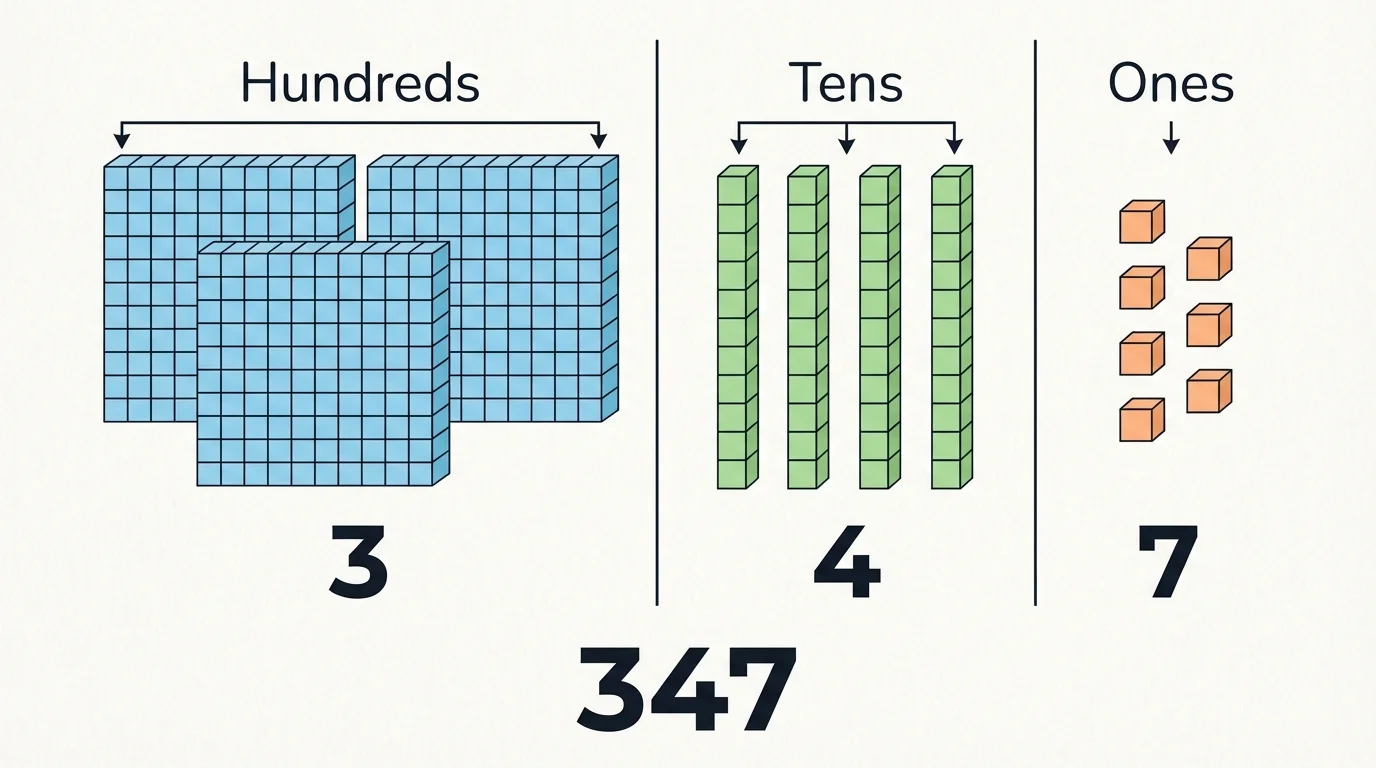
For example, in \(58\), the \(5\) means \(5\) tens, or \(50\), and the \(8\) means \(8\) ones. In \(243\), the \(2\) means \(2\) hundreds, or \(200\), the \(4\) means \(4\) tens, or \(40\), and the \(3\) means \(3\) ones.
In our base-ten system, each digit has a value based on its position, as [Figure 1] shows with hundreds, tens, and ones. This is why the digit \(4\) in \(347\) means \(40\), not just \(4\).
The place values we use most in this lesson are ones, tens, and hundreds. These place values help us decide how to round. If we want to round to the nearest \(10\), we look at the ones place. If we want to round to the nearest \(100\), we look at the tens place.
Rounding means changing a number to a nearby number that is easier to use. Nearest means closest. A benchmark number is a number such as \(10\), \(20\), \(100\), or \(300\) that helps us compare and round.
Think about the number \(347\). If you round it to the nearest \(10\), you compare it to \(340\) and \(350\). If you round it to the nearest \(100\), you compare it to \(300\) and \(400\). The number itself stays in the same place on the number line, but the rounded form becomes a nearby benchmark number.
Rounding asks a simple question: which benchmark number is closer? If a number is closer to one ten than another ten, it rounds to that ten. If it is closer to one hundred than another hundred, it rounds to that hundred.
Sometimes a number is exactly halfway between two benchmark numbers. For example, \(45\) is halfway between \(40\) and \(50\). Also, \(250\) is halfway between \(200\) and \(300\). In school math, when a number is exactly halfway, we round up to the greater ten or hundred.
The halfway rule is very important. If the digit you check is \(5\) or more, round up. If it is \(4\) or less, round down. Rounding down does not mean making the number smaller in every digit. It means choosing the lower benchmark number.
For nearest \(10\), the digit we check is the ones digit. For nearest \(100\), the digit we check is the tens digit. This works because those digits tell us whether the number is past the halfway point.
To round a whole number to the nearest \(10\), look at the ones digit.
If the ones digit is \(0, 1, 2, 3, 4\), round down to the smaller ten. If the ones digit is \(5, 6, 7, 8, 9\), round up to the next ten.
Here are some quick examples:
Notice that when we round to the nearest \(10\), the ones digit in the answer is always \(0\). That makes sense because every multiple of \(10\) ends in \(0\).
Numbers ending in \(5\) are special in rounding because they sit exactly halfway between two tens. That is why \(35\) rounds to \(40\), not \(30\).
We can also describe rounding with place value words. In \(68\), the \(6\) means \(6\) tens. The ones digit is \(8\), so the number is closer to \(70\) than to \(60\). So \(68\) rounds to \(70\).
To round a whole number to the nearest \(100\), look at the tens digit.
If the tens digit is \(0, 1, 2, 3, 4\), round down to the smaller hundred. If the tens digit is \(5, 6, 7, 8, 9\), round up to the next hundred.
Here are some quick examples:
When we round to the nearest \(100\), the tens and ones digits in the answer are both \(0\). That happens because every multiple of \(100\) ends in \(00\).
Use the place-value chart idea from [Figure 1] to help you remember what to check. Nearest \(10\) means check the ones. Nearest \(100\) means check the tens.
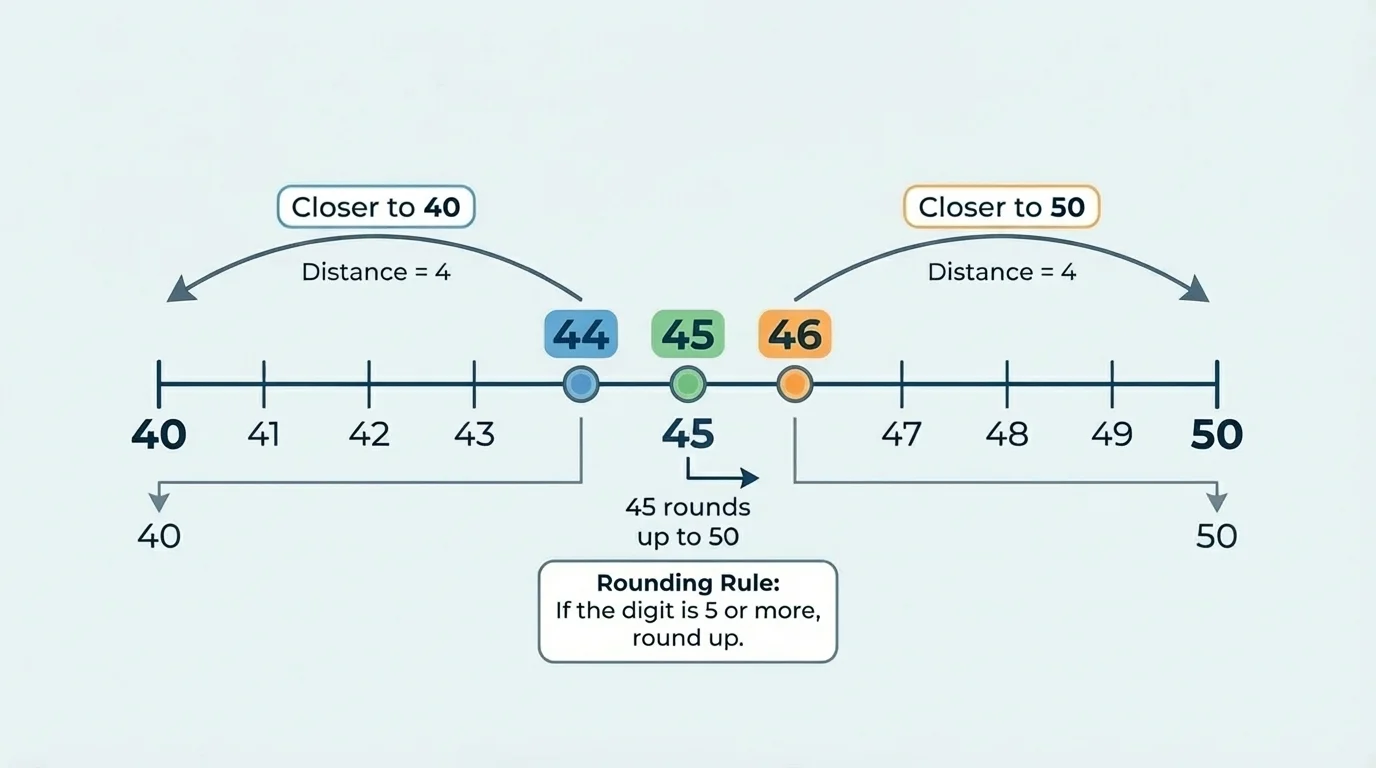
A number line helps us see rounding clearly, as [Figure 2] illustrates with numbers between \(40\) and \(50\). On a number line, the nearest ten is the endpoint that is closer to the number you are rounding.
Suppose we round \(44\) to the nearest \(10\). The two tens around it are \(40\) and \(50\). Since \(44\) is only \(4\) away from \(40\) and \(6\) away from \(50\), it rounds to \(40\).
Now think about \(46\). It is \(6\) away from \(40\) and \(4\) away from \(50\). So \(46\) rounds to \(50\). The midpoint is \(45\), and any number at \(45\) or above rounds up to \(50\).
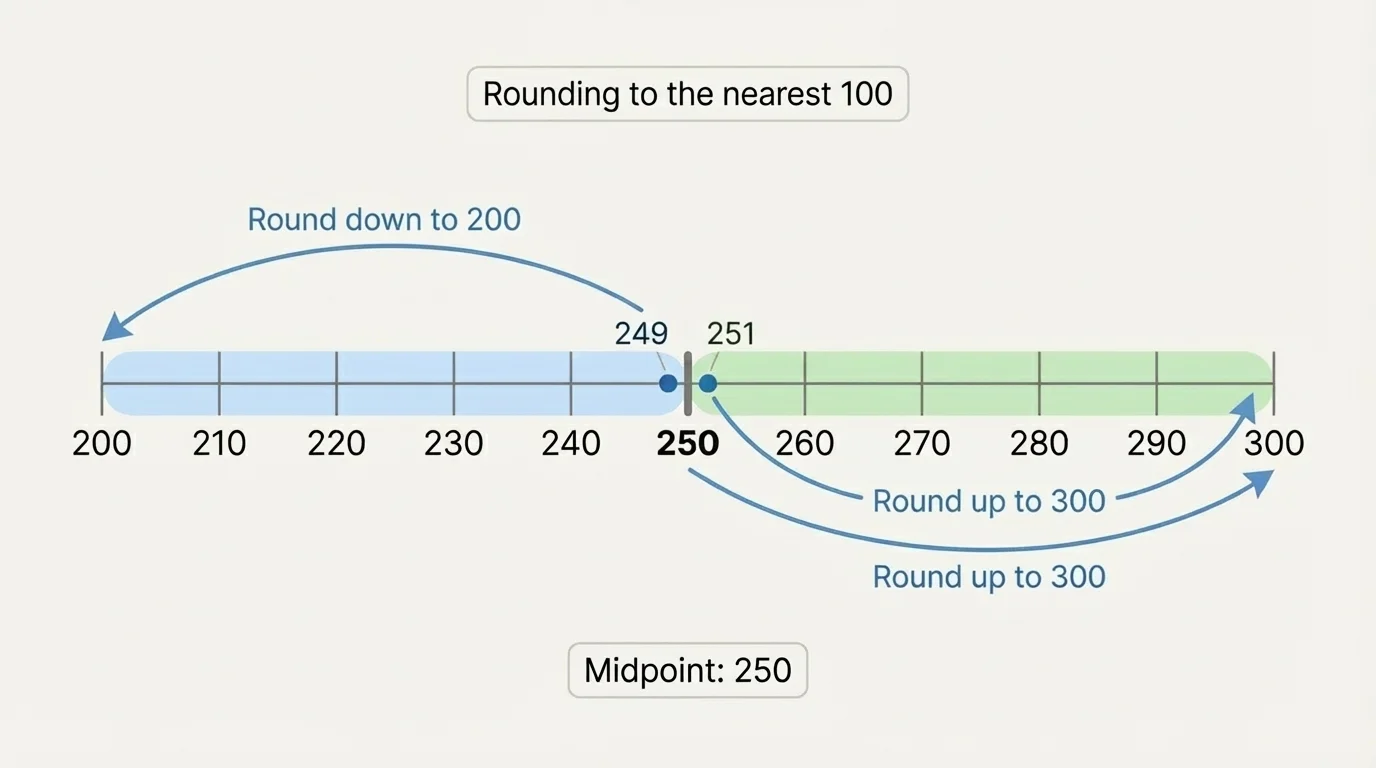
The same idea works for hundreds, as [Figure 3] shows. When rounding to the nearest \(100\), we find the two hundreds around the number and see which one is closer.
For example, \(234\) is between \(200\) and \(300\). The midpoint is \(250\). Since \(234\) is less than \(250\), it is closer to \(200\), so it rounds to \(200\).
But \(267\) is greater than \(250\), so it is closer to \(300\), and it rounds to \(300\). The number line helps us see that the tens digit tells whether the number is below or above the halfway point.
Let us work through some examples slowly and carefully.
Worked example 1
Round \(72\) to the nearest \(10\).
Step 1: Find the digit to check.
To round to the nearest \(10\), check the ones digit. In \(72\), the ones digit is \(2\).
Step 2: Use the rounding rule.
Since \(2\) is less than \(5\), round down to the smaller ten.
Step 3: Write the rounded number.
The smaller ten is \(70\).
\[72 \approx 70\]
This answer makes sense because \(72\) is much closer to \(70\) than to \(80\).
Worked example 2
Round \(168\) to the nearest \(10\).
Step 1: Find the digit to check.
To round to the nearest \(10\), check the ones digit. In \(168\), the ones digit is \(8\).
Step 2: Use the rounding rule.
Since \(8\) is \(5\) or more, round up to the next ten.
Step 3: Write the rounded number.
The next ten after \(168\) is \(170\).
\[168 \approx 170\]
Notice that even though the tens digit stays \(7\) in the rounded answer, the reason we rounded up came from the ones digit.
Worked example 3
Round \(341\) to the nearest \(100\).
Step 1: Find the digit to check.
To round to the nearest \(100\), check the tens digit. In \(341\), the tens digit is \(4\).
Step 2: Use the rounding rule.
Since \(4\) is less than \(5\), round down to the smaller hundred.
Step 3: Write the rounded number.
The smaller hundred is \(300\).
\[341 \approx 300\]
That result matches the number-line idea because \(341\) is less than the midpoint \(350\).
Worked example 4
Round \(286\) to the nearest \(100\).
Step 1: Find the digit to check.
To round to the nearest \(100\), check the tens digit. In \(286\), the tens digit is \(8\).
Step 2: Use the rounding rule.
Since \(8\) is \(5\) or more, round up to the next hundred.
Step 3: Write the rounded number.
The next hundred after \(286\) is \(300\).
\[286 \approx 300\]
The midpoint between \(200\) and \(300\) is \(250\), so the number line in [Figure 3] helps explain why \(286\) rounds up.
One common mistake is checking the wrong digit. If you are rounding to the nearest \(10\), do not look at the tens digit. Look at the ones digit. If you are rounding to the nearest \(100\), do not look at the ones digit. Look at the tens digit.
Another mistake is forgetting what the rounded answer should look like. A number rounded to the nearest \(10\) must end in \(0\). A number rounded to the nearest \(100\) must end in \(00\).
| What you are rounding to | Digit to check | What the answer looks like |
|---|---|---|
| Nearest \(10\) | Ones digit | Ends in \(0\) |
| Nearest \(100\) | Tens digit | Ends in \(00\) |
Table 1. A quick guide to which digit to check when rounding.
Here is a smart check: ask whether the rounded number is reasonable. For \(63\), an answer of \(600\) cannot be correct because that changes the number far too much. But \(60\) makes sense when rounding to the nearest \(10\).
Rounding changes the name, not the size very much. A rounded number should still be close to the original number. If the answer seems far away, check whether you rounded to the wrong place or looked at the wrong digit.
Another good check is to use a number line in your head. Ask, "What two tens is this number between?" or "What two hundreds is this number between?" Then decide which one is closer, just as we saw with [Figure 2].
Rounding is useful in everyday life because exact numbers are not always needed. Suppose a library has \(389\) books in one section. A librarian might say there are about \(400\) books. That is rounding to the nearest \(100\).
If a class collects \(47\) cans of food, a teacher might say the class collected about \(50\) cans. That is rounding to the nearest \(10\). The rounded number is easier to share quickly, but it is still close to the exact amount.
Even travel uses rounding. If a park is \(92\) miles away, someone may say it is about \(90\) miles away. If a town has \(1,248\) people, a news report might say about \(1,200\) people or about \(1,250\) people depending on what kind of estimate is needed.
Real-world example
A school raised \(257\) dollars for a fundraiser. About how much is that to the nearest \(100\)?
Step 1: Decide the place.
We are rounding to the nearest \(100\), so we check the tens digit.
Step 2: Check the tens digit.
In \(257\), the tens digit is \(5\).
Step 3: Round.
Since \(5\) means halfway or more, round up to \(300\).
\[257 \approx 300\]
Rounded numbers are especially helpful when we want a fast estimate instead of an exact count. That is why rounding is part of many jobs and daily tasks.
When you round, follow the same routine each time. First, decide whether you are rounding to the nearest \(10\) or \(100\). Next, find the digit to check. Then use the rule: if the digit is \(0, 1, 2, 3, 4\), round down, and if it is \(5, 6, 7, 8, 9\), round up. Finally, make sure the answer has the correct number of zeros.
With practice, rounding becomes quick because place value gives you a clear path. Instead of trying to memorize many separate facts, you can trust the same idea again and again: look at the place just to the right of the place you are rounding to.
