If one sandwich is shared among \(4\) children, each child does not get a random piece. Each child should get an equal share. That simple idea is the start of fractions. Fractions help us talk about parts of a whole in a fair and exact way. When we cut, split, or share something into equal parts, math gives those parts names like \(\dfrac{1}{2}\), \(\dfrac{1}{3}\), and \(\dfrac{3}{4}\).
Fractions are numbers. They are not just pieces of pizza or slices of cake. They tell how much of a whole we have. When you understand fractions, you can describe part of a cookie, part of a group, or part of a strip of paper with clear math language.
We use fractions all the time. If you drink half a bottle of water, you drank \(\dfrac{1}{2}\) of it. If a game has \(4\) quarters and you have finished \(3\) of them, you have finished \(\dfrac{3}{4}\) of the game. If a chocolate bar is broken into \(8\) equal pieces and you eat \(2\), you ate \(\dfrac{2}{8}\) of the bar.
In all of these examples, the whole is important. The whole might be one sandwich, one bottle, one candy bar, or one group. A fraction only makes sense when we know what the whole is.
You already know how to count objects and how to divide a shape into parts. Fractions build on those ideas. Now the parts must be equal, and we use a special way to name them.
When the parts are equal, each part has the same size. If one piece is bigger and another is smaller, the pieces do not make a correct fraction model for that whole.
A fraction names a part of a whole or a part of a group. Fractions are written with two numbers. For example, \(\dfrac{3}{5}\) is a fraction.
The bottom number is called the denominator. In \(\dfrac{3}{5}\), the denominator is \(5\). It tells how many equal parts the whole is split into.
The top number is called the numerator. In \(\dfrac{3}{5}\), the numerator is \(3\). It tells how many of those equal parts we are talking about.
Whole: the complete object, amount, or group.
Equal parts: parts that are the same size.
Denominator: the number of equal parts in the whole.
Numerator: the number of equal parts being counted.
So in \(\dfrac{3}{5}\), the whole is split into \(5\) equal parts, and we are counting \(3\) of those parts.
A unit fraction is a fraction with \(1\) on top. It means one part of a whole that has been split into equal parts. As [Figure 1] shows, when one whole is partitioned into equal parts, one shaded piece can be named using a unit fraction.
If a whole is partitioned into \(b\) equal parts, then one part is \(\dfrac{1}{b}\). The letter \(b\) stands for any whole number greater than \(0\). This means:
If a whole is split into \(2\) equal parts, one part is \(\dfrac{1}{2}\); if a whole is split into \(3\) equal parts, one part is \(\dfrac{1}{3}\); if a whole is split into \(4\) equal parts, one part is \(\dfrac{1}{4}\).
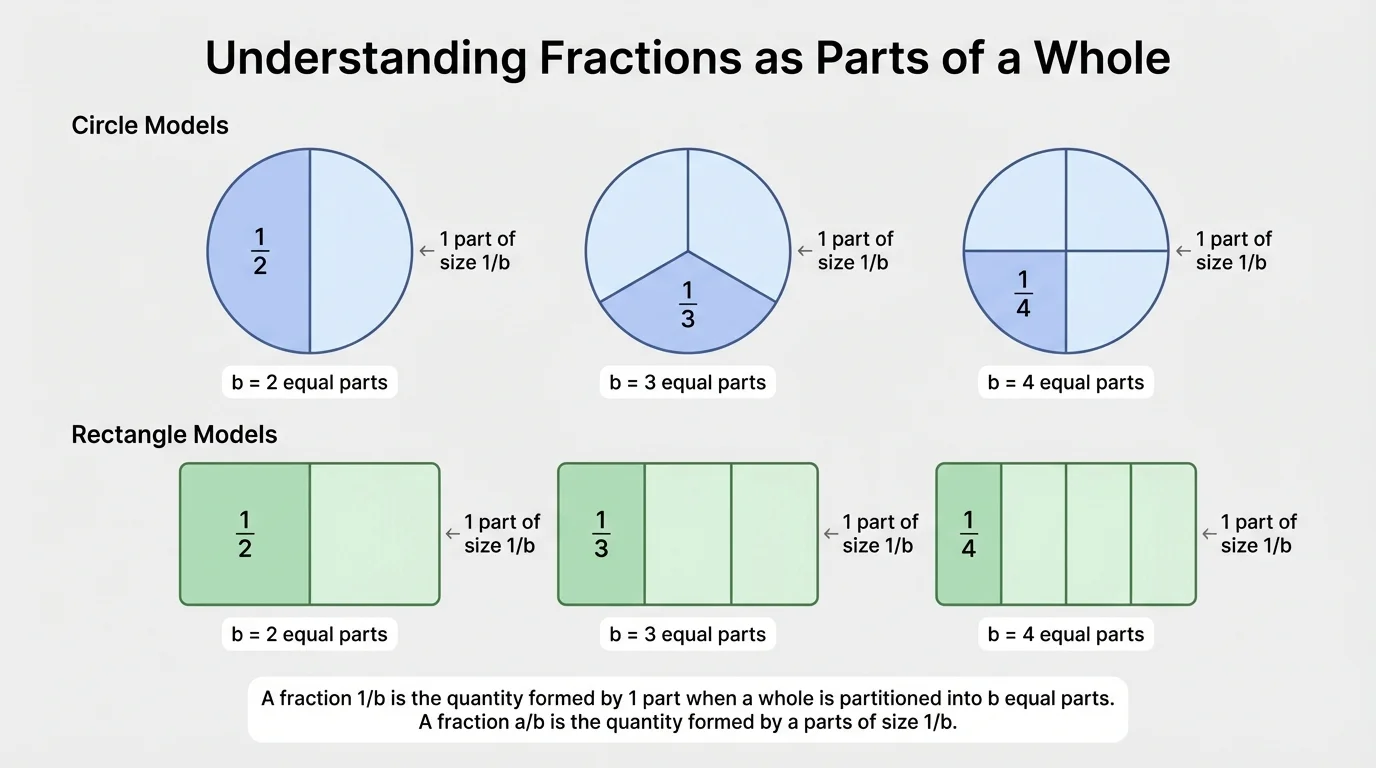
This idea is very important: \(\dfrac{1}{4}\) does not mean just any small piece. It means exactly one of \(4\) equal parts. The denominator tells the number of equal parts in the whole.
Here are some examples:
The more equal parts the whole is divided into, the smaller each part becomes. For example, \(\dfrac{1}{8}\) is smaller than \(\dfrac{1}{4}\) because a whole cut into \(8\) equal parts makes smaller pieces than a whole cut into \(4\) equal parts.
A brownie cut into \(8\) equal pieces gives smaller pieces than the same brownie cut into \(4\) equal pieces, even though both brownies started as the same whole.
That is why the denominator matters so much. It tells how many equal pieces the whole has been divided into, and that changes the size of each piece.
Once you know what \(\dfrac{1}{b}\) means, you can understand any fraction of the form \(\dfrac{a}{b}\). As [Figure 2] illustrates, \(\dfrac{a}{b}\) means \(a\) parts, and each part has size \(\dfrac{1}{b}\).
Think of \(\dfrac{a}{b}\) as counting unit fractions. For example, \(\dfrac{3}{4}\) means \(3\) parts of size \(\dfrac{1}{4}\). You can write that as:
\[\frac{3}{4} = \frac{1}{4} + \frac{1}{4} + \frac{1}{4}\]
In the same way, \(\dfrac{5}{6}\) means \(5\) parts of size \(\dfrac{1}{6}\):
\[\frac{5}{6} = \frac{1}{6} + \frac{1}{6} + \frac{1}{6} + \frac{1}{6} + \frac{1}{6}\]
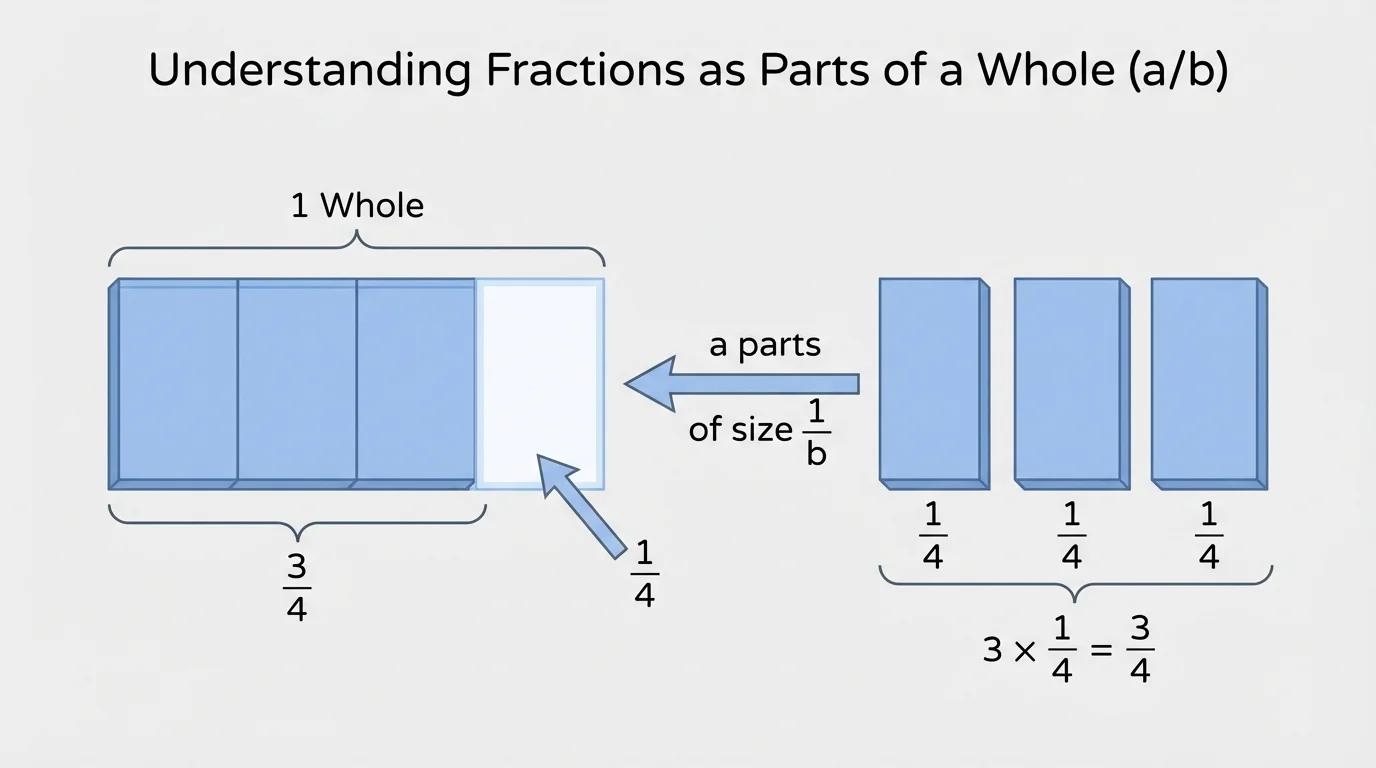
This helps us see the jobs of the two numbers. The denominator \(b\) tells the size of each part: each part is \(\dfrac{1}{b}\). The numerator \(a\) tells how many of those parts we have.
If a rectangle is divided into \(8\) equal parts and \(5\) are shaded, the shaded part is \(\dfrac{5}{8}\). Each small part is \(\dfrac{1}{8}\), and there are \(5\) of them shaded.
We can also think of fractions by counting equal jumps in size. Three pieces of size \(\dfrac{1}{5}\) make \(\dfrac{3}{5}\). Four pieces of size \(\dfrac{1}{7}\) make \(\dfrac{4}{7}\).
Fractions are built from unit fractions. A unit fraction such as \(\dfrac{1}{6}\) is like one building block. If you put together \(4\) of those blocks, you get \(\dfrac{4}{6}\). This is why understanding \(\dfrac{1}{b}\) helps you understand every fraction \(\dfrac{a}{b}\).
Later, when you learn more about number lines and equivalent fractions, this idea will keep helping you. For now, the big idea is that \(\dfrac{a}{b}\) is made from \(a\) equal parts, each of size \(\dfrac{1}{b}\).
Fractions can describe more than just a shape, as [Figure 3] shows. They can also describe part of a set of objects, as long as the whole set is clear.
Suppose there are \(6\) apples in a basket and \(2\) are red. Then \(\dfrac{2}{6}\) of the apples are red. The whole is the set of \(6\) apples. The denominator \(6\) tells the total number of items in the set, and the numerator \(2\) tells how many are being counted.
Fractions with shapes work the same way. If a rectangle is split into \(6\) equal boxes and \(2\) are shaded, then \(\dfrac{2}{6}\) of the rectangle is shaded.
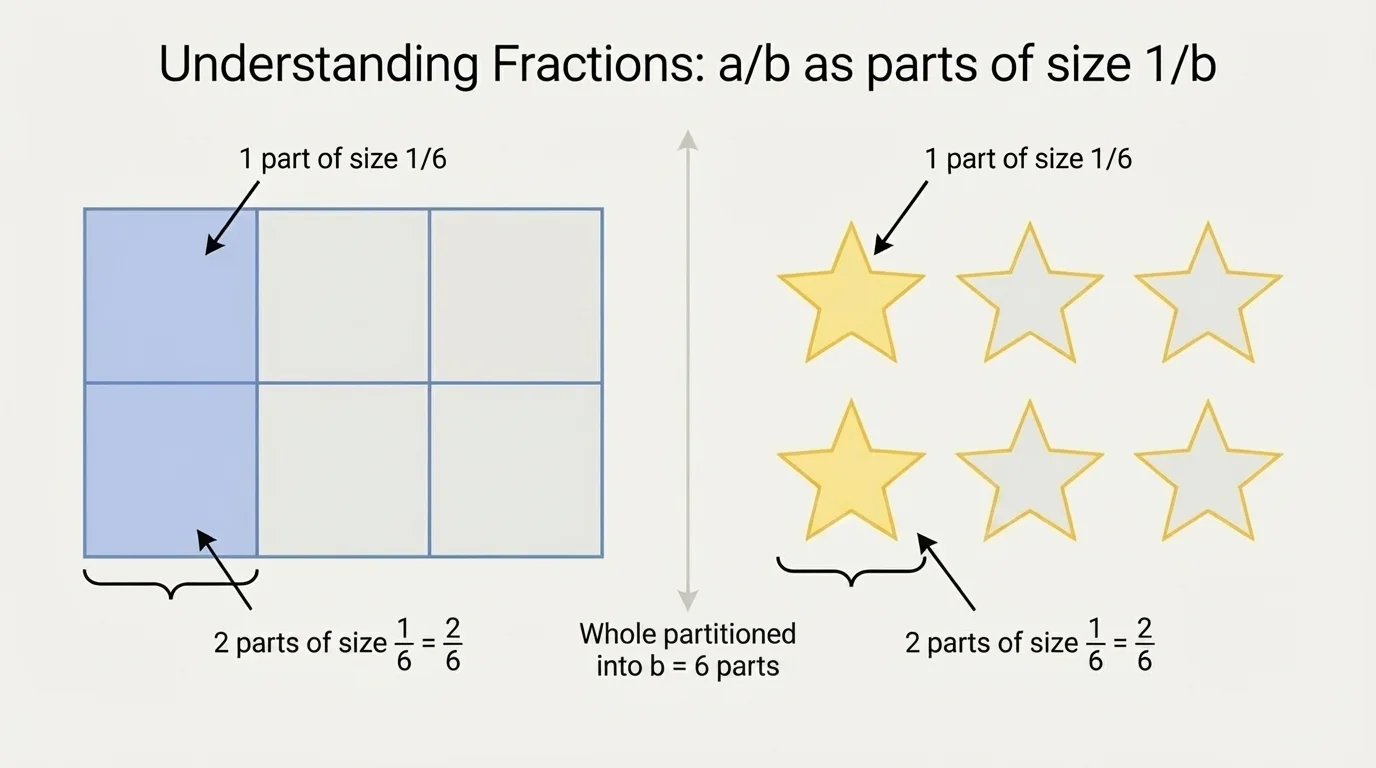
This means the same fraction can appear in different ways. It can be part of a shape, part of a group, or part of a length model. The important idea is still the same: the whole must be known, and the parts or items being counted must match that whole.
Notice that \(\dfrac{2}{6}\) in a shape model and \(\dfrac{2}{6}\) in a set model both mean \(2\) out of \(6\), but the whole is different in each case. In one case the whole is one shape. In the other case the whole is one set of objects.
Thinking carefully about the whole helps avoid mistakes. If the whole changes, the fraction can change too.
Worked examples help us see exactly how fractions are named and understood.
Worked Example 1
A pizza is cut into \(4\) equal slices. You take \(1\) slice. What fraction of the pizza do you have?
Step 1: Find the denominator.
The pizza is cut into \(4\) equal slices, so the denominator is \(4\).
Step 2: Find the numerator.
You have \(1\) slice, so the numerator is \(1\).
Step 3: Write the fraction.
\[\frac{1}{4}\]
You have one fourth of the pizza.
In this example, each slice has size \(\dfrac{1}{4}\) because the whole pizza was split into \(4\) equal parts.
Worked Example 2
A strip of paper is divided into \(5\) equal parts. \(3\) parts are colored blue. What fraction of the strip is blue?
Step 1: Name the size of one part.
One part is \(\dfrac{1}{5}\) because the strip is divided into \(5\) equal parts.
Step 2: Count how many parts are blue.
\(3\) parts are blue.
Step 3: Write the fraction.
\[\frac{3}{5}\]
The blue part of the strip is three fifths.
You can also think of this as \(\dfrac{1}{5} + \dfrac{1}{5} + \dfrac{1}{5} = \dfrac{3}{5}\).
Worked Example 3
There are \(8\) crayons in a box. \(6\) are unbroken. What fraction of the crayons are unbroken?
Step 1: Identify the whole.
The whole set is \(8\) crayons, so the denominator is \(8\).
Step 2: Count the part you want.
\(6\) crayons are unbroken, so the numerator is \(6\).
Step 3: Write the fraction.
\[\frac{6}{8}\]
The fraction of crayons that are unbroken is six eighths.
Even though this example uses a set instead of a shape, the meaning of numerator and denominator stays the same.
Worked Example 4
A brownie pan is cut into \(6\) equal pieces. Mia eats \(2\) pieces. What fraction of the brownie pan did Mia eat?
Step 1: Find one piece.
One piece is \(\dfrac{1}{6}\).
Step 2: Count the pieces Mia ate.
Mia ate \(2\) pieces, each of size \(\dfrac{1}{6}\).
Step 3: Combine the unit fractions.
\(\dfrac{1}{6} + \dfrac{1}{6} = \dfrac{2}{6}\)
Step 4: State the answer.
\[\frac{2}{6}\]
Mia ate two sixths of the brownie pan.
As we saw earlier in [Figure 2], larger fractions with the same denominator are made by joining more unit fractions of the same size.
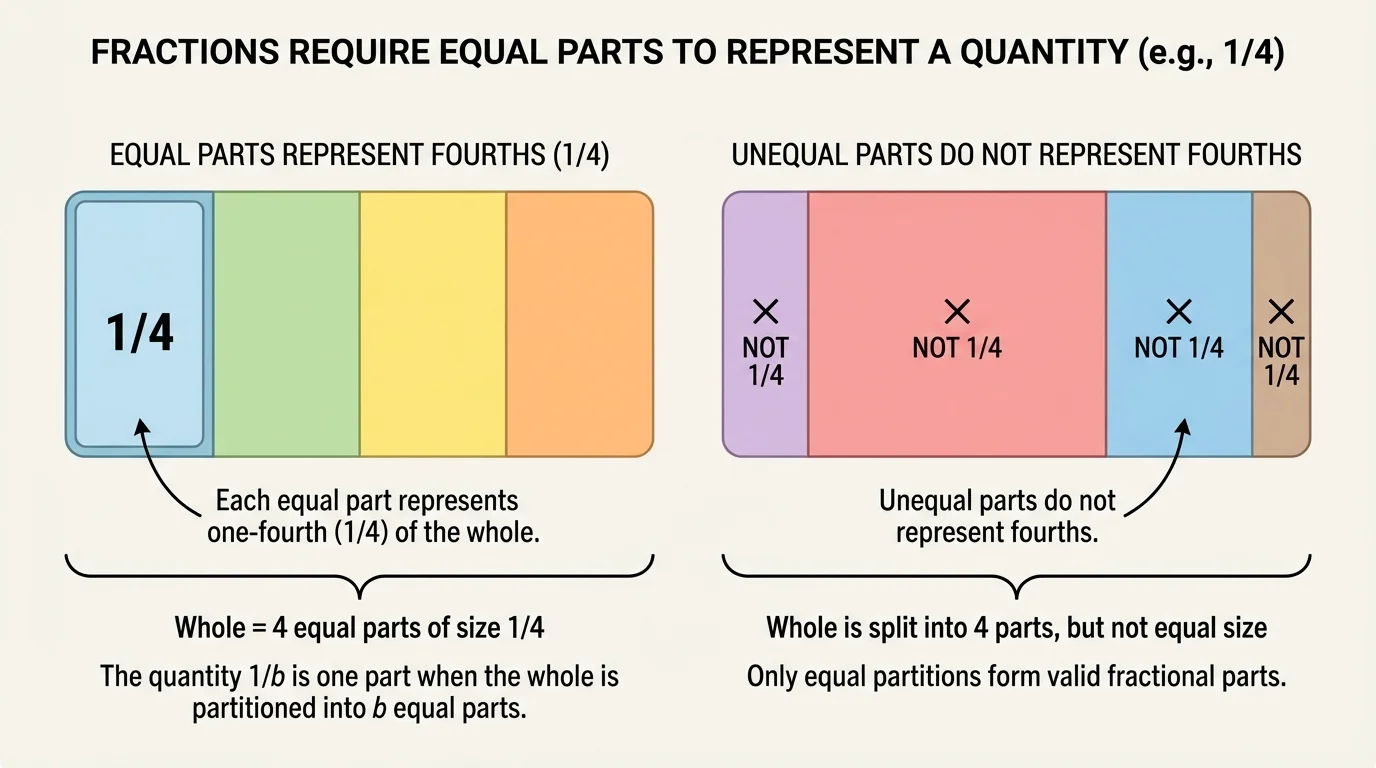
As [Figure 4] makes clear, one big mistake is forgetting that fraction parts must be equal. As [Figure 4] makes clear, a shape split into pieces of different sizes does not show correct fraction parts like fourths or thirds.
For example, if a rectangle is split into \(4\) pieces but one piece is much larger than the others, those are not \(4\) equal parts. So one piece is not \(\dfrac{1}{4}\) of the whole.
Another mistake is mixing up numerator and denominator. Remember: the denominator tells how many equal parts the whole has. The numerator tells how many of those parts are being counted.
A third mistake is changing the whole without noticing. If \(2\) slices are taken from a pizza cut into \(8\) equal slices, that is \(\dfrac{2}{8}\) of the whole pizza. But if the whole changes and now we only talk about \(4\) slices left on a plate, then \(2\) slices out of those \(4\) would be \(\dfrac{2}{4}\) of that new whole.
That is why good fraction thinking always starts with the question, "What is the whole?"
Fractions help people share fairly. If \(3\) children share a sandwich cut into \(3\) equal parts, each child gets \(\dfrac{1}{3}\) of the sandwich. If one child gets \(2\) of those equal parts, that child gets \(\dfrac{2}{3}\).
Fractions also appear in time. An hour can be thought of as a whole. If the hour is split into \(4\) equal parts, each part is \(\dfrac{1}{4}\) of an hour. That means \(15\) minutes is \(\dfrac{1}{4}\) of an hour, and \(30\) minutes is \(\dfrac{2}{4}\) of an hour.
Sports use fractions too. If a basketball player makes \(5\) shots out of \(8\) tries, that can be described as \(\dfrac{5}{8}\) of the shots made. The whole is the set of \(8\) tries.
Music uses fraction ideas when notes last for parts of a measure, and cooking uses them when recipes ask for part of a cup. Understanding equal parts makes these ideas easier later on.
"A fraction tells how many equal parts of a whole are being counted."
This sentence is a strong rule to remember whenever you read or write a fraction.
Fractions with the same denominator are built from the same-sized pieces. For example, \(\dfrac{1}{5}\), \(\dfrac{2}{5}\), \(\dfrac{3}{5}\), and \(\dfrac{4}{5}\) all use pieces of size \(\dfrac{1}{5}\).
You can think of them like this:
So the denominator stays the same because the size of each part stays the same. The numerator changes because the number of counted parts changes.
This is the same pattern we saw in [Figure 1] and later built on in [Figure 2]: start with one equal part, then count how many such parts you have.
| Fraction | Meaning | Repeated Unit Fraction |
|---|---|---|
| \(\dfrac{1}{4}\) | one part when the whole is split into \(4\) equal parts | \(\dfrac{1}{4}\) |
| \(\dfrac{2}{4}\) | two parts of size \(\dfrac{1}{4}\) | \(\dfrac{1}{4} + \dfrac{1}{4}\) |
| \(\dfrac{3}{4}\) | three parts of size \(\dfrac{1}{4}\) | \(\dfrac{1}{4} + \dfrac{1}{4} + \dfrac{1}{4}\) |
| \(\dfrac{4}{4}\) | four parts of size \(\dfrac{1}{4}\) | \(\dfrac{1}{4} + \dfrac{1}{4} + \dfrac{1}{4} + \dfrac{1}{4}\) |
Table 1. Fractions with denominator \(4\) shown as counts of unit fractions.
Tables like this help us see that fractions are organized and meaningful. They are not random symbols. Each one tells a clear story about equal parts of a whole.
When you look at any fraction, pause and ask three questions: What is the whole? Into how many equal parts is it divided? How many of those parts are being counted? If you can answer those questions, you understand the fraction's meaning.
For \(\dfrac{1}{b}\), the answer is simple: one part, when the whole is divided into \(b\) equal parts. For \(\dfrac{a}{b}\), the answer is: \(a\) parts, where each part is \(\dfrac{1}{b}\).
That is the heart of fraction understanding. Fractions name equal parts. Unit fractions name one equal part. Larger fractions count several of those equal parts together.
