What if you had a ribbon and divided it into \(4\) equal parts, then took \(3\) of those pieces and laid them end to end? You would have a length of \(\dfrac{3}{4}\). A fraction is not only part of a pizza or part of a shape. It is also a number, and every number has a place on the number line.
On a number line, whole numbers like \(0\), \(1\), and \(2\) each have their own locations. Fractions also have locations. That means \(\dfrac{1}{2}\), \(\dfrac{3}{4}\), and even \(\dfrac{5}{3}\) are numbers you can point to.
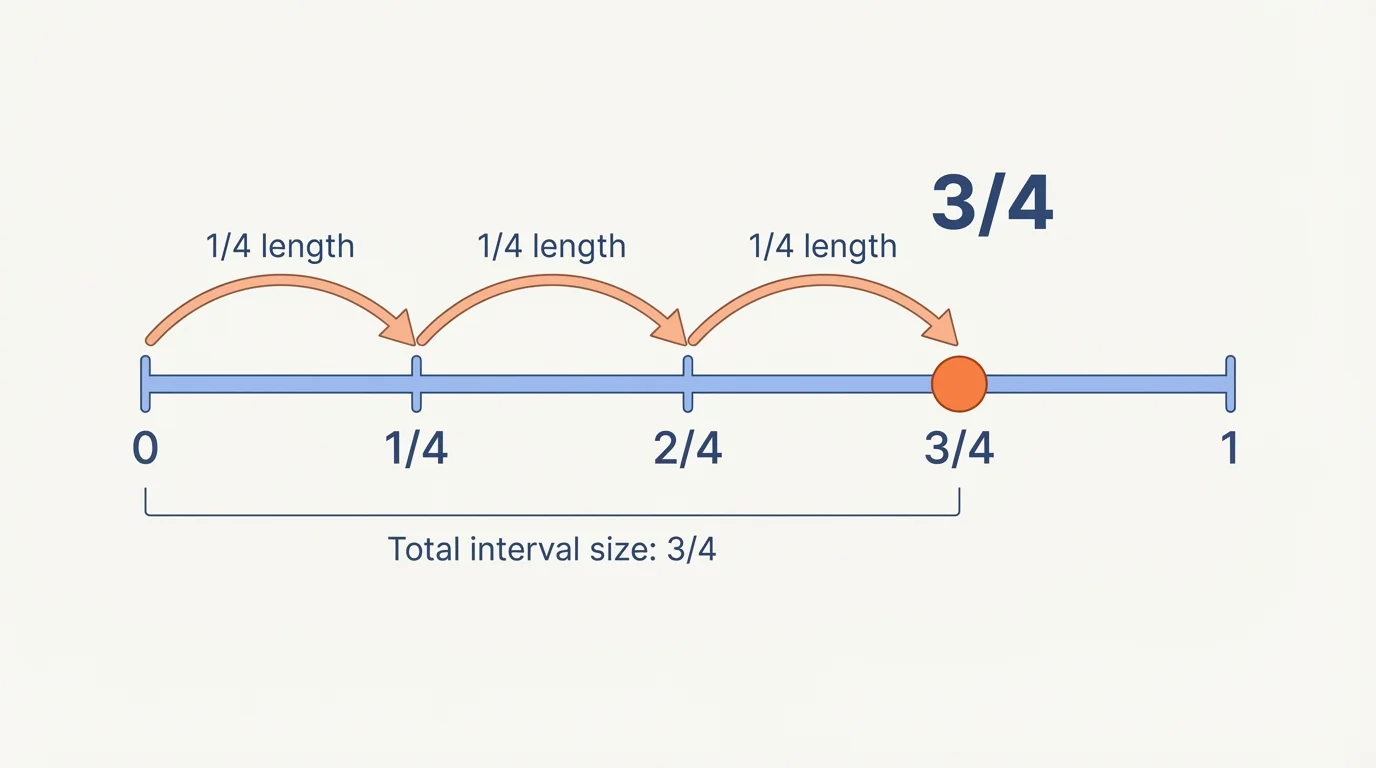
[Figure 1] A fraction represents a distance from \(0\). For example, \(\dfrac{1}{4}\) means one part when the space from \(0\) to \(1\) is split into \(4\) equal parts. Then \(\dfrac{2}{4}\) means two of those same parts, and \(\dfrac{3}{4}\) means three of those same parts.
So when you place a fraction on a number line, you are showing how far it is from \(0\). That distance is exactly what the fraction means.
You already know that a whole number can be shown on a number line by marking its spot. Fractions work the same way, but first you must divide the space between whole numbers into equal parts.
This idea is powerful because it connects fractions to measurement. If each small jump is the same size, then several jumps together make a bigger distance.
When we write \(\dfrac{a}{b}\), the bottom number \(b\) tells how many equal parts are in one whole. The top number \(a\) tells how many of those equal parts we count.
Denominator: the bottom number in a fraction. It tells how many equal parts make one whole.
Numerator: the top number in a fraction. It tells how many equal parts are being counted.
Unit fraction: a fraction with \(1\) on top, such as \(\dfrac{1}{2}\), \(\dfrac{1}{3}\), or \(\dfrac{1}{8}\). A unit fraction names one equal part.
Endpoint: the point where a marked distance stops on the number line.
Interval: the space or distance between two points on a number line.
If you know the unit fraction \(\dfrac{1}{b}\), then you can build many other fractions. For example, if one jump is \(\dfrac{1}{5}\), then \(2\) jumps make \(\dfrac{2}{5}\), \(3\) jumps make \(\dfrac{3}{5}\), and \(5\) jumps make \(\dfrac{5}{5} = 1\).
That is why unit fractions are so important. They are the small equal steps that help us find larger fractions.
A number line diagram helps us see this clearly. To place \(\dfrac{a}{b}\), start at \(0\). Then look at the denominator \(b\). Divide the space from \(0\) to \(1\) into \(b\) equal parts. Each part has length \(\dfrac{1}{b}\).
Next, use the numerator \(a\). Starting at \(0\), mark off \(a\) lengths of \(\dfrac{1}{b}\). The point where you stop is the location of \(\dfrac{a}{b}\) on the number line.
This means the interval from \(0\) to that point has size \(\dfrac{a}{b}\). The endpoint is not just a dot. It locates the number on the number line.
Here is the general idea written in math:
Each small part is \(\dfrac{1}{b}\).
After \(a\) equal parts, the total distance is
\[\frac{1}{b} + \frac{1}{b} + \frac{1}{b} + \cdots = \frac{a}{b}\]
where there are \(a\) copies of \(\dfrac{1}{b}\).
A fraction is a distance from zero. On a number line, \(\dfrac{a}{b}\) means you begin at \(0\) and move \(a\) equal jumps, each of size \(\dfrac{1}{b}\). The total distance traveled is the fraction, and the point where you land names that number.
This is different from just shading part of a picture. On a number line, the focus is on distance and location.
Let us place \(\dfrac{3}{4}\) on a number line.
Worked example 1
Step 1: Look at the denominator.
The denominator is \(4\), so divide the space from \(0\) to \(1\) into \(4\) equal parts.
Step 2: Name each small part.
Each part has length \(\dfrac{1}{4}\).
Step 3: Use the numerator.
The numerator is \(3\), so start at \(0\) and count \(3\) lengths of \(\dfrac{1}{4}\): \(\dfrac{1}{4}\), \(\dfrac{2}{4}\), \(\dfrac{3}{4}\).
Step 4: Mark the endpoint.
The third mark lands at \(\dfrac{3}{4}\).
The point is \(\dfrac{3}{4}\), and the whole interval from \(0\) to that point has size \(\dfrac{3}{4}\).
You can also think of this as adding unit fractions: \(\dfrac{1}{4} + \dfrac{1}{4} + \dfrac{1}{4} = \dfrac{3}{4}\). The dot at the end names the sum.
As you saw earlier in [Figure 1], the jumps are equal in size. Equal parts are the most important rule when placing fractions on a number line.
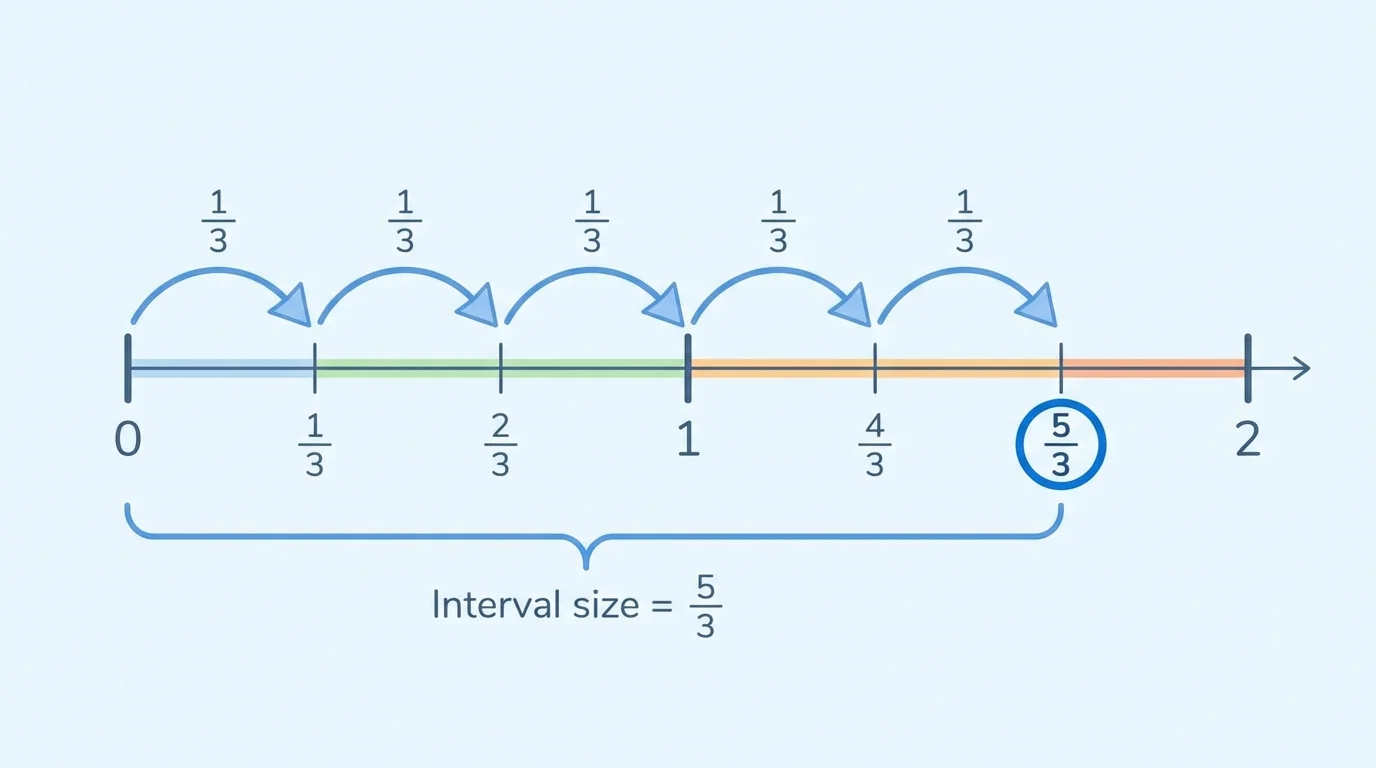
[Figure 2] Some fractions are greater than \(1\). The improper fraction \(\dfrac{5}{3}\) is one of them, and its point lies to the right of \(1\).
Worked example 2
Step 1: Look at the denominator.
The denominator is \(3\), so divide each whole into \(3\) equal parts.
Step 2: Start at \(0\) and mark off unit fractions.
Each jump is \(\dfrac{1}{3}\).
Step 3: Count \(5\) jumps.
From \(0\): \(\dfrac{1}{3}\), \(\dfrac{2}{3}\), \(\dfrac{3}{3} = 1\), \(\dfrac{4}{3}\), \(\dfrac{5}{3}\).
Step 4: Mark the endpoint.
After \(5\) jumps, the endpoint is \(\dfrac{5}{3}\).
The interval from \(0\) to that endpoint has size \(\dfrac{5}{3}\).
This example is important because it shows that fractions are not only between \(0\) and \(1\). Fractions can also be greater than \(1\).
Another way to think about it is that \(\dfrac{5}{3}\) is \(1\) whole and \(\dfrac{2}{3}\) more. On the number line, you move one full whole to reach \(1\), then move \(2\) more jumps of size \(\dfrac{1}{3}\).
When you compare this to fractions less than \(1\), the rule is still the same: divide into equal parts and count the correct number of parts.
Now let us place \(\dfrac{2}{6}\). This fraction has a denominator of \(6\), so the space from \(0\) to \(1\) must be divided into \(6\) equal parts.
Worked example 3
Step 1: Divide from \(0\) to \(1\) into \(6\) equal parts.
Each part has length \(\dfrac{1}{6}\).
Step 2: Count \(2\) parts from \(0\).
The first point is \(\dfrac{1}{6}\). The second point is \(\dfrac{2}{6}\).
Step 3: Mark the endpoint.
The endpoint after two equal jumps is \(\dfrac{2}{6}\).
The interval from \(0\) to the endpoint has size \(\dfrac{2}{6}\).
Even when a fraction can be renamed in a different way, its location on the number line stays the same. For example, \(\dfrac{2}{6}\) lands at the same point as \(\dfrac{1}{3}\). That means two jumps of size \(\dfrac{1}{6}\) make the same total distance as one jump of size \(\dfrac{1}{3}\).
Fractions on number lines help people in real jobs. Builders, bakers, and engineers all use equal parts and measured lengths when they work.
This makes number lines a great tool for seeing when two fractions name the same amount.
The endpoint is the point where your counting stops. If you marked off \(a\) lengths of \(\dfrac{1}{b}\), then the endpoint names the number \(\dfrac{a}{b}\).
Suppose you start at \(0\) and make \(4\) jumps of \(\dfrac{1}{5}\). The jumps are \(\dfrac{1}{5}\), \(\dfrac{2}{5}\), \(\dfrac{3}{5}\), and \(\dfrac{4}{5}\). The endpoint is \(\dfrac{4}{5}\), and the entire interval from \(0\) to that point has size \(\dfrac{4}{5}\).
This is the big idea: after \(a\) jumps of size \(\dfrac{1}{b}\), the endpoint is at \(\dfrac{a}{b}\).
That statement tells us two things at the same time. First, the interval from \(0\) has size \(\dfrac{a}{b}\). Second, the endpoint locates the number \(\dfrac{a}{b}\) on the number line.
Once fractions are placed on a number line, they can be compared. A point farther to the right is greater. A point farther to the left is smaller.
For example, \(\dfrac{1}{4}\) is to the left of \(\dfrac{3}{4}\), so \(\dfrac{1}{4} < \dfrac{3}{4}\). Also, \(\dfrac{5}{3}\) is to the right of \(1\), so \(\dfrac{5}{3} > 1\).
This is another reason number lines are helpful. They show order clearly. When fractions are placed correctly, you can see which one is greater just by looking at the positions.
The point \(\dfrac{5}{3}\) is to the right of \(1\), which makes it clear that this fraction is greater than one whole.
Fractions on number lines connect to measurement in everyday life. If a string is \(1\) meter long and is divided into \(4\) equal parts, then each part is \(\dfrac{1}{4}\) meter. A length of \(\dfrac{3}{4}\) meter means counting \(3\) of those equal parts from \(0\).
Think about a recipe. If one cup is the whole and you pour \(\dfrac{1}{3}\) cup at a time, then after \(2\) pours you have \(\dfrac{2}{3}\) cup. That is just like making two jumps of \(\dfrac{1}{3}\) on a number line.
In sports, a runner might complete \(\dfrac{1}{2}\) of a lap, then \(\dfrac{1}{4}\) more. Distances can be shown on a number line to keep track of how far the runner has gone from the start.
Fractions help measure real lengths. Number lines are like measuring tools. Every equal space stands for the same amount, so fractions show exact distances from a starting point.
That is why rulers are really number lines with many equal intervals.
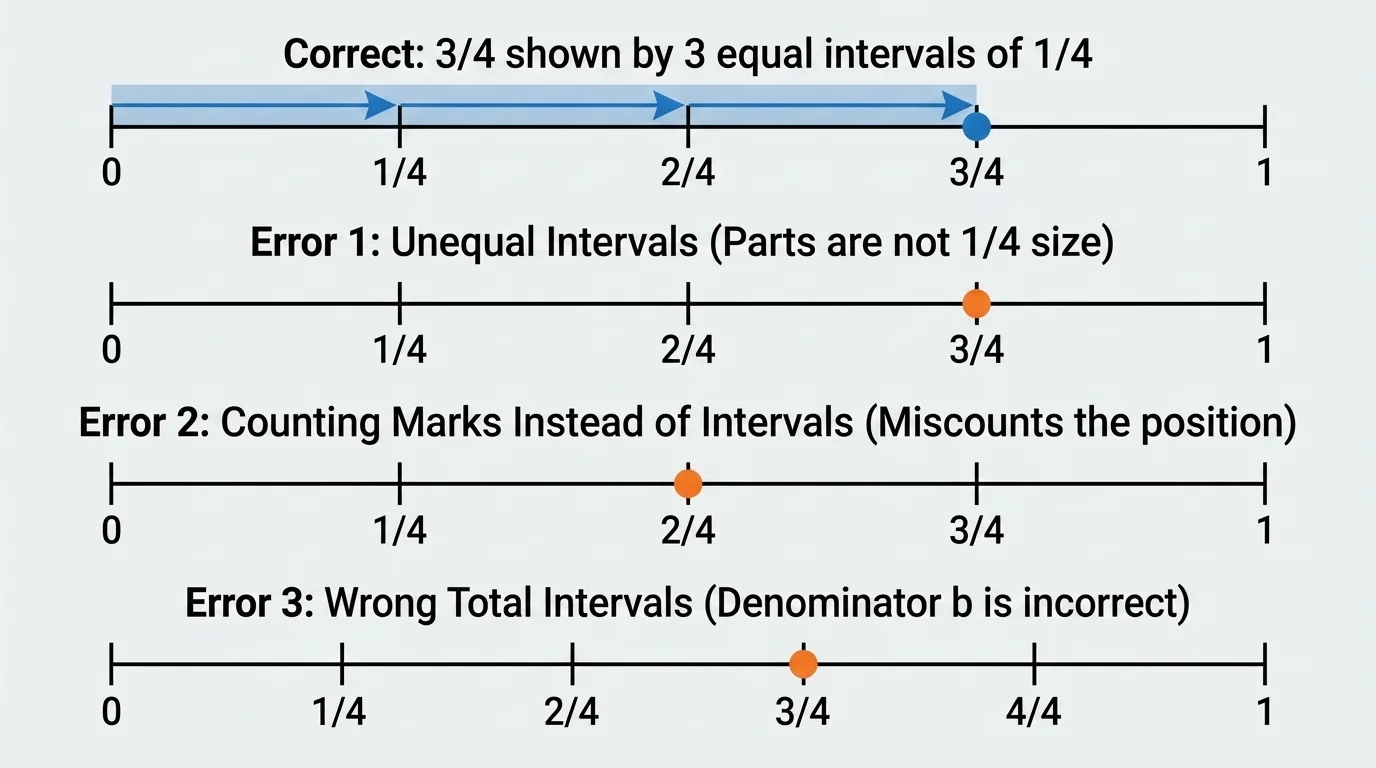
[Figure 3] Students often make a few common mistakes when they first draw fractions on number lines. One mistake is making unequal parts. If the pieces are not equal, then the fraction location is not correct.
Another mistake is counting marks instead of spaces. Fractions count equal intervals, not just little lines. The space between two marks is what matters.
A third mistake is starting from the wrong place. You must begin counting lengths from \(0\), not from \(1\) or from some other point.
Also be careful to use the denominator first. The denominator tells how many equal parts one whole is divided into. Then the numerator tells how many of those parts to count.
If you remember these rules, your number lines will be accurate and easy to read.
| Fraction | Denominator tells | Numerator tells | Where to stop |
|---|---|---|---|
| \(\dfrac{3}{4}\) | Split the whole into \(4\) equal parts | Count \(3\) parts | At the third \(\dfrac{1}{4}\) step |
| \(\dfrac{2}{6}\) | Split the whole into \(6\) equal parts | Count \(2\) parts | At the second \(\dfrac{1}{6}\) step |
| \(\dfrac{5}{3}\) | Split each whole into \(3\) equal parts | Count \(5\) parts | At the fifth \(\dfrac{1}{3}\) step |
Table 1. How the numerator and denominator work together to locate a fraction on a number line.
A fraction such as \(\dfrac{a}{b}\) is a number. To place it on a number line, divide the whole into \(b\) equal parts, so each part is \(\dfrac{1}{b}\). Then count \(a\) of those parts from \(0\).
The total distance from \(0\) to the point is \(\dfrac{a}{b}\). The point itself is the location of \(\dfrac{a}{b}\). So a fraction is both a distance and a number with a place on the line.
When you understand that idea, fractions become much easier to picture, compare, and use in real life.
