Have you ever cut a sandwich one way and then cut another sandwich a different way, but both people still got the same amount to eat? That is exactly what happens with fractions. A fraction can have more than one name, and those different names can still mean the very same amount.
A fraction is not just part of a picture. A fraction is a number. It can describe part of a whole, and it can also be placed on a number line between \(0\) and \(1\), or even past \(1\).
When we write \(\dfrac{1}{2}\), the bottom number tells how many equal parts the whole is split into. The top number tells how many of those equal parts we are talking about.
For example, in \(\dfrac{3}{4}\), the whole is split into \(4\) equal parts, and we are talking about \(3\) of those parts.
Fractions only make sense when the parts are equal. If one piece is bigger than another, then the pieces do not make a fair fraction model.
This idea of equal parts matters a lot when we learn about fraction names that are equal to each other.
Two fractions are equivalent fractions when they are the same size. They may look different because the numbers are different, but they represent the same amount.
Another way to say this is that equivalent fractions are at the same point on a number line. If two fractions land in the same place, then they are equal.
Equivalent fractions are fractions that name the same amount.
Numerator is the top number in a fraction. It tells how many equal parts are being counted.
Denominator is the bottom number in a fraction. It tells how many equal parts make one whole.
For example, \(\dfrac{1}{2}\) and \(\dfrac{2}{4}\) are equivalent fractions. One half of a whole is the same amount as two fourths of the same whole.
You can think of this as a renaming. Just like one year is also twelve months, \(\dfrac{1}{2}\) can also be named \(\dfrac{2}{4}\) when the whole stays the same size.
Pictures help us see fraction size clearly. In shape models, equivalent fractions cover the same amount of the whole, as [Figure 1] shows with two rectangles that are the same size but split into different numbers of equal parts.
Suppose one rectangle is split into \(2\) equal parts and \(1\) part is shaded. That shaded amount is \(\dfrac{1}{2}\).
Now suppose another rectangle of the same size is split into \(4\) equal parts and \(2\) parts are shaded. That shaded amount is \(\dfrac{2}{4}\).
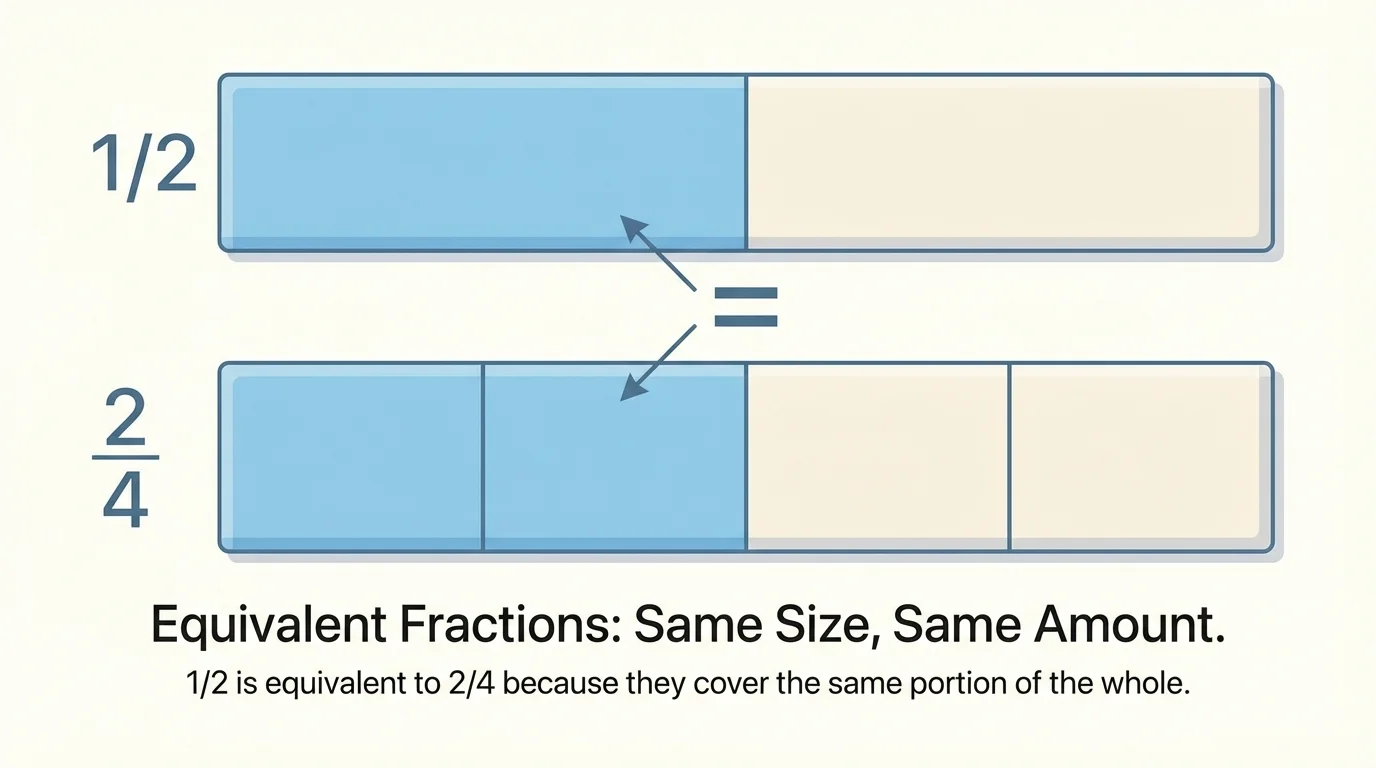
Even though one picture uses halves and the other uses fourths, the shaded area is the same. So \(\dfrac{1}{2} = \dfrac{2}{4}\).
Here is another example. If a circle is split into \(3\) equal parts and \(1\) part is shaded, that is \(\dfrac{1}{3}\). If the same-sized circle is split into \(6\) equal parts and \(2\) parts are shaded, that is \(\dfrac{2}{6}\). These are also the same size, so \(\dfrac{1}{3} = \dfrac{2}{6}\).
Same whole, same amount
Equivalent fractions only work when the wholes are the same size. If one pizza is large and another pizza is small, then \(\dfrac{1}{2}\) of one pizza may not equal \(\dfrac{1}{2}\) of the other pizza. To decide whether fractions are equivalent, we compare parts of the same-sized whole.
This is why drawings must be careful. Equal fractions do not just mean "same number of pieces shaded." They mean "same amount shaded."
Fractions are numbers, so we can place them on a number line. Equivalent fractions sit at the same location, as [Figure 2] shows with halves, fourths, and eighths lining up at one point.
Start with a line from \(0\) to \(1\). If we split it into \(2\) equal parts, the middle point is \(\dfrac{1}{2}\).
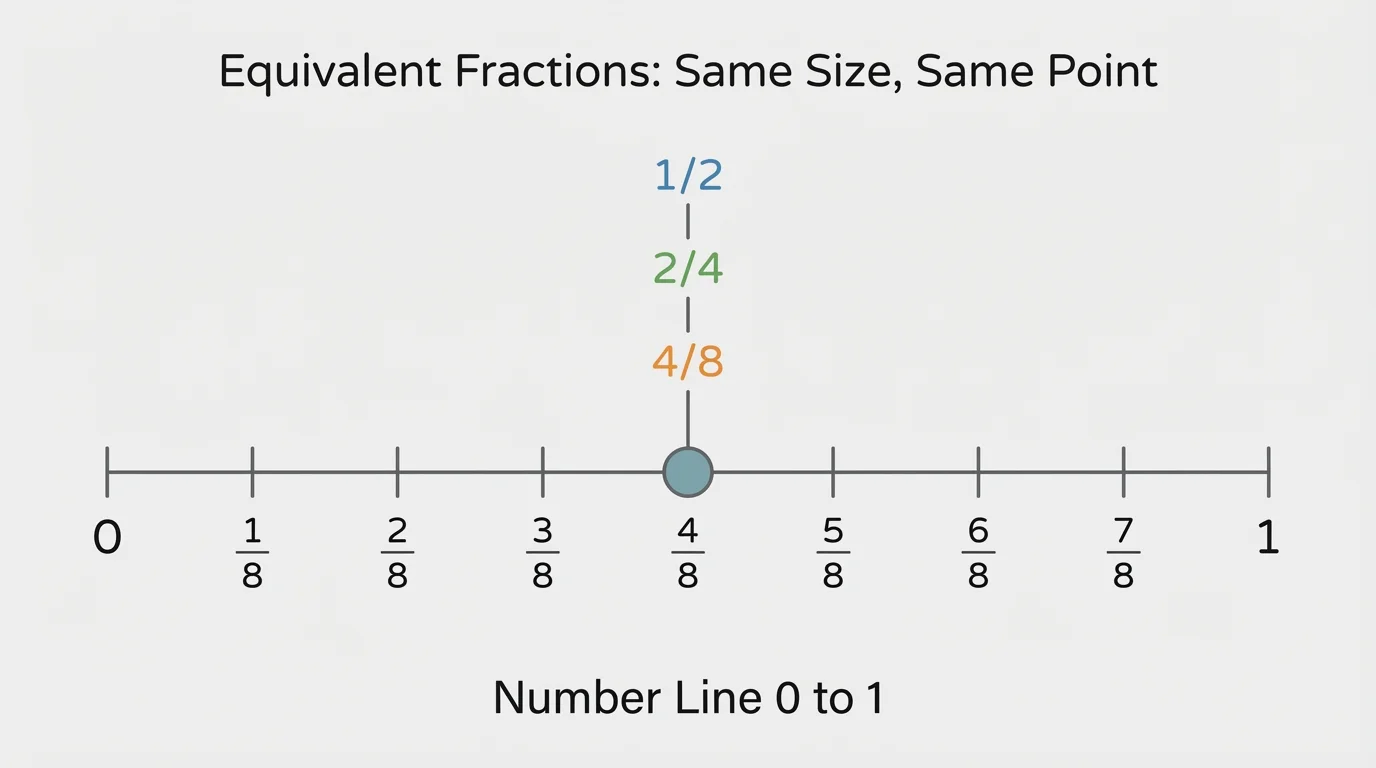
If we split the same line into \(4\) equal parts, the point \(\dfrac{2}{4}\) lands exactly in the middle too.
If we split the same line into \(8\) equal parts, the point \(\dfrac{4}{8}\) also lands in the middle.
That means
\[\frac{1}{2} = \frac{2}{4} = \frac{4}{8}\]
All three fractions name the same point on the line. Seeing them this way helps us understand that fractions are real numbers, not just pieces of a picture.
Later, when you compare fractions, the number line is a powerful tool. If two fractions are on the same point, they are equal. If one is farther to the right, it is greater.
There is a pattern in equivalent fractions. When each part is cut into the same number of smaller equal parts, the fraction gets a new name but keeps the same value, as [Figure 3] illustrates.
For example, begin with \(\dfrac{2}{3}\). If each third is split into \(2\) equal smaller parts, then the whole now has \(6\) equal parts. The shaded amount becomes \(\dfrac{4}{6}\).
We can write this pattern as
\[\frac{2}{3} = \frac{4}{6}\]
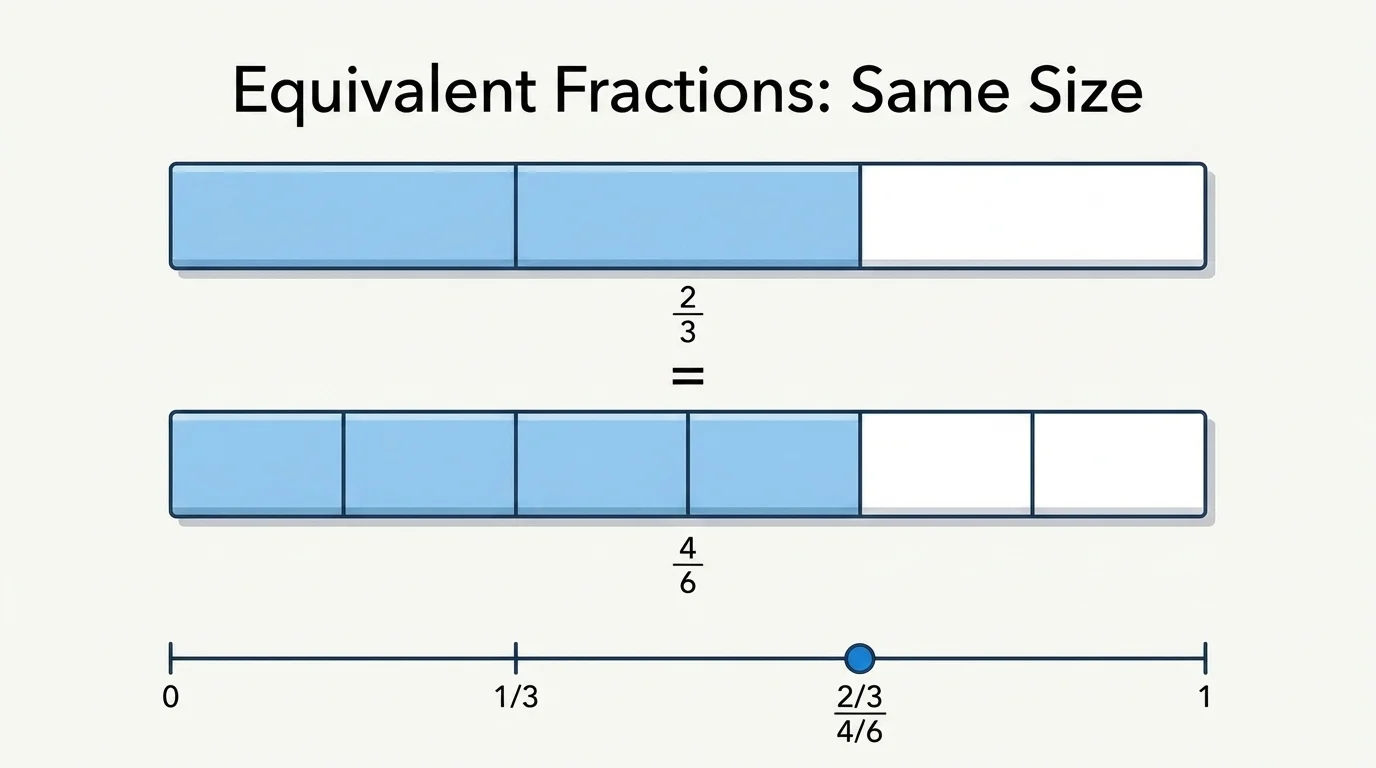
What changed? The number of shaded parts doubled, and the total number of parts also doubled. Because both changed in the same way, the amount stayed the same.
Here are some more equivalent fractions:
| Fraction | Equivalent Name |
|---|---|
| \(\dfrac{1}{2}\) | \(\dfrac{2}{4}\), \(\dfrac{3}{6}\), \(\dfrac{4}{8}\) |
| \(\dfrac{1}{3}\) | \(\dfrac{2}{6}\), \(\dfrac{3}{9}\) |
| \(\dfrac{2}{5}\) | \(\dfrac{4}{10}\) |
Table 1. Examples of fractions and some equivalent names.
One simple way to make an equivalent fraction is to multiply the numerator and denominator by the same number.
For example, \(\dfrac{1}{2}\) becomes \(\dfrac{2}{4}\) when both numbers are multiplied by \(2\). It becomes \(\dfrac{3}{6}\) when both are multiplied by \(3\).
We can show that with number sentences:
\[\frac{1 \times 2}{2 \times 2} = \frac{2}{4}\]
and
\[\frac{1 \times 3}{2 \times 3} = \frac{3}{6}\]
You do not need to memorize a tricky rule. Just remember: if the pieces get smaller in a fair way, there will be more pieces, but the amount can stay the same.
A ruler gives a great real-life example. One half inch and two fourths of an inch are the same distance on the ruler, even though they are written with different fractions.
This matches what we saw earlier on the number line. Different fraction names can point to exactly the same location.
Worked example 1
Show why \(\dfrac{1}{2}\) and \(\dfrac{2}{4}\) are equivalent.
Step 1: Think about the whole.
Use two wholes that are the same size.
Step 2: Name the first fraction.
If one whole is split into \(2\) equal parts and \(1\) part is chosen, the fraction is \(\dfrac{1}{2}\).
Step 3: Name the second fraction.
If another whole of the same size is split into \(4\) equal parts and \(2\) parts are chosen, the fraction is \(\dfrac{2}{4}\).
Step 4: Compare the amounts.
The chosen parts cover the same amount of the whole.
So, \[\frac{1}{2} = \frac{2}{4}\]
This is the same idea shown in the shape model earlier. The pieces look different, but the amount stays equal.
Worked example 2
Are \(\dfrac{3}{6}\) and \(\dfrac{1}{2}\) equivalent?
Step 1: Use the number line idea.
\(\dfrac{1}{2}\) is the middle point between \(0\) and \(1\).
Step 2: Think about sixths.
If a whole is split into \(6\) equal parts, then \(3\) parts also reach the middle.
Step 3: Compare the positions.
Both fractions land at the same point.
Yes. \[\frac{3}{6} = \frac{1}{2}\]
Equivalent fractions can be found by looking at position, not just by looking at the numbers.
Worked example 3
Find an equivalent fraction for \(\dfrac{2}{3}\).
Step 1: Multiply the numerator and denominator by the same number.
Choose \(2\).
Step 2: Multiply the top number.
\(2 \times 2 = 4\).
Step 3: Multiply the bottom number.
\(3 \times 2 = 6\).
Step 4: Write the new fraction.
\(\dfrac{2}{3}\) becomes \(\dfrac{4}{6}\).
So, \[\frac{2}{3} = \frac{4}{6}\]
The visual model shown earlier helps explain why this works: each third is split into two equal smaller pieces.
Worked example 4
Are \(\dfrac{2}{5}\) and \(\dfrac{2}{6}\) equivalent?
Step 1: Compare the size of the parts.
Fifths are larger than sixths because the whole is split into fewer pieces.
Step 2: Compare the fractions.
Both fractions count \(2\) parts, but \(2\) fifths uses larger parts than \(2\) sixths.
Step 3: Decide.
The amounts are not the same.
No. \[\frac{2}{5} \ne \frac{2}{6}\]
This example is important because not every pair of fractions with the same numerator is equal.
To decide whether fractions are equivalent, ask one main question: Do they name the same amount?
You can check in several ways:
For example, \(\dfrac{1}{4}\) and \(\dfrac{2}{8}\) are equivalent because the amount is the same, the point on the number line is the same, and both numerator and denominator were multiplied by \(2\).
But \(\dfrac{1}{4}\) and \(\dfrac{2}{6}\) are not equivalent. On a picture or a number line, they do not match.
Reasoning about size
You can often tell that two fractions are not equivalent just by thinking about size. For example, \(\dfrac{1}{2}\) is larger than \(\dfrac{1}{3}\). So any fraction equal to \(\dfrac{1}{2}\), such as \(\dfrac{2}{4}\), must also be larger than \(\dfrac{1}{3}\).
Good fraction thinkers do not only look for rules. They also ask whether the answer makes sense.
Equivalent fractions appear in everyday life more often than you might notice.
In cooking, a measuring cup may show that \(\dfrac{1}{2}\) cup is the same as \(\dfrac{2}{4}\) cup. Both names describe the same amount of liquid or flour.
In sports, if a game is half over, that is the same as saying \(\dfrac{2}{4}\) of the game is over. The time passed is equal even though the fraction name changes.
When sharing food, one person might eat \(\dfrac{3}{6}\) of a granola bar, while another says that amount is \(\dfrac{1}{2}\). If the bar is the same size, both statements can be true.
On rulers and measuring tapes, equal distances often have different names. A point halfway between \(0\) and \(1\) inch can be called \(\dfrac{1}{2}\) inch, \(\dfrac{2}{4}\) inch, or \(\dfrac{4}{8}\) inch.
One mistake is thinking that any fraction with bigger numbers must be bigger in size. That is not true. For example, \(\dfrac{2}{4}\) has bigger numbers than \(\dfrac{1}{2}\), but both fractions are equal.
Another mistake is using wholes of different sizes. One half of a tiny cookie is not the same amount as one half of a giant cookie.
A third mistake is changing only one number. If you change the numerator but not the denominator, or the denominator but not the numerator, you usually change the amount.
For example, \(\dfrac{1}{2}\) is not equal to \(\dfrac{1}{4}\). The denominator changed, but the numerator did not, so the size changed.
Another common mistake is to add the same number instead of multiplying by the same number. Starting with \(\dfrac{1}{2}\), adding \(1\) to the top and bottom gives \(\dfrac{2}{3}\), but \(\dfrac{2}{3}\) is not equivalent to \(\dfrac{1}{2}\).
Always return to the meaning: same size, same point on the number line, same whole.
"Equivalent fractions have different names, but they tell the same story about size."
Once you understand that idea, fractions become much easier to read, compare, and use.
