If two friends each get a piece of the same-size sandwich, and one says, "I got \(\dfrac{1}{2}\)," while the other says, "I got \(\dfrac{2}{4}\)," could they both be right? Yes. Fractions can have different names and still mean the same amount. That is one of the most interesting ideas in mathematics: something can look different and still be equal.
A fraction is a number that names part of a whole or part of a group. In a fraction, the top number is the numerator, and the bottom number is the denominator.
For example, in \(\dfrac{3}{4}\), the numerator \(3\) tells how many parts we have, and the denominator \(4\) tells that the whole is split into \(4\) equal parts.
The words equal parts are very important. If a shape is not split into equal parts, then the pieces do not make a correct fraction of the whole.
You already know that a whole can be divided into equal parts such as halves, thirds, and fourths. Fractions are numbers that help us describe those parts exactly.
Think of a chocolate bar. If it is broken into \(4\) equal pieces and you eat \(1\) piece, you ate \(\dfrac{1}{4}\). If it is broken into \(2\) equal pieces and you eat \(1\) piece, you ate \(\dfrac{1}{2}\). The size of the pieces depends on how many equal parts the whole is split into.
Equivalent fractions are fractions that name the same amount, even if the numbers in the fractions are different.
For example, \(\dfrac{1}{2}\) and \(\dfrac{2}{4}\) are equivalent fractions. They both describe the same part of a whole. Also, \(\dfrac{2}{3}\) and \(\dfrac{4}{6}\) are equivalent fractions.
Equivalent fractions are fractions that are equal in value. They may have different numerators and denominators, but they point to the same place on a number line and cover the same amount of a whole.
When fractions are equivalent, the pieces may be cut into more parts, but the total amount stays the same. That means the name changes, but the size does not.
This is like cutting a sandwich into pieces in a different way. One half of a sandwich is the same food as two fourths of the same sandwich. You did not get more food just because there are more pieces.
[Figure 1] Visual models help us understand why fractions are equal. A visual fraction model is a drawing that shows a whole split into equal parts. In fraction bars, the shaded length for \(\dfrac{1}{2}\) matches the shaded length for \(\dfrac{2}{4}\).
Picture one bar that is one whole. If we split it into \(2\) equal parts and shade \(1\) part, we get \(\dfrac{1}{2}\). Now picture another bar of the same length split into \(4\) equal parts. If we shade \(2\) of those parts, we get \(\dfrac{2}{4}\).
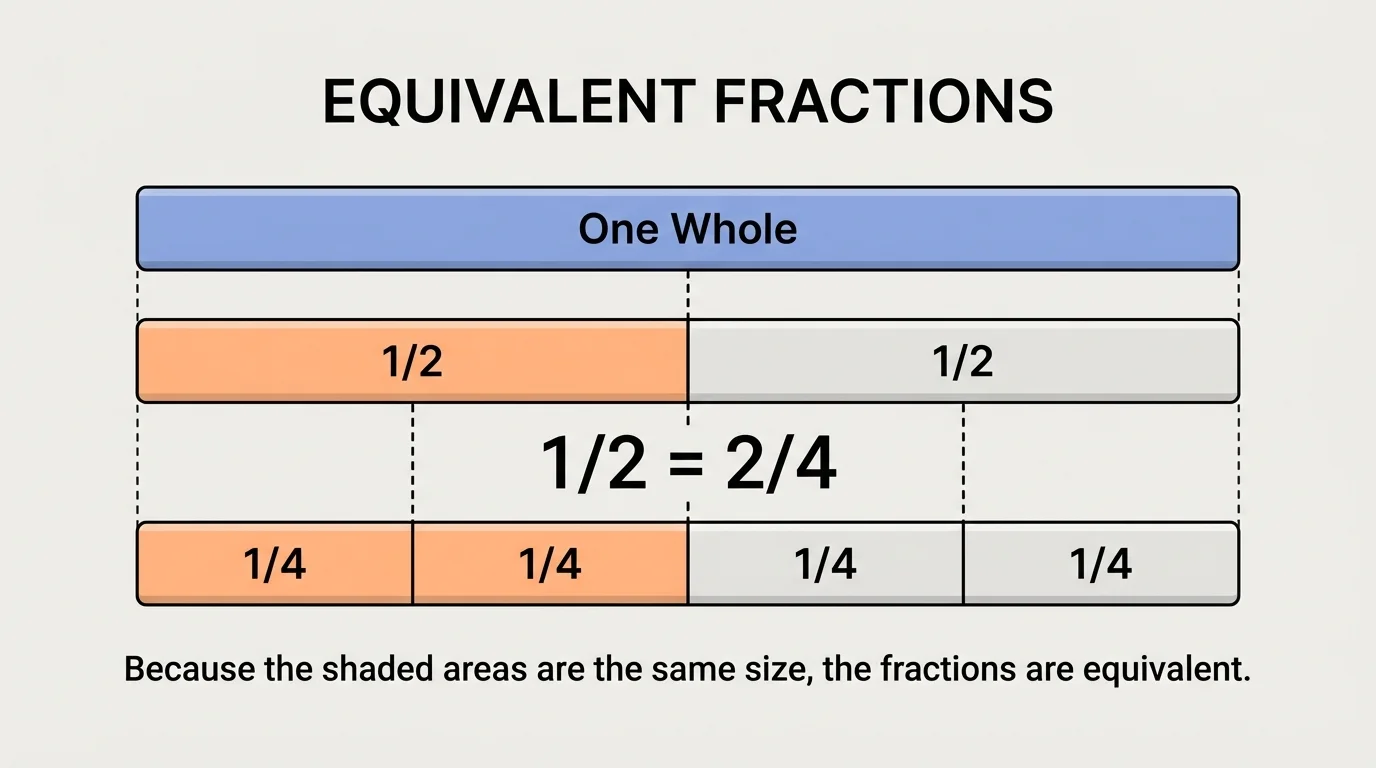
Even though one model has \(2\) parts and the other has \(4\) parts, the shaded amount covers the same length. That is why:
\[\frac{1}{2} = \frac{2}{4}\]
Here is another way to think about it: each half can be split into \(2\) smaller equal pieces. Then \(1\) half becomes \(2\) fourths. The total amount is unchanged. Only the size of each piece changed.
[Figure 2] The same idea works for \(\dfrac{2}{3}\) and \(\dfrac{4}{6}\). In a circle model, the same amount is shaded in both pictures.
If a circle is divided into \(3\) equal parts and \(2\) are shaded, that is \(\dfrac{2}{3}\). If each third is split into \(2\) equal smaller pieces, the whole circle now has \(6\) equal parts. The shaded amount becomes \(4\) of those \(6\) parts, or \(\dfrac{4}{6}\).
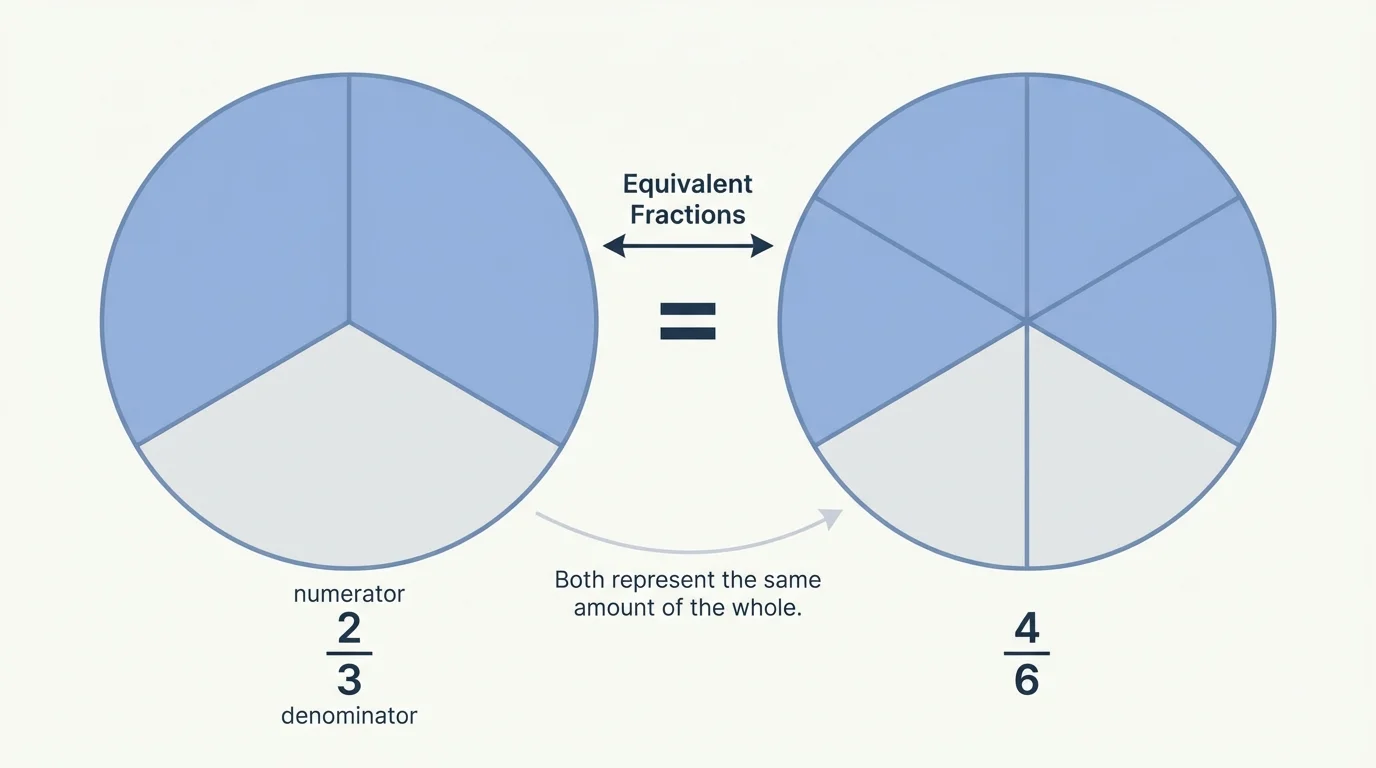
So
\[\frac{2}{3} = \frac{4}{6}\]
because both fractions name the same part of the whole. The model makes the idea easy to see.
Why the fractions stay equal
When we split every part into the same number of smaller equal parts, we make more pieces, but we do not change the total amount. One half becomes two fourths, three fourths becomes six eighths, and two thirds becomes four sixths. The whole stays the same size, so the amount stays the same too.
Visual models are powerful because they show that equivalent fractions are not just a rule to memorize. They are really the same quantity.
To generate an equivalent fraction, multiply the numerator and denominator by the same number.
For example, start with \(\dfrac{1}{2}\). Multiply the numerator by \(2\), and multiply the denominator by \(2\):
\[\frac{1 \times 2}{2 \times 2} = \frac{2}{4}\]
Because both numbers are multiplied by the same amount, the fraction keeps the same value.
We can do it again with \(\dfrac{2}{3}\):
\[\frac{2 \times 2}{3 \times 2} = \frac{4}{6}\]
We can also multiply by other whole numbers. For example:
\[\frac{3}{5} = \frac{3 \times 3}{5 \times 3} = \frac{9}{15}\]
This does not mean every fraction with bigger numbers is equivalent. The key is that both the numerator and denominator must be multiplied by the same number.
A fraction can have many equivalent names. For example, \(\dfrac{1}{2}\), \(\dfrac{2}{4}\), \(\dfrac{3}{6}\), and \(\dfrac{4}{8}\) all name the same amount.
You can think of this as zooming in on the same part of a whole. The pieces get smaller, so you need more of them, but the total amount stays equal.
Sometimes you will see two fractions and need to decide if they are equivalent. There are two helpful ways: use a visual model, or look for a pattern in the numbers.
With a visual model, ask: do the shaded parts cover the same amount of the whole? If yes, the fractions are equivalent.
With numbers, ask: can I multiply the numerator and denominator of one fraction by the same number to get the other fraction? For example, from \(\dfrac{3}{4}\) to \(\dfrac{6}{8}\), both numbers are multiplied by \(2\), so the fractions are equivalent.
You can also reason backward by dividing both numbers by the same number. Since \(4 \div 2 = 2\) and \(6 \div 2 = 3\), \(\dfrac{4}{6}\) is the same as \(\dfrac{2}{3}\).
Solved example 1
Show why \(\dfrac{1}{2} = \dfrac{2}{4}\).
Step 1: Think about a whole split into \(2\) equal parts.
Shading \(1\) of the \(2\) parts gives \(\dfrac{1}{2}\).
Step 2: Split each half into \(2\) smaller equal parts.
Now the whole has \(4\) equal parts.
Step 3: Count the shaded parts again.
The same shaded amount is now \(2\) out of \(4\) parts, or \(\dfrac{2}{4}\).
So the fractions are equivalent: \[\frac{1}{2} = \frac{2}{4}\]
This example shows that cutting the same amount into smaller equal pieces changes the name of the fraction, not the value.
Solved example 2
Generate an equivalent fraction for \(\dfrac{2}{3}\).
Step 1: Choose a number to multiply by.
Use \(2\).
Step 2: Multiply the numerator and denominator by \(2\).
\(2 \times 2 = 4\) and \(3 \times 2 = 6\).
Step 3: Write the new fraction.
\[\frac{2}{3} = \frac{4}{6}\]
The two fractions are equivalent because both parts of the fraction were multiplied by the same number.
The same strategy works for many fractions. For instance, \(\dfrac{1}{3} = \dfrac{2}{6}\) and \(\dfrac{3}{4} = \dfrac{6}{8}\).
Solved example 3
Are \(\dfrac{3}{4}\) and \(\dfrac{6}{8}\) equivalent?
Step 1: Compare the numerators.
\(3 \times 2 = 6\).
Step 2: Compare the denominators.
\(4 \times 2 = 8\).
Step 3: Check whether both were changed by the same number.
Both were multiplied by \(2\), so the fractions are equivalent.
Therefore, \[\frac{3}{4} = \frac{6}{8}\]
When the same multiplication pattern works for the numerator and denominator, that is strong evidence that the fractions are equal.
Solved example 4
Are \(\dfrac{2}{4}\) and \(\dfrac{2}{5}\) equivalent?
Step 1: Look at the numerators.
They are both \(2\).
Step 2: Look at the denominators.
One denominator is \(4\), and the other is \(5\).
Step 3: Reason about the size of the parts.
Fifths are smaller than fourths, so \(\dfrac{2}{5}\) is less than \(\dfrac{2}{4}\).
So these fractions are not equivalent.
This example is important because fractions do not become equivalent just because one number matches.
Equivalent fractions also help us compare fractions. Sometimes two fractions are hard to compare because the pieces are different sizes. Renaming them with equal-size pieces helps, as shown in [Figure 3].
Suppose we want to compare \(\dfrac{3}{4}\) and \(\dfrac{2}{3}\). Fourths and thirds are different-size pieces, so it is not easy to compare them right away. But we can rename both fractions using twelfths.
Since \(\dfrac{3}{4} = \dfrac{9}{12}\) and \(\dfrac{2}{3} = \dfrac{8}{12}\), we can compare \(9\) twelfths and \(8\) twelfths.
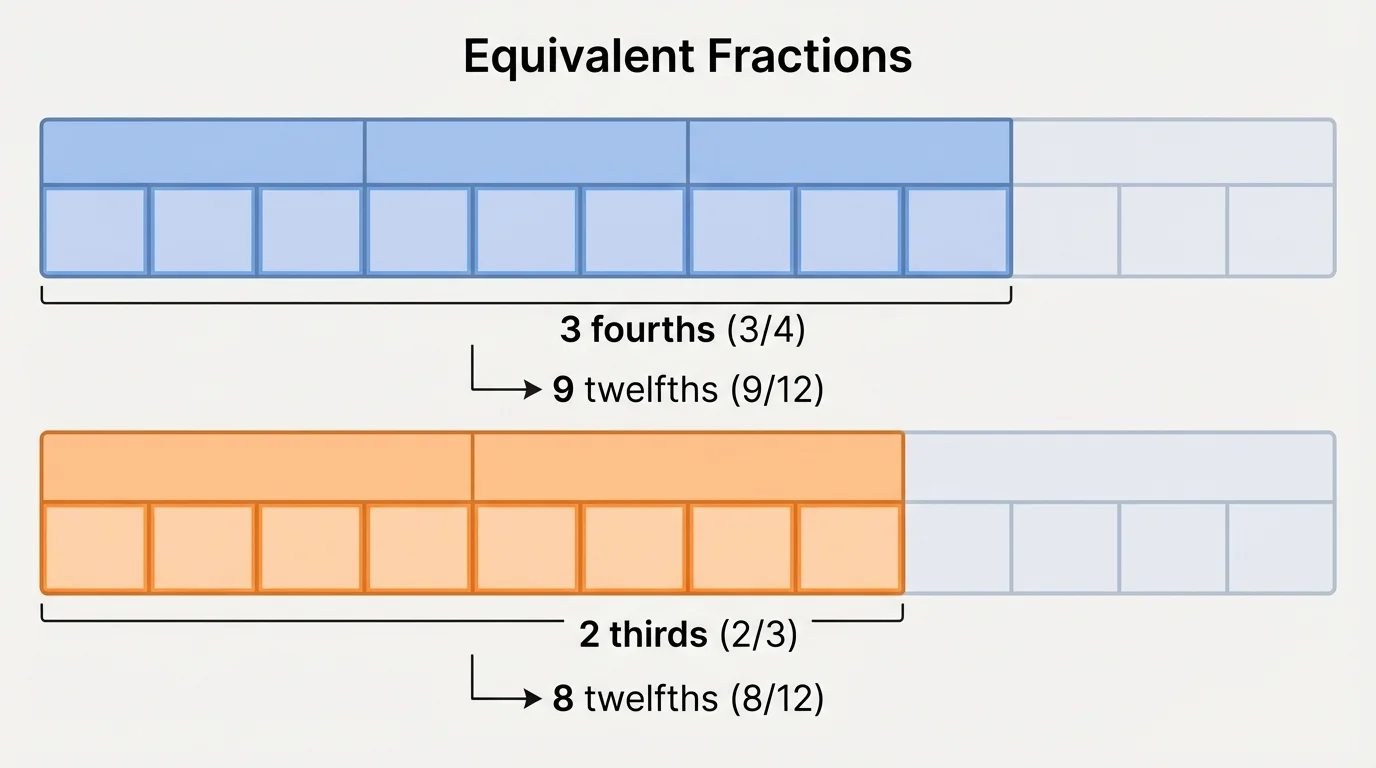
Because \(9\) twelfths is greater than \(8\) twelfths, we know:
\[\frac{3}{4} > \frac{2}{3}\]
Equivalent fractions are helpful because they let us compare amounts using the same-size parts. This is a smart way to reason about fraction size.
Sometimes fractions are already equivalent, so comparing them is simple. For example, \(\dfrac{1}{2}\) and \(\dfrac{2}{4}\) are equal, not greater or less. The models from [Figure 1] show why their shaded lengths match exactly.
| Fraction | Equivalent Fraction | Comparison Idea |
|---|---|---|
| \(\dfrac{1}{2}\) | \(\dfrac{2}{4}\) | Equal amounts |
| \(\dfrac{2}{3}\) | \(\dfrac{4}{6}\) | Equal amounts |
| \(\dfrac{3}{4}\) | \(\dfrac{9}{12}\) | Useful for comparing |
| \(\dfrac{2}{3}\) | \(\dfrac{8}{12}\) | Useful for comparing |
Table 1. Examples of equivalent fractions and how they help compare sizes.
Equivalent fractions appear in everyday life. In cooking, one recipe might use \(\dfrac{1}{2}\) cup of milk, while another measurement might describe the same amount as \(\dfrac{2}{4}\) cup. The amount is the same even though the fraction name is different.
When sharing food, two people may describe equal portions in different ways. A pizza can be cut into \(2\), \(4\), or \(8\) equal slices. One half of a pizza is the same as \(2\) fourths or \(4\) eighths.
In art and building projects, people often divide shapes and spaces into equal parts. Understanding equivalent fractions helps them describe the same length or area in different ways.
Equivalent fractions on a number line
Fractions are numbers, so they can be placed on a number line. Equivalent fractions land at the same point. That means \(\dfrac{1}{2}\), \(\dfrac{2}{4}\), and \(\dfrac{3}{6}\) all belong at the same location between \(0\) and \(1\).
This idea matters because fractions are not just pieces of shapes. They are numbers with size and position.
One common mistake is using pieces that are not equal. If the parts of the whole are different sizes, the fraction model is not correct.
Another mistake is changing only the numerator or only the denominator. For example, \(\dfrac{1}{2}\) does not become \(\dfrac{2}{2}\) by multiplying just the numerator. That changes the value from one half to one whole.
A third mistake is adding the same number to the numerator and denominator. For example, going from \(\dfrac{1}{2}\) to \(\dfrac{2}{3}\) by adding \(1\) to both does not make an equivalent fraction. The value changes.
To keep a fraction equivalent, multiply both numbers by the same number, or divide both by the same number when possible.
As we saw with circles in [Figure 2], splitting each original part into the same number of smaller equal parts preserves the amount. That is the big idea to remember.
