Here is a surprising math idea: the number \(3\) and the fraction \(\dfrac{3}{1}\) are exactly the same amount. That may look strange at first, because fractions often make us think of parts, like half a sandwich or a quarter of a pizza. But fractions can also name whole amounts. Once you see how this works, many fractions make much more sense.
A fraction is a number. It is not just a picture of a pizza or a shaded shape. Fractions belong on the number line, just like whole numbers do. Some fractions are less than \(1\), some are greater than \(1\), and some are exactly equal to whole numbers like \(1\), \(2\), or \(5\).
When we say a whole number can be written as a fraction, we mean the value stays the same. For example, \(4\) and \(\dfrac{4}{1}\) are two different ways to write the same number. In the same way, some fractions such as \(\dfrac{2}{2}\), \(\dfrac{3}{3}\), and \(\dfrac{10}{5}\) are equal to whole numbers.
You already know that a whole is one complete object or one complete group. You also know that equal parts must be the same size. Fractions are built from these two ideas.
Understanding this helps with comparing numbers too. If you know that \(\dfrac{6}{3} = 2\), then you know \(\dfrac{6}{3}\) is greater than \(1\) and lands exactly on the whole number \(2\).
A fraction has two parts. The top number is the numerator. The bottom number is the denominator. In \(\dfrac{3}{4}\), the numerator is \(3\) and the denominator is \(4\).
The denominator tells how many equal parts make one whole. The numerator tells how many of those equal parts we have. So in \(\dfrac{3}{4}\), one whole is cut into \(4\) equal parts, and we have \(3\) of them.
Numerator: the top number in a fraction. It tells how many equal parts are being counted.
Denominator: the bottom number in a fraction. It tells how many equal parts make one whole.
Equivalent fractions: fractions that name the same amount, even though they look different.
Now think about a denominator of \(1\). If one whole is divided into \(1\) equal part, that one part is the whole itself. So \(\dfrac{1}{1} = 1\). If you have \(3\) parts and each part is a whole, then \(\dfrac{3}{1} = 3\). This is the key idea for writing whole numbers as fractions.
Every whole number can be written as a fraction with denominator \(1\), as shown in [Figure 1]. That is because when the denominator is \(1\), each part is one whole. So \(1 = \dfrac{1}{1}\), \(2 = \dfrac{2}{1}\), \(7 = \dfrac{7}{1}\), and \(15 = \dfrac{15}{1}\).
We can write this pattern like this:
\[n = \frac{n}{1}\]
Here, \(n\) stands for any whole number. If \(n = 5\), then \(5 = \dfrac{5}{1}\). If \(n = 12\), then \(12 = \dfrac{12}{1}\).
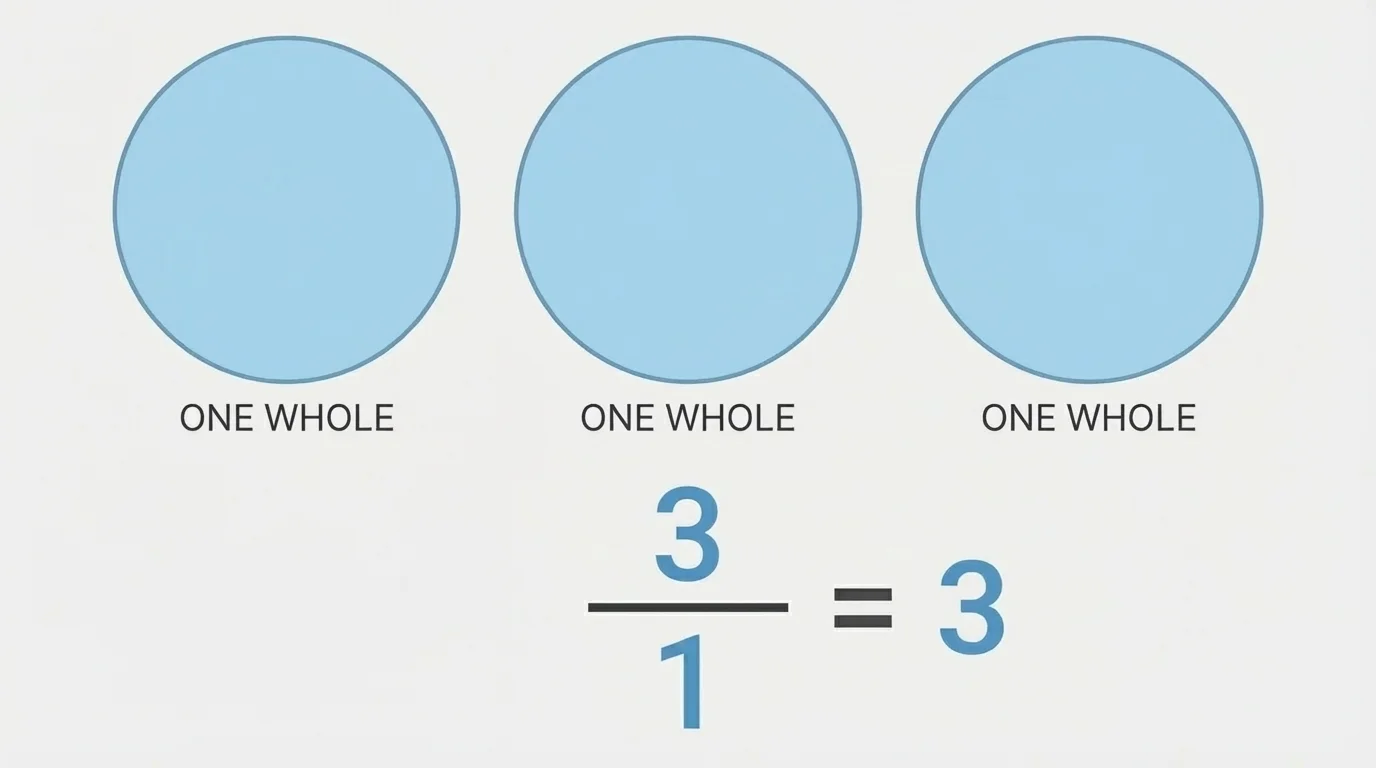
You can think about it with objects. Suppose there are \(4\) complete apples. That is \(4\) wholes. As a fraction, that same amount is \(\dfrac{4}{1}\), because each apple is one whole apple. Nothing is cut into smaller equal parts.
Worked example 1
Write \(6\) as a fraction.
Step 1: Use the rule for whole numbers.
Any whole number \(n\) can be written as \(\dfrac{n}{1}\).
Step 2: Substitute \(6\) for \(n\).
\(6 = \dfrac{6}{1}\)
The fraction form of \(6\) is \(\dfrac{6}{1}\).
This does not change the amount. It only changes the way the number is written. In the same way, \(9\) can be written as \(\dfrac{9}{1}\), and \(100\) can be written as \(\dfrac{100}{1}\).
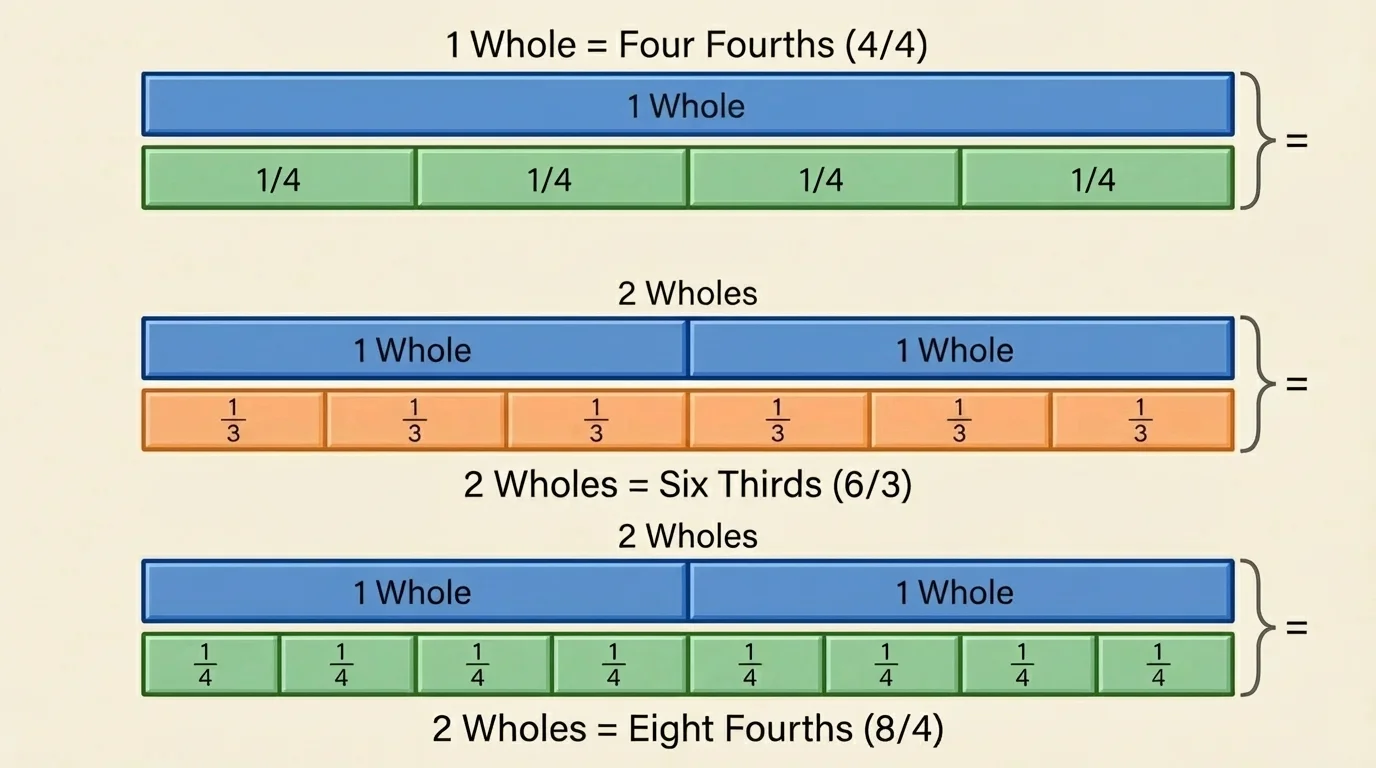
Some fractions are not written with denominator \(1\), but they are still equal to whole numbers. A picture of full groups helps us see this, and [Figure 2] illustrates several examples. For instance, if a whole is split into \(4\) equal parts and you have all \(4\) parts, then you have \(1\) whole. So \(\dfrac{4}{4} = 1\).
If you have \(8\) fourths, that means you have enough fourths to make \(2\) complete wholes. So \(\dfrac{8}{4} = 2\). If you have \(12\) thirds, that makes \(4\) complete wholes, so \(\dfrac{12}{3} = 4\).
A fraction is equal to a whole number when the numerator can be split into equal groups of the denominator with no leftovers. Another way to say this is: the numerator is a multiple of the denominator.
Here are some examples:
| Fraction | Whole number it equals | Why |
|---|---|---|
| \(\dfrac{2}{2}\) | \(1\) | Two halves make one whole |
| \(\dfrac{3}{3}\) | \(1\) | Three thirds make one whole |
| \(\dfrac{6}{3}\) | \(2\) | Six thirds make two wholes |
| \(\dfrac{10}{5}\) | \(2\) | Ten fifths make two wholes |
| \(\dfrac{15}{5}\) | \(3\) | Fifteen fifths make three wholes |
Table 1. Fractions that are equal to whole numbers and the reasoning for each one.
Notice the pattern. In \(\dfrac{2}{2}\), \(\dfrac{3}{3}\), and \(\dfrac{5}{5}\), the numerator and denominator are the same, so each fraction equals \(1\). In \(\dfrac{6}{3}\) and \(\dfrac{8}{4}\), the numerator is larger, but it still makes complete wholes.
How to tell when a fraction equals a whole number
If the numerator is the same as the denominator, the fraction equals \(1\). If the numerator is \(2\) times the denominator, the fraction equals \(2\). If the numerator is \(3\) times the denominator, the fraction equals \(3\), and so on.
So \(\dfrac{9}{3} = 3\) because \(9\) is \(3\) groups of \(3\). Also, \(\dfrac{20}{5} = 4\) because \(20\) is \(4\) groups of \(5\).
A number line helps show that fractions are numbers with exact places, and [Figure 3] shows fractions landing right on whole numbers. When a fraction equals a whole number, it lands on the same point as that whole number.
For example, \(\dfrac{2}{2}\) lands on \(1\). The fraction \(\dfrac{4}{2}\) lands on \(2\). The fraction \(\dfrac{9}{3}\) lands on \(3\). This shows that fractions and whole numbers belong in the same number system.
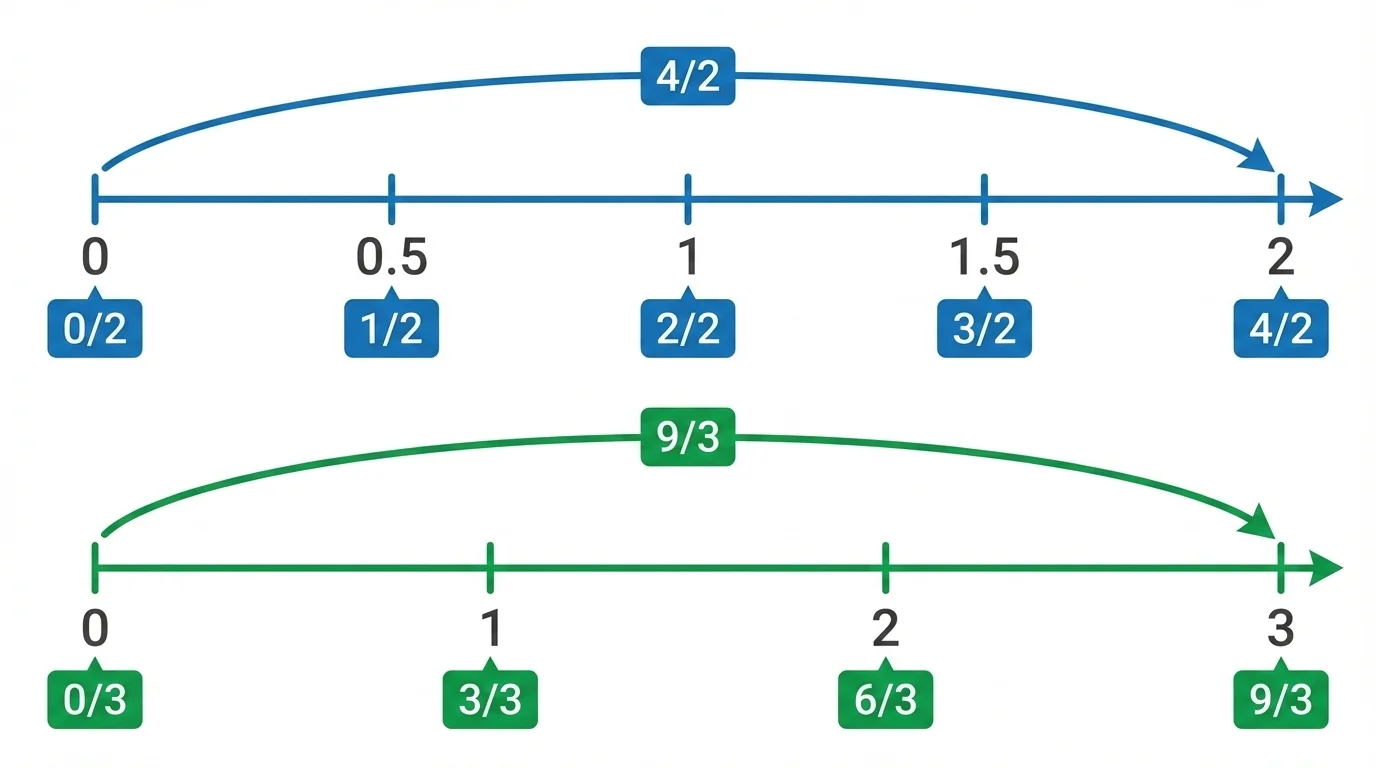
You can also use groups to think about this. If \(1\) whole is made of \(3\) equal parts, then \(3\) thirds make \(1\) whole. Then \(6\) thirds make \(2\) wholes. Then \(9\) thirds make \(3\) wholes. The denominator tells the size of each part, and the numerator tells how many parts you have.
This is why \(\dfrac{8}{4}\) is not just read as "eight over four." It means \(8\) parts where each whole is made of \(4\) equal parts. Since \(4\) fourths make \(1\) whole, \(8\) fourths make \(2\) wholes.
Fractions larger than \(1\) are called improper fractions in later grades. Even when the numerator is bigger than the denominator, the fraction is still a number with a real place on the number line.
The number line also helps with comparing. Since \(\dfrac{4}{4} = 1\), we know \(\dfrac{4}{4}\) is not less than \(1\); it is exactly equal to \(1\). And since \(\dfrac{6}{3} = 2\), that fraction is greater than \(1\).
Let's work through several examples carefully.
Worked example 2
Is \(\dfrac{5}{5}\) equal to a whole number?
Step 1: Compare the numerator and denominator.
The numerator is \(5\) and the denominator is \(5\).
Step 2: Use the idea that when the numerator and denominator are the same, the fraction equals \(1\).
\(\dfrac{5}{5} = 1\)
Yes. \(\dfrac{5}{5}\) is equal to the whole number \(1\).
This is like having all \(5\) of the \(5\) equal parts needed to make one whole.
Worked example 3
Find the whole number equal to \(\dfrac{12}{4}\).
Step 1: Think in groups of the denominator.
The denominator is \(4\), so we ask: how many groups of \(4\) are in \(12\)?
Step 2: Count the groups.
\(12 = 4 + 4 + 4\), so there are \(3\) groups of \(4\).
Step 3: Write the whole number.
\(\dfrac{12}{4} = 3\)
The fraction \(\dfrac{12}{4}\) is equal to \(3\).
As we saw earlier in [Figure 2], complete groups of equal fractional parts make whole numbers.
Worked example 4
Write \(11\) as a fraction, and then decide whether that fraction is equal to a whole number.
Step 1: Write the whole number with denominator \(1\).
\(11 = \dfrac{11}{1}\)
Step 2: Decide whether the fraction equals a whole number.
Yes, because \(\dfrac{11}{1}\) is just another way to write \(11\).
The answer is \(\dfrac{11}{1}\), and it equals the whole number \(11\).
Here is one more example to strengthen the pattern. The fraction \(\dfrac{14}{7}\) equals \(2\) because \(14\) is \(2\) groups of \(7\). The fraction \(\dfrac{18}{6}\) equals \(3\) because \(18\) is \(3\) groups of \(6\).
One common mistake is thinking every fraction is less than \(1\). That is not true. Fractions like \(\dfrac{4}{4}\), \(\dfrac{7}{7}\), and \(\dfrac{10}{10}\) are equal to \(1\). Fractions like \(\dfrac{8}{4}\) and \(\dfrac{6}{3}\) are greater than \(1\) and equal to whole numbers.
Another mistake is mixing up the numerator and denominator. In \(\dfrac{3}{5}\), the denominator \(5\) tells how many equal parts make one whole, and the numerator \(3\) tells how many parts are counted.
A third mistake is looking only at the size of the numerator. For example, \(\dfrac{8}{4}\) has a bigger numerator than \(\dfrac{3}{4}\), but what matters is the relationship between the numerator and denominator. In \(\dfrac{8}{4}\), the \(8\) fourths make complete wholes.
"A fraction is a number, and numbers can name parts, wholes, or even more than one whole."
Checking with a model or a number line can help. On the number line in [Figure 3], fractions that equal whole numbers land exactly on \(1\), \(2\), or \(3\), not between them.
Fractions equal to whole numbers appear in everyday life. Suppose one ribbon is \(1\) meter long and is cut into \(4\) equal parts. Each part is \(\dfrac{1}{4}\) meter. If you put \(4\) of those parts together, you get \(\dfrac{4}{4} = 1\) meter. If you put \(8\) of those parts together, you get \(\dfrac{8}{4} = 2\) meters.
Think about eggs packed in cartons of \(6\). If you have \(12\) eggs, that is \(\dfrac{12}{6} = 2\) full cartons. If you have \(18\) eggs, that is \(\dfrac{18}{6} = 3\) full cartons.
Cooking gives another good example. If a recipe uses cups divided into equal parts, then \(\dfrac{2}{2}\) cup is \(1\) cup. Also, \(\dfrac{4}{2}\) cups is \(2\) cups. Knowing this helps people measure correctly.
Why this matters
Seeing whole numbers and fractions as connected helps you understand that math uses different names for the same amount. This idea becomes very important when you compare fractions, add fractions, and learn mixed numbers later.
Once you know that whole numbers can be written as fractions and some fractions equal whole numbers, you can move more easily between different forms of the same number. For example, \(3\), \(\dfrac{3}{1}\), and the point at \(3\) on the number line all represent the same value.
