If two friends each say they ate \(\dfrac{1}{2}\) of a sandwich, did they eat the same amount? Not always. One sandwich might be big, and the other might be small. That is what makes comparing fractions so interesting: the numbers matter, but the whole matters too.
A fraction is a number that names part of a whole or sometimes several equal parts of a whole. In a fraction such as \(\dfrac{3}{4}\), the top number tells how many parts we have, and the bottom number tells how many equal parts the whole is split into.
When we compare fractions, we are deciding which fraction is greater, which fraction is less, or whether the fractions are equal. We use symbols to record our thinking:
\[\frac{a}{b} > \frac{c}{d}, \quad \frac{a}{b} < \frac{c}{d}, \quad \frac{a}{b} = \frac{c}{d}\]
For example, \(\dfrac{3}{4} > \dfrac{1}{4}\) because three fourths is more than one fourth. Also, \(\dfrac{2}{6} < \dfrac{5}{6}\) because two sixths is less than five sixths.
You already know that a whole can be split into equal parts. Fractions only make sense when the parts are equal. If the parts are not equal, the picture does not correctly show a fraction.
To compare fractions well, it helps to look for patterns. Two very important patterns are when fractions have the same denominator or the same numerator.
[Figure 1] Before comparing, always ask: are these fractions parts of the same-size whole? This idea is so important that mathematicians say a comparison is valid only when the fractions refer to the same whole.
Suppose one small brownie and one large brownie are each cut into \(2\) equal pieces. If someone eats \(\dfrac{1}{2}\) of the small brownie and someone else eats \(\dfrac{1}{2}\) of the large brownie, the fraction name is the same, but the actual amount of food is not the same. Half of a large brownie is more than half of a small brownie.
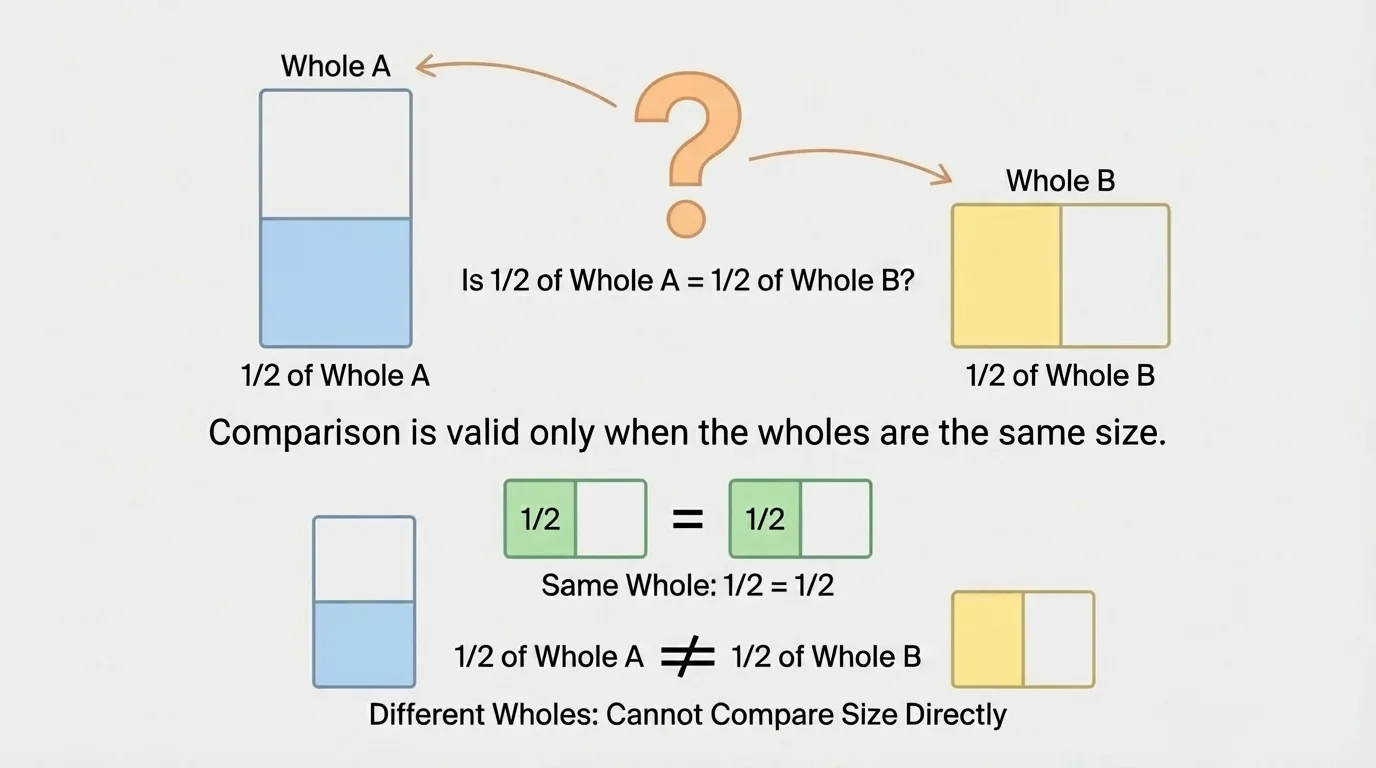
That means we must be careful. The fractions \(\dfrac{1}{2}\) and \(\dfrac{1}{2}\) are equal as numbers, but when they are used to describe parts of different wholes, the pieces you see in real life may not match in size. Later, when you compare fractions in a math problem, the pictures or words usually mean the wholes are the same unless the problem says otherwise.
Numerator: the top number in a fraction. It tells how many equal parts are being counted.
Denominator: the bottom number in a fraction. It tells how many equal parts make the whole.
Keep this idea in mind the whole time: same whole, equal parts, then compare.
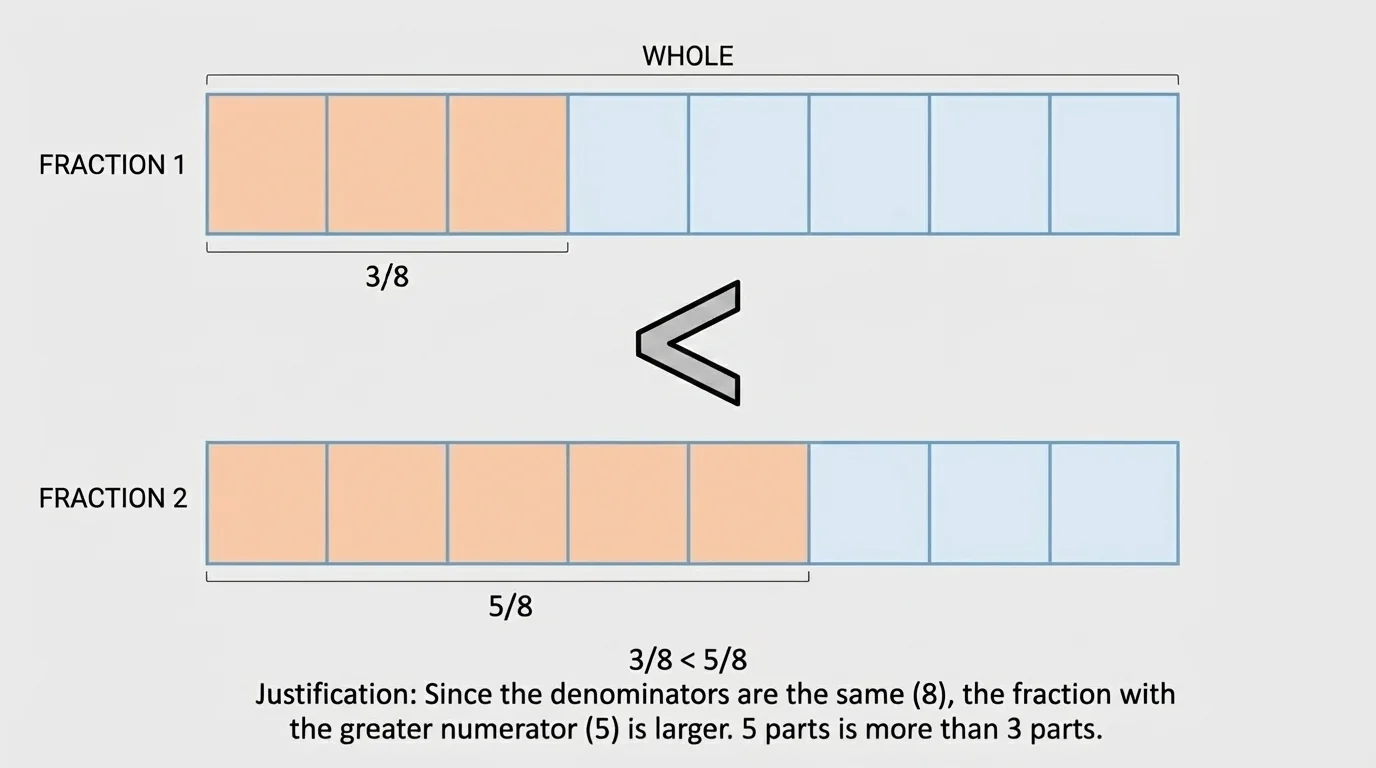
[Figure 2] When fractions have the same denominator, the whole is split into the same number of equal parts. So the pieces are the same size. That makes comparing easier.
If the pieces are the same size, the fraction with more pieces is greater. For example, compare \(\dfrac{3}{8}\) and \(\dfrac{5}{8}\). Both fractions are made of eighths. Since \(5\) eighths is more than \(3\) eighths, we know:
\[\frac{3}{8} < \frac{5}{8}\]
Here are more examples:
\(\dfrac{1}{6} < \dfrac{4}{6}\) because one sixth is less than four sixths.
\(\dfrac{7}{9} > \dfrac{2}{9}\) because seven ninths is greater than two ninths.
\(\dfrac{5}{12} = \dfrac{5}{12}\) because they are the same fraction.
You can think of same-denominator fractions like slices from the same pizza. If every slice is the same size, then having more slices means having more pizza. As we saw with the fraction bars in [Figure 2], equal-size parts make the comparison simple.
Same denominator rule: if two fractions have the same denominator, compare the numerators. The greater numerator names the greater fraction because it counts more equal-size parts.
This rule works because the denominator tells the size of the parts, and when denominators are equal, the part size stays the same in both fractions.
[Figure 3] When fractions have the same numerator, they name the same number of parts. But those parts may not be the same size. A fraction model makes this easy to see.
Compare \(\dfrac{2}{3}\) and \(\dfrac{2}{5}\). Both fractions show \(2\) parts. But thirds are larger pieces than fifths because splitting a whole into \(3\) equal parts makes bigger pieces than splitting it into \(5\) equal parts. So:
\[\frac{2}{3} > \frac{2}{5}\]
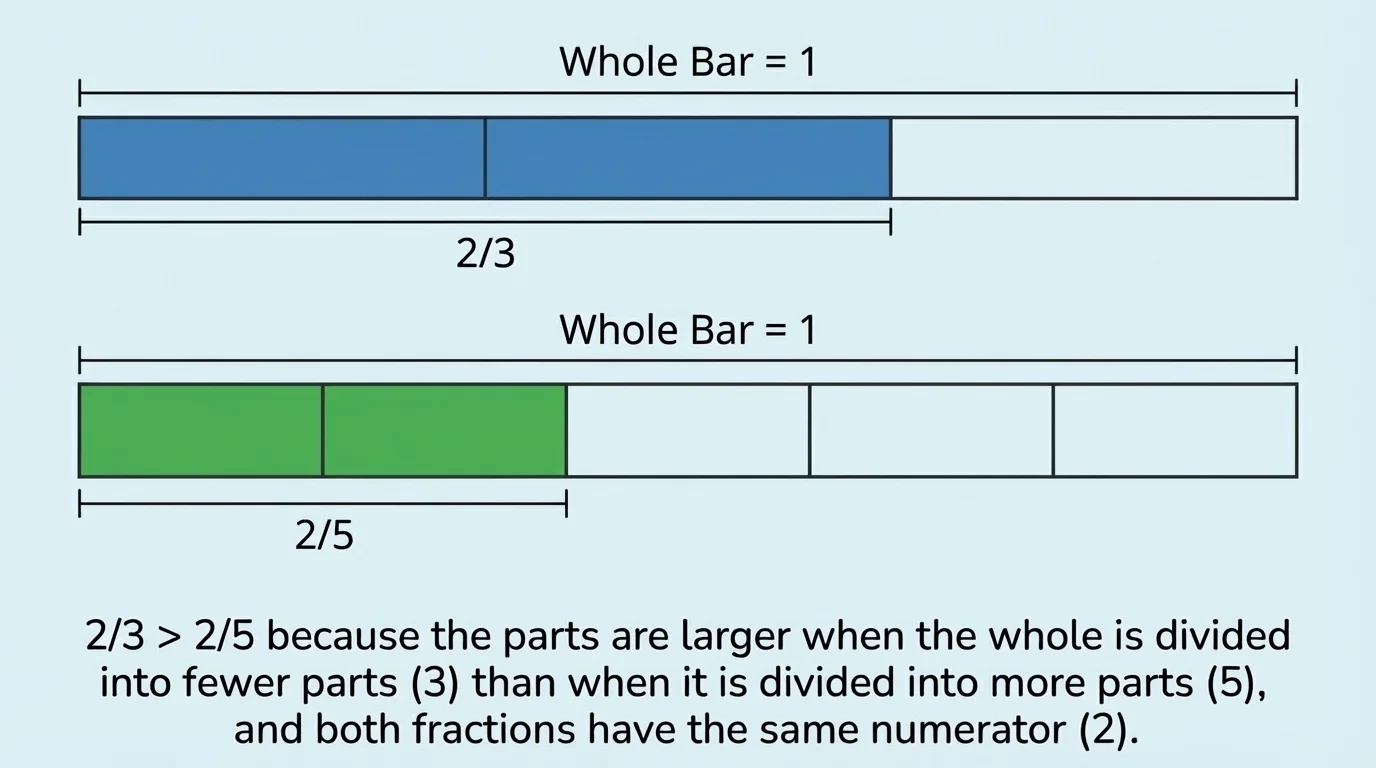
This can feel backward at first. The denominator \(5\) is greater than \(3\), but \(\dfrac{2}{5}\) is smaller than \(\dfrac{2}{3}\). That happens because a larger denominator means the whole is cut into more pieces, so each piece is smaller.
Here are more examples:
\(\dfrac{4}{6} < \dfrac{4}{5}\) because sixths are smaller than fifths, and both fractions count \(4\) parts.
\(\dfrac{1}{8} < \dfrac{1}{4}\) because one eighth is smaller than one fourth.
\(\dfrac{3}{7} = \dfrac{3}{7}\) because they are identical fractions.
Fractions with the same numerator often surprise students. Many children first think the larger denominator makes the larger fraction, but with the same numerator, the opposite is true because the pieces get smaller.
Think about sharing. If you get \(2\) pieces from a chocolate bar cut into \(3\) equal parts, that is more chocolate than getting \(2\) pieces from a bar cut into \(5\) equal parts. The models in [Figure 3] show those bigger and smaller pieces clearly.
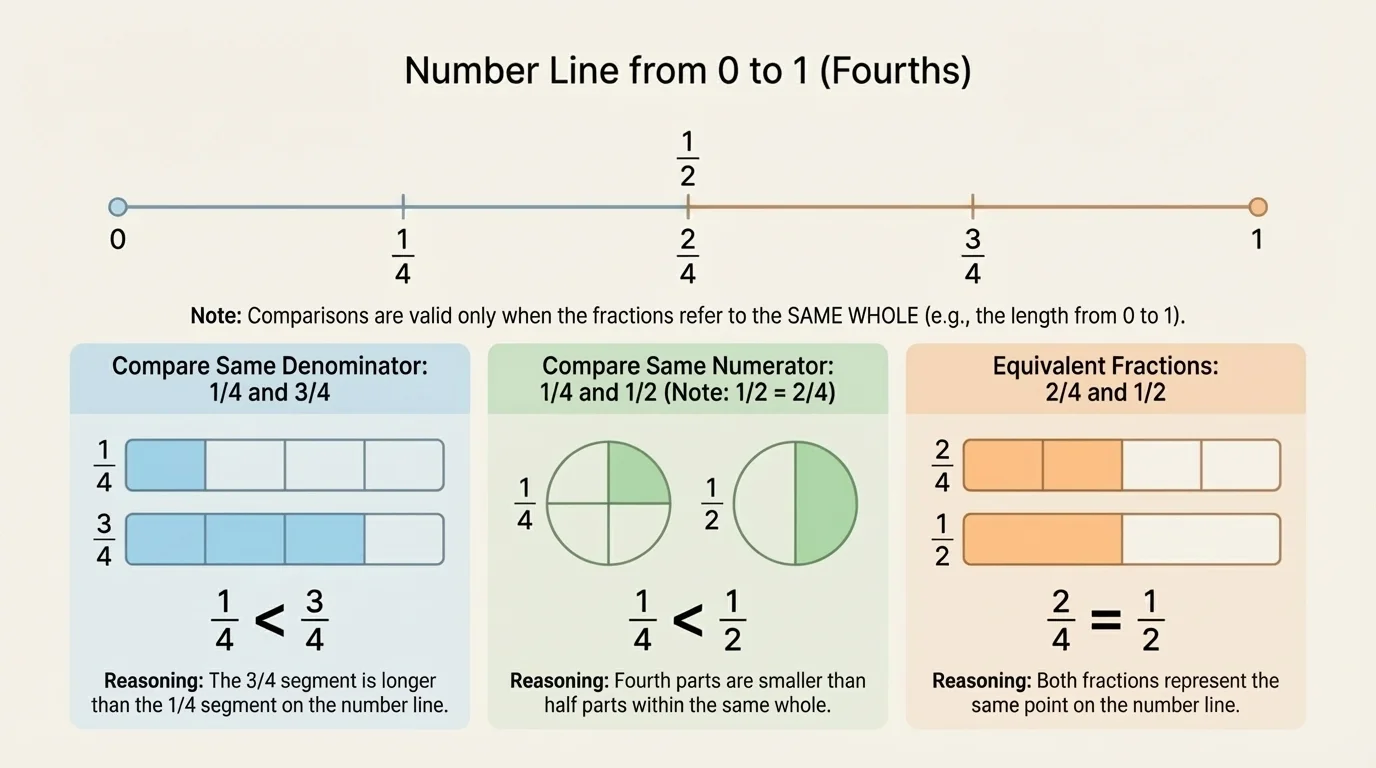
[Figure 4] Pictures help us justify our thinking. A visual fraction model can be a fraction bar, a circle, or another picture split into equal parts. A number line also helps because fractions farther to the right are greater.
Suppose we compare \(\dfrac{1}{4}\) and \(\dfrac{3}{4}\). On a number line from \(0\) to \(1\), both fractions are marked using fourths. Since \(\dfrac{3}{4}\) is to the right of \(\dfrac{1}{4}\), we know:
\[\frac{1}{4} < \frac{3}{4}\]
Suppose we compare \(\dfrac{2}{3}\) and \(\dfrac{2}{6}\). A fraction bar model shows the same number of parts shaded, but the thirds are larger than the sixths. So:
\[\frac{2}{3} > \frac{2}{6}\]
When you write a comparison, use one of these symbols correctly:
| Symbol | Meaning | Example |
|---|---|---|
| \(>\) | is greater than | \(\dfrac{5}{8} > \dfrac{2}{8}\) |
| \(<\) | is less than | \(\dfrac{1}{3} < \dfrac{1}{2}\) |
| \(=\) | is equal to | \(\dfrac{4}{7} = \dfrac{4}{7}\) |
Table 1. Symbols used to record fraction comparisons.
The number line in [Figure 4] also reminds us that fractions are numbers. They belong on the number line just like whole numbers do.
Let's work through some comparisons step by step.
Worked example 1
Compare \(\dfrac{2}{7}\) and \(\dfrac{5}{7}\).
Step 1: Look at the denominators.
Both fractions have denominator \(7\), so the parts are the same size.
Step 2: Compare the numerators.
Since \(2 < 5\), the fraction with \(2\) parts is smaller.
Step 3: Write the comparison.
\[\frac{2}{7} < \frac{5}{7}\]
The fraction \(\dfrac{5}{7}\) is greater because it has more sevenths.
This example used the same-denominator rule. Since the pieces were equal in size, counting the number of pieces was enough.
Worked example 2
Compare \(\dfrac{3}{4}\) and \(\dfrac{3}{8}\).
Step 1: Look at the numerators.
Both fractions have numerator \(3\), so each fraction counts \(3\) pieces.
Step 2: Compare the size of the pieces.
Fourths are larger than eighths because a whole cut into \(4\) equal parts has bigger pieces than a whole cut into \(8\) equal parts.
Step 3: Write the comparison.
\[\frac{3}{4} > \frac{3}{8}\]
The fraction \(\dfrac{3}{4}\) is greater because it has \(3\) larger pieces.
This is a great reminder that a bigger denominator does not always mean a bigger fraction.
Worked example 3
Compare \(\dfrac{1}{2}\) of a small cake and \(\dfrac{1}{2}\) of a large cake.
Step 1: Notice the fractions.
Both amounts are named \(\dfrac{1}{2}\).
Step 2: Think about the whole.
The wholes are different sizes: one cake is small and one cake is large.
Step 3: Decide whether the comparison is valid.
You cannot say the amounts are the same just from the fractions, because the fractions do not refer to the same whole.
The comparison is not valid unless the cakes are the same size.
This kind of example matters in real life. Math comparisons depend on the size of the whole, not just on the fraction name.
Worked example 4
Compare \(\dfrac{4}{9}\) and \(\dfrac{4}{6}\).
Step 1: Check what is the same.
Both fractions have the same numerator, \(4\).
Step 2: Compare the denominators.
Ninths are smaller pieces than sixths because \(9\) equal parts make smaller pieces than \(6\) equal parts.
Step 3: Write the comparison.
\[\frac{4}{9} < \frac{4}{6}\]
The fraction \(\dfrac{4}{6}\) is greater because it has \(4\) larger pieces.
As you solve more problems, always ask yourself whether you are comparing the number of same-size pieces or comparing the size of pieces.
Fractions appear everywhere. In cooking, you may compare \(\dfrac{3}{4}\) cup of juice with \(\dfrac{1}{4}\) cup of juice. Since both are measured in fourths of the same cup, \(\dfrac{3}{4} > \dfrac{1}{4}\).
In sports, a runner might complete \(\dfrac{5}{8}\) of a track lap while another runner completes \(\dfrac{3}{8}\) of the same lap. Because the denominators match and the lap is the same whole, \(\dfrac{5}{8} > \dfrac{3}{8}\).
With ribbons, one ribbon piece may be \(\dfrac{2}{3}\) of a meter and another may be \(\dfrac{2}{5}\) of a meter. Since both fractions name \(2\) parts but thirds are bigger than fifths, \(\dfrac{2}{3} > \dfrac{2}{5}\).
These examples show how fraction comparisons help us decide who has more, which amount is longer, or which portion is bigger.
One common mistake is thinking that the fraction with the larger denominator is always larger. That is not true. Compare \(\dfrac{1}{3}\) and \(\dfrac{1}{6}\). Since thirds are bigger pieces than sixths, \(\dfrac{1}{3} > \dfrac{1}{6}\).
Another mistake is forgetting about the same whole. A student might say \(\dfrac{1}{2} = \dfrac{1}{2}\), so the actual pieces must match. But as we learned earlier with different-size wholes in [Figure 1], the real amounts may be different.
A third mistake is comparing only the top numbers or only the bottom numbers without thinking about what they mean. In fractions, the numbers work together. The numerator counts parts, and the denominator tells the size of the parts.
"When the pieces are the same size, count the pieces. When the number of pieces is the same, compare the size of the pieces."
That short rule can help you choose the right strategy every time.
Fractions are numbers, and we can compare them by thinking carefully about their size. If fractions have the same denominator, compare the numerators. If fractions have the same numerator, compare the size of the parts by thinking about the denominators.
Visual models are powerful because they help you justify your answer. A picture can show equal parts, bigger pieces, smaller pieces, and which fraction is farther right on a number line.
Most importantly, every correct comparison depends on the same whole. Without the same whole, the comparison may not make sense in the real world.
