Have you ever noticed that a window, a kite, a picture frame, and a floor tile can all look different but still be alike in an important way? In geometry, shapes can belong to different groups, but they can still share the same attributes. That is what makes classifying shapes so interesting. A shape might have its own special name and also belong to a larger family of shapes.
When mathematicians talk about shapes, they look at their attributes. Attributes are features we can notice about a shape. Some important attributes are the number of sides, the number of corners, whether sides are equal, and whether corners are right angles.
A side is a straight line on the edge of a shape. A corner is where two sides meet. A right angle is a square corner, like the corner of a sheet of paper. If a shape has 4 sides, that is one of its attributes. If all 4 sides are the same length, that is another attribute.
Attributes are the features of a shape that help describe and sort it, such as how many sides it has or whether its sides are equal.
A quadrilateral is a closed shape with exactly 4 straight sides.
We can sort shapes by their attributes. For example, shapes with 3 sides are triangles. Shapes with 4 sides belong to a larger group called quadrilaterals. Inside that larger group, there are smaller groups with extra special attributes.
Many shapes that look different can still belong to the same big group, as [Figure 1] shows. If a shape has exactly 4 straight sides and is closed, it is a quadrilateral. A square is a quadrilateral. A rectangle is a quadrilateral. A rhombus is a quadrilateral. Some other 4-sided shapes are quadrilaterals too, even if they do not have one of those special names.
The shared attribute is having 4 sides. That one shared attribute is enough to make a larger category. So when we say quadrilateral, we mean all shapes that have 4 sides. Some are wide, some are tall, some are slanted, and some have matching side lengths. They can still all belong together because of that shared feature.
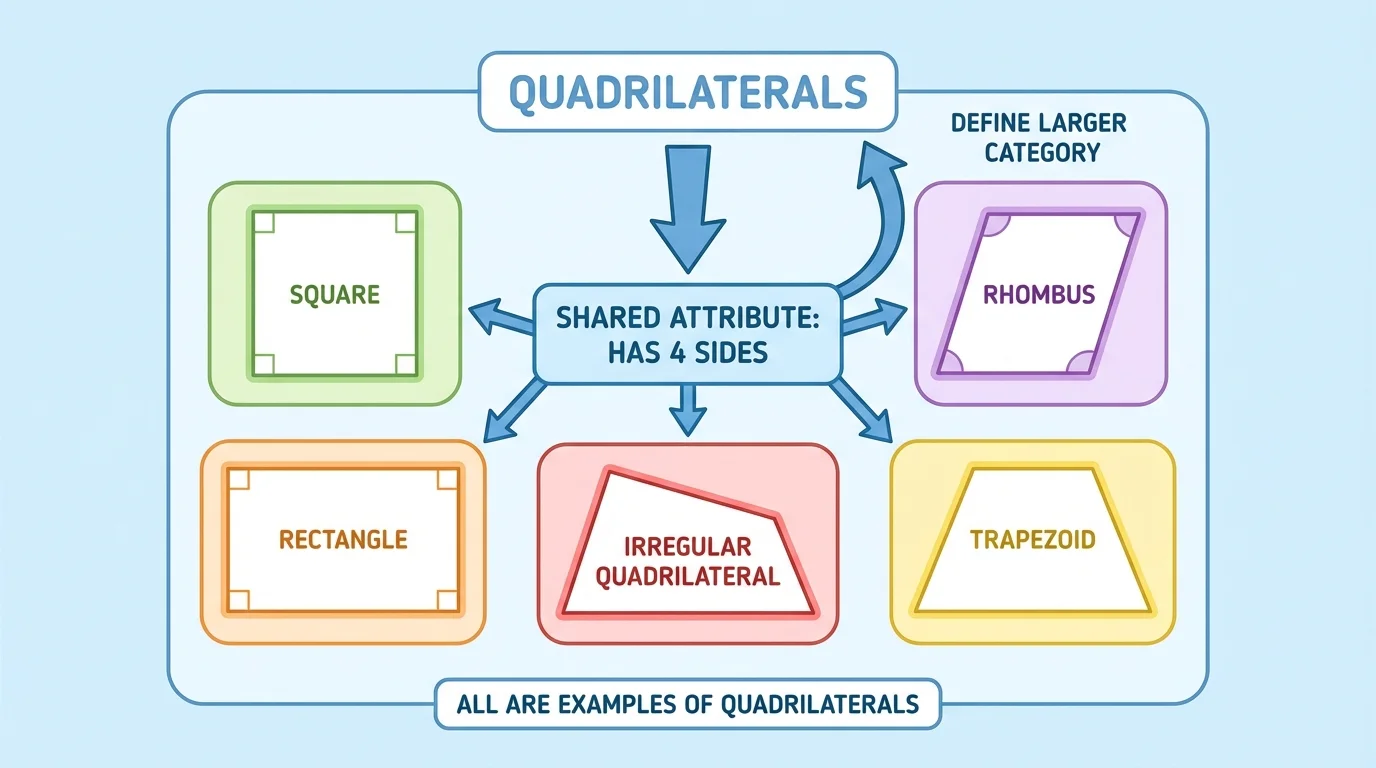
A shape is not a quadrilateral if it has fewer than 4 sides or more than 4 sides. A triangle has 3 sides, so it is not a quadrilateral. A pentagon has 5 sides, so it is not a quadrilateral. Also, the sides must be straight. A shape with curved edges does not fit this group.
Remember that a shape must be closed to count as a polygon. That means all sides connect with no gaps. A quadrilateral is a closed polygon with 4 straight sides.
It helps to think about categories like toy boxes. One box might be labeled "all toys with wheels." Inside it, you could have cars, trucks, and buses. In geometry, the big box is "all shapes with 4 sides." Inside it, you can have squares, rectangles, rhombuses, and other quadrilaterals.
These three shapes share some features and also have different special features. All three are quadrilaterals because each one has 4 sides. But each type has its own rule.
A rectangle has 4 sides and 4 right angles. Opposite sides are equal in length. That means the top and bottom sides match, and the left and right sides match. A picture frame is often shaped like a rectangle.
A rhombus also has 4 sides, but its special rule is that all 4 sides are equal in length. A rhombus may or may not have right angles. Some rhombuses look slanted. A tilted square is also a rhombus.
A square is a very special shape. It has 4 equal sides and 4 right angles. That means a square follows the rule for a rhombus and also follows the rule for a rectangle.
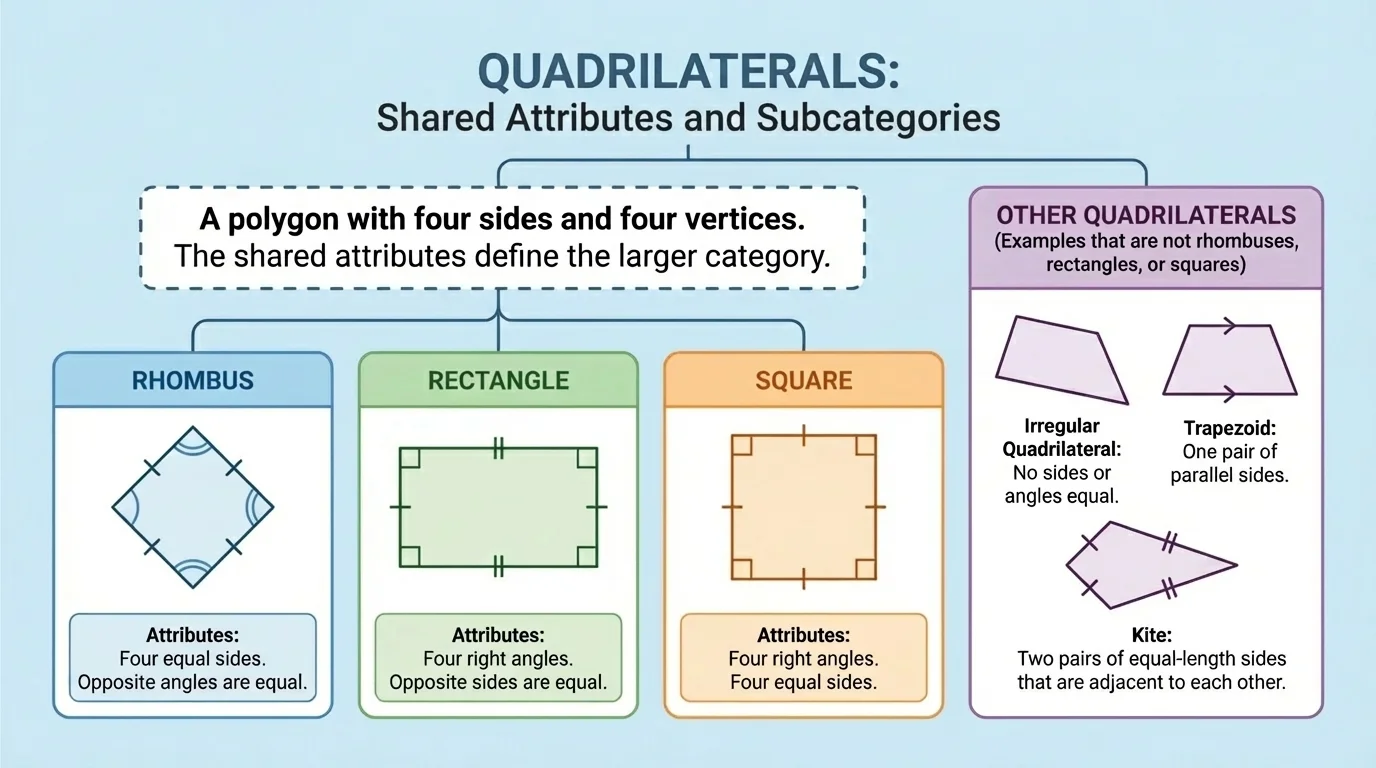
Look closely at how these shapes are alike. A rectangle and a square both have 4 right angles. A rhombus and a square both have 4 equal sides. Because a square has both of those attributes, it belongs to both smaller groups.
| Shape | Has 4 sides | All sides equal | Has 4 right angles |
|---|---|---|---|
| Rectangle | Yes | No | Yes |
| Rhombus | Yes | Yes | Not always |
| Square | Yes | Yes | Yes |
This idea surprises many students at first. Sometimes we think one shape should fit in only one group. But in geometry, a shape can belong to more than one category if it has the right attributes.
A square is a rectangle because it has 4 right angles. A square is also a rhombus because all 4 sides are equal. And since it has 4 sides, it is also a quadrilateral. So one shape can have several names that are all correct.
One shape, more than one category
Categories in geometry can fit inside each other. The larger group is quadrilaterals. Inside that group are smaller groups, such as rectangles and rhombuses. A square fits inside both of those smaller groups because it has the attributes of each one.
This is like saying a golden retriever is a dog, and a dog is an animal. The same thing belongs to a smaller group and also to larger groups. In geometry, a square belongs to the smaller group "square," but it also belongs to "rectangle," "rhombus," and "quadrilateral."
We can also use true statements to help: "All squares are quadrilaterals" is true. "All rectangles are quadrilaterals" is true. "All rhombuses are quadrilaterals" is true. "All quadrilaterals are squares" is not true, because many 4-sided shapes are not squares.
Some shapes have 4 sides without being a rectangle, rhombus, or square. This is an important part of understanding categories. The larger category includes more shapes than just the special ones we may know best.
For example, a trapezoid is a quadrilateral because it has 4 sides. But it may not have 4 right angles, and it may not have all 4 sides equal. Another example is an irregular quadrilateral. That means it still has 4 sides, but the side lengths and angles do not follow the special rules of a rectangle, rhombus, or square.
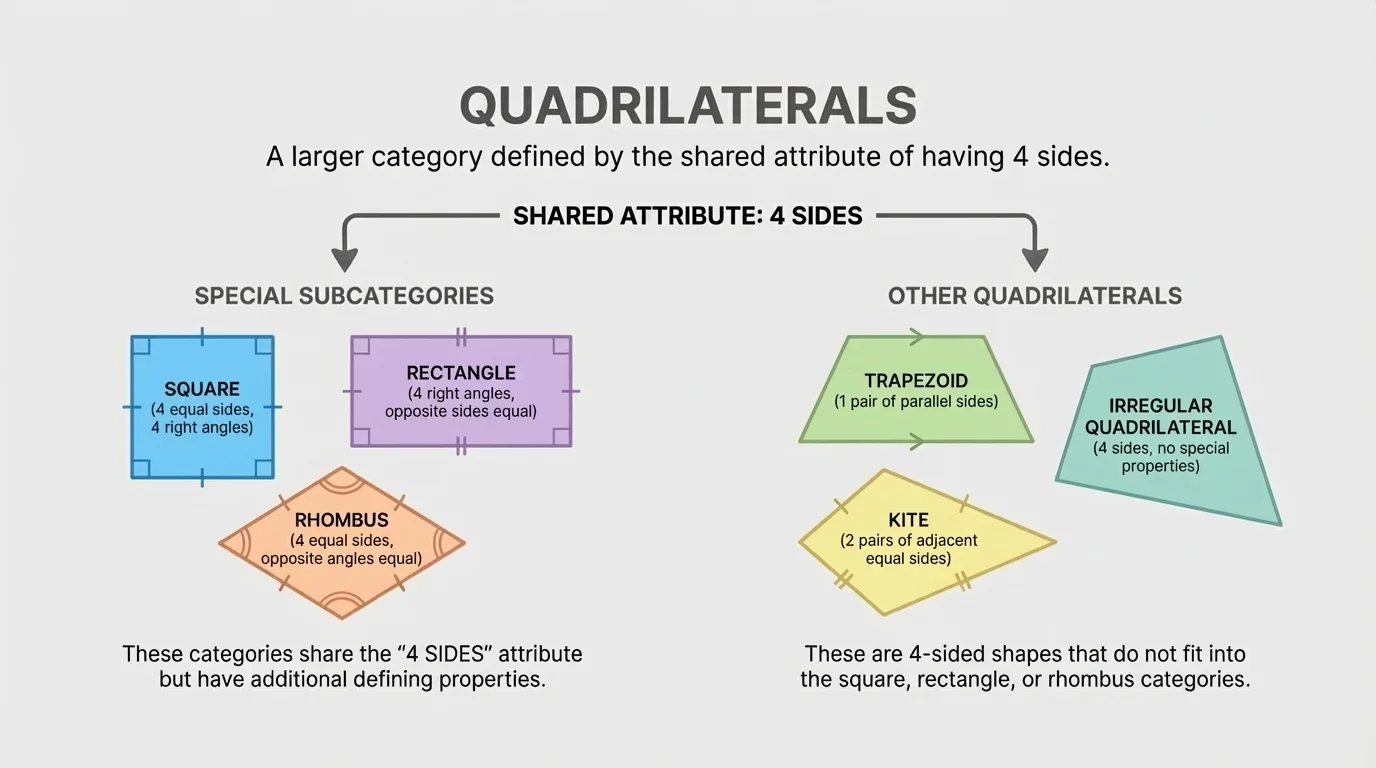
When drawing a quadrilateral that is not one of these special shapes, check carefully. It must have exactly 4 straight sides. Then make sure it does not have all 4 equal sides with 4 right angles, and does not have only the special rectangle or rhombus rules either.
One way to draw one is to make a shape with 4 sides where the top is shorter than the bottom and the sides slant. Another way is to draw a shape with 4 sides of different lengths. As long as it is closed and has exactly 4 straight sides, it is a quadrilateral.
Some road signs and logos use quadrilaterals because straight-edged shapes are easy to build, tile, and arrange. Designers often choose different quadrilaterals to create patterns and frames.
Later, when you look back at [Figure 1], you can see that the big group includes both regular-looking and unusual-looking 4-sided shapes. The shared attribute matters more than whether the shapes look exactly alike.
Now let's use what we know about attributes to classify shapes and think about drawings.
Worked example 1
A shape has 4 sides and 4 right angles. Its opposite sides are equal, but not all 4 sides are equal. What is the shape?
Step 1: Find the larger category.
The shape has 4 sides, so it is a quadrilateral.
Step 2: Check for right angles.
The shape has 4 right angles. That matches the rule for a rectangle.
Step 3: Check whether it is a square.
Not all 4 sides are equal, so it is not a square.
The shape is a rectangle.
This example shows that knowing just one attribute is not always enough for the most specific name. We often need to look at several attributes together.
Worked example 2
A shape has 4 sides. All 4 sides are equal. It does not have 4 right angles. What is the shape?
Step 1: Find the larger category.
It has 4 sides, so it is a quadrilateral.
Step 2: Look at side lengths.
All 4 sides are equal. That matches the rule for a rhombus.
Step 3: Check for square rules.
It does not have 4 right angles, so it is not a square.
The shape is a rhombus.
That is why a slanted figure can still be a rhombus. Equal side lengths matter, even when the corners are not right angles.
Worked example 3
You need to draw a quadrilateral that is not a rectangle, not a rhombus, and not a square. What could you draw?
Step 1: Start with the larger rule.
Draw a closed shape with exactly 4 straight sides.
Step 2: Avoid rectangle rules.
Do not make 4 right angles.
Step 3: Avoid rhombus and square rules.
Do not make all 4 sides equal.
Step 4: Choose a possible shape.
You could draw a trapezoid with a short top side, a longer bottom side, and two slanted sides.
Your drawing is a quadrilateral, but it is not a rectangle, rhombus, or square.
When you compare your idea with [Figure 3], you can see that many different drawings can work. There is not just one correct-looking non-special quadrilateral.
Geometry is not only in math books. Rectangles are everywhere: doors, books, screens, and tables. Squares appear in tiles, game boards, and sticky notes. Rhombus shapes can be seen in some kites, quilt patterns, and warning signs turned at an angle.
Builders, artists, and designers think about shape attributes all the time. A floor pattern may use square tiles because the equal sides and right angles help them fit together neatly. A window may be rectangular because right angles help make strong frames. Decorative art may use rhombuses because the slanted equal sides make repeating patterns look interesting.
When people organize shapes for design or building, they often think in categories. A worker might ask for all 4-sided tiles, which means all quadrilaterals. Then the worker might choose a smaller group, such as squares, for a particular project. This is the same idea as sorting shapes by shared attributes.
One common mistake is thinking that if a shape is slanted, it cannot be a rectangle or a rhombus. What matters is not whether the shape sits straight on the page. What matters is its attributes. A square turned sideways is still a square.
Another common mistake is saying a square is not a rectangle. But a square is a rectangle because it has 4 right angles. It just has one extra feature too: all 4 sides are equal. The extra feature does not take it out of the rectangle group.
A third mistake is thinking every quadrilateral must be one of the famous types. But as we saw earlier in [Figure 1], the larger group is bigger than those special examples. Some quadrilaterals have no special subcategory name that we are using here, and they still belong to the quadrilateral family.
