Have you ever solved a hard math fact by turning it into an easier one? That is exactly what strong mathematicians do. Instead of trying to remember every single fact separately, they look for patterns. A fact like \(4 \times 8\) can connect to \(2 \times 8\) and \(2 \times 8\) again. A division problem like \(24 \div 6\) can connect to a multiplication fact you already know. These smart moves help math feel faster, clearer, and more fun.
Multiplication and division are full of helpful patterns. When you learn to notice them, you do not have to start from the beginning every time. You can use facts you already know to find new facts. This is called using a strategy. A strategy is a smart plan for solving a problem.
Before learning new ways to solve, remember what multiplication means. Multiplication shows equal groups. If there are \(3\) bags with \(5\) marbles in each bag, then the total number of marbles is \(3 \times 5 = 15\). Multiplication can also describe arrays. An array is a set of objects arranged in rows and columns.
You already know that repeated addition and multiplication are connected. For example, \(4 + 4 + 4 = 12\) matches \(3 \times 4 = 12\). You also know that division can mean sharing equally or finding how many groups.
These ideas matter because the strategies in this lesson build on them. If you can picture equal groups, rows, columns, and sharing, then you can understand why multiplication and division facts work the way they do.
Multiplication means finding the total in equal groups.
Division means splitting into equal groups or finding how many equal groups there are.
Array is a picture of objects arranged in rows and columns to show multiplication.
For example, \(5 \times 2\) means \(5\) groups of \(2\), and the total is \(10\). The related division facts are \(10 \div 5 = 2\) and \(10 \div 2 = 5\). These connected facts help you move back and forth between multiplying and dividing.
Sometimes a multiplication fact can be turned around and still have the same answer, as [Figure 1] shows with arrays. If you know \(3 \times 4 = 12\), then you also know \(4 \times 3 = 12\). The number of objects does not change. Only the way you look at the groups changes.
Think about an array. You might see \(3\) rows of \(4\), or you might see \(4\) columns of \(3\). Either way, the total is still \(12\). This is helpful because if one fact is easier to remember, you can use it to find the other fact.
For example, if \(2 \times 9\) feels easier than \(9 \times 2\), that is fine. Both have the same product: \(18\). If you know \(5 \times 7 = 35\), then \(7 \times 5 = 35\) too.
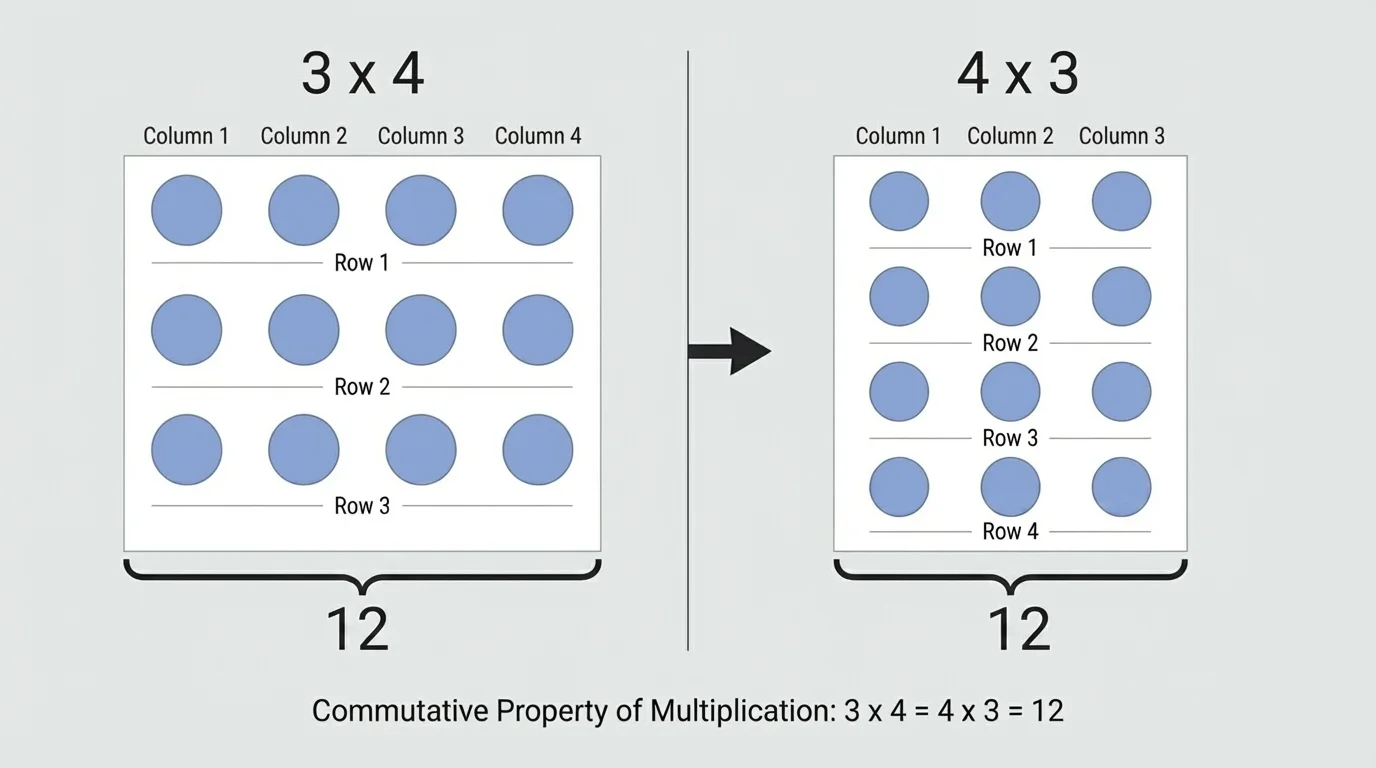
This turn-around idea helps when one factor is small and familiar. Many students quickly know facts with \(2\), \(5\), or \(10\). So if you see \(8 \times 5\), you can think of \(5 \times 8\). That may feel easier because skip-counting by \(5\) is often fast: \(5, 10, 15, 20, 25, 30, 35, 40\).
Later, when you solve division problems, this idea also helps you remember the matching multiplication facts. This array reminds us that the same total can be described in more than one way.
You can also solve multiplication by thinking about groups inside groups. Suppose you want to find \(2 \times 6\). You might think of \(2 \times 3 = 6\), and then double that because \(6\) is two groups of \(3\). Or you might think of \(2\) groups of \(6\) as \(1\) group of \(6\) and another \(1\) group of \(6\). Different groupings can help you use facts you know well.
Here is another example. To find \(3 \times 8\), you might think of \(3 \times 4 = 12\), then add another \(12\), because \(8\) is two groups of \(4\). So \(3 \times 8 = 24\). You still get the correct product, but you got there by using an easier fact first.
Helpful groupings help you use facts you already know. When a number can be seen in smaller equal parts, you can use those smaller parts to build the larger answer.
This does not change the total. It only changes the path your brain uses to get there. Good strategies make hard facts feel more familiar.
Another useful idea is to break apart one factor into easier pieces, as [Figure 2] illustrates. Then you multiply each piece and put the answers together. This is very helpful when a fact is close to one you already know.
Suppose you want to solve \(6 \times 7\). You may know \(6 \times 5\) and \(6 \times 2\) more quickly. Since \(7 = 5 + 2\), you can think:
\(6 \times 7 = 6 \times 5 + 6 \times 2 = 30 + 12 = 42\).
You can also break apart a different way. Since \(7 = 3 + 4\), you could think \(6 \times 7 = 6 \times 3 + 6 \times 4 = 18 + 24 = 42\). The answer stays the same because both parts together still make \(7\).
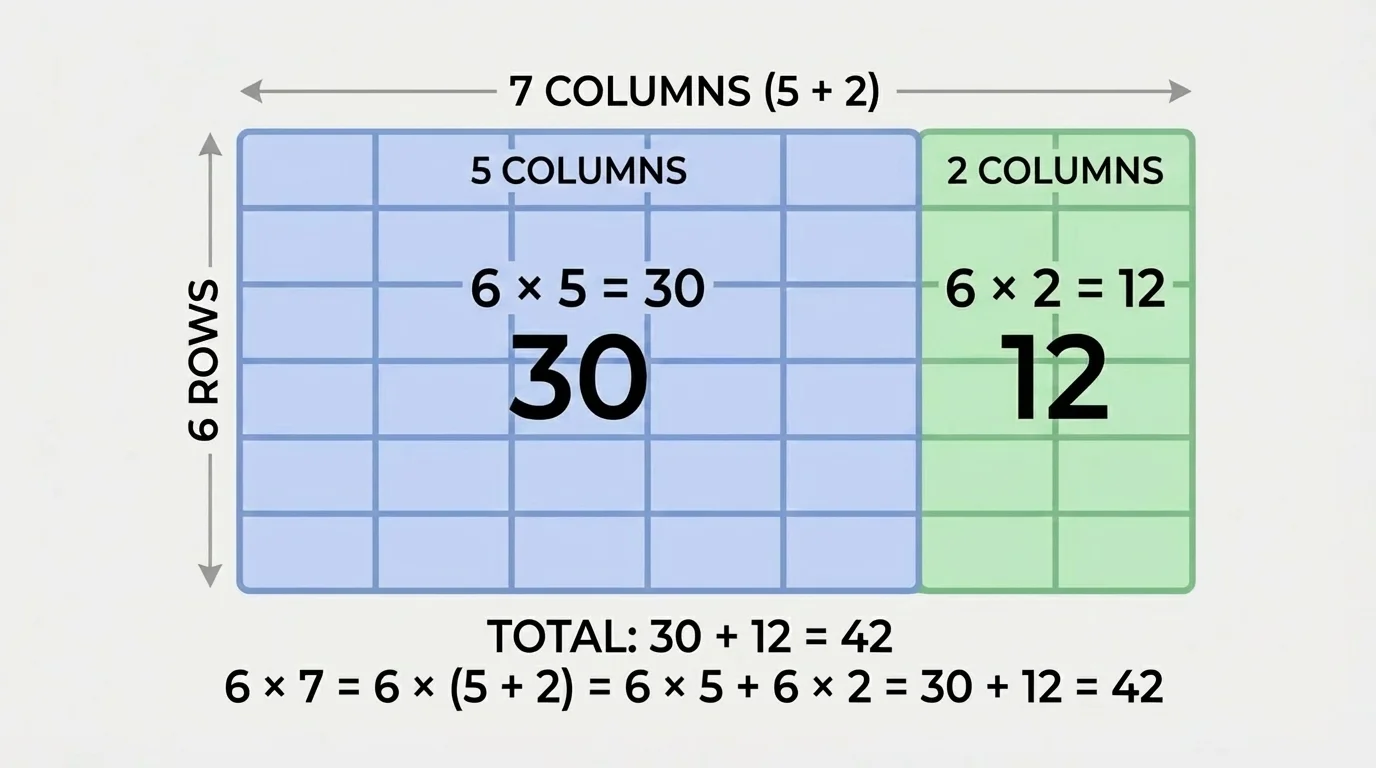
This idea works with many facts. For \(8 \times 6\), you might break \(6\) into \(5 + 1\). Then \(8 \times 5 = 40\) and \(8 \times 1 = 8\), so \(8 \times 6 = 48\). Or for \(4 \times 9\), you can think of \(4 \times 10 = 40\), then take away one group of \(4\), which gives \(36\).
This picture shows that one big rectangle can be split into smaller rectangles. Their totals combine to make the whole product. This is a powerful way to see multiplication instead of just memorizing it.
Many adults use break-apart thinking in their heads without even noticing. It is one reason mental math can be so quick.
Related facts connect multiplication and division, and [Figure 3] helps show that division can be solved by asking, "What multiplication fact matches this problem?" If \(3 \times 4 = 12\), then \(12 \div 3 = 4\) and \(12 \div 4 = 3\).
Think about \(12 \div 3\). This asks, "If \(12\) things are split into \(3\) equal groups, how many are in each group?" Since \(3 \times 4 = 12\), each group has \(4\). Division and multiplication work together like a team.
Here is a fact family:
\(4 \times 6 = 24\)
\(6 \times 4 = 24\)
\(24 \div 4 = 6\)
\(24 \div 6 = 4\)
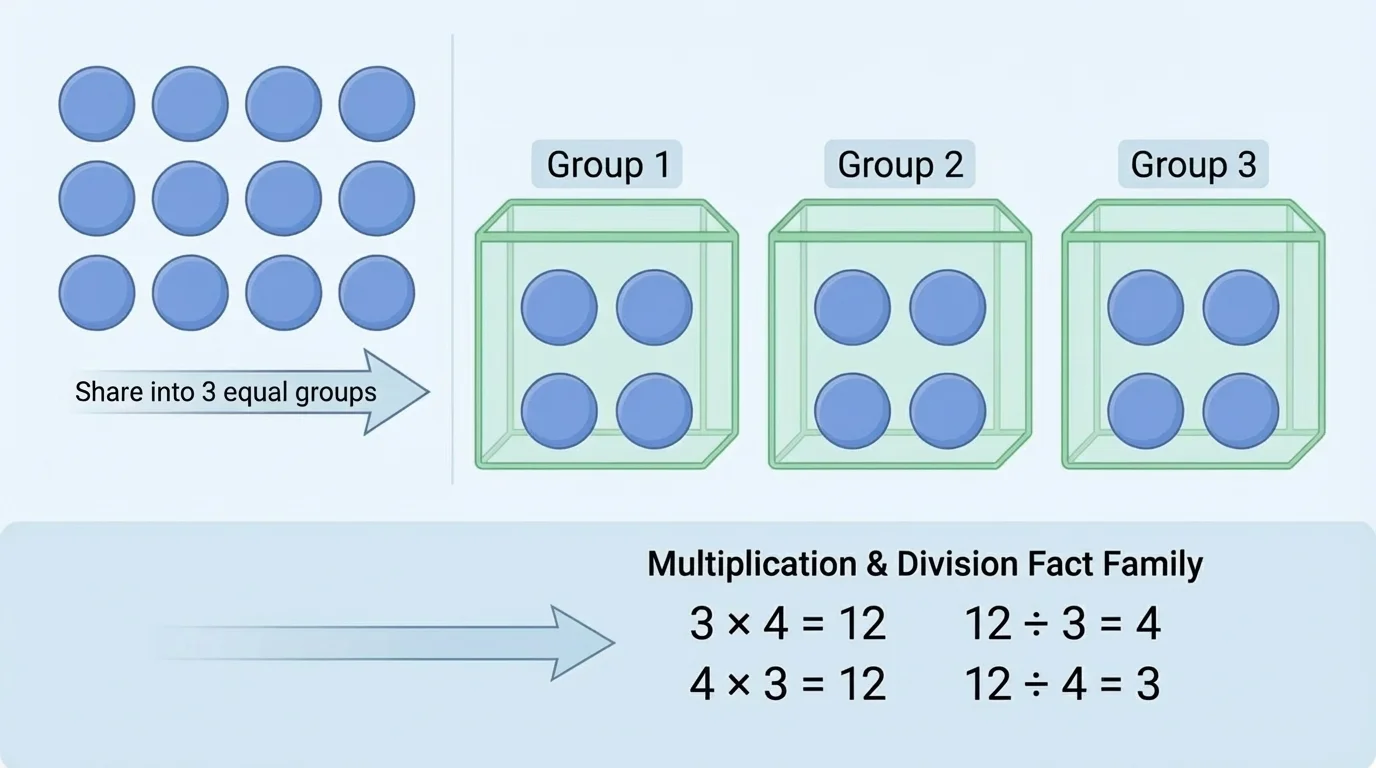
If you forget a division fact, think of the multiplication fact that matches. For \(35 \div 5\), ask, "\(5\) times what equals \(35\)?" Since \(5 \times 7 = 35\), the answer is \(7\).
This helps with both meanings of division. In a sharing problem, you find how many in each group. In a grouping problem, you find how many groups. These equal groups show why both ideas connect to multiplication facts.
Now let's look closely at how these strategies work step by step.
Worked example 1
Find \(4 \times 7\) by breaking apart \(7\).
Step 1: Split \(7\) into easier parts.
Use \(7 = 5 + 2\).
Step 2: Multiply each part.
\(4 \times 5 = 20\) and \(4 \times 2 = 8\).
Step 3: Add the partial products.
\(20 + 8 = 28\).
\[4 \times 7 = 28\]
This example works because \(5 + 2\) still makes \(7\). You are finding the same total in an easier way.
Worked example 2
Find \(9 \times 3\) using a turn-around fact.
Step 1: Turn the fact around.
Think of \(3 \times 9\) instead of \(9 \times 3\).
Step 2: Use a fact you know.
\(3 \times 9 = 27\).
\[9 \times 3 = 27\]
Nothing changes except the order. The product stays the same.
Worked example 3
Find \(24 \div 6\).
Step 1: Ask what multiplication fact matches.
Think, "\(6\) times what equals \(24\)?"
Step 2: Use a known multiplication fact.
\(6 \times 4 = 24\).
Step 3: Write the quotient.
If \(6 \times 4 = 24\), then \(24 \div 6 = 4\).
\[24 \div 6 = 4\]
Division becomes easier when you know your multiplication facts and can connect them quickly.
Worked example 4
Find \(8 \times 4\) by grouping in a helpful way.
Step 1: See \(8\) as two groups of \(4\).
So \(8 \times 4\) can be thought of as \((4 \times 4) + (4 \times 4)\).
Step 2: Find each smaller fact.
\(4 \times 4 = 16\).
Step 3: Add the two parts.
\(16 + 16 = 32\).
\[8 \times 4 = 32\]
These strategies are not only for worksheets. They help in everyday situations. If a teacher arranges \(6\) rows of \(7\) chairs, break-apart thinking can help find the total number of chairs: \(6 \times 7 = 42\). If \(42\) markers are shared equally among \(6\) tables, multiplication helps you divide: \(42 \div 6 = 7\).
Suppose a store puts juice boxes into packs of \(4\). If there are \(8\) packs, the total is \(8 \times 4 = 32\). If there are \(32\) juice boxes and each pack holds \(4\), then the number of packs is \(32 \div 4 = 8\). Multiplication and division describe the same situation in different ways.
Sports also use these ideas. If a team has \(3\) racks with \(5\) basketballs on each rack, that is \(3 \times 5 = 15\) basketballs. If \(15\) basketballs are shared equally among \(5\) players to carry, then each player carries \(3\).
One common mistake is adding when you should multiply. If there are \(4\) groups of \(6\), the total is not \(4 + 6\). It is \(4 \times 6 = 24\). Equal groups mean multiplication.
Another mistake is forgetting to connect division to multiplication. For \(18 \div 3\), do not guess. Ask, "\(3\) times what equals \(18\)?" The answer is \(6\), because \(3 \times 6 = 18\).
You can also check whether your answer makes sense. For example, \(5 \times 8\) should be more than \(5 \times 5 = 25\), so an answer like \(13\) cannot be correct. For division, if \(20\) things are shared into \(4\) equal groups, each group should have fewer than \(20\), so \(20 \div 4 = 5\) makes sense.
When you use smart strategies, math facts become connected instead of separate. You can turn around factors, use easier groupings, break apart numbers, and use multiplication to solve division.
