Have you ever noticed that many everyday problems are really like little mysteries? A class needs enough chairs for guests, a team divides snacks into bags, or a store packs boxes for delivery. These situations are not solved with just one quick number sentence. They often need several steps, careful thinking, and a final check to make sure the answer makes sense.
When you solve a multistep word problem, you use more than one operation. You might add first and then divide. You might multiply and then subtract. Sometimes the answer is exact, and sometimes there is a remainder that you must understand correctly. The story tells you what the remainder means.
Good problem solvers do more than compute. They also organize information, write an equation, solve carefully, and check whether the answer is reasonable. That is how mathematicians think, and it is also how people solve real problems every day.
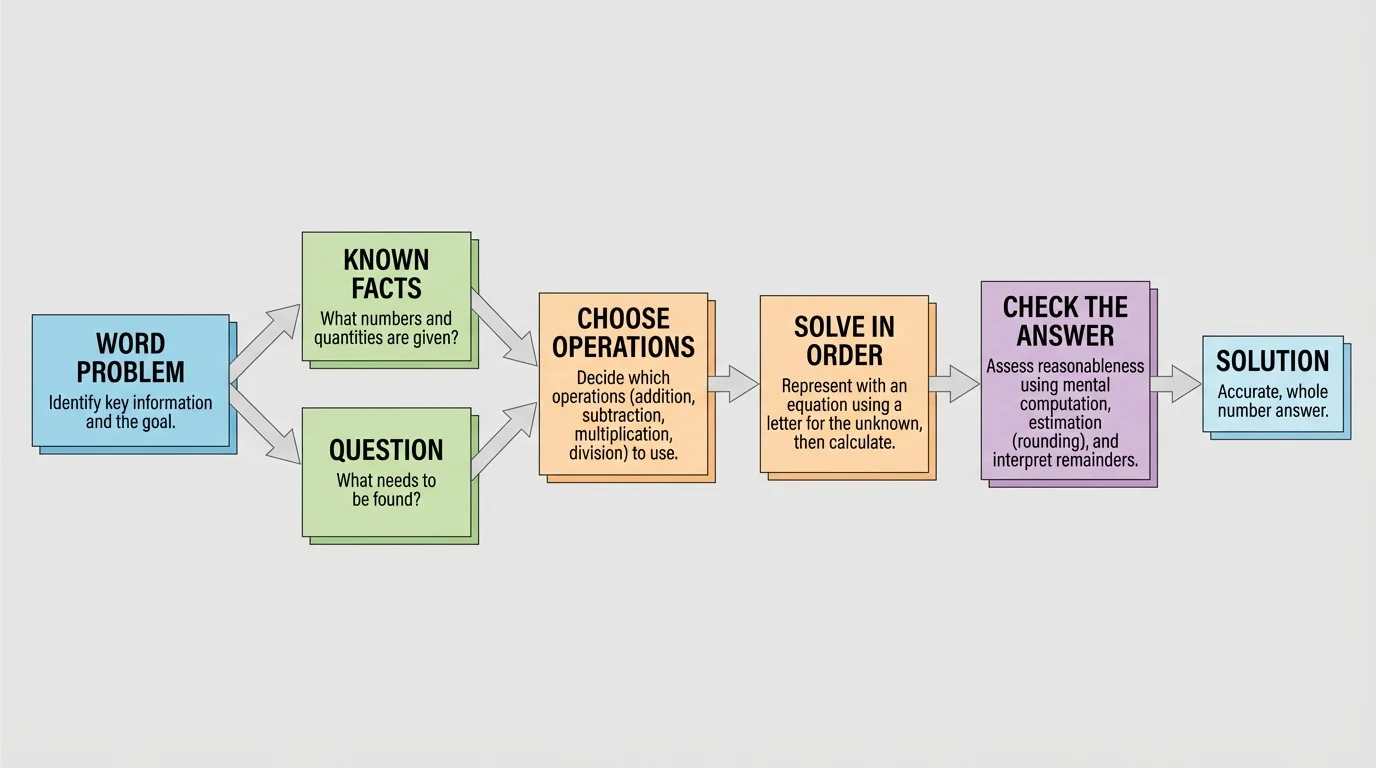
A multistep problem has more than one action to figure out. It helps to sort the problem into facts you know, the question being asked, and the steps needed. If you try to do everything at once, the problem can feel confusing. If you break it apart, it becomes much easier.
As [Figure 1] suggests, here are useful questions to ask yourself: What numbers do I know? What am I trying to find? Which operation makes sense first? What should I do after that? Is there an answer left over that I need to interpret?
Sometimes a problem includes extra information. That means you should read carefully and decide which facts matter for the question. Circle or underline the important numbers and words.
Signal words can help, but they do not solve the problem for you. Words like in all often suggest addition. Words like left often suggest subtraction. Equal groups often suggest multiplication or division. But the story matters most. You must think about what is happening.
You already know the four operations: addition, subtraction, multiplication, and division. In multistep problems, the big job is deciding which operation to use first and why.
A strong way to start is to make a short plan in words. For example, you might say, "First find how many apples are in all. Then divide them equally among the baskets." That short plan is often enough to guide your work.
In math, we can represent a story with an equation. An equation is a number sentence that shows two amounts are equal. When we do not know one amount yet, we can use a variable, such as x, b, or m. The letter stands for the unknown number.
Suppose a teacher has some boxes of crayons. Each box has \(12\) crayons. There are \(96\) crayons in all. We can write:
\(12b = 96\)
Here, the letter stands for the unknown number of boxes. Since each box has \(12\) crayons and \(12 \times 8 = 96\), we know \(b = 8\).
In a multistep problem, the equation may represent the whole situation or just one part of it. You can also solve one step at a time and write equations for each step. Both ways are useful.
Unknown quantity means the amount you are trying to find. A letter can stand for that amount in an equation.
Remainder is the amount left over when a number does not divide evenly.
Reasonable answer means an answer that makes sense when you think about the problem and estimate.
For example, if a bakery makes \(48\) muffins each day for \(5\) days and then sells \(73\) muffins, the number left can be shown with the equation \(m = 48 \times 5 - 73\). The letter \(m\) stands for the number of muffins left.
Before solving, make a path. Ask what happens first in the story. If something is combined, you may need addition. If an amount is compared or taken away, you may need subtraction. If there are equal groups, you may need multiplication or division.
A good plan often looks like this: understand, choose operations, write an equation, solve, check. This is like following a map. It keeps you from getting lost.
Look at this quick example. "There are \(6\) tables. Each table seats \(4\) students. Then \(3\) more students arrive. How many students are there altogether if every seat is filled and the new students join too?" First find the seats: \(6 \times 4 = 24\). Then add the new students: \(24 + 3 = 27\). An equation is \(s = 6 \times 4 + 3\).
Let us solve a problem step by step.
Worked example
The school library has \(7\) shelves. Each shelf holds \(36\) books. Then the librarian puts \(18\) more books on a display table. How many books are there altogether?
Step 1: Find what happens first.
The shelves each hold \(36\) books, and there are \(7\) shelves. That means we multiply: \(7 \times 36\).
Step 2: Compute the number of books on the shelves.
\(7 \times 36 = 252\)
Step 3: Add the books on the display table.
\(252 + 18 = 270\)
Step 4: Write an equation with a letter.
\(b = 7 \times 36 + 18\)
The answer is:
\(b = 270\)
You can check mentally. Since \(7 \times 36\) is a little more than \(7 \times 35 = 245\), adding \(18\) should give a little more than \(263\). The exact answer, \(270\), makes sense.
Some of the trickiest problems involve division that does not come out evenly. A remainder does not always mean the same thing. You must look at the story to decide what to do with it.
As [Figure 2] shows, there are four common ways to interpret a remainder:
Round down: when only full groups count.
Round up: when you need enough groups to cover everyone or everything.
Use the remainder as a leftover: when the extra amount matters by itself.
Write the exact answer: in some situations, the quotient and remainder together are the answer.
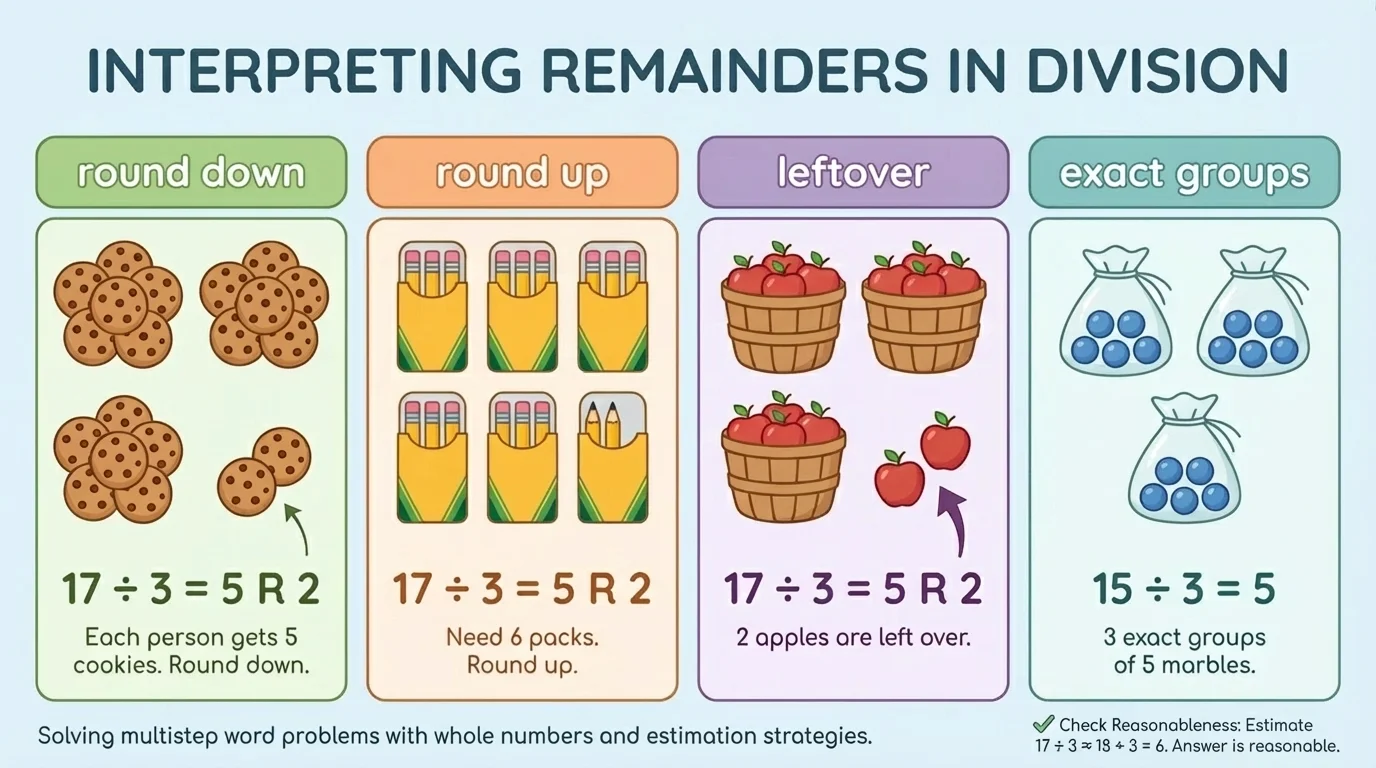
For example, if \(26\) students ride in vans that hold \(4\) students each, \(26 \div 4 = 6\) remainder \(2\). You cannot use only \(6\) vans because \(2\) students would have no ride. You must round up to \(7\) vans.
But if \(26\) cookies are packed into bags of \(4\), then \(6\) full bags can be made and \(2\) cookies are left over. Here, the remainder is not rounded up to another full bag unless the problem says every cookie must be bagged.
How the story changes the math answer
The division calculation may be the same, but the meaning can change. In both examples, \(26 \div 4 = 6\) remainder \(2\). In a transportation problem, you need enough vans, so the answer is \(7\). In a packing problem, the answer may be \(6\) bags with \(2\) left over. Always let the situation decide.
This is why it is not enough to say only "remainder \(2\)." A complete answer explains what that remainder means.
Now let us solve a problem where the remainder must be interpreted carefully.
Worked example
A museum has \(95\) visitors. Each tour guide can lead \(8\) visitors. How many tour guides are needed?
Step 1: Decide the operation.
We are putting \(95\) visitors into groups of \(8\), so we divide: \(95 \div 8\).
Step 2: Divide.
\(95 \div 8 = 11\) remainder \(7\), because \(8 \times 11 = 88\) and \(95 - 88 = 7\).
Step 3: Interpret the remainder.
Those \(7\) extra visitors still need a guide, so \(11\) guides are not enough. We need one more guide.
Step 4: Write an equation.
Let \(g\) be the number of guides needed. The division part is \(95 \div 8\), and the story tells us to round up.
The answer is:
\(g = 12\)
Later, when you solve other division problems, remember the museum example from [Figure 2]. If every person or item must fit into a group, you often need to round up.
Good mathematicians do not stop after getting an answer. They ask, "Does this make sense?" A estimate is a close answer found with easier numbers. It helps you turn a hard calculation into a quick mental check.
As [Figure 3] shows, one common strategy is rounding. You replace a number with a nearby number that is easier to use. For example, \(198\) is close to \(200\), and \(49\) is close to \(50\). Then you solve the easier problem in your head.
If the exact answer is very far from the estimate, something may be wrong. Maybe you used the wrong operation, made a computation error, or forgot part of the story.
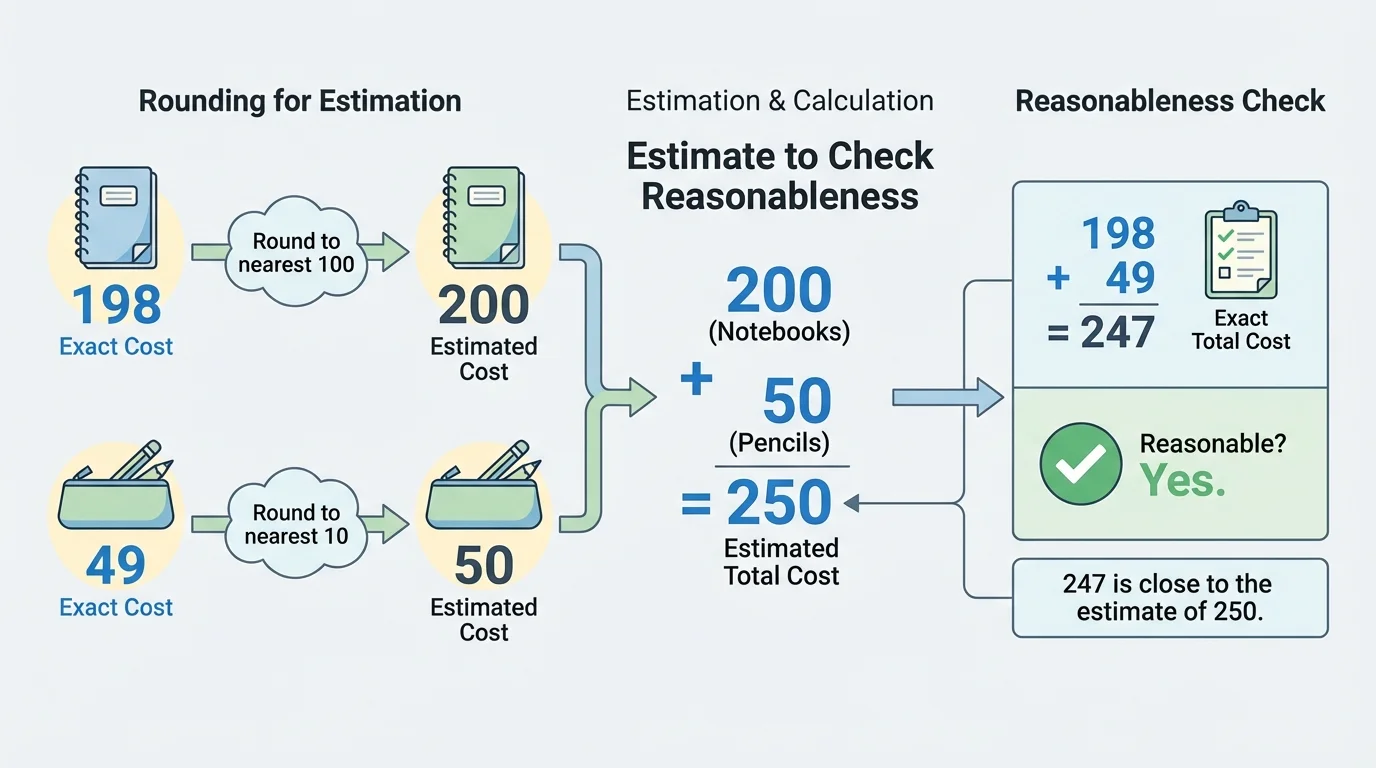
Suppose you calculate \(39 \times 6 = 234\). To check, round \(39\) to \(40\). Then \(40 \times 6 = 240\). Since \(234\) is close to \(240\), the answer seems reasonable.
Estimation is especially helpful in multistep problems. You can estimate each step or estimate the whole problem. This helps you notice mistakes before they become big problems.
This example uses subtraction, division, and estimation.
Worked example
A teacher bought \(128\) pencils for the grade level. Then \(19\) pencils were used for a project. The remaining pencils are shared equally among \(3\) classes. How many pencils does each class get?
Step 1: Find how many pencils are left.
\(128 - 19 = 109\)
Step 2: Divide equally among the classes.
\(109 \div 3 = 36\) remainder \(1\)
Step 3: Interpret the remainder.
Each class gets \(36\) pencils, and \(1\) pencil is left over.
Step 4: Write an equation.
\(p = (128 - 19) \div 3\)
Step 5: Check reasonableness.
Round \(128\) to \(120\) and \(19\) to \(20\). Then \(120 - 20 = 100\), and \(100 \div 3\) is about \(33\). The exact answer, \(36\) each with \(1\) left over, is close enough to be reasonable.
The answer is:
\[p = 36 \textrm{ each, with } 1 \textrm{ left over}\]
Notice that the estimate is not exactly the same as the final answer. That is normal. An estimate only needs to be close enough to help you judge whether the answer makes sense.
Multistep word problems are everywhere. Stores use them to pack items into boxes. Coaches use them to divide players into teams and count equipment. Families use them when planning meals, trips, and budgets. Schools use them when arranging seats, supplies, and schedules.
Suppose a cafeteria makes \(9\) trays of sandwiches with \(24\) sandwiches on each tray. After lunch, \(58\) sandwiches are left. If the leftovers are packed equally into \(7\) containers, how many sandwiches go in each container? This is a real situation with multiplication, subtraction, and division: \((9 \times 24 - 58) \div 7\).
Problems like these matter because they help you make decisions. Math is not just about numbers on a page. It helps people know how many supplies to buy, how much space they need, and how to share things fairly.
Professional event planners use the same kind of thinking when they decide how many tables, meals, buses, or tickets are needed. They often estimate first and then calculate exactly.
When you estimate and check, you are thinking like someone solving a real problem in the world.
One common mistake is doing only one step when the story needs two or more. Another is choosing the wrong operation because of one keyword without thinking about the full situation.
A third mistake is forgetting to interpret the remainder. The calculation might be right, but the final answer can still be wrong if the story needs you to round up or keep leftovers.
Here are smart strategies that help:
These strategies connect to the planning idea in [Figure 1]. Organizing the facts and question before solving helps you avoid rushing into the wrong operation.
Let us put everything together in one longer example.
Worked example
A school is sending students on a field trip. There are \(6\) classes, and each class has \(27\) students. On the morning of the trip, \(11\) students are absent. The remaining students ride on buses that hold \(25\) students each. How many buses are needed?
Step 1: Find the total number of students before absences.
\(6 \times 27 = 162\)
Step 2: Subtract the absent students.
\(162 - 11 = 151\)
Step 3: Divide by the number of seats on each bus.
\(151 \div 25 = 6\) remainder \(1\)
Step 4: Interpret the remainder.
Even though only \(1\) student is left after filling \(6\) buses, that student still needs a seat. So we round up.
Step 5: Write an equation.
\(b = (6 \times 27 - 11) \div 25\)
Step 6: Check with an estimate.
Round \(27\) to \(30\). Then \(6 \times 30 = 180\). Subtract about \(10\) to get \(170\). Now \(170 \div 25\) is a little less than \(7\). So \(7\) buses is reasonable.
The answer is:
\(b = 7\)
The estimate supports the exact answer. This is another place where the idea from [Figure 3] helps. Rounded numbers make a fast mental check possible.
As you grow stronger in solving word problems, remember that the goal is not just to compute. The real goal is to understand the story, choose the right operations, represent the unknown clearly, and make sure the answer fits the situation.
