Did you notice how often large numbers appear in everyday life? A video might have \(245{,}678\) views, a city might have \(3{,}000{,}000\) people, and a stadium might hold \(72{,}500\) fans. Big numbers are everywhere, and place value helps us read them, write them, and understand what they mean. When you know the value of each digit, a long number stops looking confusing and starts making sense.
Whole numbers are built on a pattern called the place value system. In this system, the value of a digit depends on where it is in the number. The digit \(5\) can mean \(5\), \(50\), \(500\), or even \(5{,}000\), depending on its place. That is why reading and comparing numbers is really about understanding the meaning of each digit.
Suppose one school library has \(18{,}432\) books and another has \(18{,}243\) books. These numbers look similar, but they are not the same. The digits are almost identical, yet their places change the value. A small change in place can mean a difference of hundreds or even thousands.
Learning to read, write, and compare large numbers helps in science, sports, business, travel, and everyday life. It helps you understand scores, distances, populations, and data. It also prepares you for addition, subtraction, multiplication, and division with larger numbers.
Remember that in our number system, each place to the left is worth 10 times as much as the place to its right. For example, \(1\) ten is \(10\) ones, \(1\) hundred is \(10\) tens, and \(1\) thousand is \(10\) hundreds.
This repeating pattern is what makes large numbers organized instead of random.
As [Figure 1] shows, each digit in a number has both a place and a value. The places in a multi-digit whole number can include ones, tens, hundreds, thousands, ten thousands, and hundred thousands. If we look at the number \(482{,}715\), the digit \(4\) means \(400{,}000\), the digit \(8\) means \(80{,}000\), the digit \(2\) means \(2{,}000\), the digit \(7\) means \(700\), the digit \(1\) means \(10\), and the digit \(5\) means \(5\).
The same digit can have different values in different numbers. In \(5{,}321\), the digit \(5\) means \(5{,}000\). In \(351\), the digit \(5\) means \(50\). In \(15\), the digit \(5\) means just \(5\). The digit stays the same, but the place changes its value.
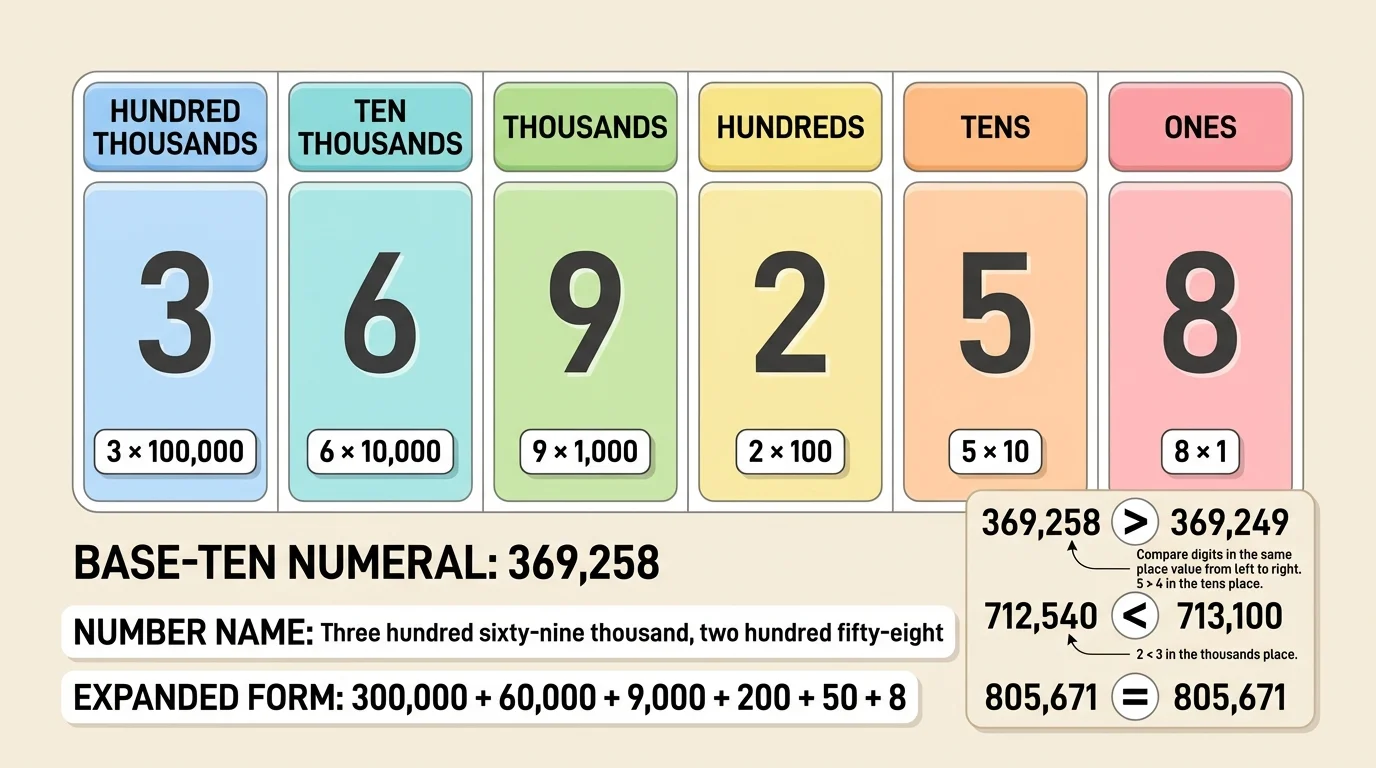
Place value is the value a digit has because of its position in a number.
Base-ten numerals are numbers written with the digits \(0, 1, 2, 3, 4, 5, 6, 7, 8, 9\).
Expanded form is a way to write a number as the sum of the value of each digit.
Numbers are grouped in periods of three digits. Starting from the right, the first period is ones, the next period is thousands, and the next is millions. For example, in \(3{,}456{,}789\), the periods are \(3\) million, \(456\) thousand, and \(789\) ones.
A number can be written in more than one form. [Figure 2] illustrates how one number can be shown as a numeral, in words, and in expanded form. These three ways all represent the same amount, but each form is useful in a different situation.
Here is an example with the number \(56{,}304\).
Base-ten numeral: \(56{,}304\)
Number name: fifty-six thousand, three hundred four
Expanded form: \(50{,}000 + 6{,}000 + 300 + 4\)
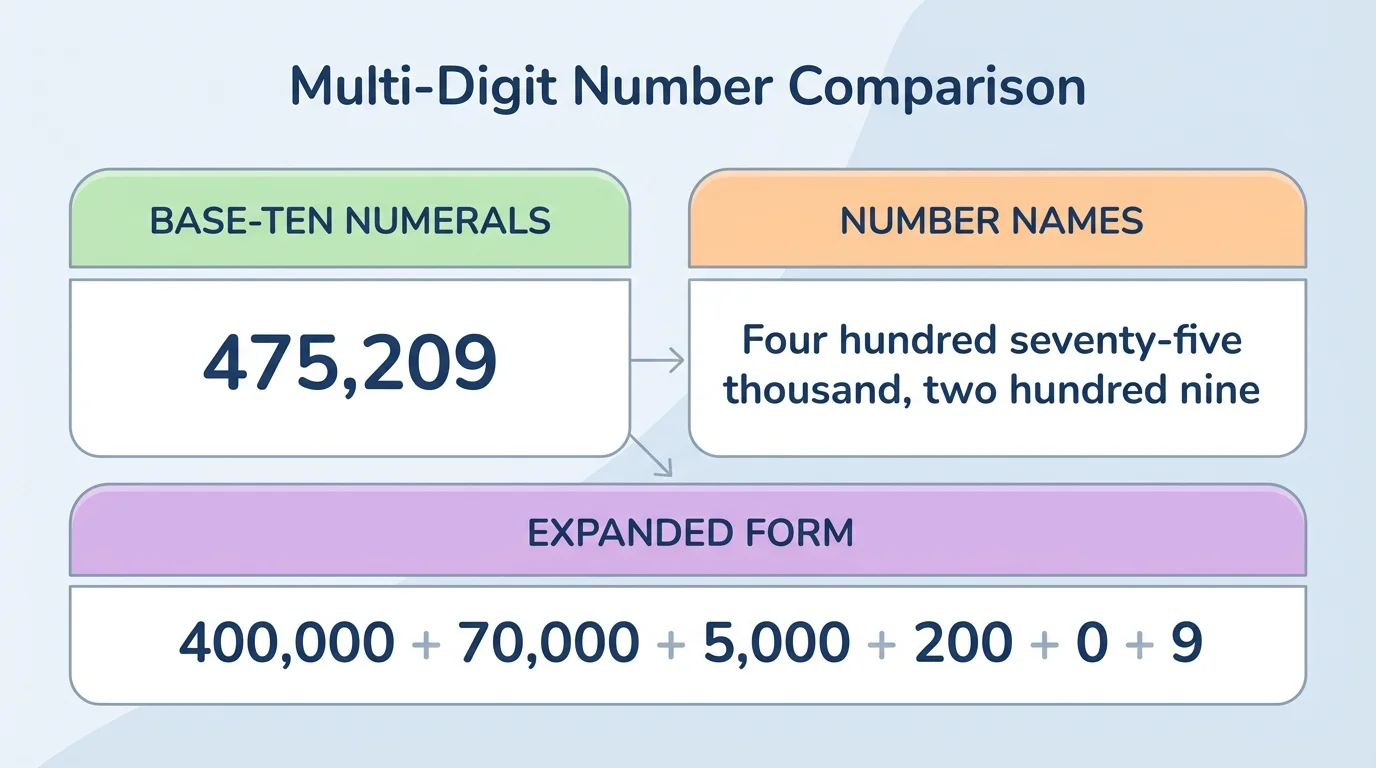
All three forms match. The digit \(5\) is in the ten thousands place, so it is worth \(50{,}000\). The digit \(6\) is in the thousands place, so it is worth \(6{,}000\). The digit \(3\) is in the hundreds place, so it is worth \(300\). The digit \(0\) is in the tens place, so it is worth \(0\) tens, and the digit \(4\) is in the ones place, so it is worth \(4\).
Sometimes a zero is very important. In \(7{,}042\), the zero shows that there are no hundreds. Without it, the number would change completely.
Zero is one of the most powerful digits in our number system. It can show that a place is empty, but it also helps hold the value of the other digits in the correct positions.
This is why careful reading and writing matter when numbers have many digits.
To read a large whole number, separate it into periods of three digits from right to left. Then read each period and say its name. For example, \(624{,}913\) can be read as six hundred twenty-four thousand, nine hundred thirteen.
When writing whole numbers in words, many math books avoid using the word and in the middle of the number name. So \(624{,}913\) is usually written as six hundred twenty-four thousand, nine hundred thirteen, not six hundred twenty-four thousand and nine hundred thirteen. This helps keep whole numbers clear and avoids confusion with decimals.
Here are more examples:
| Numeral | Number Name |
|---|---|
| \(4{,}008\) | four thousand, eight |
| \(90{,}120\) | ninety thousand, one hundred twenty |
| \(305{,}706\) | three hundred five thousand, seven hundred six |
Table 1. Examples of multi-digit whole numbers written as number names.
Notice how zeros affect the reading. In \(4{,}008\), there are no hundreds and no tens, but the number still has a ones digit. In \(90{,}120\), the zero in the thousands place and the zero in the ones place still matter because they hold the other digits in the correct places.
Expanded form breaks a number into the value of each digit. This helps you see exactly what the number means.
For example, \(347{,}205\) in expanded form is \(300{,}000 + 40{,}000 + 7{,}000 + 200 + 5\). We do not usually include the zero tens because adding \(0\) does not change the value.
Another way to show expanded form is by multiplication:
\(347{,}205 = 3 \times 100{,}000 + 4 \times 10{,}000 + 7 \times 1{,}000 + 2 \times 100 + 0 \times 10 + 5 \times 1\)
This version makes the place value even clearer. It shows both the digit and the value of its place.
Why expanded form is useful
Expanded form helps you understand the meaning of each digit and prepares you for operations with larger numbers. When you know that \(6{,}482\) means \(6{,}000 + 400 + 80 + 2\), it becomes easier to add, subtract, estimate, and compare numbers.
We can connect this back to the place value chart in [Figure 1]. The chart organizes where digits go, and expanded form tells the value of those digits.
When comparing multi-digit numbers, begin with the digit in the greatest place value. The first place where the digits are different tells which number is greater. If one number has a larger digit in that place, then that whole number is greater.
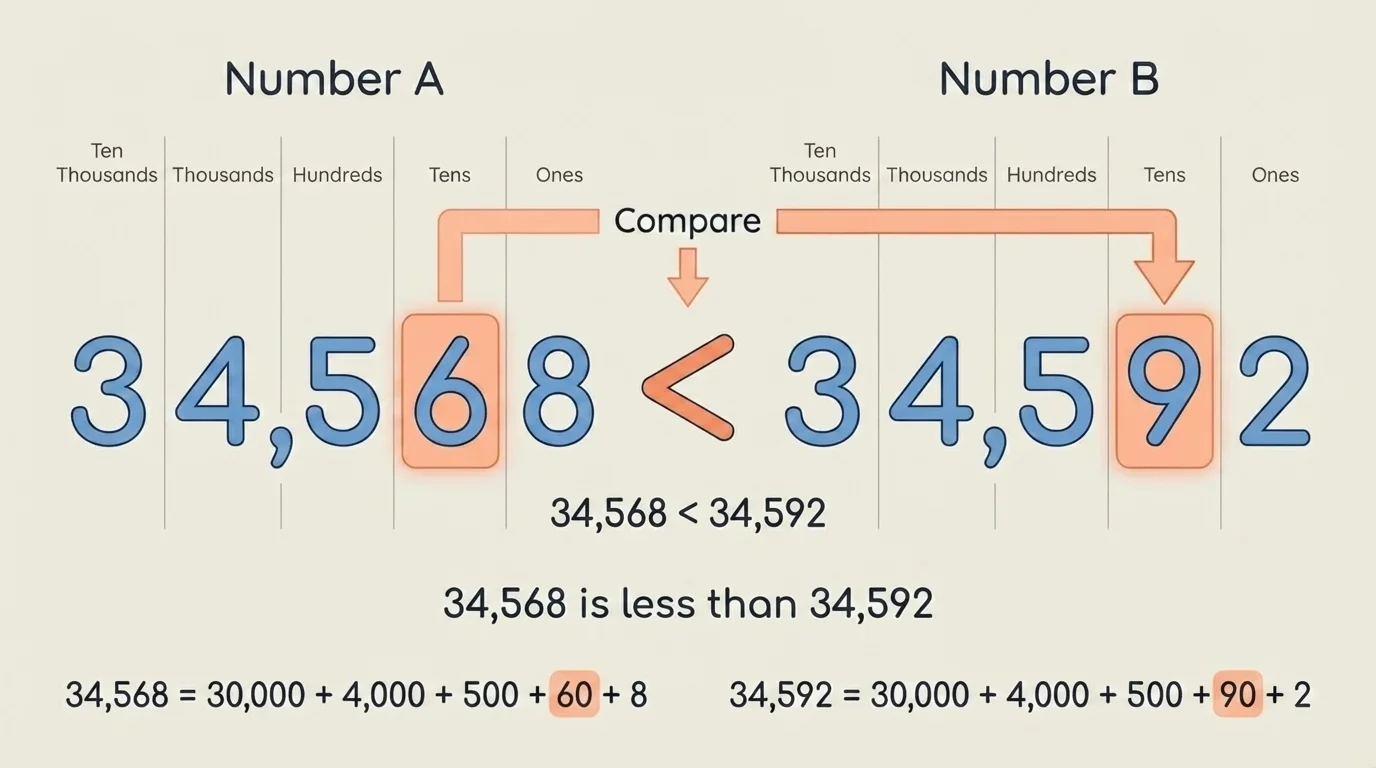
As [Figure 3] shows, suppose we compare \(58{,}421\) and \(58{,}391\). The ten thousands digits are both \(5\). The thousands digits are both \(8\). The hundreds digits are different: \(4\) and \(3\). Since \(4 > 3\), we know \(58{,}421 > 58{,}391\).
If two numbers have different numbers of digits, the number with more digits is greater, as long as neither number has leading zeros. For example, \(9{,}999 < 10{,}000\) because \(10{,}000\) has five digits and \(9{,}999\) has four digits.
If every digit in matching places is the same, then the numbers are equal. For example, \(403{,}210 = 403{,}210\).
The comparison symbols work like this:
| Symbol | Meaning | Example |
|---|---|---|
| \(>\) | is greater than | \(7{,}000 > 699\) |
| \(<\) | is less than | \(45{,}123 < 45{,}321\) |
| \(=\) | is equal to | \(12{,}050 = 12{,}050\) |
Table 2. Comparison symbols used to record whether one whole number is greater than, less than, or equal to another.
A place value chart can help line numbers up correctly before comparing them. For example, compare \(602{,}145\) and \(599{,}999\). The hundred thousands digits are \(6\) and \(5\). Since \(6 > 5\), we already know \(602{,}145 > 599{,}999\). There is no need to check the smaller places.
Now compare \(470{,}308\) and \(470{,}380\). The hundred thousands, ten thousands, thousands, and hundreds digits match until we reach the tens place. One number has \(0\) tens and the other has \(8\) tens. Since \(0 < 8\), we know \(470{,}308 < 470{,}380\).
That same idea appears in [Figure 3]: line up the places and compare from left to right until you find the first difference.
Worked Example 1
Write \(84{,}206\) in number words and expanded form.
Step 1: Identify each digit's place.
The digit \(8\) is in the ten thousands place, \(4\) is in the thousands place, \(2\) is in the hundreds place, \(0\) is in the tens place, and \(6\) is in the ones place.
Step 2: Write the number in words.
\(84{,}206\) is written as eighty-four thousand, two hundred six.
Step 3: Write the number in expanded form.
\(84{,}206 = 80{,}000 + 4{,}000 + 200 + 6\)
The number name is eighty-four thousand, two hundred six, and the expanded form is \(80{,}000 + 4{,}000 + 200 + 6\).
This example shows how zero can be part of a number without being written in the expanded sum if its value is \(0\).
Worked Example 2
Write the number named "three hundred seven thousand, fifty-two" as a numeral and in expanded form.
Step 1: Break the words into periods.
"Three hundred seven thousand" means \(307{,}000\). "Fifty-two" means \(52\).
Step 2: Combine the periods.
\(307{,}000 + 52 = 307{,}052\)
Step 3: Write the expanded form.
\(307{,}052 = 300{,}000 + 7{,}000 + 50 + 2\)
The numeral is \(307{,}052\), and the expanded form is \(300{,}000 + 7{,}000 + 50 + 2\).
Notice that there are no hundreds and no tens of thousands in this number, so zeros hold those places.
Worked Example 3
Compare \(451{,}203\) and \(451{,}230\) using \(>\), \(<\), or \(=\).
Step 1: Compare digits from left to right.
The hundred thousands digits are both \(4\). The ten thousands digits are both \(5\). The thousands digits are both \(1\). The hundreds digits are both \(2\).
Step 2: Find the first place where the digits differ.
The tens digits are \(0\) and \(3\).
Step 3: Decide which number is greater.
Since \(0 < 3\), we know \(451{,}203 < 451{,}230\).
The correct comparison is \[451{,}203 < 451{,}230\]
Comparing numbers this way is faster and more accurate than trying to guess from the way the numerals look.
Worked Example 4
Which is greater: \(90{,}501\) or \(89{,}999\)?
Step 1: Compare the greatest place.
In the ten thousands place, the digits are \(9\) and \(8\).
Step 2: Use that place to decide.
Since \(9 > 8\), the first number is greater.
The correct comparison is \[90{,}501 > 89{,}999\]
Even though \(89{,}999\) has many \(9\)s, the ten thousands place matters first, so \(90{,}501\) is greater.
Place value helps people read real data. A town population of \(125{,}430\) means there are \(1\) hundred thousand, \(2\) ten thousands, \(5\) thousands, \(4\) hundreds, and \(3\) tens. If another town has \(125{,}403\) people, we can compare the tens and ones places to decide which population is greater.
Sports statistics also use large numbers. If one baseball team had \(2{,}145{,}678\) fans attend games during a season and another had \(2{,}104{,}987\), comparing the hundred thousands place shows the first team had more attendance.
Stores, libraries, and websites track large counts too. A website with \(980{,}450\) visits has fewer visits than one with \(1{,}020{,}100\) visits because a seven-digit number is greater than a six-digit number. Understanding the size of numbers helps people make decisions from data.
One common mistake is reading digits without paying attention to place. For example, \(32{,}105\) is not three hundred twenty-one thousand, five. It is thirty-two thousand, one hundred five.
Another mistake is forgetting zeros. The number \(4008\) is not a correct way to write \(4{,}008\). Every place must be in the correct position.
Students also sometimes compare by looking at the last digit first. That does not work for whole numbers. Compare from the greatest place on the left, not from the ones place on the right.
"The value of a digit depends on its place."
— A key idea of our number system
Once you understand that idea, reading, writing, expanding, and comparing large numbers becomes much easier.
