Have you ever noticed that news reports often say a city has about 500,000 people, even when the exact number is different? That is rounding. Rounding helps us turn long numbers into numbers that are easier to understand, compare, and use quickly. When numbers get large, place value helps us decide how to round correctly.
Sometimes an exact number is important, but sometimes a close number is enough. If a stadium has 48,672 people at a game, you might say there were about 49,000 people. That rounded number is easier to say and still gives a good idea of the crowd size.
Rounding is useful when estimating, checking if an answer makes sense, and talking about large numbers. To round well, you need to understand what each digit is worth.
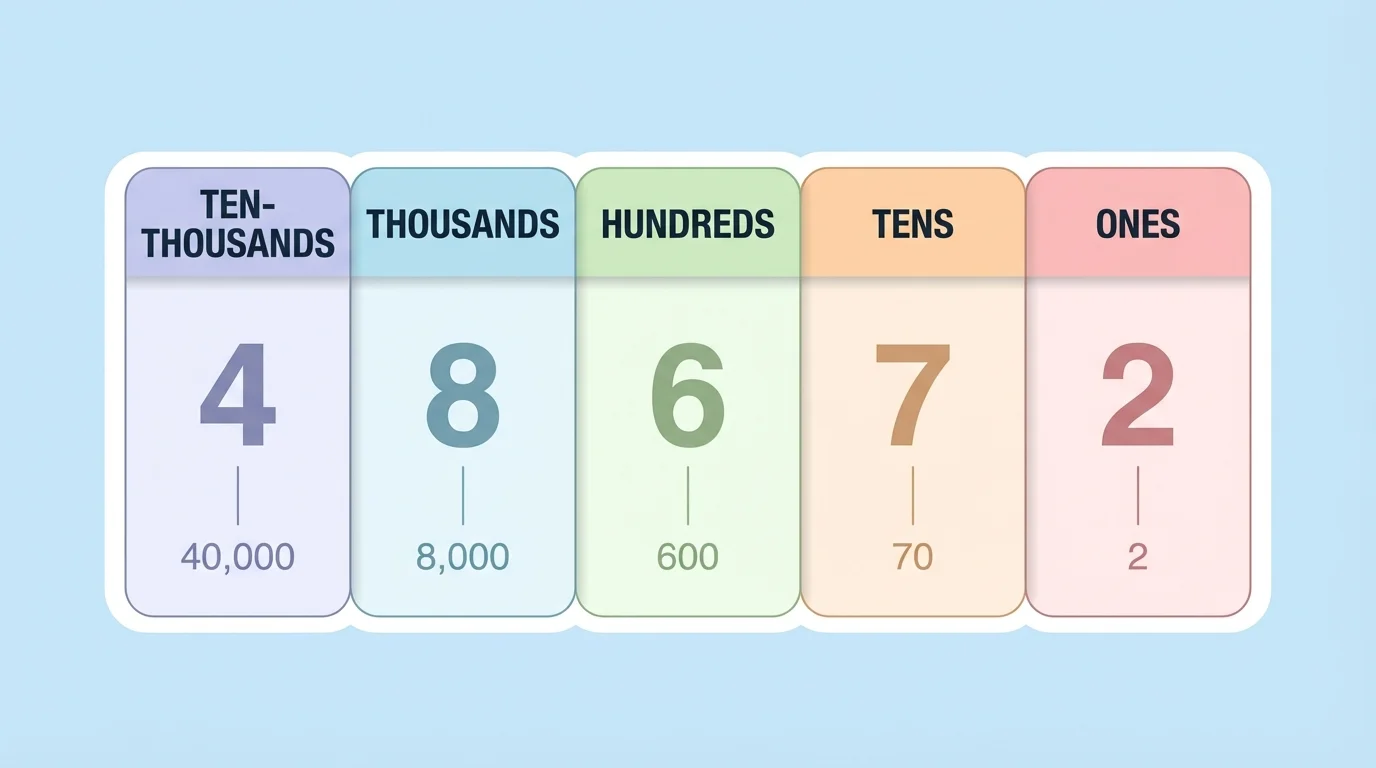
[Figure 1] In our base-ten number system, each place has a value that is 10 times the value of the place to its right. In the number 48,672, the digit 4 means 4 ten-thousands, or 40,000. The digit 8 means 8 thousands, or 8,000. The same digit can have very different values depending on where it is in the number.
Here are the values of the digits in 48,672: 4 ten-thousands, 8 thousands, 6 hundreds, 7 tens, and 2 ones. Written in expanded form, the number is \[48,672 = 40,000 + 8,000 + 600 + 70 + 2\]
When you round, you choose one place to focus on. Then you decide if the digit in that place should stay the same or increase by 1. Digits to the right of that place become zeros, because you are replacing the exact number with a nearby, simpler number.
You already know that numbers can be compared and that each digit has a value based on its position. Rounding uses that same idea. You are finding the nearest ten, hundred, thousand, or other place-value unit.
Think of rounding as finding which benchmark number is closest. For example, when rounding to the nearest hundred, the benchmark numbers are multiples of 100, such as 3,400 and 3,500.
To round a number means to replace it with a nearby number that is easier to use. The rounded number is not exactly the same as the original number, but it should be close.
If you round 3,476 to the nearest hundred, you are asking, "Is 3,476 closer to 3,400 or to 3,500?" Since 3,476 is closer to 3,500, it rounds to 3,500.
Benchmark number means one of the nearby numbers you compare to decide which is closest to the original number. Digit to the right means the digit immediately after the place you are rounding to, and it helps you decide whether to round up or round down.
Rounding does not change every part of the number. It mainly changes one digit, and all digits to its right become 0. Digits to the left stay the same.
[Figure 2] There is a simple rule for rounding. First, find the place you are rounding to. Next, look at the digit immediately to the right of that place. That digit tells you what to do.
If the digit to the right is \(0\), \(1\), \(2\), \(3\), or \(4\), you round down. This means the digit in the rounding place stays the same. If the digit to the right is \(5\), \(6\), \(7\), \(8\), or \(9\), you round up. This means the digit in the rounding place increases by \(1\).
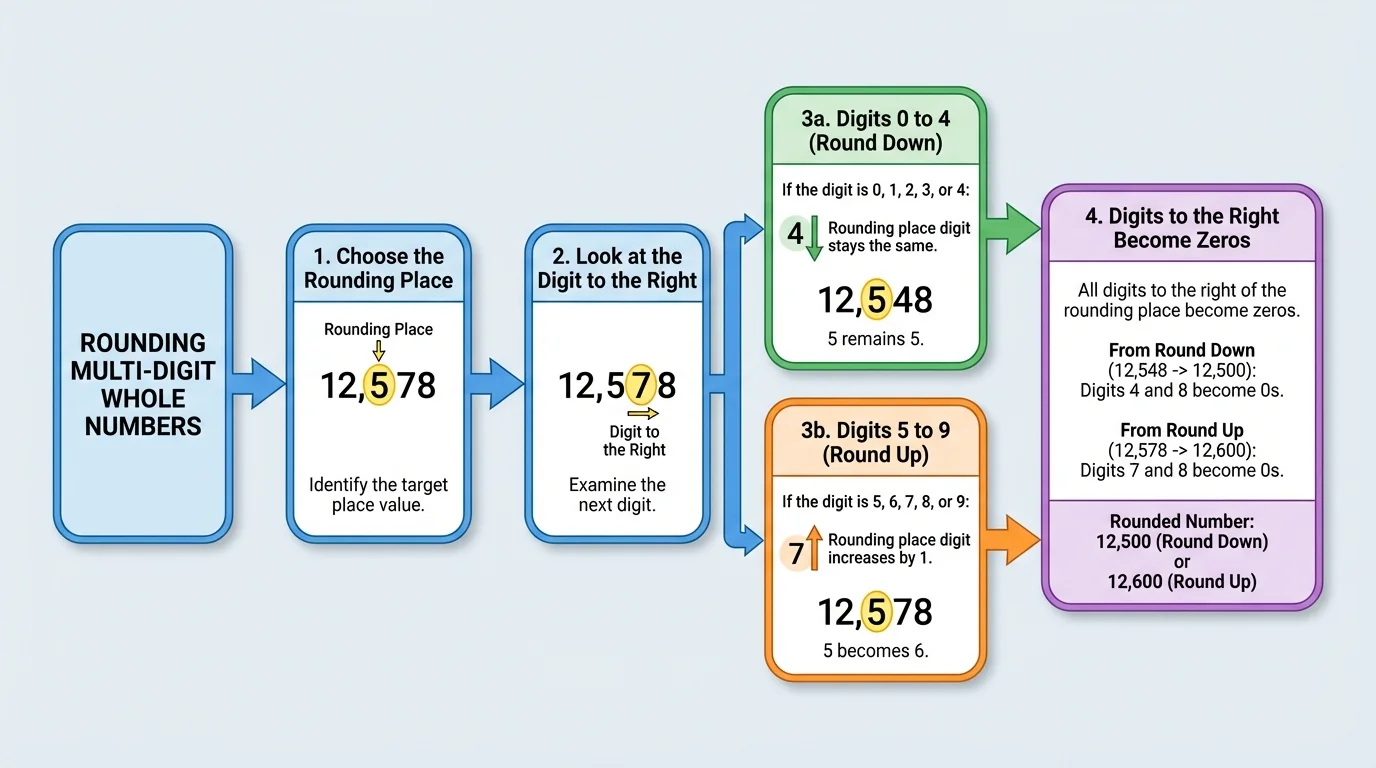
After that, every digit to the right of the rounding place becomes 0. This is true whether you round up or round down. The digits to the left do not change.
For example, to round 6,241 to the nearest hundred, look at the hundreds digit, which is 2. Then look to the right at the tens digit, which is 4. Since 4 is less than 5, the number rounds down to \(6,200\)
To round 6,281 to the nearest hundred, look at the hundreds digit, which is 2. The tens digit is 8. Since 8 is 5 or more, round up. The 2 becomes 3, and the tens and ones become 0, so the answer is \(6,300\)
Why the digit 5 matters
The digit 5 is the halfway point in a group of 10. When rounding to the nearest ten, 5 ones means the number is halfway to the next ten. When rounding to the nearest hundred, 50 means halfway to the next hundred. That is why digits 5 through 9 tell us to round up.
Another way to say this is that numbers ending in 5, 6, 7, 8, or 9 are closer to the next greater benchmark. Numbers ending in 0, 1, 2, 3, or 4 are closer to the lower benchmark.
You can round the same number to different places. The place you choose changes the answer. Let us use the number 48,672.
To round 48,672 to the nearest ten, look at the ones digit, 2. Since 2 is less than 5, round down: \[48,672 \approx 48,670\]
To round 48,672 to the nearest hundred, look at the tens digit, 7. Since 7 is 5 or more, round up: \[48,672 \approx 48,700\]
To round 48,672 to the nearest thousand, look at the hundreds digit, 6. Since 6 is 5 or more, round up: \[48,672 \approx 49,000\]
To round 48,672 to the nearest ten-thousand, look at the thousands digit, 8. Since 8 is 5 or more, round up: \[48,672 \approx 50,000\]
Notice how the number becomes less exact as you round to a greater place. Rounding to the nearest ten keeps more detail than rounding to the nearest thousand.
| Original number | Place to round | Digit to the right | Rounded number |
|---|---|---|---|
| \(48,672\) | nearest ten | \(2\) | \(48,670\) |
| \(48,672\) | nearest hundred | \(7\) | \(48,700\) |
| \(48,672\) | nearest thousand | \(6\) | \(49,000\) |
| \(48,672\) | nearest ten-thousand | \(8\) | \(50,000\) |
Table 1. The same number rounded to different place values.
Let us solve several examples step by step so the method becomes clear.
Example 1: Round \(3,841\) to the nearest hundred.
Step 1: Find the hundreds digit.
In \(3,841\), the hundreds digit is \(8\).
Step 2: Look at the digit to the right.
The tens digit is \(4\).
Step 3: Decide whether to round up or down.
Since \(4 < 5\), round down. The hundreds digit stays \(8\).
Step 4: Change the digits to the right into zeros.
The rounded number is \(3,800\)
This answer makes sense because 3,841 is closer to 3,800 than to 3,900.
Example 2: Round \(7,268\) to the nearest thousand.
Step 1: Find the thousands digit.
In \(7,268\), the thousands digit is \(7\).
Step 2: Look at the hundreds digit.
The digit to the right is \(2\).
Step 3: Apply the rounding rule.
Since \(2 < 5\), round down. The \(7\) stays the same.
Step 4: Replace digits to the right with zeros.
The hundreds, tens, and ones become \(0\).
The rounded number is \(7,000\)
Even though 7,268 has extra hundreds, tens, and ones, it is still closer to 7,000 than to 8,000.
Example 3: Round \(9,856\) to the nearest hundred.
Step 1: Find the hundreds digit.
The hundreds digit is \(8\).
Step 2: Look at the tens digit.
The digit to the right is \(5\).
Step 3: Apply the rule for \(5\).
Since \(5\) means halfway or more, round up. The \(8\) becomes \(9\).
Step 4: Change digits to the right into zeros.
The tens and ones become \(0\).
The rounded number is \(9,900\)
This example is important because it shows that when the digit to the right is exactly \(5\), you round up.
Example 4: Round \(24,999\) to the nearest thousand.
Step 1: Find the thousands digit.
The thousands digit is \(4\).
Step 2: Look at the hundreds digit.
The hundreds digit is \(9\).
Step 3: Round up.
Since \(9 \geq 5\), the \(4\) becomes \(5\).
Step 4: Change the digits to the right into zeros.
The result is
\(25,000\)This example shows that rounding can change more than one digit in the final number's appearance, even though the main decision was made at the thousands place.
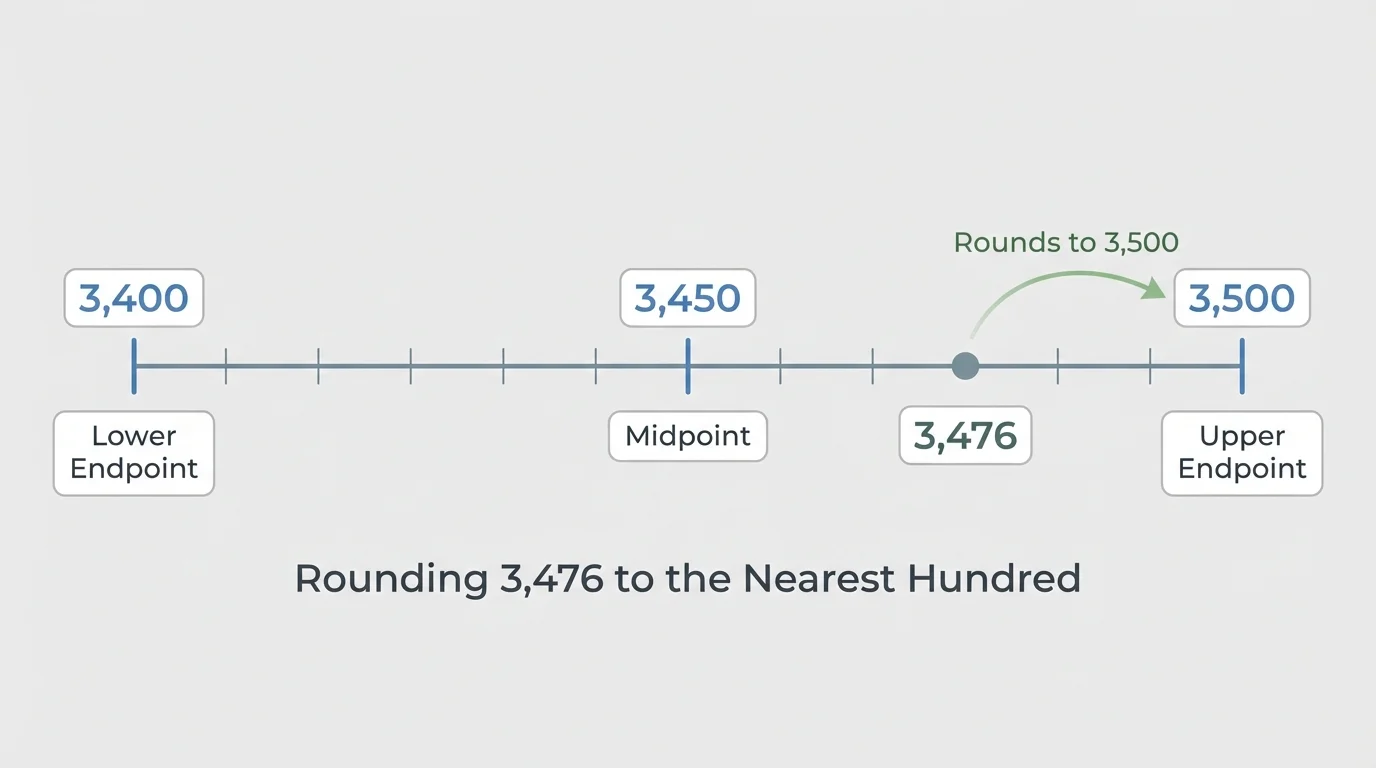
As [Figure 3] shows, a number line is another helpful way to think about rounding.
A number line displays the two benchmark numbers and the number you are rounding. In this example, the number 3,476 sits between 3,400 and 3,500.
The halfway point between 3,400 and 3,500 is 3,450. Since 3,476 is greater than 3,450, it is closer to 3,500. So 3,476 rounds to 3,500.
Number lines are especially useful when you are first learning, because they help you see why rounding works. Later, the digit rule becomes a faster shortcut.
The shortcut and the number line agree with each other. As we saw in [Figure 3], numbers past the midpoint round up, and numbers before the midpoint round down.
Large groups of people often use rounded numbers every day. Weather reports, sports attendance, and population counts are often given as rounded amounts so listeners can understand them quickly.
For nearest ten, the midpoint is 5. For nearest hundred, the midpoint is 50. For nearest thousand, the midpoint is 500. That is why looking at the digit to the right works so well.
One common mistake is looking at the wrong digit. If you are rounding to the nearest hundred, do not look at the ones digit first. Look at the tens digit, because it is directly to the right of the hundreds place.
Another mistake is changing digits that should stay the same. When rounding 6,241 to the nearest hundred, the 6 in the thousands place stays 6. Only the hundreds digit may change, and the tens and ones become zeros.
A third mistake is forgetting to use zeros. If 5,682 rounds to the nearest thousand, the answer is not 6. The correct rounded number is \(6,000\)
Some students also think rounding means always making numbers bigger. That is not true. Rounding can make a number bigger or smaller depending on which benchmark number is closer.
Rounding appears in many places outside math class. A store manager might estimate that about 2,000 items were sold this week instead of saying the exact total was 1,968. A scientist may describe a mountain as about 5,000 meters tall instead of giving every exact digit.
Suppose a town has 31,482 people. If someone asks for a quick estimate of the population, rounding to the nearest thousand gives \(31,000\)
If a bus trip is 286 miles long, a traveler might round to the nearest ten and say the trip is about \(290\) miles.
Sports announcers also use rounding. If 18,749 fans attend a game, a reporter may say about 19,000 fans came. That estimate is fast, clear, and close to the actual number. The same place-value ideas from [Figure 1] help decide which rounded value is best.
Real-world example: Estimating books in a school library
A school library has \(12,462\) books. The principal wants a quick estimate to the nearest thousand.
Step 1: Find the thousands digit.
The thousands digit is \(2\).
Step 2: Look at the hundreds digit.
The hundreds digit is \(4\).
Step 3: Apply the rule.
Since \(4 < 5\), round down.
Step 4: Write the rounded estimate.
\[12,462 \approx 12,000\]
The estimate tells the principal the library has about 12,000 books.
Rounding is useful because it lets people communicate quickly without losing the general size of the number.
After rounding, ask yourself whether the result is close to the original number. If you round 4,321 to the nearest hundred, getting 4,300 makes sense because 4,321 is only 21 away from 4,300 and 79 away from 4,400.
You can also check by naming the two closest benchmark numbers. For nearest hundred, 4,321 is between 4,300 and 4,400. It is closer to 4,300, so the rounding is correct.
If you are ever unsure, use both strategies: the digit rule from [Figure 2] and the closeness idea from the number line. When both methods agree, you can be confident in your answer.
