Have you ever noticed how quickly scores, distances, and populations can grow into big numbers? A baseball stadium might hold more than 40,000 people, a road trip might cover 1,275 miles, and a school fundraiser might collect 3,648 cans of food. To work with numbers this large, mathematicians use a reliable method called the standard algorithm. It is a careful step-by-step way to add and subtract numbers by using place value.
When you add and subtract large numbers correctly, you can solve real problems with confidence. You can find the total number of books in two libraries, compare the points scored by teams over a season, or figure out how many more people visited one park than another. These situations require precise answers, not guesses.
The good news is that the standard algorithm is not a trick. It works because our number system is based on groups of ten. Once you understand place value, the method makes sense and becomes faster with practice.
You already know that in a number like \(4,382\), the \(4\) means \(4\) thousands, the \(3\) means \(3\) hundreds, the \(8\) means \(8\) tens, and the \(2\) means \(2\) ones. The standard algorithm uses this idea in every column.
[Figure 1] To use the standard algorithm correctly, each digit must be lined up with the digit in the same place. The ones go under the ones, the tens go under the tens, the hundreds go under the hundreds, and so on. This is why writing numbers in neat columns matters so much.
A place value chart helps us see what each digit means. For example, in \(4,382\), the \(4\) is worth \(4,000\), not just \(4\). In \(1,547\), the \(1\) is worth \(1,000\). If we do not line up the places, we may accidentally add thousands to hundreds or tens to ones.
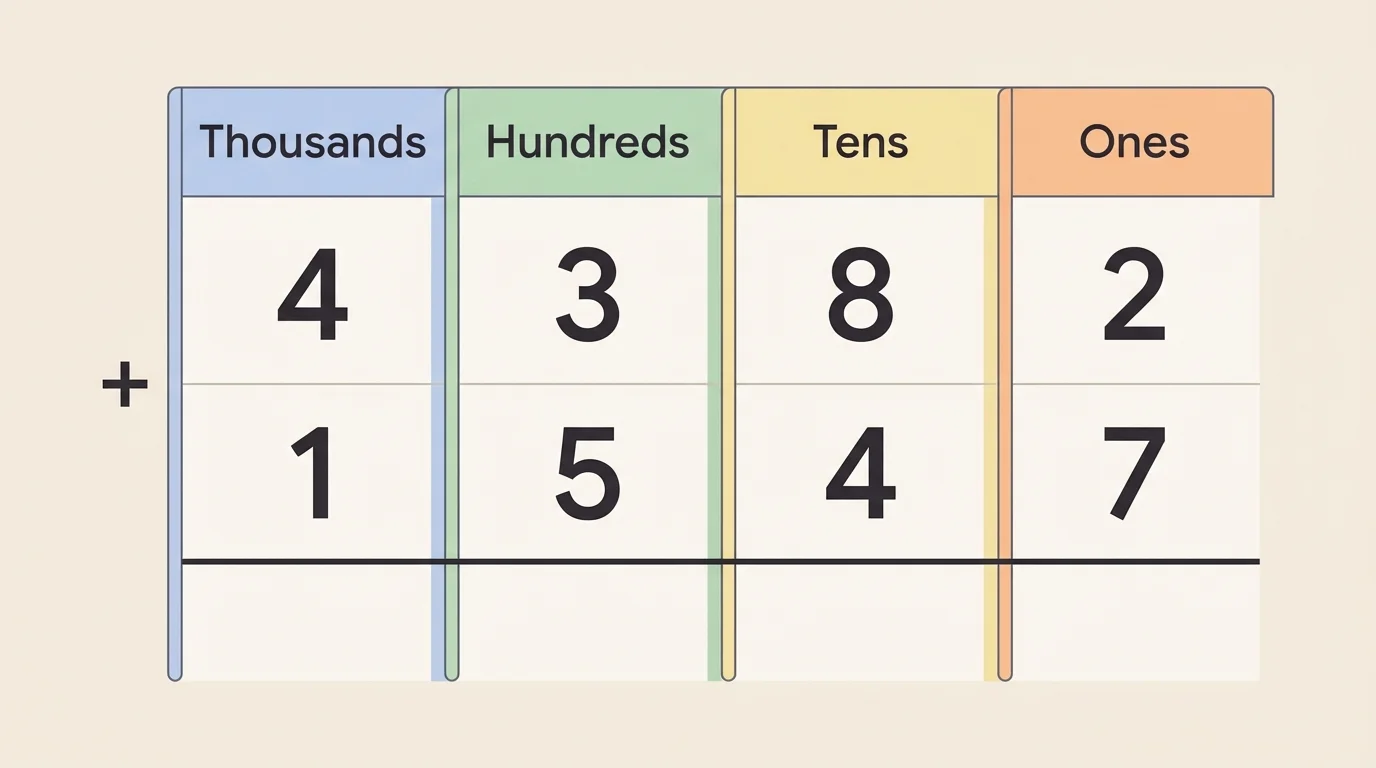
Think of each column as a different size of box. You should only combine numbers from matching boxes. Ones belong with ones. Tens belong with tens. That idea is the foundation for both addition and subtraction.
Standard algorithm is a step-by-step method for calculating using place value. In addition and subtraction, it means lining numbers up by place value and working one column at a time, usually from right to left.
[Figure 2] When we add using the standard algorithm, we start with the ones column and move left. If a column totals \(10\) or more, we regroup by writing the ones digit in that column and moving the extra ten to the next column.
This works because \(10\) ones make \(1\) ten, \(10\) tens make \(1\) hundred, and \(10\) hundreds make \(1\) thousand. Regrouping is just another way of trading a group of ten for one of the next larger place value.
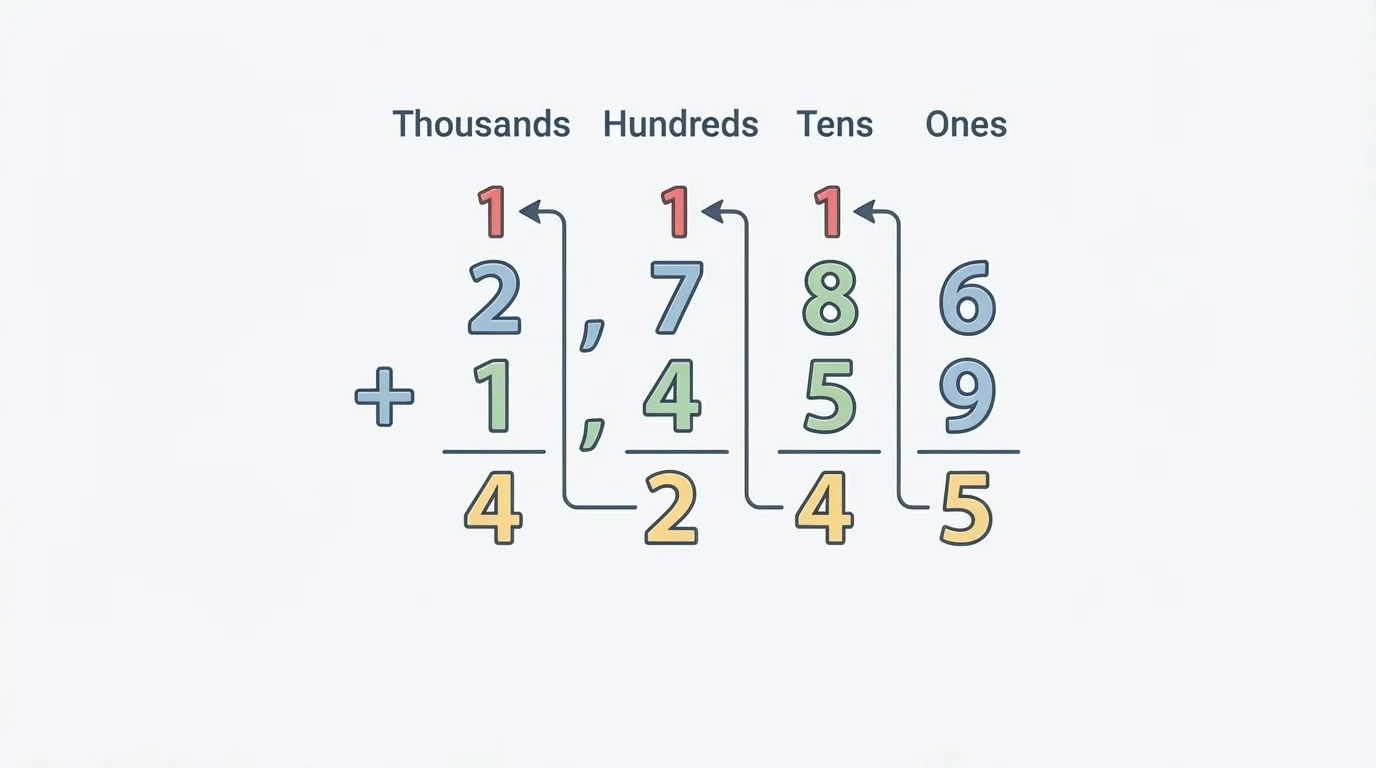
Here is the basic pattern for addition: line up the numbers, add the ones, regroup if needed, then add the tens, then hundreds, then thousands. Always pay attention to any regrouped digit written above a column.
Example 1
Find \(2,341 + 5,426\).
Step 1: Line up the numbers by place value.
\[\begin{array}{r} 2,341 \\ +\;5,426 \\ \hline \end{array}\]
Step 2: Add the ones: \(1 + 6 = 7\).
Write \(7\) in the ones place.
Step 3: Add the tens: \(4 + 2 = 6\).
Write \(6\) in the tens place.
Step 4: Add the hundreds: \(3 + 4 = 7\).
Write \(7\) in the hundreds place.
Step 5: Add the thousands: \(2 + 5 = 7\).
So, \[\begin{array}{r} 2,341 \\ +\;5,426 \\ \hline 7,767 \end{array}\]
This example is straightforward because no column sums to \(10\) or more. Even so, place value still guides every step.
Example 2
Find \(2,786 + 1,459\).
Step 1: Line up the numbers.
\[\begin{array}{r} 2,786 \\ +\;1,459 \\ \hline \end{array}\]
Step 2: Add the ones: \(6 + 9 = 15\).
Write \(5\) in the ones place and regroup \(1\) ten.
Step 3: Add the tens: \(1 + 8 + 5 = 14\).
The extra \(1\) is the regrouped ten. Write \(4\) in the tens place and regroup \(1\) hundred.
Step 4: Add the hundreds: \(1 + 7 + 4 = 12\).
Write \(2\) in the hundreds place and regroup \(1\) thousand.
Step 5: Add the thousands: \(1 + 2 + 1 = 4\).
So, \[\begin{array}{r} 2,786 \\ +\;1,459 \\ \hline 4,245 \end{array}\]
Notice how the regrouped digit must be included in the next column. The movement of value from one place to the next is the same idea shown earlier.
Subtraction with the standard algorithm also starts at the ones place and moves left. If the top digit in a column is smaller than the bottom digit, you regroup from the place to the left. This is sometimes called borrowing, but it is really decomposing one larger unit into smaller units.
For example, \(1\) ten can be decomposed into \(10\) ones. So if you need more ones to subtract, you can take \(1\) ten from the tens place and add \(10\) ones to the ones place.
Why regrouping in subtraction works
Suppose you have \(5\) tens and \(2\) ones. That is \(52\). If you regroup \(1\) ten, you now have \(4\) tens and \(12\) ones. The total value is still \(52\). You have not changed the number. You have only changed how it is written so subtraction is easier.
Example 3
Find \(8,754 - 3,212\).
Step 1: Line up the numbers.
\[\begin{array}{r} 8,754 \\ -\;3,212 \\ \hline \end{array}\]
Step 2: Subtract the ones: \(4 - 2 = 2\).
Step 3: Subtract the tens: \(5 - 1 = 4\).
Step 4: Subtract the hundreds: \(7 - 2 = 5\).
Step 5: Subtract the thousands: \(8 - 3 = 5\).
So, \[\begin{array}{r} 8,754 \\ -\;3,212 \\ \hline 5,542 \end{array}\]
This example has no regrouping, so each column can be subtracted directly.
Example 4
Find \(6,432 - 2,578\).
Step 1: Write the subtraction problem in columns.
\[\begin{array}{r} 6,432 \\ -\;2,578 \\ \hline \end{array}\]
Step 2: Start with the ones: \(2 - 8\) cannot be done without regrouping.
Regroup \(1\) ten from the tens place. Now the ones are \(12\), and the tens become \(2\).
Step 3: Subtract the ones: \(12 - 8 = 4\).
Step 4: Move to the tens: \(2 - 7\) cannot be done, so regroup \(1\) hundred.
The tens become \(12\), and the hundreds become \(3\).
Step 5: Subtract the tens: \(12 - 7 = 5\).
Step 6: Subtract the hundreds: \(3 - 5\) cannot be done, so regroup \(1\) thousand.
The hundreds become \(13\), and the thousands become \(5\).
Step 7: Subtract the hundreds: \(13 - 5 = 8\). Then subtract the thousands: \(5 - 2 = 3\).
So, \[\begin{array}{r} 6,432 \\ -\;2,578 \\ \hline 3,854 \end{array}\]
Many students think subtraction with regrouping is hard because several columns change. But if you go one column at a time and keep track carefully, the method stays organized.
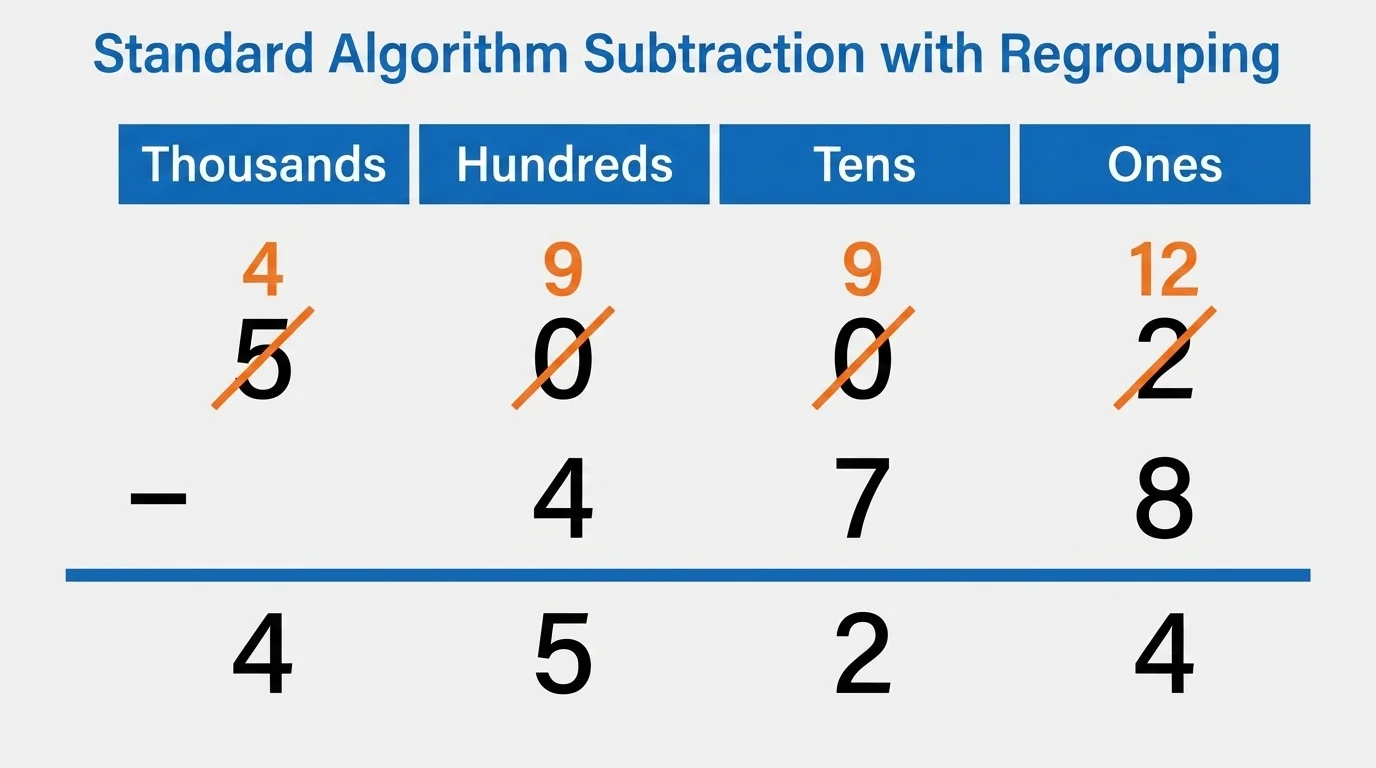
[Figure 3] Some subtraction problems are extra tricky because of zeroes. In a problem like \(5,002 - 478\), the zeroes in the hundreds and tens places cannot give anything to the column on their right. So the regrouping must move across more than one place.
This means you may need to go left until you find a digit that is not zero, regroup from that place, and then move the regrouped value across the zeroes until the needed column has enough.
Example 5
Find \(5,002 - 478\).
Step 1: Write the problem in columns.
\[\begin{array}{r} 5,002 \\ -\;478 \\ \hline \end{array}\]
Step 2: In the ones place, \(2 - 8\) cannot be done. The tens digit is \(0\), so regrouping must begin farther left.
Step 3: Take \(1\) thousand from the \(5\) thousands. Now there are \(4\) thousands and \(10\) hundreds.
Step 4: Regroup \(1\) hundred to the tens place. Now there are \(9\) hundreds and \(10\) tens.
Step 5: Regroup \(1\) ten to the ones place. Now there are \(9\) tens and \(12\) ones.
Step 6: Subtract each column: ones \(12 - 8 = 4\), tens \(9 - 7 = 2\), hundreds \(9 - 4 = 5\), thousands \(4 - 0 = 4\).
So, \[\begin{array}{r} 5,002 \\ -\;478 \\ \hline 4,524 \end{array}\]
The regrouping across zeroes may look dramatic, but it follows the same place-value rules as every other subtraction problem. The flow of value from a larger place to smaller places becomes clear when you track each regrouping step carefully.
Strong mathematicians do not just calculate. They also check whether an answer makes sense. One easy way is to estimate by rounding.
For example, to check \(2,786 + 1,459 = 4,245\), round \(2,786\) to \(2,800\) and \(1,459\) to \(1,500\). Then \(2,800 + 1,500 = 4,300\). The exact answer, \(4,245\), is close to \(4,300\), so it seems reasonable.
For subtraction, check \(6,432 - 2,578 = 3,854\). Round \(6,432\) to \(6,400\) and \(2,578\) to \(2,600\). Then \(6,400 - 2,600 = 3,800\). The exact answer, \(3,854\), is close to \(3,800\), so it is likely correct.
Mental estimation is used by adults all the time in stores, on budgets, and when checking travel distances. A fast estimate can warn you right away if an exact answer is much too big or much too small.
One common mistake is not lining up digits by place value. If \(352\) and \(4,908\) are not written carefully, you may add the digits in the wrong columns. Always line up the ones first, then the tens, hundreds, and thousands.
Another mistake is forgetting to add a regrouped digit in addition. In Example \(2\), if you forget the extra \(1\) that moves to the next column, your answer will be too small. Keep regrouped digits neat and easy to see, just like the regrouping marks shown earlier.
In subtraction, some students try to subtract the smaller digit from the larger digit in each column no matter what. That does not work. You must subtract the bottom digit from the top digit after regrouping correctly.
Addition and subtraction of multi-digit numbers appear in many everyday situations. A city might track visitors to two museums: \(12,485\) visitors at one museum and \(9,367\) at another. The total is \(21,852\). A sports league might compare total points scored by two teams over a season to find the difference.
Suppose one school collected \(8,245\) cans of food and another collected \(6,978\). To find how many more cans the first school collected, subtract: \(8,245 - 6,978 = 1,267\). Problems like this use the same standard algorithm you use on paper.
Even maps and travel planning use these skills. If a family drives \(1,248\) miles on one trip and \(876\) miles on another, the total distance is \(2,124\) miles. Accurate computation helps people plan time, fuel, and cost.
| Situation | Operation | Example | Result |
|---|---|---|---|
| Total visitors | Add | \(12,485 + 9,367\) | \(21,852\) |
| More cans collected | Subtract | \(8,245 - 6,978\) | \(1,267\) |
| Total travel miles | Add | \(1,248 + 876\) | \(2,124\) |
Table 1. Examples of real-world situations that use multi-digit addition and subtraction.
Fluency means more than getting a single correct answer. It means you understand why the method works, you can use it accurately, and you can decide whether the answer makes sense.
