A family road trip, a recipe, a soccer game, and a trip to the store all have something in common: they involve measurement. You may need to find how far someone traveled, how much time passed, how much juice is in a pitcher, the mass of a backpack, or how much money is left after buying supplies. Measurement helps us solve real-world problems, and the four operations help us do the work.
When we solve measurement word problems, we do more than just calculate. We also pay attention to units. A number without a unit can be confusing. For example, saying \(5\) does not tell us whether we mean \(5\) miles, minutes, liters, grams, or dollars. The unit tells what the number measures.
Measurement is all around us. A runner might jog \(2.5\) miles. A movie might last \(1\) hour \(45\) minutes. A water bottle might hold \(0.75\) liter. A bag of flour might have a mass of \(1.5\) kilograms. A lunch might cost $6.80. In each case, math helps us combine, compare, or split amounts.
Sometimes a problem is simple, like adding two lengths. Sometimes it is multi-step, like changing hours to minutes first and then subtracting. Good problem solvers look carefully at what the question asks and choose an operation that makes sense.
You already know the four operations: addition joins amounts, subtraction finds how much more or how much is left, multiplication combines equal groups, and division splits into equal groups or finds how many groups there are.
Those same ideas work with measurements too. The only extra challenge is that measurement problems often include units and conversions.
A distance tells how far something travels or how far apart two places are. We can measure distance in units such as miles, feet, yards, meters, or inches.
An interval of time tells how much time passes from one moment to another. We often measure time in hours, minutes, and seconds.
Liquid volume tells how much space a liquid takes up. We might measure it in liters, milliliters, cups, or ounces.
Mass tells how much matter an object has. We might use kilograms, grams, pounds, or ounces.
Money is measured in dollars and cents. Since \(1\) dollar equals \(100\) cents, money problems often use decimals.
Conversion means changing a measurement from one unit to another without changing the amount being measured. For example, \(1\) foot and \(12\) inches name the same length.
If two measurements use different units, we often need to convert them before we can combine them correctly. For example, we should not add \(2\) feet and \(6\) inches until both measurements are written in compatible units.
One of the most useful ideas in measurement is that one larger unit can be renamed as many smaller units. This helps us add, subtract, multiply, or divide measurements more easily.
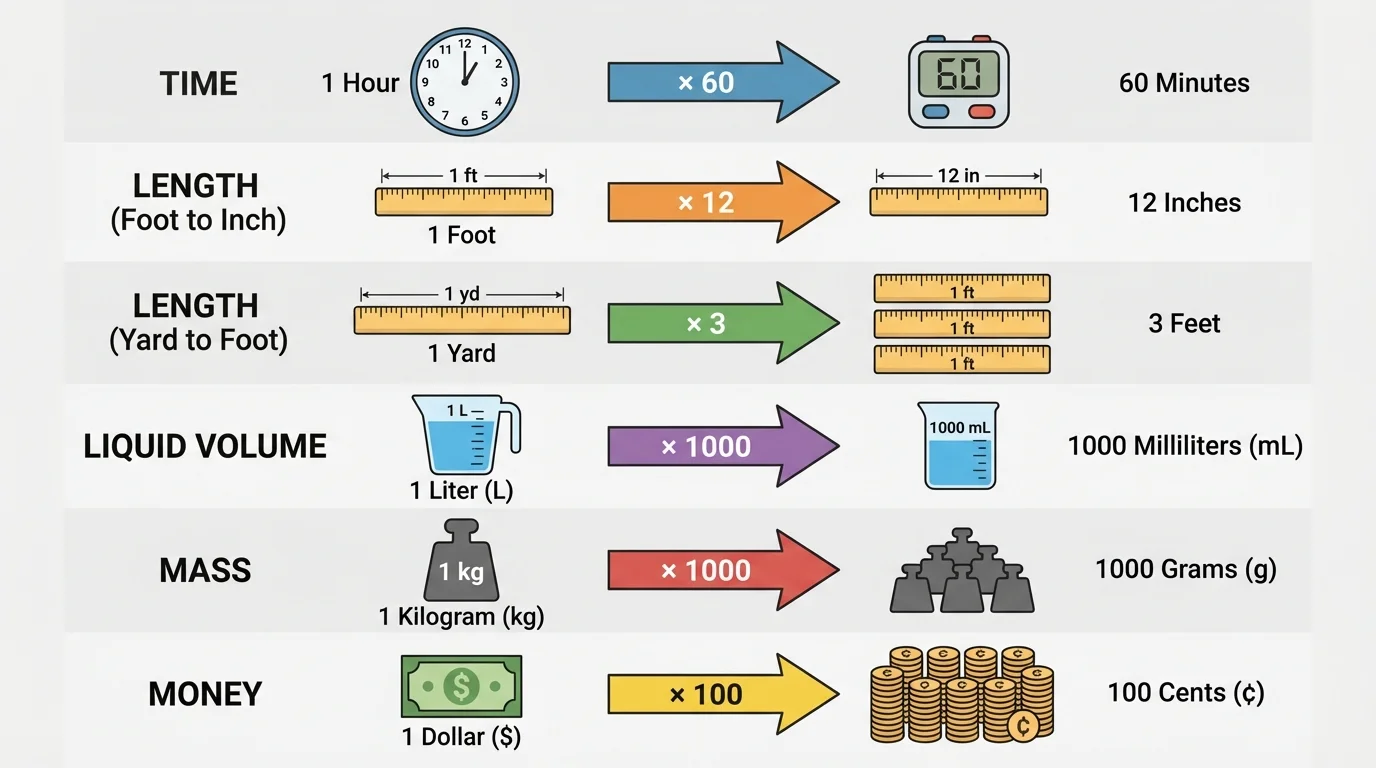
[Figure 1] Here are some common conversions:
| Large unit | Smaller unit | Conversion |
|---|---|---|
| hour | minutes | \(1\) hour = \(60\) minutes |
| foot | inches | \(1\) foot = \(12\) inches |
| yard | feet | \(1\) yard = \(3\) feet |
| kilogram | grams | \(1\) kilogram = \(1{,}000\) grams |
| liter | milliliters | \(1\) liter = \(1{,}000\) milliliters |
| dollar | cents | \(1\) dollar = \(100\) cents |
To convert from a larger unit to a smaller unit, we multiply by the number of smaller units in one larger unit.
For example, to change \(3\) hours to minutes, multiply: \(3 \times 60 = 180\), so \(3\) hours = \(180\) minutes. To change \(4\) liters to milliliters, multiply: \(4 \times 1{,}000 = 4{,}000\), so \(4\) liters = \(4{,}000\) milliliters.
Fractions and decimals can be converted too. For example, \(1.5\) liters equals \(1.5 \times 1{,}000 = 1{,}500\) milliliters. Also, \(\dfrac{1}{2}\) dollar equals \(0.5\) dollar, and \(0.5 \times 100 = 50\) cents.
Measurement word problems use the same four operations as other word problems. The key is understanding the situation.
Use addition when you join amounts. Example: a hiker walks \(2\) miles in the morning and \(1.5\) miles in the afternoon. The total is \(2 + 1.5 = 3.5\) miles.
Use subtraction when you compare amounts or find what is left. Example: a bottle holds \(1\) liter of juice, and \(0.35\) liter is poured out. The amount left is \(1 - 0.35 = 0.65\) liter.
Use multiplication when you have equal groups. Example: \(4\) bags each weigh \(0.75\) kilogram. The total mass is \(4 \times 0.75 = 3\) kilograms.
Use division when you split an amount equally or find how many groups. Example: \(6\) cups of soup are shared equally into \(3\) bowls. Each bowl gets \(6 \div 3 = 2\) cups.
Look for the action in the story. Ask yourself: Are amounts being joined, compared, repeated, or shared? The words in a problem can help, but the situation matters more than clue words alone. A word like each often suggests multiplication, and a phrase like how much longer often suggests subtraction.
Sometimes a problem uses more than one operation. For example, you may convert hours to minutes first, then subtract to find how much time remains. Or you may add prices and then subtract from the amount of money you have.
A number line diagram is a helpful way to show measurement quantities. A measurement scale shows numbers in order and helps us see jumps, parts, and total distances.
[Figure 2] For distance, a number line can show how far someone travels. For time, it can show jumps from one time to another. For fractions and decimals, it helps place measurements between whole numbers.
Suppose a movie starts at 2:15 and ends at 4:00. On a time number line, we can jump from 2:15 to 3:00, then to 3:30, then to 4:00. The jumps are 45 minutes, 30 minutes, and 30 minutes. Adding the jumps gives \(45 + 30 + 30 = 105\) minutes.
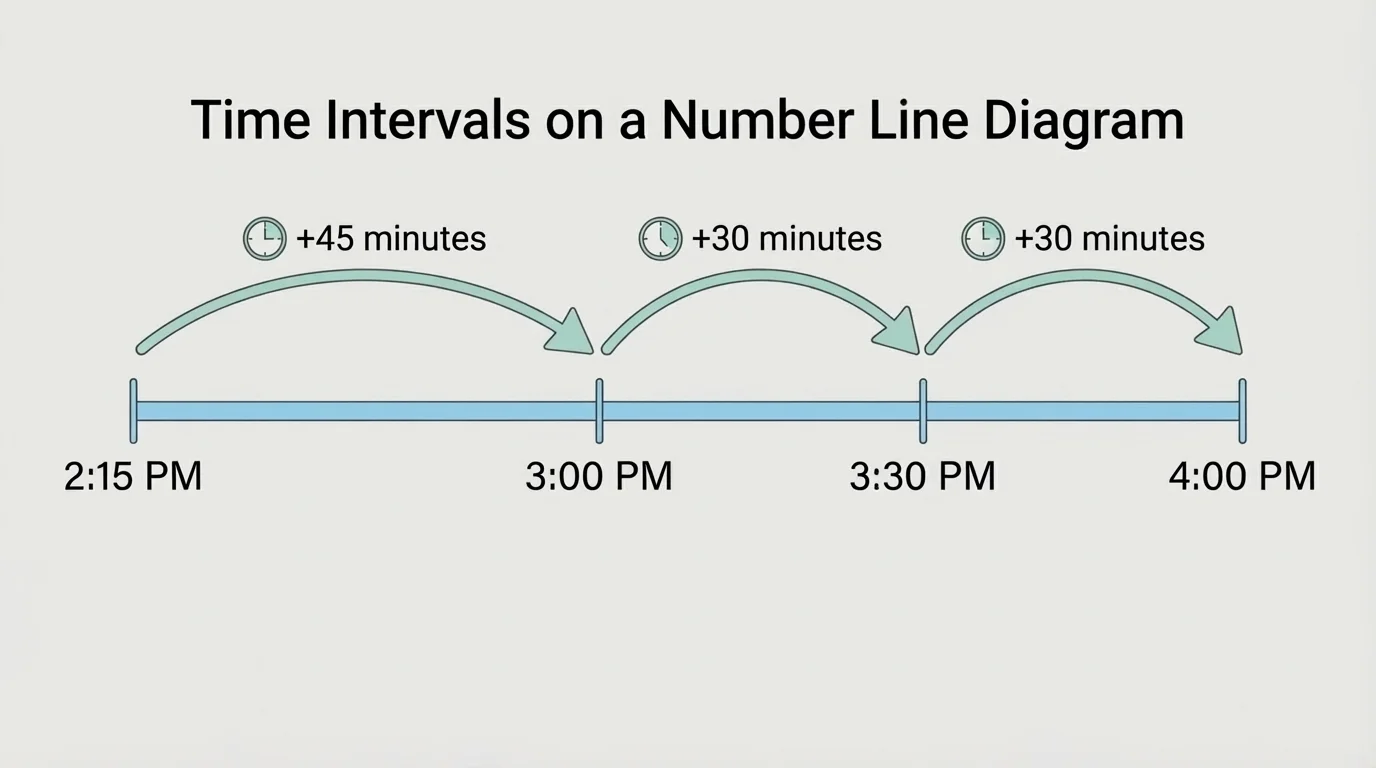
Since \(60\) minutes make \(1\) hour, \(105\) minutes is \(1\) hour \(45\) minutes. Number line diagrams are useful because they break a big problem into smaller, easier parts.
[Figure 3] A trail walk can be pictured on a measurement scale and helps show the parts and the total distance. Let us solve a distance problem step by step.
Worked example 1
Maya hikes \(2.5\) miles in the morning. In the afternoon, she hikes \(1.5\) miles less than she did in the morning. How many miles does she hike altogether?
Step 1: Find the afternoon distance.
Morning distance is \(2.5\) miles. The afternoon distance is \(2.5 - 1.5 = 1.0\) mile.
Step 2: Add the two distances.
Total distance is \(2.5 + 1.0 = 3.5\) miles.
\(3.5\) miles is the total distance Maya hikes.
This problem uses subtraction first and then addition. It also shows that decimals can represent measurements just as whole numbers do.
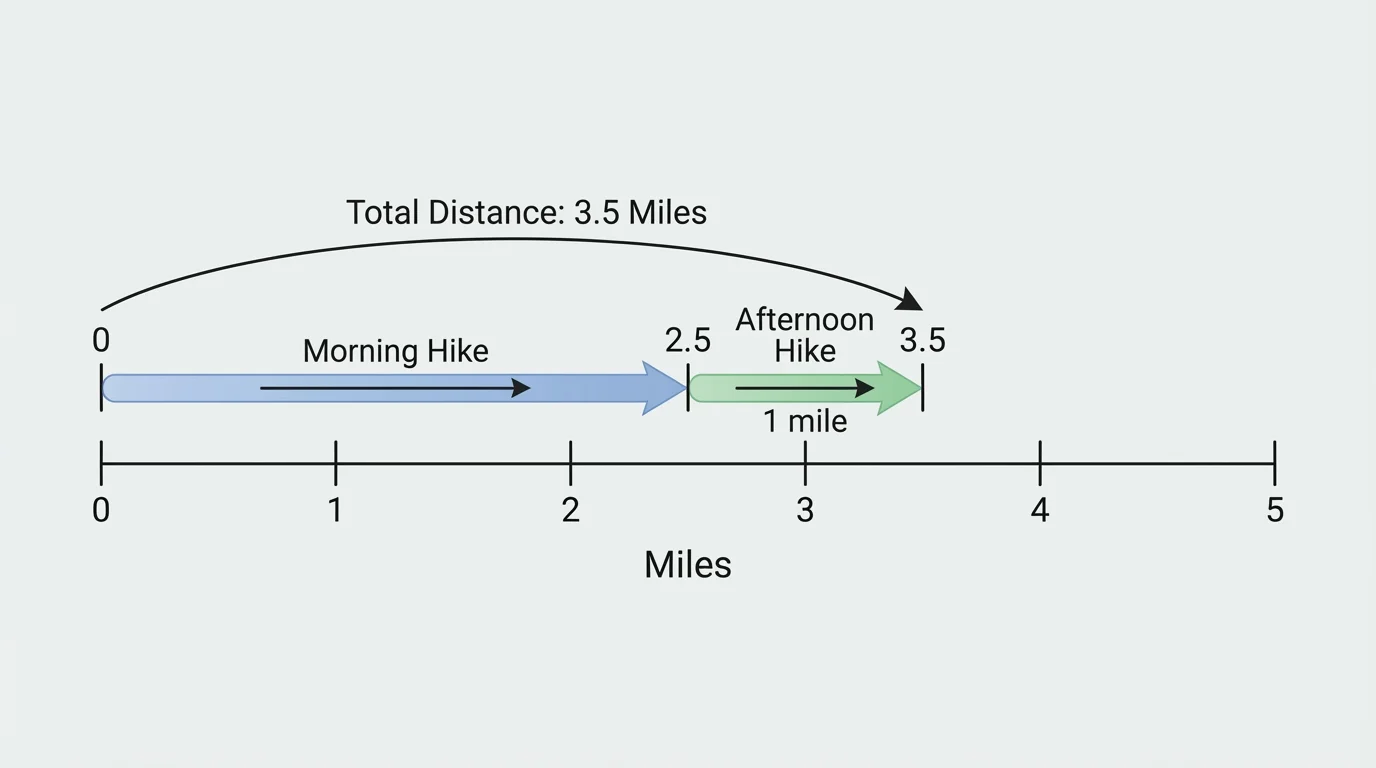
Later, when comparing other distances, the same kind of measurement scale helps us see part-part-whole relationships clearly.
Elapsed time problems often become easier when we move in jumps from one friendly time to the next.
Worked example 2
A swimming lesson begins at 2:35 and ends at 4:10. How long is the lesson?
Step 1: Jump from 2:35 to 3:00.
That jump is 25 minutes.
Step 2: Jump from 3:00 to 4:00.
That jump is 60 minutes.
Step 3: Jump from 4:00 to 4:10.
That jump is 10 minutes.
Step 4: Add the jumps.
\(25 + 60 + 10 = 95\) minutes.
\(95\) minutes equals \(1\) hour \(35\) minutes.
The number line uses the same idea: smaller jumps can be easier to add than trying to subtract clock times all at once.
Volume and mass problems often need conversions, especially when one measurement is given in a larger unit and another is given in a smaller unit.
Worked example 3
A large jug holds \(2\) liters of water. Zoe pours \(550\) milliliters into one bottle and \(700\) milliliters into another bottle. How many milliliters of water are left in the jug?
Step 1: Convert liters to milliliters.
\(2\) liters \(= 2 \times 1{,}000 = 2{,}000\) milliliters.
Step 2: Find how much was poured out.
\(550 + 700 = 1{,}250\) milliliters.
Step 3: Subtract to find what is left.
\(2{,}000 - 1{,}250 = 750\) milliliters.
\(750\) milliliters of water are left.
Now consider a mass example with a fraction. If one apple has a mass of \(\dfrac{1}{4}\) kilogram, then \(3\) apples have a total mass of \(3 \times \dfrac{1}{4} = \dfrac{3}{4}\) kilogram. Fractions can represent equal parts of a measurement unit.
Money problems are measurement problems too because dollars and cents are units. Since \(1\) dollar equals \(100\) cents, decimals help us write money amounts.
Worked example 4
Lena has $20.00. She buys a notebook for $4.75 and pens for $3.60. Then she buys \(2\) erasers at $0.85 each. How much money does she have left?
Step 1: Find the cost of the erasers.
\(2 \times 0.85 = 1.70\), so the erasers cost $1.70.
Step 2: Add all the costs.
\(4.75 + 3.60 + 1.70 = 10.05\), so the total cost is $10.05.
Step 3: Subtract from the amount Lena has.
\(20.00 - 10.05 = 9.95\).
Lena has $9.95 left.
When solving money problems, line up decimal points carefully. The tenths place shows dimes, and the hundredths place shows cents.
Measurements are not always whole numbers. A piece of ribbon might be \(\dfrac{3}{4}\) yard long. A bottle might hold \(0.6\) liter. A runner might finish a race in \(7.5\) minutes. Fractions and decimals help us describe exact amounts and show how they fit on a measurement scale.
[Figure 4] Fractions often appear when a whole unit is divided into equal parts. For example, \(\dfrac{1}{2}\) hour is \(30\) minutes because \(\dfrac{1}{2}\) of \(60\) is \(30\). Also, \(\dfrac{1}{4}\) of a liter is \(250\) milliliters because \(\dfrac{1}{4}\) of \(1{,}000\) is \(250\).
Decimals often appear in money and metric measurements. For example, \(0.4\) kilogram means four tenths of a kilogram. Since \(1\) kilogram equals \(1{,}000\) grams, \(0.4\) kilogram equals \(400\) grams.
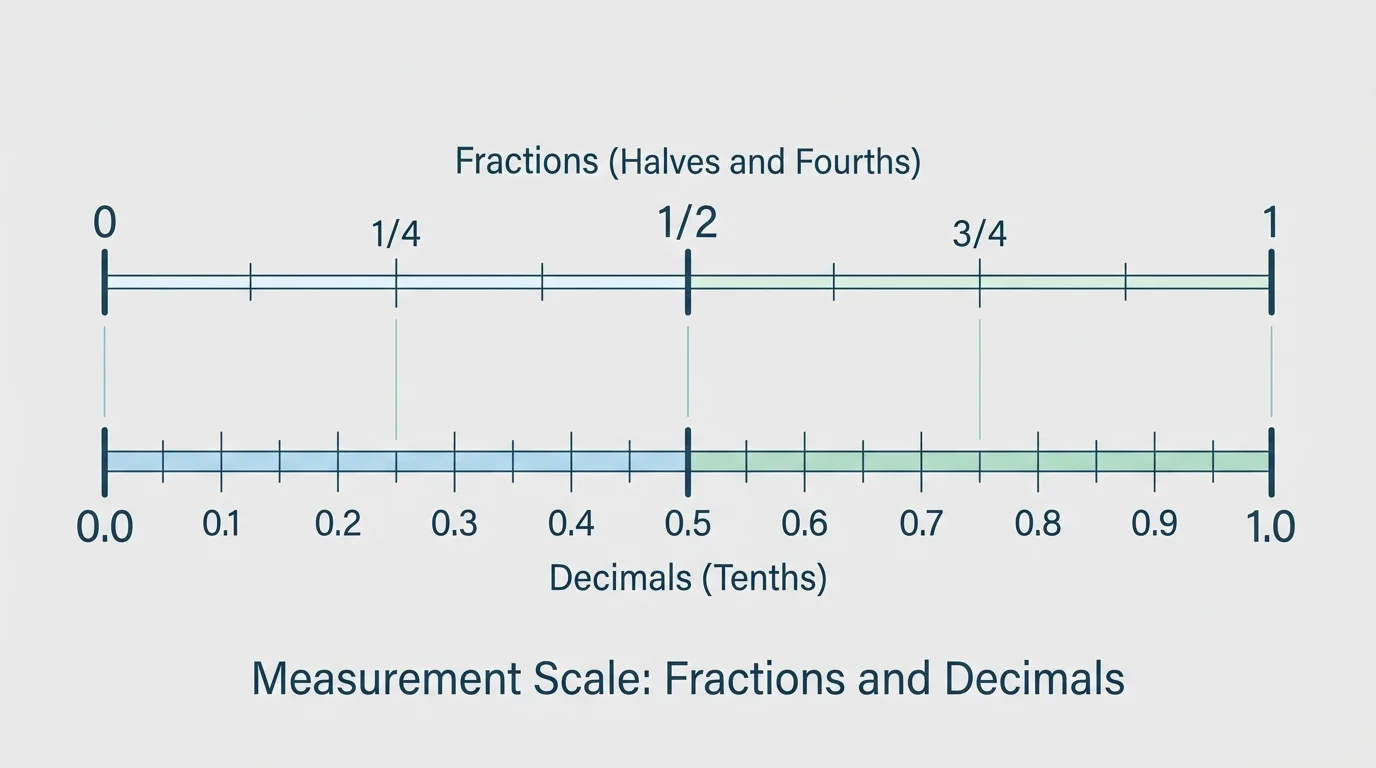
On a scale, fractions and decimals mark points between whole numbers. That is why ruler marks, clock intervals, and measuring cups are so useful. The matching positions help us compare parts of a unit.
A quarter is worth \(\dfrac{1}{4}\) of a dollar, which is the same as $0.25. That means fractions and decimals can name the same amount of money in different ways.
You can often solve fraction measurement problems by thinking about equal parts, and you can solve decimal measurement problems by thinking about place value.
Some word problems have more than one part. A good plan can make them much easier.
Read carefully. Find out what is being measured and what the question asks for.
Write the units. Units help keep your work organized.
Convert if needed. If the problem mixes units, rename measurements in the same unit before combining them. The conversion relationships shown earlier in [Figure 1] are useful here.
Choose the operation. Decide whether to add, subtract, multiply, or divide.
Estimate. A quick estimate can tell whether your answer makes sense. For example, if an item costs about $5 and another costs about $4, then a total near $9 is reasonable.
Check the answer. Ask whether the unit and the size of the answer fit the story.
In cooking, measurements matter when doubling a recipe, pouring liquids, or comparing amounts in cups and liters. If a recipe uses \(1.5\) liters of soup and you make \(2\) batches, you need \(2 \times 1.5 = 3\) liters.
In sports, time and distance are everywhere. A runner may compare lap times, a cyclist may total miles ridden, and a swimmer may find elapsed time between start and finish.
In shopping, people add prices, compare costs, and subtract from the money they have. Discounts, totals, and change all depend on accurate measurement with money.
In science, liquid volume and mass are used when measuring ingredients for experiments. Even small differences can matter, so correct units are important.
One common mistake is forgetting to convert units. Adding \(1\) hour and \(30\) minutes as if they were the same unit gives the wrong result. First change \(1\) hour to \(60\) minutes, then add: \(60 + 30 = 90\) minutes.
Another mistake is ignoring the unit in the final answer. A result of 50 should be written as 50 milliliters, 50 grams, or another correct unit.
A third mistake is misplacing decimal points in money and metric measurements. Careful place value work helps prevent that.
Time problems can also be tricky because clocks are not based on tens. For example, \(1\) hour \(60\) minutes is really \(2\) hours \(0\) minutes because \(60\) minutes make \(1\) hour.
"The unit is part of the answer."
— A strong rule for measurement problems
When you solve measurement word problems, you are using math to understand the world more clearly. Every distance, time interval, liquid amount, mass, and money value tells a story, and the four operations help you read it correctly.
