A classroom floor, a tablet screen, a garden bed, and a picture frame may look very different, but they all share a useful shape: the rectangle. When builders cover a floor, they care about how much surface is inside. When they put trim around a wall or fence around a garden, they care about the distance around the outside. Learning how to measure both helps us solve real problems quickly and correctly.
A rectangle is a four-sided shape with four right angles. Its side measurements are called length and width. The length is usually the longer side, and the width is the shorter side. A rectangle has four sides, and opposite sides are equal. That means the top and bottom sides have the same length, and the left and right sides have the same width.
If a rectangle has length \(8\) units and width \(3\) units, then both long sides are \(8\) units and both short sides are \(3\) units. These side lengths help us find two important measurements: area and perimeter.
Area is the amount of surface inside a shape.
Perimeter is the total distance around the outside of a shape.
These two ideas are connected to the same rectangle, but they answer different questions. Area asks, "How much space does it cover?" Perimeter asks, "How far is it around the edge?"
A rectangle has both an inside region and a boundary, and [Figure 1] shows that area measures the inside while perimeter measures the border. This is why two problems about the same rectangle may need different formulas.
Suppose a rug is shaped like a rectangle. If you want to know how much carpet covers the floor, you need the area. If you want to sew ribbon all the way around the edge of the rug, you need the perimeter.
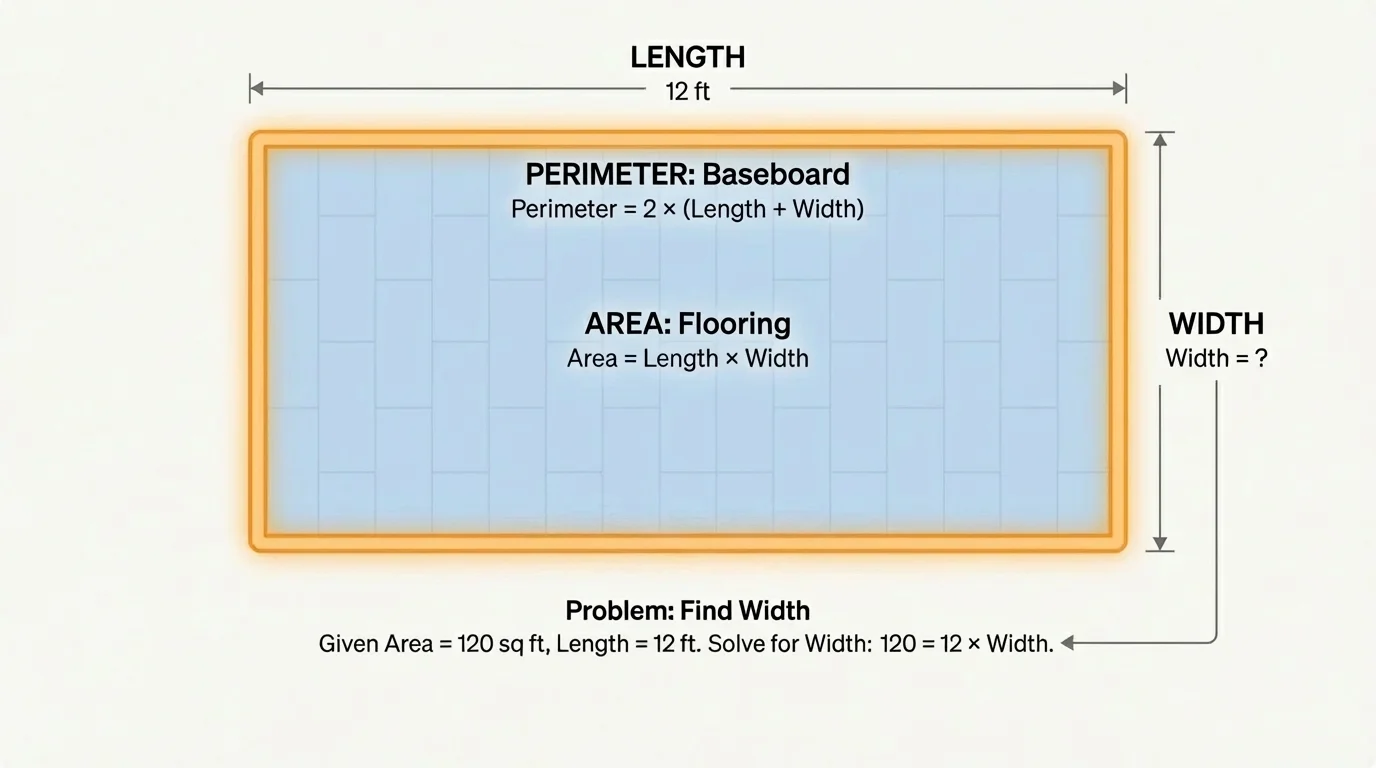
Area is measured in square units, such as square inches, square feet, or square meters. Perimeter is measured in regular units of length, such as inches, feet, or meters.
For example, if a rectangle is \(5\) feet by \(4\) feet, its area is measured in square feet, but its perimeter is measured in feet. The units help you understand what kind of measurement you are finding.
For rectangles, the formulas are simple and powerful.
The formula for area is:
\[A = l \times w\]
Here, \(A\) means area, \(l\) means length, and \(w\) means width.
The formula for perimeter is:
\(P = 2l + 2w\)
You can also write perimeter as:
\[P = 2(l + w)\]
Both perimeter formulas mean the same thing. Since a rectangle has two lengths and two widths, we add both pairs of equal sides.
Why the formulas work
Area is found by counting how many equal squares fit inside the rectangle. If there are \(l\) squares in each row and \(w\) rows, then the total number of squares is \(l \times w\). Perimeter is found by adding the lengths of all four sides, so we add two lengths and two widths.
When you use a formula, always match the numbers to the correct meaning. A side length belongs in a length or width spot. The final answer must match the kind of measurement you are finding.
When we find area, we are really counting little equal squares, and [Figure 2] illustrates how rows and columns of squares fill a rectangle. That is why area uses square units instead of plain length units.
If a rectangle is \(4\) units long and \(3\) units wide, then it has \(3\) rows of \(4\) squares. We can count them: \(4 + 4 + 4 = 12\), or multiply: \(4 \times 3 = 12\). So the area is \(12\) square units.
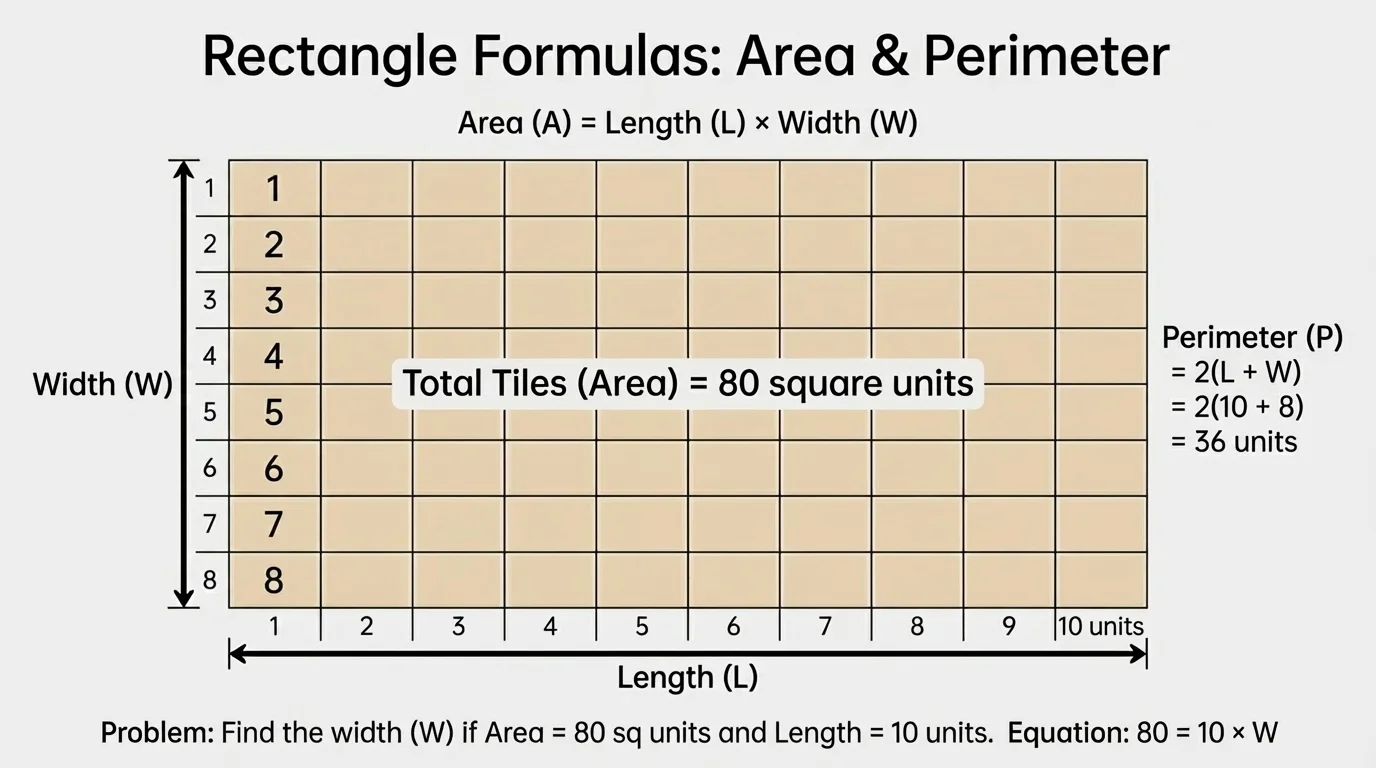
Perimeter is different. We do not count inside squares. We add the side lengths. For the same rectangle, the perimeter is \(4 + 3 + 4 + 3 = 14\) units.
Sometimes measurements are given in larger units, but a problem asks you to think in smaller units. For example, \(1\) foot equals \(12\) inches. If a rectangle is \(2\) feet by \(3\) feet, you can still find the area in square feet: \(2 \times 3 = 6\) square feet. But if you want the side lengths in inches first, then \(2\) feet is \(24\) inches and \(3\) feet is \(36\) inches.
Using inches, the perimeter would be \(24 + 36 + 24 + 36 = 120\) inches. This matches \(10\) feet, because \(120 \div 12 = 10\).
Be careful with area when converting units. Since area uses square units, the number changes in a bigger way. A rectangle that is \(1\) foot by \(1\) foot has area \(1\) square foot, but it is also \(12\) inches by \(12\) inches, so the area is \(12 \times 12 = 144\) square inches.
| Measurement | What it means | Example unit |
|---|---|---|
| Area | Space inside | square feet |
| Perimeter | Distance around | feet |
Table 1. This table compares area and perimeter by meaning and units.
Sometimes you know the area and one side of a rectangle, but not the other side. In that case, [Figure 3] shows how area can be viewed as a multiplication equation with one unknown factor. If \(A = l \times w\), then knowing \(A\) and one side lets you find the missing side.
For example, if the area is \(24\) square feet and the length is \(6\) feet, then the width must satisfy \(6 \times w = 24\). Since \(24 \div 6 = 4\), the width is \(4\) feet.
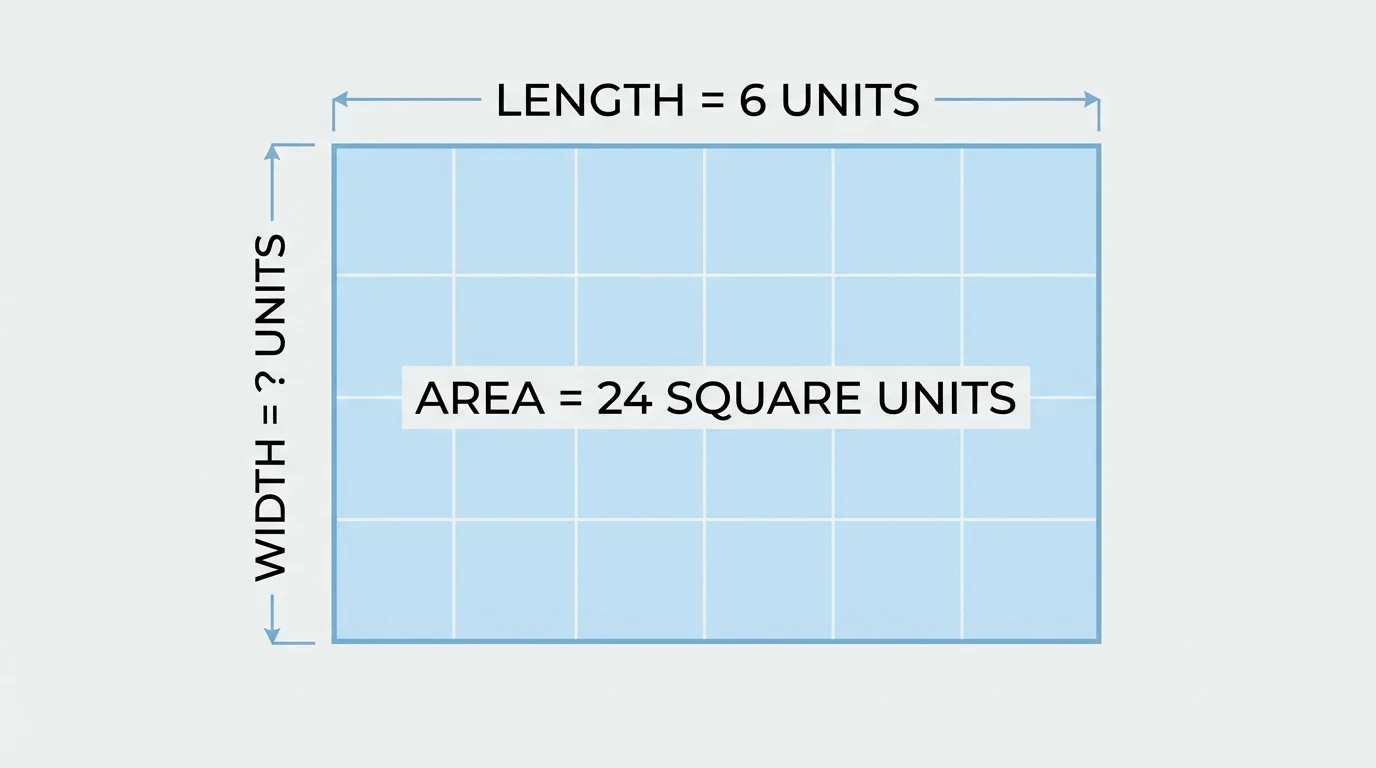
This is called finding an unknown factor. Multiplication and division work together. If \(l \times w = A\), then \(A \div l = w\) and \(A \div w = l\).
Think back to multiplication facts and fact families. If \(6 \times 4 = 24\), then \(24 \div 6 = 4\) and \(24 \div 4 = 6\). That same idea helps you find missing side lengths in rectangles.
The same idea works with any units, as long as you keep them consistent. If the area is in square inches, the side lengths will be in inches. If the area is in square meters, the side lengths will be in meters.
Worked examples help show how to choose the right formula and solve step by step.
Worked example 1: Find area
A rectangular bulletin board is \(9\) feet long and \(4\) feet wide. Find its area.
Step 1: Write the area formula.
\(A = l \times w\)
Step 2: Substitute the known values.
\(A = 9 \times 4\)
Step 3: Multiply.
\(A = 36\)
The area is \(36\) square feet.
This answer makes sense because the board covers a flat surface. Area tells how much space the board covers.
Worked example 2: Find perimeter
A rectangular garden is \(7\) meters long and \(5\) meters wide. Find its perimeter.
Step 1: Write the perimeter formula.
\(P = 2l + 2w\)
Step 2: Substitute the values.
\(P = 2(7) + 2(5)\)
Step 3: Multiply and add.
\(P = 14 + 10 = 24\)
The perimeter is \(24\) meters.
If someone wants to put a fence around the garden, perimeter is the correct measurement because the fence goes around the outside edge.
Worked example 3: Find an unknown width from area
A rectangular room has an area of \(48\) square feet. Its length is \(8\) feet. Find the width.
Step 1: Write the area equation.
\(A = l \times w\)
Step 2: Substitute what you know.
\(48 = 8 \times w\)
Step 3: Divide to find the unknown factor.
\(w = 48 \div 8 = 6\)
The width is \(6\) feet.
This is the kind of problem builders and designers solve often. If they know how much flooring covers a room and they know one side length, they can find the missing side.
Worked example 4: Convert units, then find perimeter
A picture frame is \(2\) feet long and \(1\) foot wide. Find the perimeter in inches.
Step 1: Convert each side length to inches.
\(2\) feet \(= 24\) inches and \(1\) foot \(= 12\) inches.
Step 2: Use the perimeter formula.
\(P = 2l + 2w\)
Step 3: Substitute and solve.
\(P = 2(24) + 2(12) = 48 + 24 = 72\)
The perimeter is \(72\) inches.
Since frame material goes around the edge, perimeter is the needed measurement, not area.
Worked example 5: Decide whether to use area or perimeter
A rectangular patio is \(10\) feet by \(6\) feet. How much stone is needed to cover it?
Step 1: Decide what the question asks.
The patio must be covered, so use area.
Step 2: Use the area formula.
\(A = 10 \times 6 = 60\)
Step 3: State the answer with units.
The patio needs \(60\) square feet of stone.
The answer is \(60\) square feet.
Notice that the word cover is a clue for area. Words like around, border, and edge are clues for perimeter.
Rectangles appear everywhere in daily life. Floors, windows, books, screens, playgrounds, tables, and fields are often rectangles. Knowing whether to use area or perimeter helps people buy the right amount of material.
If a family wants to put tile on a kitchen floor, they need the area because tile covers the inside surface. If they want to add trim around the floor, they need the perimeter. The same rectangle can lead to two very different answers, just as [Figure 1] reminds us.
Rows and columns of tiles are also a helpful way to picture multiplication, and [Figure 2] connects the area formula to counting equal squares. That is why area problems often feel like multiplication arrays.
Builders, gardeners, and painters all use rectangle measurements. A small mistake in area or perimeter can mean buying too much or too little material.
Here are some common real-world matches:
| Situation | Use area or perimeter? | Why |
|---|---|---|
| Covering a floor with carpet | Area | Carpet covers the inside surface |
| Putting a fence around a garden | Perimeter | The fence goes around the edge |
| Painting a rectangular wall | Area | Paint covers the surface |
| Adding ribbon around a poster | Perimeter | Ribbon goes around the outside |
Table 2. This table shows when to use area and when to use perimeter in real-life situations.
Unknown side length problems are also useful in real life. If a room's flooring covers \(72\) square feet and one side is \(9\) feet, then the other side must satisfy \(9 \times w = 72\). So \(w = 8\) feet, as the area model in [Figure 3] helps us picture.
One common mistake is mixing up area and perimeter. Another is forgetting units. A third mistake is not checking whether the answer is reasonable.
Here are smart checks you can use:
You can also estimate. For a rectangle that is about \(8\) units by \(5\) units, the area should be about \(40\) square units and the perimeter should be about \(26\) units. If you get an answer like \(13\) square units for the area, something has probably gone wrong.
"Use area for what fills the inside. Use perimeter for what goes around the outside."
Careful reading matters. The math may be easy, but choosing the correct formula is the most important step. Once you know whether the problem is about inside space or outside distance, the rectangle formulas become very helpful tools.
