Suppose a scientist measures the lengths of tiny insects and discovers that two insects differ by only \(\dfrac{1}{8}\) of an inch. That sounds tiny, but a line plot can make that difference easy to see. A line plot is a simple graph, yet it is powerful because it helps us organize measurements, compare them, and solve problems using fractions.
When measurements are not whole numbers, a line plot becomes especially useful. In grade \(4\), you will often work with measurements such as \(\dfrac{1}{2}\), \(\dfrac{1}{4}\), and \(\dfrac{1}{8}\) of a unit. You might measure seeds, ribbons, pencils, shells, or insect specimens. A line plot helps you display all of those values clearly on one number line.
Data is information we collect. If you measure several objects, the list of measurements is called a data set. If the measurements are close together, it can be hard to understand the list just by looking at it. A line plot helps you see patterns right away.
For example, if several leaves have lengths of \(\dfrac{3}{4}\) inch and only one leaf has a length of \(1\dfrac{1}{4}\) inches, a line plot makes that pattern stand out. You can quickly tell which measurement happens most often, which one is longest, and which one is shortest.
Line plot is a graph that uses a number line and marks, often Xs, to show how many times each value appears.
Measurement is the size, length, weight, or amount of something.
Fraction is a number that names part of a whole, such as \(\dfrac{1}{2}\), \(\dfrac{1}{4}\), or \(\dfrac{1}{8}\).
A line plot is also a good thinking tool. It does not just show data. It helps you answer questions about the data using addition and subtraction.
A line plot places Xs above a number line to show where measurements belong, as [Figure 1] illustrates. Each X stands for one piece of data. If three objects measure \(\dfrac{3}{4}\) unit, then there are three Xs above \(\dfrac{3}{4}\).
The number line at the bottom must show the possible measurement values in order from least to greatest. Because the values are measurements, the spaces between them must be equal. If the plot includes fourths, then each jump might be \(\dfrac{1}{4}\). If it includes eighths, then each jump might be \(\dfrac{1}{8}\).
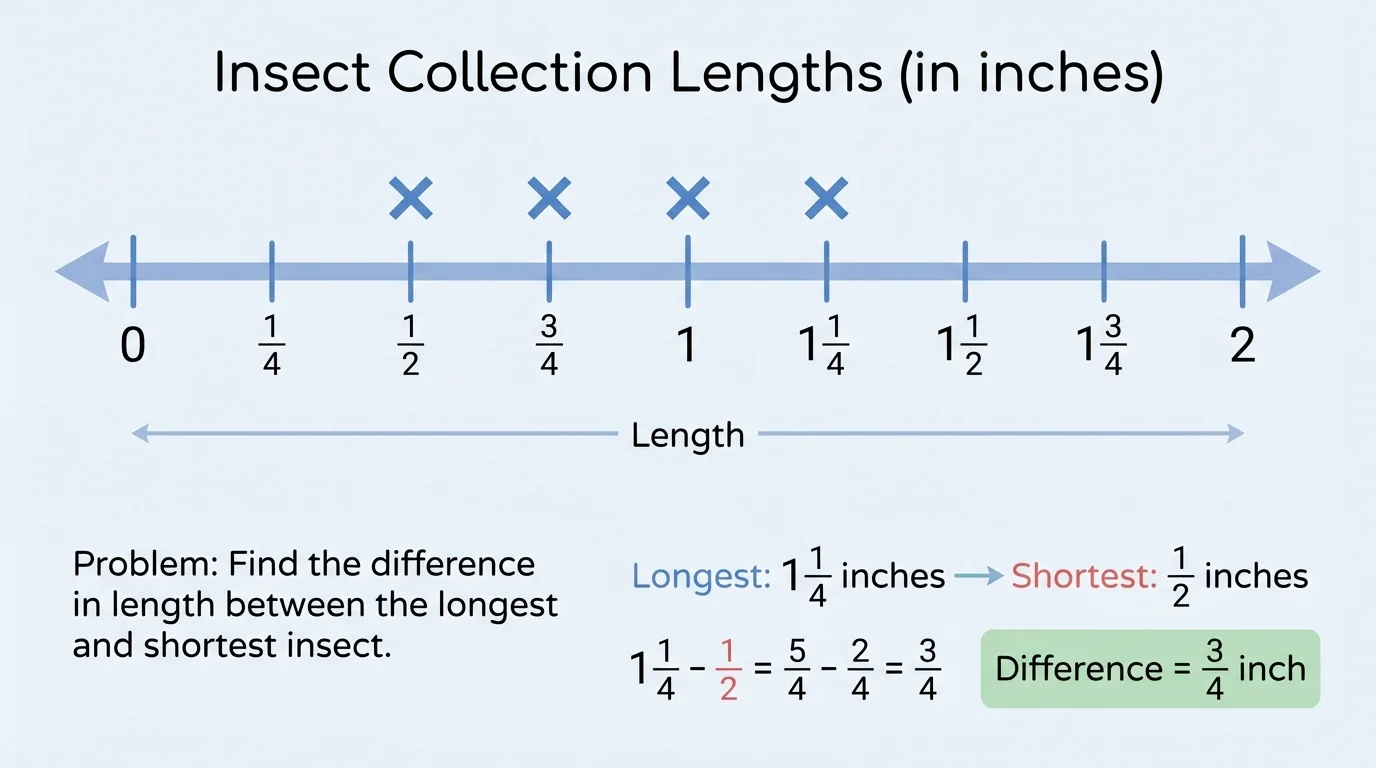
When you read a line plot, you should ask questions such as these: How many measurements are there altogether? Which measurement appears most often? What is the longest measurement? What is the shortest measurement? These are all questions about the data shown.
Sometimes a line plot includes whole numbers and fractions together. For example, the number line might show \(0\), \(\dfrac{1}{4}\), \(\dfrac{1}{2}\), \(\dfrac{3}{4}\), \(1\), \(1\dfrac{1}{4}\), and so on. That is still one number line, and every tick mark must be evenly spaced.
Before making a line plot, you need to understand where fractions belong on a number line. As [Figure 2] shows, a number line shows numbers in order, and the distance between numbers matters. Fractions must be placed at exact points.
For halves, the unit is divided into \(2\) equal parts. For fourths, it is divided into \(4\) equal parts. For eighths, it is divided into \(8\) equal parts. This means that on a number line from \(0\) to \(1\), the jumps are:
For halves: \(0, \dfrac{1}{2}, 1\)
For fourths: \(0, \dfrac{1}{4}, \dfrac{1}{2}, \dfrac{3}{4}, 1\)
For eighths: \(0, \dfrac{1}{8}, \dfrac{2}{8}, \dfrac{3}{8}, \dfrac{4}{8}, \dfrac{5}{8}, \dfrac{6}{8}, \dfrac{7}{8}, 1\)
Some fractions name the same point. These are called equivalent fractions. For example, \(\dfrac{1}{2} = \dfrac{2}{4} = \dfrac{4}{8}\). On a number line, these fractions all land at the same place.
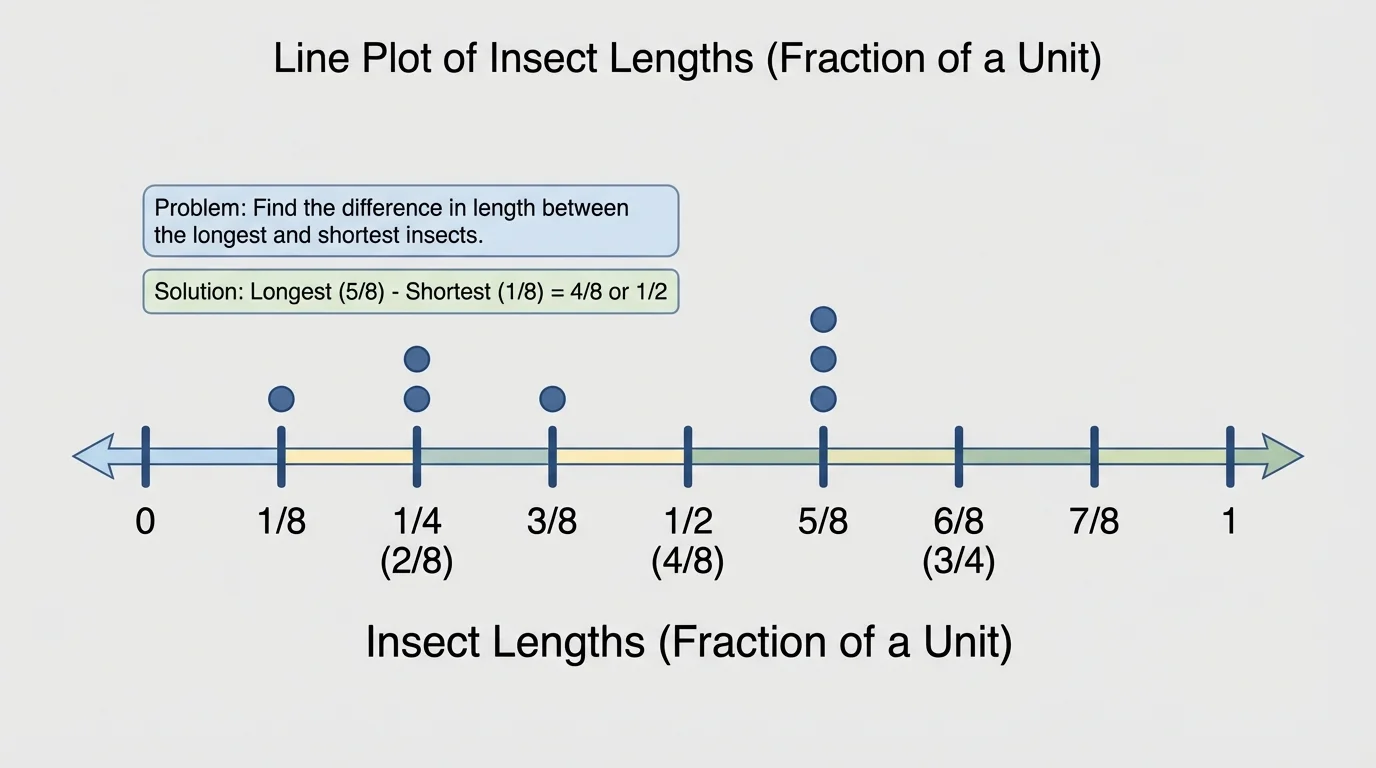
This matters when you solve problems. If one object measures \(\dfrac{1}{2}\) unit and another measures \(\dfrac{4}{8}\) unit, they are the same length even though the fractions look different.
To compare or combine fractions, it helps to think about equal parts of the same whole. Fractions can be renamed with common denominators. For example, \(\dfrac{1}{4} = \dfrac{2}{8}\), so fourths and eighths can be compared using eighths.
Equal spacing is one of the most important rules of a line plot. If the spaces are not equal, the graph gives the wrong picture of the data.
Making a line plot is a clear process, and [Figure 3] shows how a list of measurements turns into a finished plot. Start by looking carefully at the data set. Suppose the measurements of ribbon pieces are \(\dfrac{1}{2}, \dfrac{3}{4}, \dfrac{1}{2}, 1, \dfrac{3}{4}, \dfrac{7}{8}\) unit.
First, decide what values must appear on the number line. Because \(\dfrac{7}{8}\) is part of the data, it is smart to mark the line in eighths. A line marked only in fourths would not show \(\dfrac{7}{8}\) exactly.
Next, draw the number line with equal spaces: \(\dfrac{1}{2}, \dfrac{5}{8}, \dfrac{3}{4}, \dfrac{7}{8}, 1\), and any other needed values. Then place one X above each measurement. If \(\dfrac{1}{2}\) appears twice, put two Xs above \(\dfrac{1}{2}\).
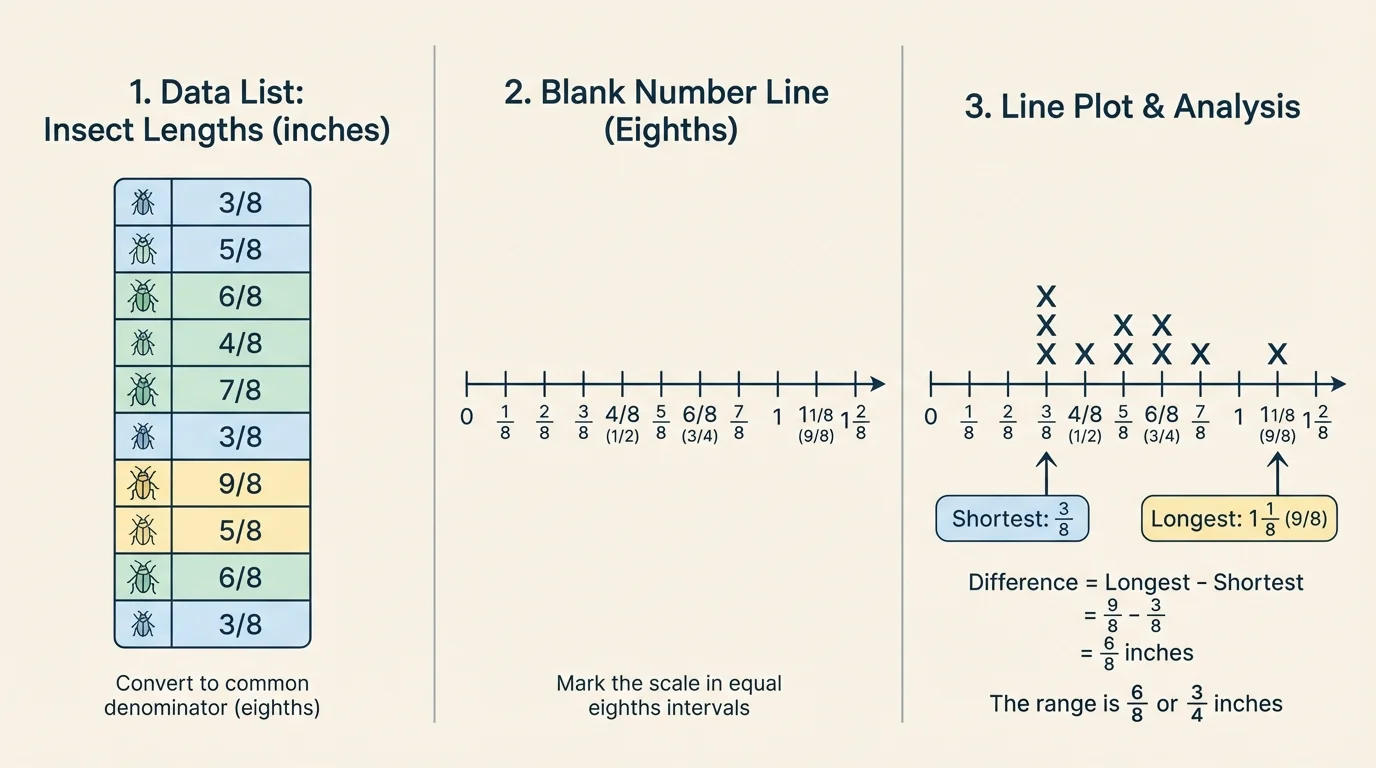
Here is the thinking process in words:
Step 1: Read the data set.
Step 2: Choose the smallest fraction parts needed, such as halves, fourths, or eighths.
Step 3: Draw a number line with equal intervals.
Step 4: Write the fraction labels in order.
Step 5: Put one X above each value in the data set.
Once the plot is complete, you have changed a list of numbers into a picture of the data. That picture makes patterns easier to notice than the list alone.
Solved example 1: Making a line plot
A class measures the lengths of crayons to the nearest fourth of a unit. The lengths are \(\dfrac{1}{4}, \dfrac{1}{2}, \dfrac{1}{4}, \dfrac{3}{4}, \dfrac{1}{2}, \dfrac{1}{2}\).
Step 1: Identify the fraction intervals needed.
The data uses fourths, so the number line should be marked in \(\dfrac{1}{4}\) units.
Step 2: List the values in order.
Possible marks are \(\dfrac{1}{4}, \dfrac{1}{2}, \dfrac{3}{4}\).
Step 3: Count how many times each value appears.
\(\dfrac{1}{4}\) appears \(2\) times, \(\dfrac{1}{2}\) appears \(3\) times, and \(\dfrac{3}{4}\) appears \(1\) time.
Step 4: Place the Xs.
Put \(2\) Xs above \(\dfrac{1}{4}\), \(3\) Xs above \(\dfrac{1}{2}\), and \(1\) X above \(\dfrac{3}{4}\).
The finished line plot shows that \(\dfrac{1}{2}\) unit is the most common crayon length.
The same method works for larger measurements too, including mixed numbers such as \(1\dfrac{1}{8}\).
Once the plot is made, you can answer many questions. You can find the total number of measurements by counting all the Xs. You can find how many objects have a certain measurement by counting the Xs above that number.
You can also compare values. If one measurement has more Xs than another, it appears more often. The measurement with the most Xs is sometimes called the most common measurement.
Looking back at [Figure 1], notice how the stacks of Xs make it easy to compare quantities without reading the whole data set again. That is one reason line plots are useful in science and everyday measurement.
| Question | What to do on the line plot |
|---|---|
| How many measurements are there? | Count all the Xs. |
| How many are \(\dfrac{3}{4}\) unit? | Count the Xs above \(\dfrac{3}{4}\). |
| What is the longest measurement? | Find the farthest X to the right. |
| What is the shortest measurement? | Find the farthest X to the left. |
| Which measurement happens most often? | Find the tallest stack of Xs. |
Table 1. Ways to answer common questions by reading a line plot.
Sometimes the question is not just about counting. Sometimes you must use the information to add or subtract fractions.
Addition problems on a line plot often ask for the total of certain measurements. You might need to combine the lengths of two or more objects or find the total length of all objects in one category.
When adding fractions, it helps if the fractions have the same denominator. If they do not, rename them using equivalent fractions first.
Using the plot to add repeated values
If a line plot shows several Xs above the same measurement, you can think of that as repeated addition. For example, three objects at \(\dfrac{1}{4}\) unit have a total length of \(\dfrac{1}{4} + \dfrac{1}{4} + \dfrac{1}{4} = \dfrac{3}{4}\) unit.
Suppose a line plot shows two shells measuring \(\dfrac{1}{2}\) inch and one shell measuring \(\dfrac{1}{4}\) inch. The total length of those three shells is:
\[\frac{1}{2} + \frac{1}{2} + \frac{1}{4} = 1 + \frac{1}{4} = 1\frac{1}{4}\]
Solved example 2: Adding measurements from a line plot
A line plot shows plant stem lengths. There are two stems at \(\dfrac{3}{8}\) unit and one stem at \(\dfrac{1}{8}\) unit. What is the total length of these three stems?
Step 1: Write the addition sentence.
\(\dfrac{3}{8} + \dfrac{3}{8} + \dfrac{1}{8}\)
Step 2: Add the numerators because the denominators are the same.
\(\dfrac{3}{8} + \dfrac{3}{8} + \dfrac{1}{8} = \dfrac{7}{8}\)
Step 3: State the result with the unit.
The total length is \(\dfrac{7}{8}\) unit.
The line plot helps because it tells exactly how many stems are at each length.
You can also add a group of measurements by counting how many Xs are above each value and then combining those amounts carefully.
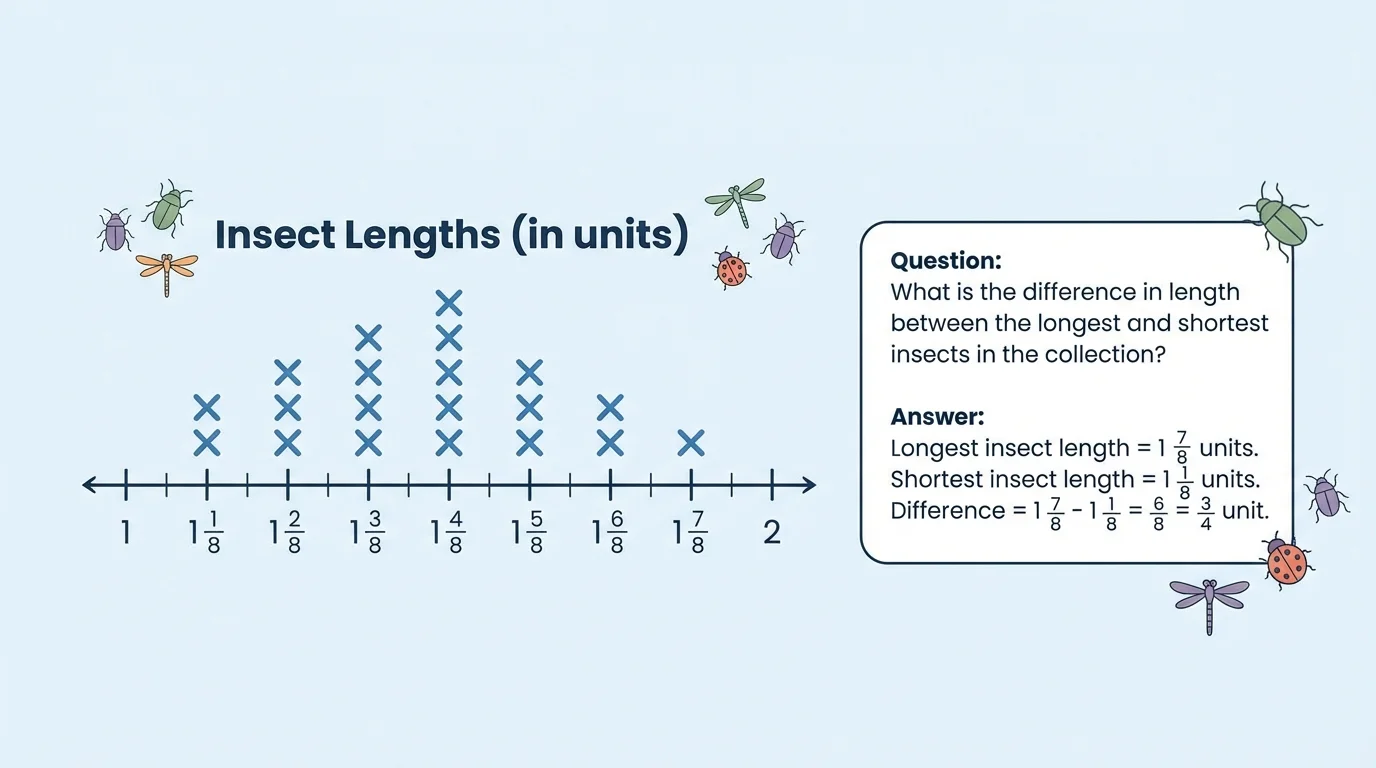
As [Figure 4] shows, subtraction on a line plot often means finding a difference. A difference tells how much longer one measurement is than another. One important comparison is the distance between the longest and shortest values shown with insect lengths.
To find that difference, identify the greatest measurement and the least measurement. Then subtract the smaller fraction from the larger one.
If the denominators are already the same, subtract the numerators. For example:
\[\frac{7}{8} - \frac{3}{8} = \frac{4}{8} = \frac{1}{2}\]
If the denominators are different, rename the fractions first. For example, to subtract \(\dfrac{3}{4} - \dfrac{1}{2}\), rename \(\dfrac{1}{2}\) as \(\dfrac{2}{4}\):
\[\frac{3}{4} - \frac{2}{4} = \frac{1}{4}\]
Solved example 3: Difference between longest and shortest insect specimens
An insect collection line plot shows that the shortest insect is \(1\dfrac{1}{8}\) inches long and the longest insect is \(1\dfrac{7}{8}\) inches long. Find the difference in length.
Step 1: Write the subtraction sentence.
\(1\dfrac{7}{8} - 1\dfrac{1}{8}\)
Step 2: Subtract the whole numbers and fractions.
The whole numbers are both \(1\), so they cancel. Then subtract the fractional parts: \(\dfrac{7}{8} - \dfrac{1}{8} = \dfrac{6}{8}\).
Step 3: Simplify if possible.
\(\dfrac{6}{8} = \dfrac{3}{4}\)
The difference in length is \(\dfrac{3}{4}\) inch.
Later, when you compare two stacks or two single values, think of subtraction as finding the space between them on the number line. That idea connects directly to what you saw earlier with fraction spacing in [Figure 2].
Not all measurements are less than \(1\). Many real data sets include mixed numbers such as \(1\dfrac{1}{4}\), \(1\dfrac{1}{2}\), or \(2\dfrac{3}{8}\). These belong on the number line just after the whole number and before the next whole number.
For example, \(1\dfrac{1}{4}\) is greater than \(1\) but less than \(1\dfrac{1}{2}\). If a line plot is marked in fourths, then the points after \(1\) are \(1\dfrac{1}{4}\), \(1\dfrac{1}{2}\), \(1\dfrac{3}{4}\), and then \(2\).
If the line plot uses eighths, then there are more points between whole numbers. This gives more exact measurement choices. That is why a scientist measuring insects or seeds may prefer eighths instead of fourths.
Solved example 4: Adding mixed-number measurements
Two twigs on a line plot measure \(1\dfrac{1}{4}\) units and \(1\dfrac{3}{4}\) units. What is their total length?
Step 1: Add the whole numbers.
\(1 + 1 = 2\)
Step 2: Add the fractions.
\(\dfrac{1}{4} + \dfrac{3}{4} = \dfrac{4}{4} = 1\)
Step 3: Combine the sums.
\(2 + 1 = 3\)
The total length is \(3\) units.
Mixed numbers on a line plot follow the same rules as smaller fractions. The only change is that you must also pay attention to the whole-number part.
Line plots are useful in many real-world situations. In science, students may measure plant growth, seed length, or insect body size. In art or crafts, they might measure ribbon pieces or strips of paper. In cooking, they might measure pieces of cut vegetables. In sports, they might record jump distances or throwing distances to the nearest fraction of a unit.
Because line plots organize data clearly, they help people make decisions. A gardener can see which plant height is most common. A scientist can compare shortest and longest specimens. A student can quickly find the total length of several pieces by using the measurements on the plot.
Scientists often collect many measurements that are very close together. Small fractional differences, such as \(\dfrac{1}{8}\) of an inch, can matter when they compare living things, materials, or test results.
When data is displayed well, the math becomes easier to think about. That is exactly what line plots do.
One common mistake is making the number line with unequal spaces. If \(\dfrac{1}{4}\) and \(\dfrac{1}{2}\) are close together but \(\dfrac{1}{2}\) and \(\dfrac{3}{4}\) are far apart, the line plot is not correct.
Another mistake is forgetting to choose small enough intervals. If your data includes \(\dfrac{1}{8}\), a line marked only in halves will not be precise enough. A better choice is eighths.
Students also sometimes miscount the Xs. Remember that each X stands for one measurement. Count carefully.
When solving subtraction problems, be careful to subtract the smaller measurement from the larger one when finding a difference. And when denominators are different, rename the fractions first so the parts match.
As you saw earlier in [Figure 4], finding the distance between the shortest and longest measurements is really a subtraction problem on the same fraction scale.
"Good graphs help us see what numbers are trying to tell us."
When you build and read line plots carefully, you are doing more than drawing Xs. You are organizing data, understanding measurements, and using fraction operations to answer meaningful questions.
