How can one pizza example have two correct answers? If you eat half a pizza, someone might say you ate \(\dfrac{1}{2}\) of it. But if the pizza was cut into four equal slices and you ate two of them, they might say you ate \(\dfrac{2}{4}\). Both are true. That is one of the coolest ideas in fractions: the numbers can look different, but the amount can stay exactly the same.
A fraction names part of a whole or part of a set. In a fraction like \(\dfrac{3}{5}\), the top number is the numerator. It tells how many parts we are talking about. The bottom number is the denominator. It tells how many equal parts the whole is divided into.
Equivalent fractions are fractions that have the same value, even though they use different numbers. For example, \(\dfrac{1}{2}\), \(\dfrac{2}{4}\), and \(\dfrac{4}{8}\) are all equivalent because they name the same amount of a whole.
To understand equivalent fractions well, it helps to think about two things at the same time. First, ask, "How many parts are there?" Second, ask, "How big is each part?" As [Figure 1] helps show, if a whole is cut into more equal parts, each part must become smaller. If a whole is cut into fewer equal parts, each part is larger.
That is why fractions can change their numerators and denominators but still stay equal. The number of parts changes, and the size of each part changes too. These changes balance each other.
Suppose we start with \(\dfrac{1}{2}\). A rectangle model helps us see that if one whole rectangle is divided into \(2\) equal parts and \(1\) part is shaded, then half the rectangle is shaded. If we split each of those halves into \(2\) smaller equal parts, the same whole is now divided into \(4\) equal parts, and \(2\) of those parts are shaded. The shaded amount has not changed.
So \(\dfrac{1}{2}\) and \(\dfrac{2}{4}\) are equal. We made this new fraction by multiplying both the numerator and denominator by \(2\): \(1 \times 2 = 2\) and \(2 \times 2 = 4\).
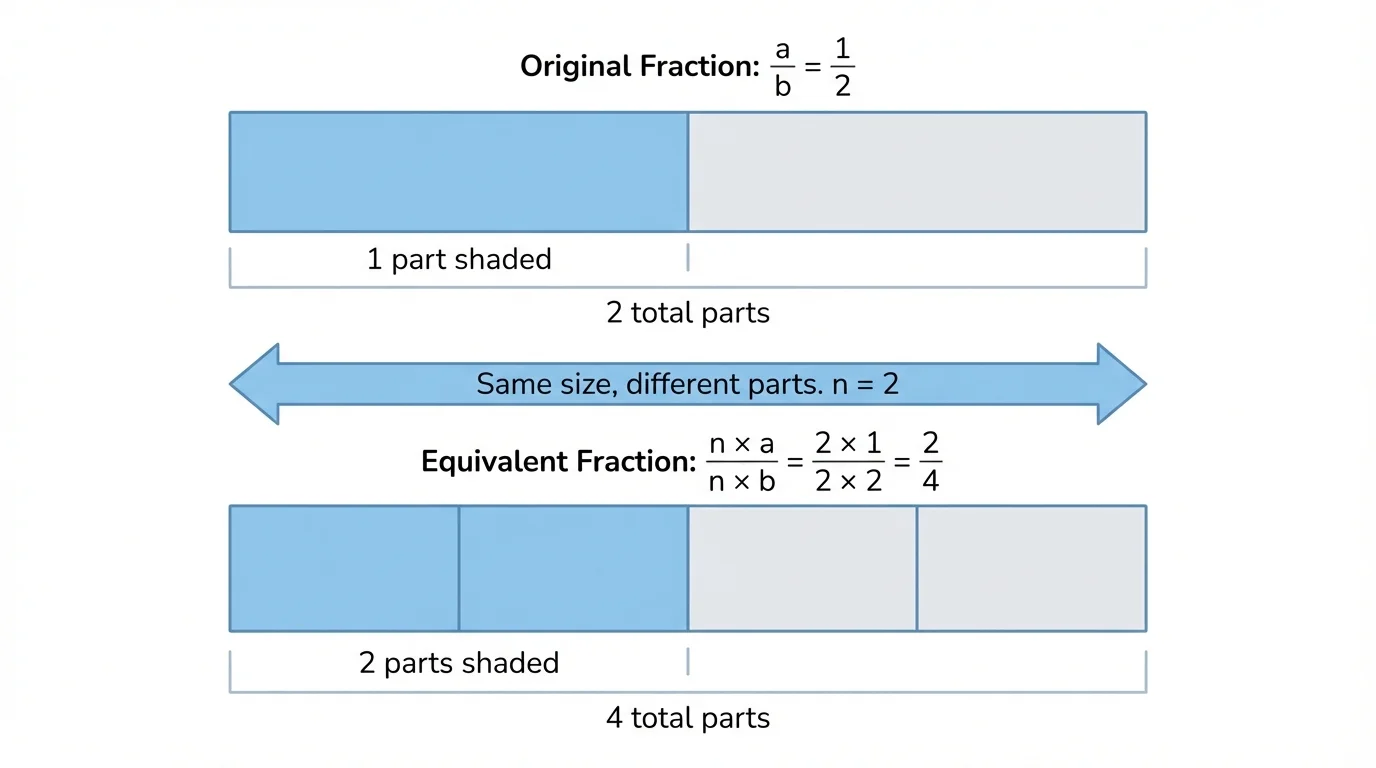
This works in general. If we have any fraction \(\dfrac{a}{b}\) and multiply both top and bottom by the same nonzero number \(n\), we get
\[\frac{a}{b} = \frac{n \times a}{n \times b}\]
Why? Because each original part is being split into \(n\) smaller equal parts. That makes the total number of parts \(n\) times larger, and it also makes the number of shaded parts \(n\) times larger. But the whole amount stays the same.
Same whole, finer partition
Equivalent fractions happen when the same whole is divided in a different way. The whole does not get bigger or smaller. Instead, the equal parts become smaller, so there are more of them. If the number of shaded parts changes in the same way, the fraction still names the same amount.
Think of a chocolate bar. As [Figure 2] helps illustrate, if \(\dfrac{3}{4}\) of the bar is eaten, and then each fourth is split into \(2\) equal pieces, the bar now has \(8\) equal parts. The amount eaten is \(6\) of those \(8\) pieces, so \(\dfrac{3}{4} = \dfrac{6}{8}\).
Students sometimes notice only one change. They see that \(\dfrac{2}{3}\) becomes \(\dfrac{4}{6}\), and they think, "There are more pieces now." That is true, but it is only half the story. The strips show the other important idea: each piece is now smaller.
When the denominator gets larger, the whole is divided into more equal parts. More equal parts means each part is smaller. So sixths are smaller than thirds, because \(6\) equal parts are smaller than \(3\) equal parts of the same whole.
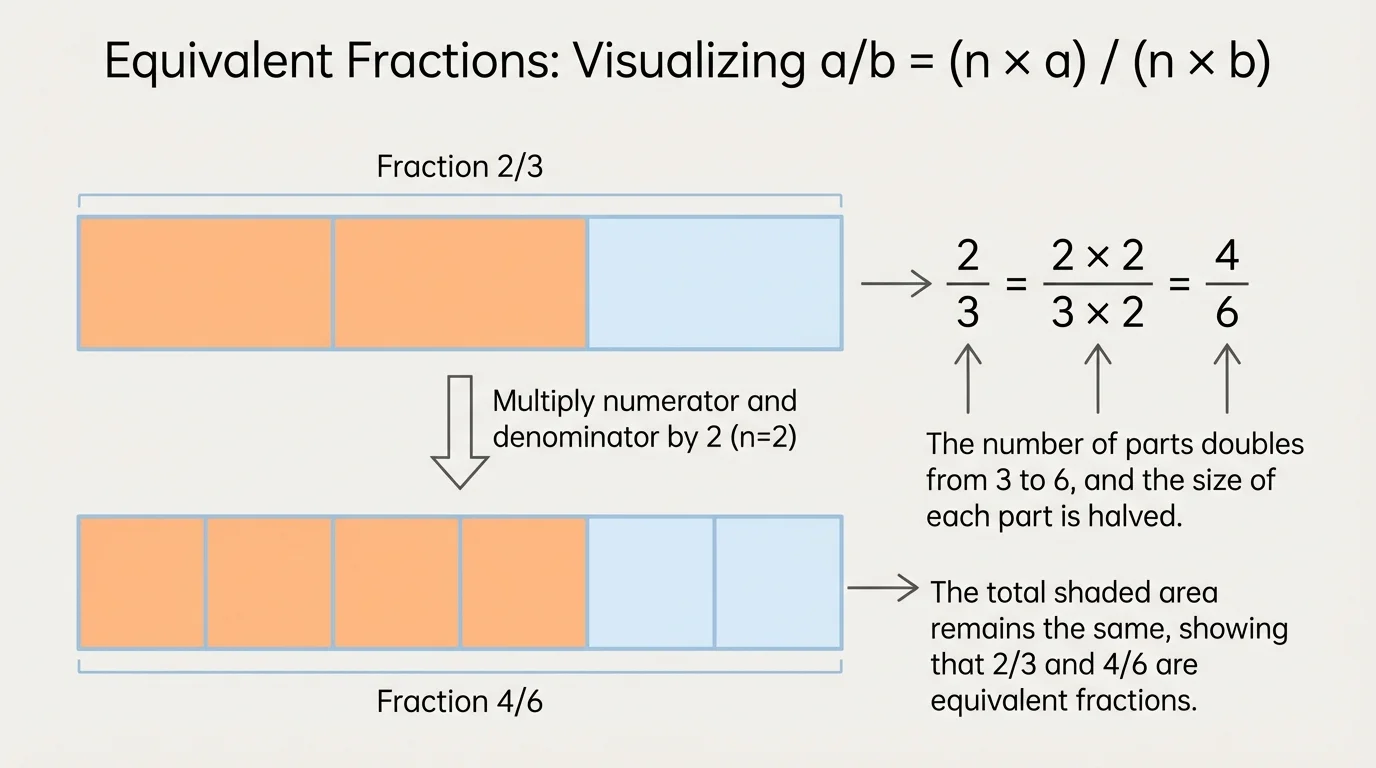
Now compare \(\dfrac{2}{3}\) and \(\dfrac{4}{6}\). The second fraction has more shaded parts, but each part is smaller. Those changes match perfectly, so the total shaded amount stays the same.
This is a very important way to talk about equivalent fractions:
The same idea works again if we multiply by \(3\). For example, \(\dfrac{1}{3} = \dfrac{3}{9}\). Ninths are smaller than thirds, but there are \(3\) times as many parts counted.
A fraction can have many equivalent names. The fraction \(\dfrac{1}{2}\) can also be written as \(\dfrac{2}{4}\), \(\dfrac{3}{6}\), \(\dfrac{4}{8}\), \(\dfrac{5}{10}\), and many more. They all describe the same amount.
That is why equivalent fractions are sometimes described as a set of equivalent fractions. The fractions look different, but they belong together because they are equal.
A fraction model is a picture or object that helps us see a fraction. Area models, strip models, and set models all help show equivalence when a set is regrouped into smaller equal parts.
Area models use shapes such as rectangles or circles. If the same whole shape is partitioned in different ways, you can compare the shaded areas. Equal shaded area means equivalent fractions.
Strip models use bars of equal length. These are useful because you can line up the strips and compare how much of each strip is shaded.
Set models use groups of objects. As [Figure 3] shows, if \(3\) of \(4\) equal groups are selected, and then each group is split into \(2\) equal smaller groups, the same amount becomes \(6\) of \(8\) smaller groups.
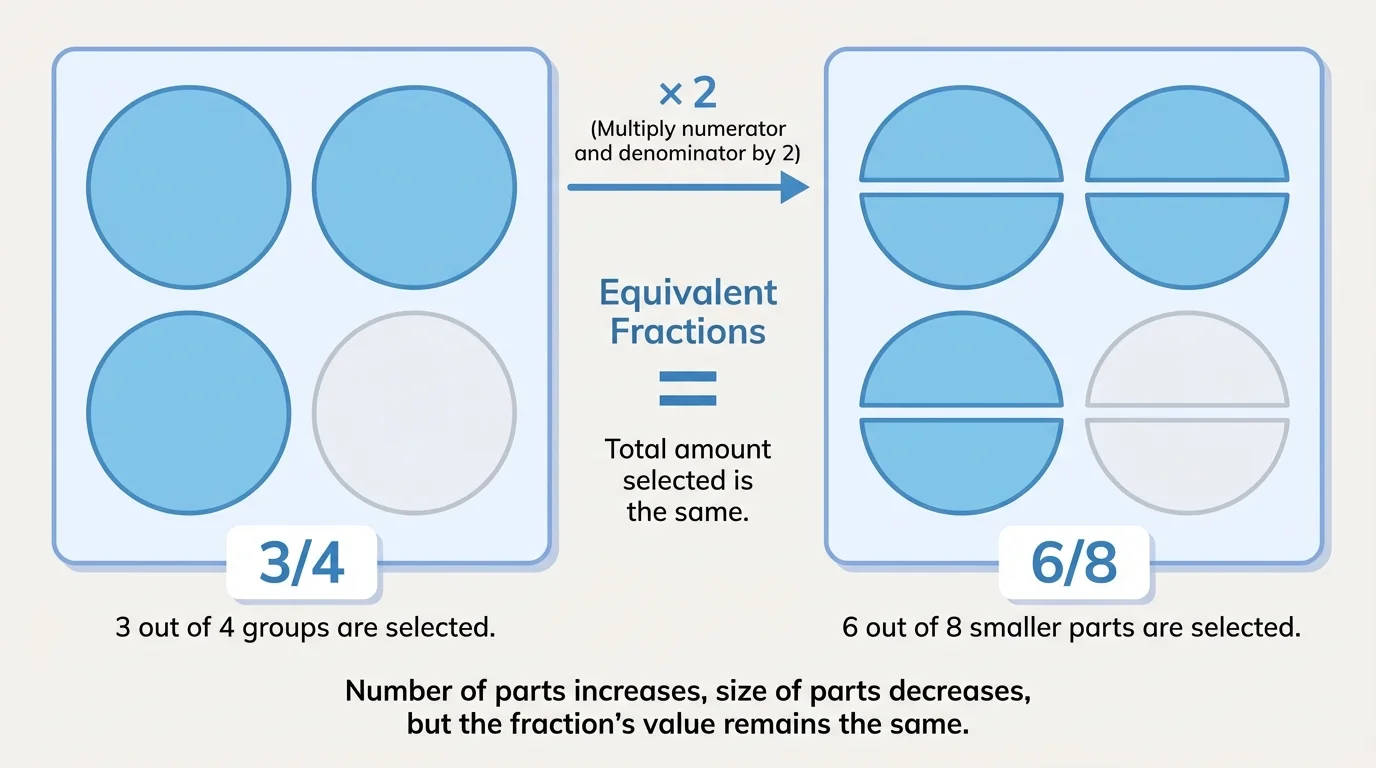
With any model, the key question is not just "How many parts are shaded?" The key question is "What fraction of the same whole is shaded?" Two fractions can be equivalent only when they describe the same whole.
For example, \(\dfrac{1}{2}\) of a small cookie is not equal to \(\dfrac{1}{2}\) of a giant cake. The fractions match, but the wholes are different sizes. When we talk about equivalent fractions, we must keep the whole the same size.
Before working with equivalent fractions, remember that the denominator tells how many equal parts make one whole. The parts must be equal. If parts are not equal, the picture does not correctly show the fraction.
That reminder matters because a badly drawn model can confuse us. A correct fraction model always uses equal parts of the same whole.
Now let's use multiplication and visual thinking together to recognize and generate equivalent fractions.
Example 1: Generate an equivalent fraction for \(\dfrac{1}{3}\)
Step 1: Choose a number to multiply by.
Use \(2\).
Step 2: Multiply the numerator and denominator by the same number.
\(1 \times 2 = 2\) and \(3 \times 2 = 6\).
Step 3: Write the new fraction.
\[\frac{1}{3} = \frac{2}{6}\]
Visual meaning: each third is split into \(2\) equal smaller parts, so \(1\) shaded third becomes \(2\) shaded sixths.
This example shows the basic rule clearly: multiply both numbers by the same number.
Example 2: Decide whether \(\dfrac{2}{5}\) and \(\dfrac{6}{15}\) are equivalent
Step 1: Look for the multiplication pattern.
From \(2\) to \(6\) is multiplying by \(3\).
Step 2: Check the denominator.
From \(5\) to \(15\) is also multiplying by \(3\).
Step 3: Decide.
Because both numerator and denominator were multiplied by \(3\), the fractions are equivalent.
\[\frac{2}{5} = \frac{6}{15}\]
A model would show the same whole cut into smaller equal parts, with the same total amount shaded.
This is a quick way to check fractions when you can spot the multiplication fact.
Example 3: Find a missing numerator
Complete the equivalent fraction: \(\dfrac{3}{4} = \dfrac{?}{8}\)
Step 1: Ask how the denominator changed.
\(4 \times 2 = 8\), so the denominator was multiplied by \(2\).
Step 2: Multiply the numerator by the same number.
\(3 \times 2 = 6\).
Step 3: Write the completed fraction.
\[\frac{3}{4} = \frac{6}{8}\]
Visual meaning: each fourth is split into \(2\) equal parts, so \(3\) fourths become \(6\) eighths.
Matching the multiplier in the denominator and numerator is what keeps the value the same.
Example 4: Generate more than one equivalent fraction
Start with \(\dfrac{2}{3}\).
Step 1: Multiply by \(2\).
\(\dfrac{2}{3} = \dfrac{4}{6}\)
Step 2: Multiply by \(3\).
\(\dfrac{2}{3} = \dfrac{6}{9}\)
Step 3: Multiply by \(4\).
\(\dfrac{2}{3} = \dfrac{8}{12}\)
These are all fractions in the same set of equivalent fractions.
As we saw earlier in [Figure 2], each new fraction uses more parts, but those parts are smaller, so the amount does not change.
A equivalent fraction can often be recognized in two ways: by a model or by number patterns.
With a model, ask whether the same amount of the same whole is shaded. If yes, the fractions are equivalent.
With numbers, ask whether the numerator and denominator were both multiplied by the same number. For example, \(\dfrac{4}{7} = \dfrac{12}{21}\) because \(4 \times 3 = 12\) and \(7 \times 3 = 21\).
If only one number changes by multiplication, the fractions are not equivalent. For example, \(\dfrac{1}{4}\) is not equal to \(\dfrac{1}{8}\). The denominator doubled, but the numerator did not. Also, eighths are smaller than fourths, so the amount changed.
| Starting fraction | Multiply by | Equivalent fraction |
|---|---|---|
| \(\dfrac{1}{2}\) | \(2\) | \(\dfrac{2}{4}\) |
| \(\dfrac{1}{2}\) | \(3\) | \(\dfrac{3}{6}\) |
| \(\dfrac{2}{3}\) | \(2\) | \(\dfrac{4}{6}\) |
| \(\dfrac{3}{5}\) | \(4\) | \(\dfrac{12}{20}\) |
| \(\dfrac{4}{9}\) | \(3\) | \(\dfrac{12}{27}\) |
Table 1. Examples showing how equivalent fractions are generated by multiplying numerator and denominator by the same number.
When you use models, the same idea appears again and again. The set model in [Figure 3] makes it easy to see that regrouping into smaller equal parts changes the count but not the fraction's value.
As [Figure 4] shows, equivalent fractions appear in recipes, measuring, and sharing food with a measuring cup. A recipe might call for \(\dfrac{1}{2}\) cup of milk, but if you only have a \(\dfrac{1}{4}\)-cup scoop, you can pour it twice. That works because \(\dfrac{1}{2} = \dfrac{2}{4}\).
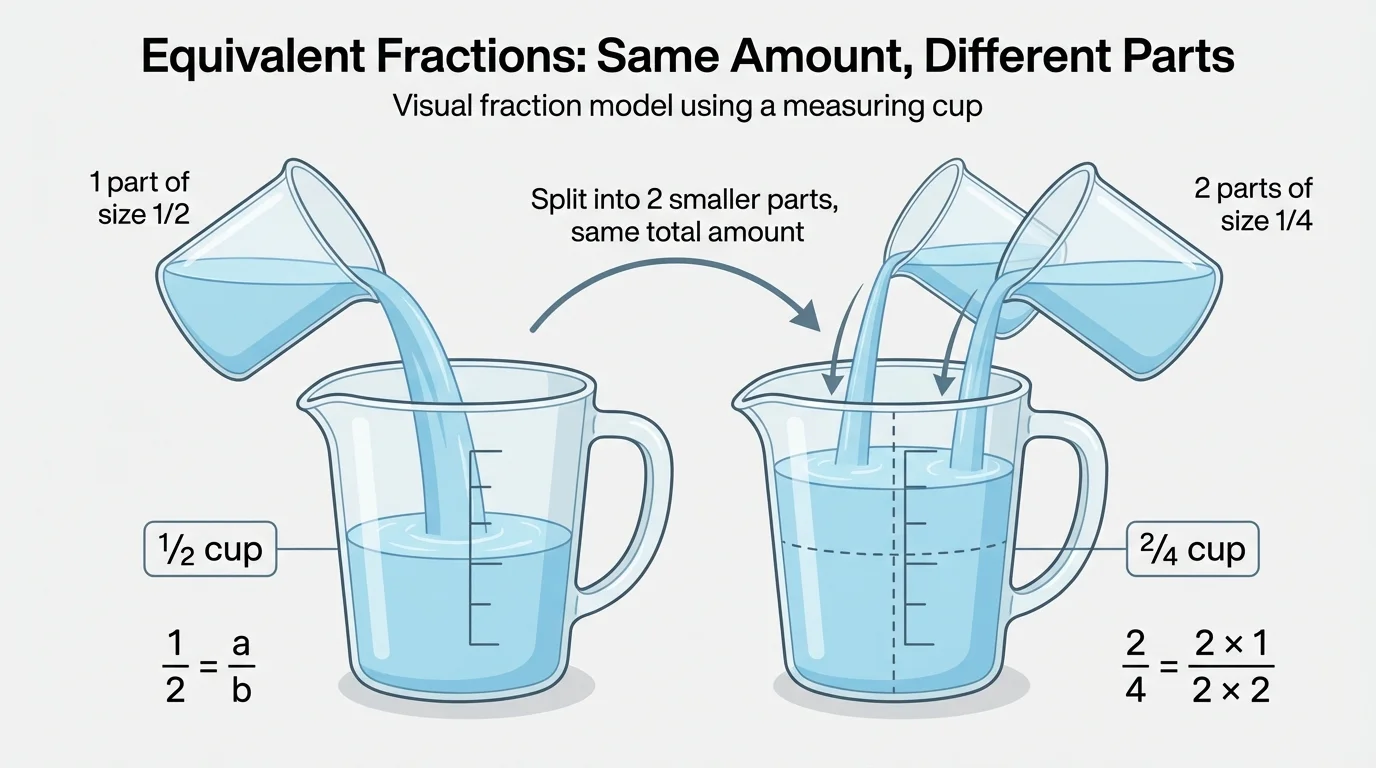
If three friends share the same granola bar equally, one friend gets \(\dfrac{1}{3}\). If each third is broken into \(2\) smaller pieces, that same share is \(\dfrac{2}{6}\). The amount is unchanged, even though the pieces look different.
On a sports team, drinking \(\dfrac{2}{3}\) of a water bottle is the same as drinking \(\dfrac{4}{6}\) of the bottle, if the bottle is marked in sixths instead of thirds. The markings changed. The amount of water did not.
Why equivalent fractions matter in real life
People often divide things in different ways depending on the tool they have. A pizza may be cut into \(4\), \(6\), or \(8\) slices. Measuring cups may use halves, thirds, or fourths. Equivalent fractions let us describe the same amount correctly even when the partitions are different.
Later, equivalent fractions also help with comparing fractions, adding fractions, and understanding decimals. They are a building block for many other math ideas.
One mistake is adding the same number to the numerator and denominator. For example, starting with \(\dfrac{1}{2}\) and adding \(1\) to both gives \(\dfrac{2}{3}\). But \(\dfrac{2}{3}\) is not equal to \(\dfrac{1}{2}\). Equivalent fractions come from multiplying or dividing both numbers by the same nonzero number, not adding.
Another mistake is changing only the numerator or only the denominator. If you change one without changing the other in the same way, the fraction value changes.
A third mistake is forgetting about the whole. Fractions can only be called equivalent when they describe the same-sized whole divided into equal parts.
"More pieces does not mean more pizza if the whole pizza stays the same size."
That sentence is simple, but it captures the heart of equivalent fractions. More pieces usually means smaller pieces.
You can create many equivalent fractions from one starting fraction. Start with \(\dfrac{5}{6}\). Multiply by \(2\), \(3\), and \(4\): \(\dfrac{10}{12}\), \(\dfrac{15}{18}\), and \(\dfrac{20}{24}\). All of these fractions are equal to \(\dfrac{5}{6}\).
Here is the pattern written clearly:
\[\frac{5}{6} = \frac{10}{12} = \frac{15}{18} = \frac{20}{24}\]
This pattern works for any fraction as long as you multiply the numerator and denominator by the same nonzero number. It is one of the most powerful ideas in the study of fractions because it lets you rename fractions without changing their size.
When you look back at [Figure 1] and [Figure 4], the same principle appears in both pictures: whether you split a shape more finely or measure with smaller scoops, the amount stays the same when both parts of the fraction change together.
