Which is more: \(\dfrac{2}{3}\) of a pizza or \(\dfrac{3}{5}\) of a pizza? At first, that question may seem tricky because both the numerators and denominators are different. But mathematicians have smart ways to compare fractions. Once you learn them, you can decide which fraction is greater, smaller, or equal, and you can explain why.
Comparing fractions matters in everyday life. You might compare how much juice is left in two bottles, how much of a race is finished, or how much of a chocolate bar two people ate. Fractions help us describe parts of a whole, and comparison helps us decide which amount is larger.
When we compare whole numbers, it is usually easy to see that \(8 > 5\). Fractions are different because the pieces may not be the same size. In \(\dfrac{1}{2}\), the whole is cut into \(2\) equal parts. In \(\dfrac{1}{6}\), the whole is cut into \(6\) equal parts. That means the size of each part changes depending on the denominator.
This is why fraction comparison is about more than just looking at the top number or the bottom number. We need to think about both numbers together and about the size of the whole.
There is one very important rule: fractions can be compared fairly only when they refer to the same whole. If one person eats \(\dfrac{1}{2}\) of a small sandwich and another person eats \(\dfrac{1}{3}\) of a giant sandwich, we cannot automatically say that \(\dfrac{1}{2}\) is more food unless the sandwiches are the same size.
If two fractions describe parts of equal-size wholes, then the comparison is valid. If the wholes are different sizes, the comparison may not tell us which amount is really bigger.
Same whole, fair comparison
A fraction tells how many equal parts are being considered out of all the equal parts in one whole. Because of that, a comparison like \(\dfrac{3}{4} > \dfrac{2}{3}\) only makes sense if both fractions describe parts of the same-size whole.
Always ask yourself: Are these fractions talking about the same whole? That question helps prevent mistakes.
The numerator is the top number in a fraction. It tells how many parts we have. The denominator is the bottom number. It tells how many equal parts the whole is divided into.
For example, in \(\dfrac{3}{4}\), the numerator is \(3\), so we have \(3\) parts. The denominator is \(4\), so the whole is divided into \(4\) equal parts.
You already know that equal fractions can look different. For example, \(\dfrac{1}{2} = \dfrac{2}{4} = \dfrac{4}{8}\). These are called equivalent fractions, and they are very useful for comparing fractions.
[Figure 1] Equivalent fractions name the same amount, even though they use different numbers. We will use that idea often.
A visual fraction model helps you see the size of fractions. If two bars are the same length, then the shaded parts can be compared directly.
Suppose we compare \(\dfrac{2}{3}\) and \(\dfrac{3}{5}\). Draw two equal-length bars. Divide one bar into \(3\) equal parts and shade \(2\). Divide the other bar into \(5\) equal parts and shade \(3\). When the wholes are the same size, the model shows that \(\dfrac{2}{3}\) is greater than \(\dfrac{3}{5}\).
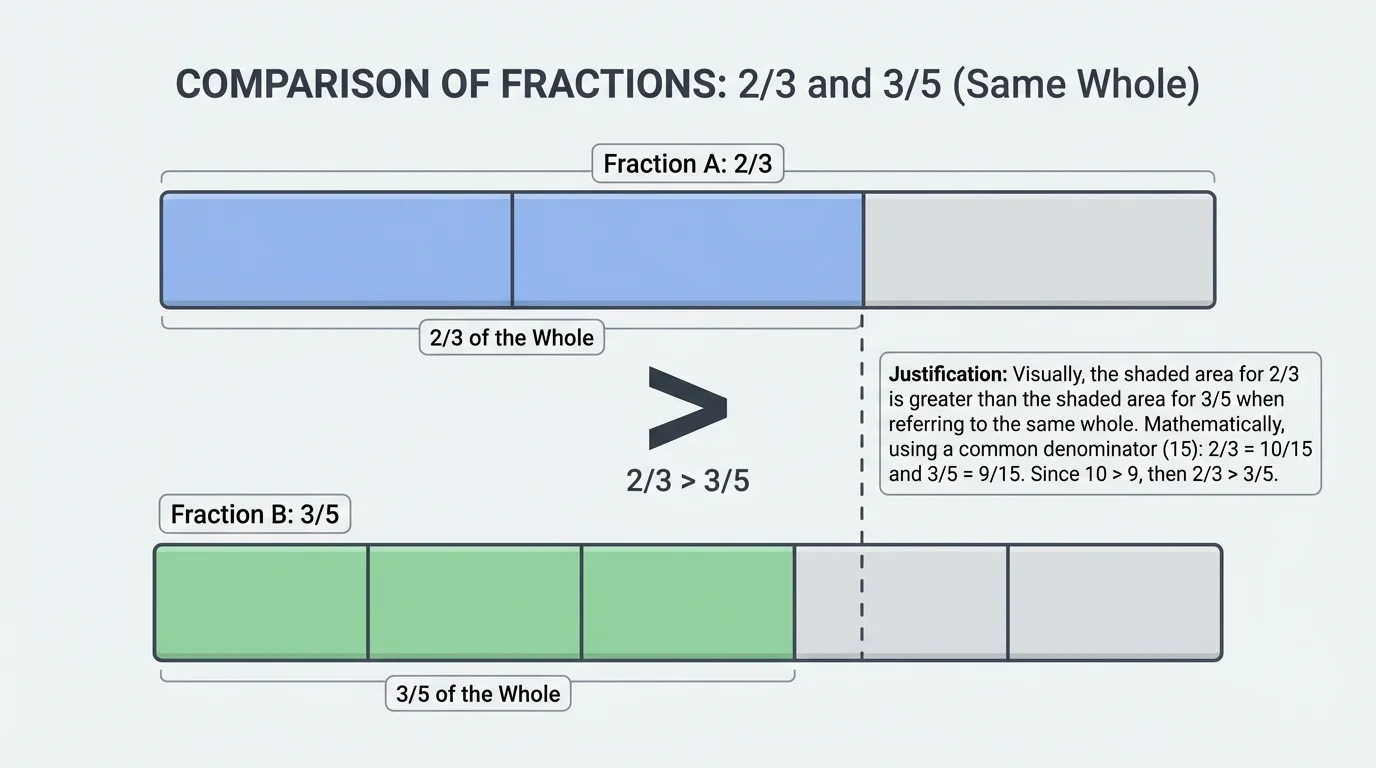
Visual models are powerful because they show that fractions represent quantities. We do not just compare digits. We compare the amount each fraction represents.
Later, when you work without a drawing, you can still imagine the bars from [Figure 1]. That mental picture helps you remember that \(\dfrac{2}{3}\) covers more of the whole than \(\dfrac{3}{5}\).
[Figure 2] A benchmark fraction is a fraction you know well and can use to compare other fractions. One very useful benchmark is \(\dfrac{1}{2}\). Fraction strips make it easier to see whether a fraction is less than, equal to, or greater than one-half.
To compare a fraction to \(\dfrac{1}{2}\), ask whether the numerator is less than, equal to, or greater than half of the denominator. For example, in \(\dfrac{3}{8}\), half of \(8\) is \(4\). Since \(3 < 4\), \(\dfrac{3}{8} < \dfrac{1}{2}\). In \(\dfrac{5}{9}\), half of \(9\) is \(4.5\). Since \(5 > 4.5\), \(\dfrac{5}{9} > \dfrac{1}{2}\).
If one fraction is less than \(\dfrac{1}{2}\) and another is greater than \(\dfrac{1}{2}\), then you can compare them right away. Since \(\dfrac{3}{8} < \dfrac{1}{2}\) and \(\dfrac{5}{9} > \dfrac{1}{2}\), we know that \(\dfrac{3}{8} < \dfrac{5}{9}\).
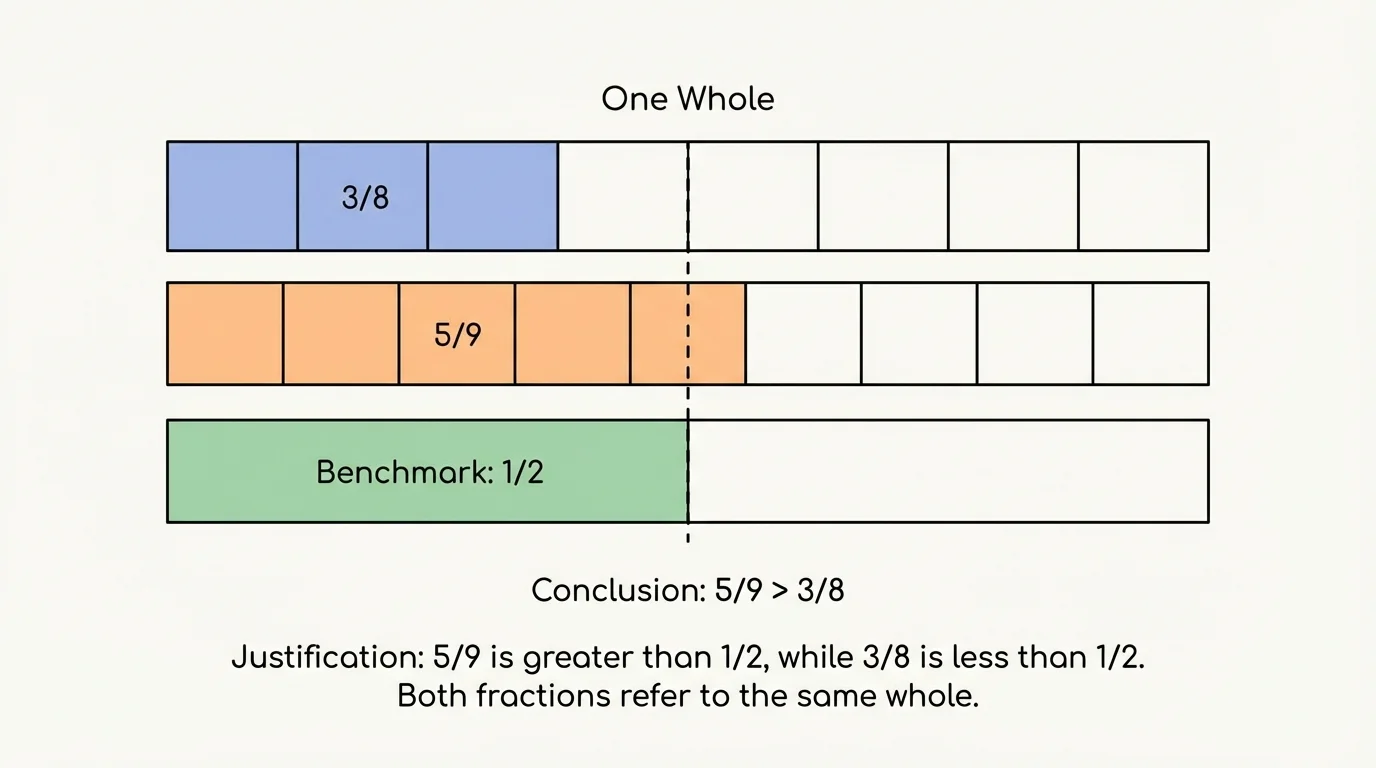
Benchmarks save time. You do not always need to make common denominators if a quick comparison to \(\dfrac{1}{2}\) or even to \(1\) gives the answer.
Fractions very close to \(\dfrac{1}{2}\) can be tricky, which is why benchmarks are so useful. A tiny difference above or below one-half can decide which fraction is greater.
For example, \(\dfrac{4}{7}\) is a little more than \(\dfrac{1}{2}\), because half of \(7\) is \(3.5\), and \(4 > 3.5\). But \(\dfrac{5}{11}\) is a little less than \(\dfrac{1}{2}\), because half of \(11\) is \(5.5\), and \(5 < 5.5\). So \(\dfrac{4}{7} > \dfrac{5}{11}\).
[Figure 3] Another effective method is to rename fractions as equivalent fractions with the same denominator. Once the parts are the same size, comparison becomes much easier.
Suppose we compare \(\dfrac{3}{4}\) and \(\dfrac{5}{6}\). The denominators are \(4\) and \(6\), so the parts are different sizes. We can change both fractions into twelfths because \(12\) is a common denominator.
We rename \(\dfrac{3}{4}\) as \(\dfrac{9}{12}\) by multiplying the numerator and denominator by \(3\). We rename \(\dfrac{5}{6}\) as \(\dfrac{10}{12}\) by multiplying the numerator and denominator by \(2\). Now we compare \(\dfrac{9}{12}\) and \(\dfrac{10}{12}\). Since \(9 < 10\), we know that \(\dfrac{3}{4} < \dfrac{5}{6}\).
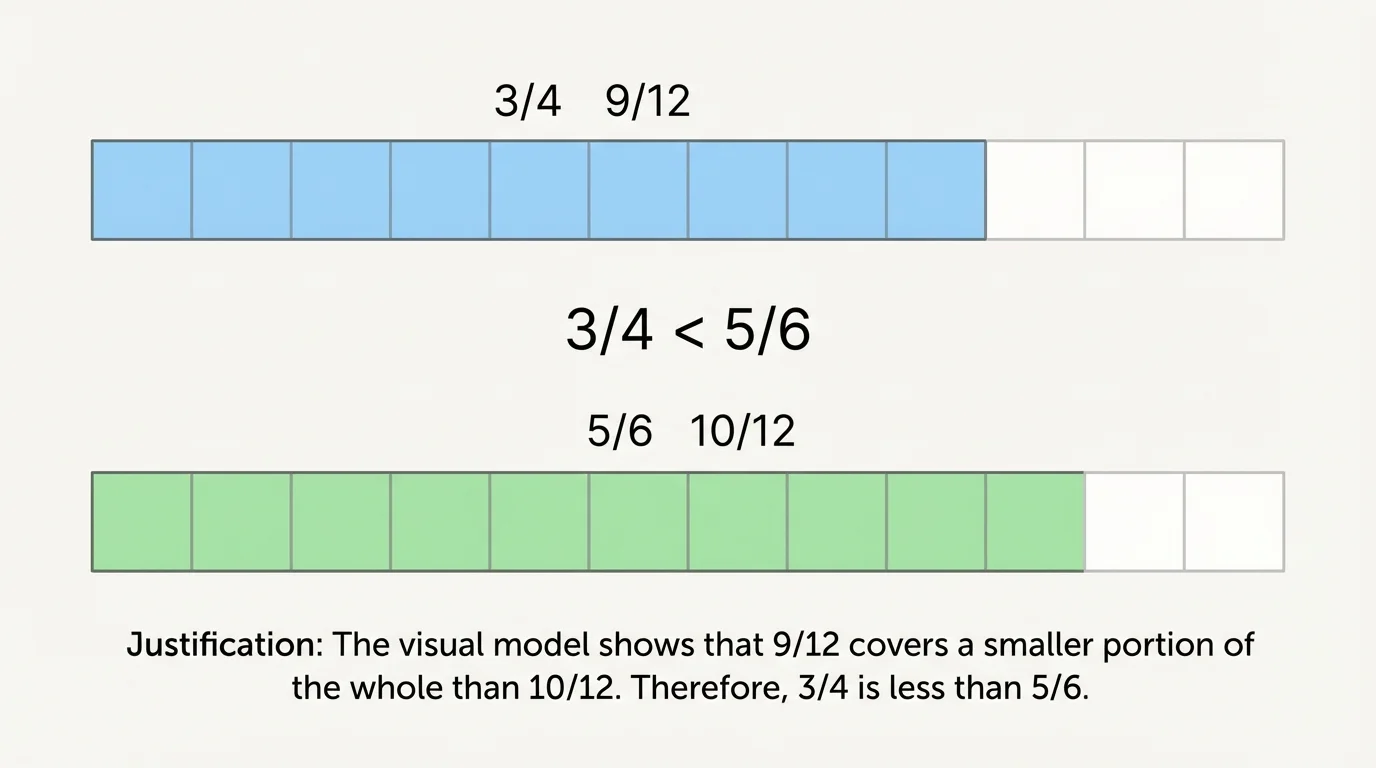
This method works because equivalent fractions name the same amount. We are not changing the value. We are only changing the way the fraction is written.
The image in [Figure 3] also helps explain why common denominators are useful: both fractions are shown in twelfths, so each shaded piece is the same size.
Sometimes it is easier to make the numerators the same instead of the denominators. When two fractions have the same numerator, the fraction with the smaller denominator is greater, because the whole has been cut into fewer pieces, so each piece is larger.
Compare \(\dfrac{3}{4}\) and \(\dfrac{3}{5}\). Both have the numerator \(3\). Since fourths are larger pieces than fifths, \(\dfrac{3}{4} > \dfrac{3}{5}\).
We can also create common numerators. Compare \(\dfrac{2}{3}\) and \(\dfrac{3}{5}\). A common multiple of the numerators is \(6\). Rename \(\dfrac{2}{3}\) as \(\dfrac{6}{9}\) and rename \(\dfrac{3}{5}\) as \(\dfrac{6}{10}\). Now both fractions have numerator \(6\). Since ninths are larger than tenths, \(\dfrac{6}{9} > \dfrac{6}{10}\), so \(\dfrac{2}{3} > \dfrac{3}{5}\).
When you compare fractions, record the result with a symbol: \(>\), \(<\), or \(=\).
Examples: \(\dfrac{2}{3} > \dfrac{3}{5}\), \(\dfrac{3}{8} < \dfrac{1}{2}\), and \(\dfrac{2}{4} = \dfrac{1}{2}\).
A good mathematical answer also includes a reason. You might say:
Worked example 1
Compare \(\dfrac{3}{8}\) and \(\dfrac{5}{9}\) using a benchmark fraction.
Step 1: Compare each fraction to \(\dfrac{1}{2}\).
Half of \(8\) is \(4\). Since \(3 < 4\), \(\dfrac{3}{8} < \dfrac{1}{2}\).
Half of \(9\) is \(4.5\). Since \(5 > 4.5\), \(\dfrac{5}{9} > \dfrac{1}{2}\).
Step 2: Use those comparisons.
One fraction is less than \(\dfrac{1}{2}\), and the other is greater than \(\dfrac{1}{2}\).
\[\frac{3}{8} < \frac{5}{9}\]
The comparison is justified by the benchmark \(\dfrac{1}{2}\).
Benchmark fractions are especially useful when the answer becomes clear quickly.
Worked example 2
Compare \(\dfrac{3}{4}\) and \(\dfrac{5}{6}\) by making common denominators.
Step 1: Find a common denominator.
A common denominator for \(4\) and \(6\) is \(12\).
Step 2: Rename each fraction.
\(\dfrac{3}{4} = \dfrac{9}{12}\) and \(\dfrac{5}{6} = \dfrac{10}{12}\).
Step 3: Compare the numerators.
Since \(9 < 10\), \(\dfrac{9}{12} < \dfrac{10}{12}\).
\[\frac{3}{4} < \frac{5}{6}\]
This works because both fractions are now written in twelfths.
When denominators are the same, comparing fractions is like comparing how many equal-size pieces are shaded.
Worked example 3
Compare \(\dfrac{2}{3}\) and \(\dfrac{3}{5}\) by making common numerators.
Step 1: Find a common numerator.
A common multiple of \(2\) and \(3\) is \(6\).
Step 2: Rename each fraction.
\(\dfrac{2}{3} = \dfrac{6}{9}\) and \(\dfrac{3}{5} = \dfrac{6}{10}\).
Step 3: Compare the denominators.
With the same numerator, the fraction with the smaller denominator is greater. Since \(9 < 10\), \(\dfrac{6}{9} > \dfrac{6}{10}\).
\[\frac{2}{3} > \frac{3}{5}\]
This matches what the visual model shows in [Figure 1].
Different methods can lead to the same correct answer. That is a sign that your reasoning is strong.
Worked example 4
Compare \(\dfrac{4}{7}\) and \(\dfrac{5}{8}\).
Step 1: Use common denominators.
A common denominator for \(7\) and \(8\) is \(56\).
Step 2: Rename the fractions.
\(\dfrac{4}{7} = \dfrac{32}{56}\) and \(\dfrac{5}{8} = \dfrac{35}{56}\).
Step 3: Compare.
Since \(32 < 35\), \(\dfrac{32}{56} < \dfrac{35}{56}\).
\[\frac{4}{7} < \frac{5}{8}\]
This example shows that even fractions that both seem close to \(\dfrac{1}{2}\) can still be compared exactly.
Fractions appear often in real life. In cooking, you may compare \(\dfrac{2}{3}\) cup of milk and \(\dfrac{3}{4}\) cup of milk to decide which recipe uses more. In sports, you may compare \(\dfrac{5}{8}\) of a game completed and \(\dfrac{2}{3}\) of another game completed. In measuring, you might compare lengths like \(\dfrac{3}{5}\) meter and \(\dfrac{7}{10}\) meter.
These comparisons help people make choices, estimate amounts, and solve problems accurately. Fractions are not just classroom numbers. They describe real parts of real wholes.
One common mistake is thinking the fraction with the larger denominator is always greater. That is not true. For example, \(\dfrac{1}{8} < \dfrac{1}{4}\), because eighths are smaller pieces than fourths.
Another mistake is looking only at the numerator. For example, \(\dfrac{3}{10}\) is not greater than \(\dfrac{2}{3}\) just because \(3 > 2\). The denominator matters too.
A third mistake is forgetting about the same whole. If the wholes are different sizes, the comparison might not be fair.
| Comparison method | What to do | Example |
|---|---|---|
| Visual model | Draw equal-size wholes and compare shaded parts | \(\dfrac{2}{3}\) and \(\dfrac{3}{5}\) |
| Benchmark fraction | Compare each fraction to \(\dfrac{1}{2}\) or \(1\) | \(\dfrac{3}{8}\) and \(\dfrac{5}{9}\) |
| Common denominator | Rename fractions with the same denominator | \(\dfrac{3}{4} = \dfrac{9}{12}\), \(\dfrac{5}{6} = \dfrac{10}{12}\) |
| Common numerator | Rename fractions with the same numerator | \(\dfrac{2}{3} = \dfrac{6}{9}\), \(\dfrac{3}{5} = \dfrac{6}{10}\) |
Table 1. Four useful methods for comparing fractions with different numerators and denominators.
The more methods you know, the more flexibly you can think. Some comparisons are easiest with a picture, some with \(\dfrac{1}{2}\), and some with equivalent fractions.
"Fractions are numbers, and numbers can always be compared when they describe the same whole."
That idea is the heart of fraction comparison. Once you understand the size of the parts and the size of the whole, the symbols \(>\), \(<\), and \(=\) become meaningful, not mysterious.
