If you cut a sandwich into \(8\) equal pieces, you can think about \(6\) of those pieces in more than one way: maybe \(3\) pieces and \(3\) pieces, or \(1\) piece and \(5\) pieces. That is exactly what happens with fractions. A fraction is not stuck in only one form. It can be broken apart and put back together in different ways, as long as the total amount stays the same.
A fraction describes equal parts of a whole. In the fraction \(\dfrac{3}{5}\), the denominator is \(5\). It tells that the whole is split into \(5\) equal parts. The numerator is \(3\). It tells that we are talking about \(3\) of those equal parts.
The size of one part is called a unit fraction. For fifths, one part is \(\dfrac{1}{5}\). So \(\dfrac{3}{5}\) means three copies of \(\dfrac{1}{5}\): \(\dfrac{1}{5} + \dfrac{1}{5} + \dfrac{1}{5}\).
You already know that when fractions have the same denominator, they are talking about parts of the same size. That is why \(\dfrac{1}{6} + \dfrac{2}{6} = \dfrac{3}{6}\): the parts are all sixths.
This idea helps us understand a bigger fraction. In general, \(\dfrac{a}{b}\) means \(a\) parts, and each part has size \(\dfrac{1}{b}\). So:
\[\frac{a}{b} = \underbrace{\frac{1}{b} + \frac{1}{b} + \cdots + \frac{1}{b}}_{a\textrm{ times}}\]
For example:
\[\frac{4}{7} = \frac{1}{7} + \frac{1}{7} + \frac{1}{7} + \frac{1}{7}\]
Once we see a fraction as a sum of equal-size parts, we can break it into smaller groups in many ways.
To decompose a fraction means to break it into a sum of smaller fractions. The denominator stays the same because the size of each part stays the same.
Decompose a fraction means to write one fraction as the sum of two or more fractions that together make the same amount.
Same denominator means the parts are the same size in every fraction in the sum.
For example, \(\dfrac{5}{6}\) can be decomposed in different ways:
\[\frac{5}{6} = \frac{1}{6} + \frac{4}{6}\]
\[\frac{5}{6} = \frac{2}{6} + \frac{3}{6}\]
\[\frac{5}{6} = \frac{1}{6} + \frac{1}{6} + \frac{1}{6} + \frac{1}{6} + \frac{1}{6}\]
All of these are correct because the pieces are all sixths, and the numerators add to \(5\).
If the denominator changes, then the size of the pieces changes. That means we are not following the rule for this lesson. When we decompose a fraction here, we keep the denominator the same.
[Figure 1] shows how a visual fraction model helps us see why a decomposition works with sixths. If a bar is divided into \(6\) equal parts and \(5\) parts are shaded, the shaded amount is \(\dfrac{5}{6}\). We can group those shaded parts in different ways without changing the total shaded amount.
Suppose the first \(2\) shaded parts are one group and the next \(3\) shaded parts are another group. Then the same bar shows \(\dfrac{5}{6} = \dfrac{2}{6} + \dfrac{3}{6}\). If we group \(1\) shaded part and then \(4\) shaded parts, it shows \(\dfrac{5}{6} = \dfrac{1}{6} + \dfrac{4}{6}\).
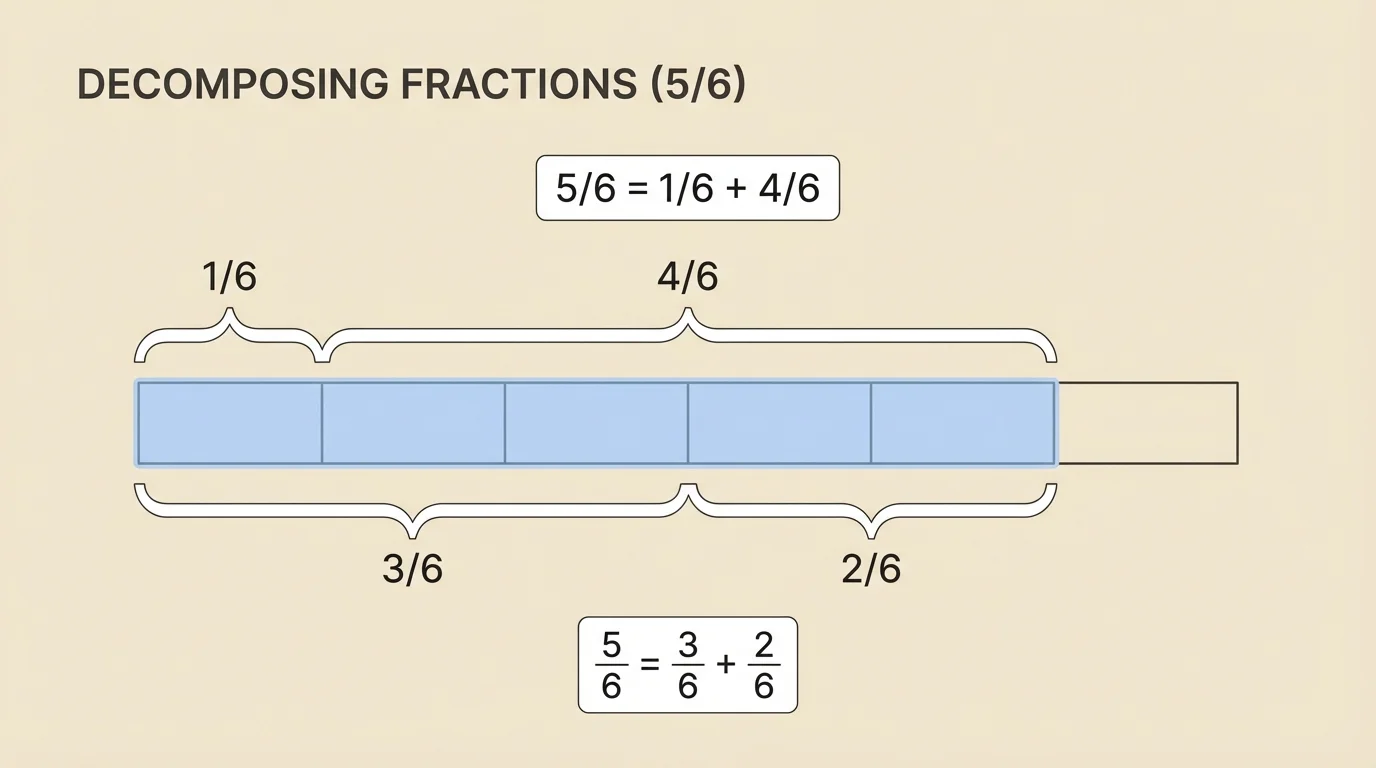
A visual model justifies the equation because you can count the same shaded pieces in each grouping. Nothing is added or taken away. The parts are only being regrouped.
Why the denominator stays the same
The denominator tells the size of the pieces. In sixths, every piece is \(\dfrac{1}{6}\). If we break \(\dfrac{5}{6}\) into \(\dfrac{2}{6}\) and \(\dfrac{3}{6}\), both new fractions still use sixths. We are grouping the same-sized pieces in different ways, not changing the piece size.
You can also think of a circle model, like a pie divided into equal slices. If \(4\) of \(8\) slices are shaded, then \(\dfrac{4}{8}\) could be shown as \(\dfrac{1}{8} + \dfrac{3}{8}\) or \(\dfrac{2}{8} + \dfrac{2}{8}\). The picture supports the equation because all slices are equal in size.
[Figure 2] shows how one picture can match several equations with eighths. A decomposition equation shows that one fraction is equal to a sum of fractions with the same denominator.
For \(\dfrac{7}{8}\), here are several correct equations:
\[\frac{7}{8} = \frac{1}{8} + \frac{6}{8}\]
\[\frac{7}{8} = \frac{2}{8} + \frac{5}{8}\]
\[\frac{7}{8} = \frac{3}{8} + \frac{4}{8}\]
\[\frac{7}{8} = \frac{1}{8} + \frac{1}{8} + \frac{1}{8} + \frac{1}{8} + \frac{1}{8} + \frac{1}{8} + \frac{1}{8}\]
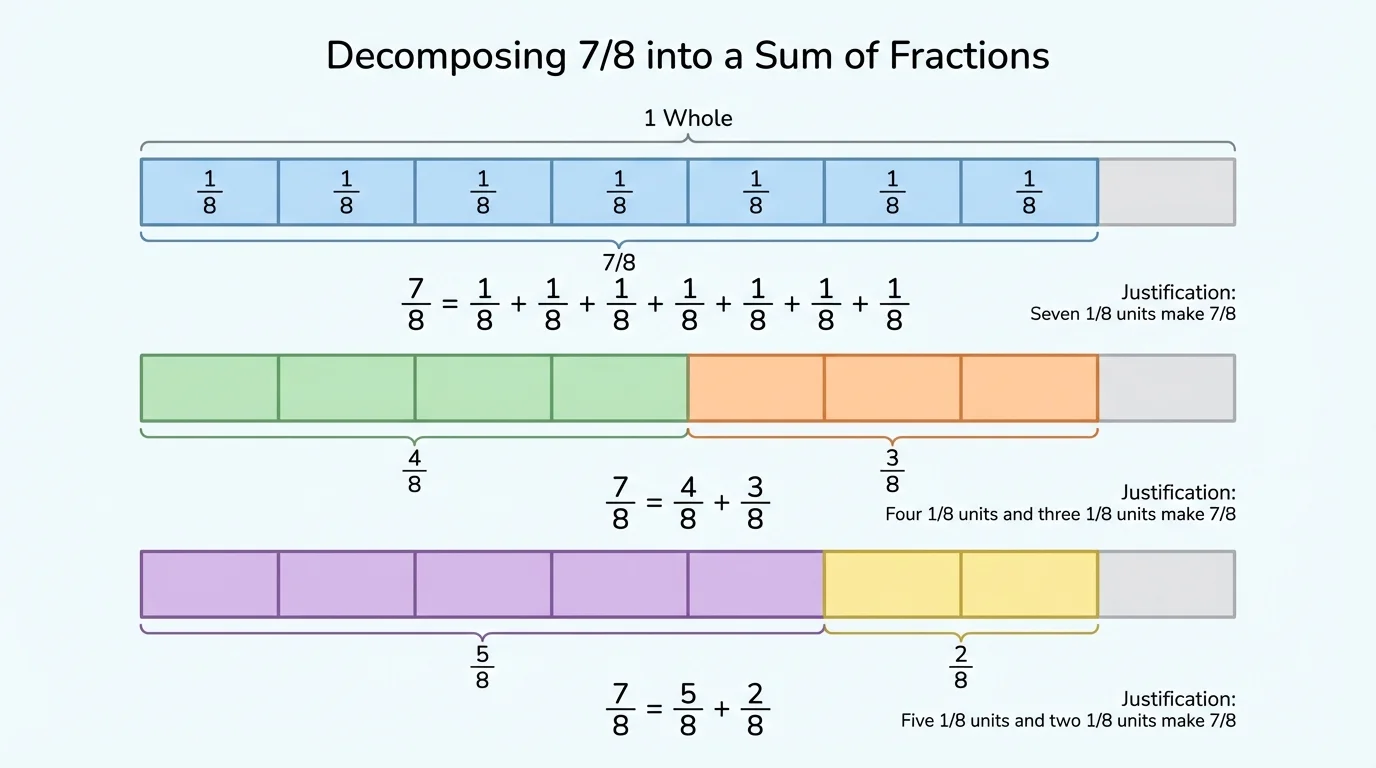
Each equation is another way to describe the same amount. The denominator \(8\) stays the same, and the numerators add to \(7\).
This is an important pattern:
\[\frac{a}{b} = \frac{m}{b} + \frac{n}{b}\quad\textrm{when}\quad m + n = a\]
For grade-level work, you do not need to memorize the letters. The big idea is simple: keep the denominator the same, and make sure the numerators add to the original numerator.
Now let us work through some decompositions step by step.
Worked Example 1
Decompose \(\dfrac{4}{5}\) in two different ways.
Step 1: Notice the denominator.
The denominator is \(5\), so all the parts must be fifths.
Step 2: Find two numerators that add to \(4\).
One choice is \(1 + 3 = 4\).
So one decomposition is \(\dfrac{4}{5} = \dfrac{1}{5} + \dfrac{3}{5}\).
Step 3: Find another pair of numerators that add to \(4\).
Another choice is \(2 + 2 = 4\).
So another decomposition is \(\dfrac{4}{5} = \dfrac{2}{5} + \dfrac{2}{5}\).
Both equations are correct because the parts are all fifths and the numerators add to \(4\).
You can also decompose a fraction into more than two addends. That means more than two fractions are being added together.
Worked Example 2
Write \(\dfrac{3}{4}\) as a sum of unit fractions.
Step 1: Identify the unit fraction.
Because the denominator is \(4\), the unit fraction is \(\dfrac{1}{4}\).
Step 2: Count how many \(\dfrac{1}{4}\) parts are needed.
The numerator is \(3\), so we need three copies of \(\dfrac{1}{4}\).
Step 3: Write the equation.
\[\frac{3}{4} = \frac{1}{4} + \frac{1}{4} + \frac{1}{4}\]
This shows that \(\dfrac{3}{4}\) is built from three unit fractions.
Sometimes a visual model makes the reasoning even clearer. Think of a strip split into \(4\) equal boxes with \(3\) shaded. Each shaded box is \(\dfrac{1}{4}\).
Worked Example 3
Decompose \(\dfrac{6}{8}\) in three different ways and justify one with a model.
Step 1: Keep the denominator the same.
Every part must be in eighths.
Step 2: Find different sums that make \(6\).
\(1 + 5 = 6\), \(2 + 4 = 6\), and \(3 + 3 = 6\).
Step 3: Write the equations.
\(\dfrac{6}{8} = \dfrac{1}{8} + \dfrac{5}{8}\)
\(\dfrac{6}{8} = \dfrac{2}{8} + \dfrac{4}{8}\)
\(\dfrac{6}{8} = \dfrac{3}{8} + \dfrac{3}{8}\)
Step 4: Justify with a model.
If a bar has \(8\) equal parts and \(6\) are shaded, you can group \(2\) shaded parts together and \(4\) shaded parts together. The total shaded amount is still \(6\) eighths, so \(\dfrac{2}{8} + \dfrac{4}{8} = \dfrac{6}{8}\).
The picture does not change the amount. It only changes how we group the shaded eighths.
Notice how the same fraction can have many different decomposition equations. This flexibility helps with later fraction work.
There are two main checks for a correct decomposition.
First, the denominator must stay the same. If the original fraction is \(\dfrac{5}{7}\), the pieces in the sum must also be sevenths.
Second, the numerators in the sum must add to the original numerator. For \(\dfrac{5}{7}\), the numerators in the sum must add to \(5\).
Here is a quick check table.
| Original fraction | Decomposition | Correct? | Why |
|---|---|---|---|
| \(\dfrac{5}{7}\) | \(\dfrac{2}{7} + \dfrac{3}{7}\) | Yes | Same denominator, and \(2 + 3 = 5\) |
| \(\dfrac{5}{7}\) | \(\dfrac{1}{7} + \dfrac{4}{7}\) | Yes | Same denominator, and \(1 + 4 = 5\) |
| \(\dfrac{5}{7}\) | \(\dfrac{2}{7} + \dfrac{3}{8}\) | No | Denominators are different, so part sizes are different |
| \(\dfrac{5}{7}\) | \(\dfrac{2}{7} + \dfrac{2}{7}\) | No | \(2 + 2 = 4\), not \(5\) |
Table 1. Examples of correct and incorrect fraction decompositions.
As we saw earlier in [Figure 1], a correct decomposition matches the same shaded amount. If the parts are not the same size or the total number of shaded parts changes, the equation is not correct.
Fractions are useful in music too. A measure can be divided into equal parts, and rhythms can be grouped in different ways while keeping the same total beat length.
[Figure 3] shows how fractions appear in everyday life whenever a whole is split into equal parts, using pizza slices as an example. If \(6\) out of \(8\) equal slices are on a plate, that amount is \(\dfrac{6}{8}\). You might describe it as \(\dfrac{3}{8} + \dfrac{3}{8}\) if two friends each eat \(3\) slices, or as \(\dfrac{1}{8} + \dfrac{5}{8}\) if one person eats one slice and another eats five.
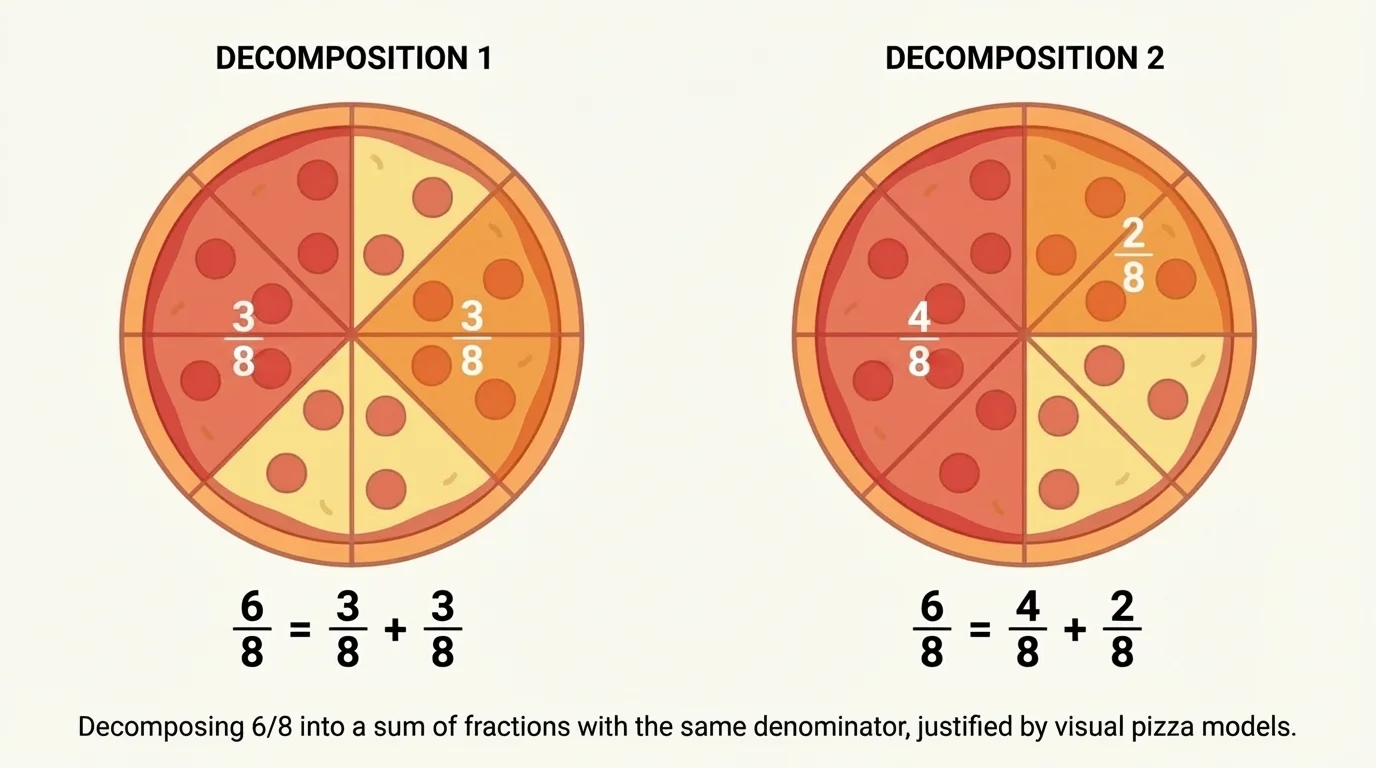
In cooking, a measuring cup might hold \(\dfrac{4}{6}\) of a recipe amount. That can be thought of as \(\dfrac{1}{6} + \dfrac{3}{6}\) or \(\dfrac{2}{6} + \dfrac{2}{6}\). Even when the numbers are written in fractions, the amount of food stays the same.
On a ruler, if a ribbon is \(\dfrac{5}{8}\) of a yard long, that same length can be decomposed as \(\dfrac{2}{8} + \dfrac{3}{8}\). This can help when combining or comparing pieces of the same size.
Later, students use this idea to add and subtract fractions more easily. Seeing a fraction as flexible helps you choose a form that is useful.
One mistake is changing the denominator. For example, \(\dfrac{4}{5} = \dfrac{2}{5} + \dfrac{2}{6}\) is not correct because fifths and sixths are not the same-sized parts.
Another mistake is forgetting to make the numerators add to the original numerator. For instance, \(\dfrac{6}{9} = \dfrac{2}{9} + \dfrac{2}{9}\) is not correct because \(2 + 2 = 4\), not \(6\).
A third mistake is thinking there is only one correct answer. But many decompositions are possible. For \(\dfrac{8}{10}\), all of these are correct:
\[\frac{8}{10} = \frac{1}{10} + \frac{7}{10}\]
\[\frac{8}{10} = \frac{4}{10} + \frac{4}{10}\]
\[\frac{8}{10} = \frac{2}{10} + \frac{3}{10} + \frac{3}{10}\]
The total just has to stay \(\dfrac{8}{10}\).
There is a simple pattern in all fraction decompositions with the same denominator. If you start with \(\dfrac{a}{b}\), then any correct decomposition must keep denominator \(b\) and make the numerators add to \(a\).
For example, for \(\dfrac{9}{10}\), possible numerators are:
\(1 + 8\), \(2 + 7\), \(3 + 6\), \(4 + 5\), or even \(1 + 1 + 1 + 1 + 1 + 1 + 1 + 1 + 1\).
That gives equations such as:
\[\frac{9}{10} = \frac{4}{10} + \frac{5}{10}\]
\[\frac{9}{10} = \frac{2}{10} + \frac{7}{10}\]
\[\frac{9}{10} = \frac{1}{10} + \frac{1}{10} + \frac{1}{10} + \frac{1}{10} + \frac{1}{10} + \frac{1}{10} + \frac{1}{10} + \frac{1}{10} + \frac{1}{10}\]
This pattern connects back to unit fractions. Every fraction with numerator greater than \(1\) can be built from repeated copies of \(\dfrac{1}{b}\), and those copies can be grouped in many ways.
That is why the same picture in [Figure 2] can match more than one equation. The amount does not change; only the grouping changes. The pizza model in [Figure 3] shows the same idea in real life.
