If you eat \(\dfrac{2}{5}\) of a granola bar each day for \(3\) days, how much have you eaten altogether? This looks like a fraction problem, but it is really about counting equal pieces. Once you see fractions as built from tiny equal parts, multiplying them by whole numbers becomes much easier.
Whole numbers tell how many groups. Fractions tell how big each group is. So when we multiply a whole number by a fraction, we are asking for several equal groups of that fraction. For example, \(4 \times \dfrac{1}{3}\) means \(4\) groups of \(\dfrac{1}{3}\).
This is useful in real life. Recipes use fractional cups. Distances can be part of a mile. Time can be part of an hour. Whenever the same fraction happens again and again, multiplication helps us find the total quickly.
A unit fraction is a fraction with \(1\) in the numerator, such as \(\dfrac{1}{2}\), \(\dfrac{1}{4}\), or \(\dfrac{1}{7}\). A unit fraction means one equal part of a whole.
A fraction tells how many equal parts we have. In \(\dfrac{3}{8}\), the denominator \(8\) tells that the whole is divided into \(8\) equal parts, and the numerator \(3\) tells that we have \(3\) of those parts.
Every fraction can be built from unit fractions. For example, \(\dfrac{3}{5}\) means \(3\) copies of \(\dfrac{1}{5}\): \(\dfrac{3}{5} = \dfrac{1}{5} + \dfrac{1}{5} + \dfrac{1}{5}\). In the same way, \(\dfrac{2}{7}\) means \(2\) copies of \(\dfrac{1}{7}\).
This idea is the key to multiplying fractions by whole numbers. If you know how many unit fractions are in one fraction, you can count even more when that fraction is repeated.
Numerator is the top number in a fraction. It tells how many equal parts are being counted.
Denominator is the bottom number in a fraction. It tells how many equal parts make one whole.
Multiple means the result of multiplying a number by a whole number. For example, \(3\) is a multiple of \(1\), and \(6\) is a multiple of \(2\).
Suppose we want to find \(2 \times \dfrac{3}{4}\). This means \(2\) groups of \(\dfrac{3}{4}\). We can write it as repeated addition: \(\dfrac{3}{4} + \dfrac{3}{4}\).
Now think about \(\dfrac{3}{4}\) as unit fractions. Since \(\dfrac{3}{4} = \dfrac{1}{4} + \dfrac{1}{4} + \dfrac{1}{4}\), then \(2 \times \dfrac{3}{4}\) means two groups of those three unit fractions. Altogether that is \(6\) copies of \(\dfrac{1}{4}\), which is \(\dfrac{6}{4}\).
So a whole number times a fraction can be understood as a whole number times several unit fractions. This makes the multiplication much more concrete: you are counting equal pieces.
A visual model makes this idea very clear. Start with one fraction, \(\dfrac{2}{5}\). That fraction is made of \(2\) unit fractions of size \(\dfrac{1}{5}\).
[Figure 1] Now multiply by \(3\). The expression \(3 \times \dfrac{2}{5}\) means \(3\) groups of \(\dfrac{2}{5}\): \(\dfrac{2}{5} + \dfrac{2}{5} + \dfrac{2}{5}\). Each group has \(2\) pieces of size \(\dfrac{1}{5}\). So \(3\) groups have \(3 \times 2 = 6\) pieces of size \(\dfrac{1}{5}\).
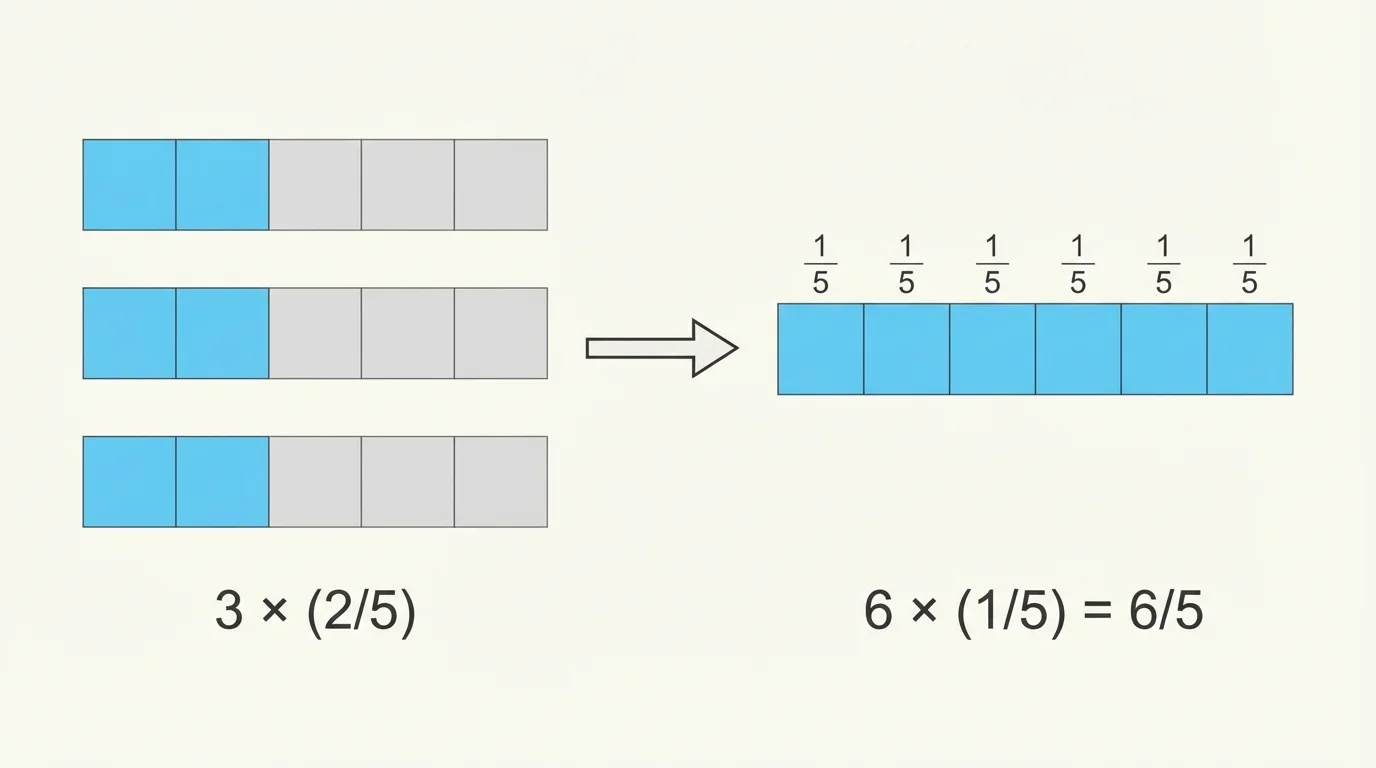
That means we can rewrite the product like this: \(3 \times \dfrac{2}{5} = 6 \times \dfrac{1}{5}\).
And \(6 \times \dfrac{1}{5}\) is just \(\dfrac{6}{5}\), because \(6\) copies of \(\dfrac{1}{5}\) make \(\dfrac{6}{5}\).
Notice something important: the denominator stays \(5\) because the size of each piece does not change. We are still counting fifths. What changes is the number of fifths, so the numerator becomes larger.
Later, when you look back at [Figure 1], you can see why the answer is bigger than \(1\). Five fifths make one whole, and there is still one more fifth left, so \(\dfrac{6}{5} = 1\dfrac{1}{5}\).
Once you understand the unit-fraction idea, the rule makes sense. If one fraction \(\dfrac{a}{b}\) is really \(a\) copies of \(\dfrac{1}{b}\), then \(n\) groups of \(\dfrac{a}{b}\) contain \(n \times a\) copies of \(\dfrac{1}{b}\).
[Figure 2] This gives the general multiplication rule:
\[n \times \frac{a}{b} = \frac{n \times a}{b}\]
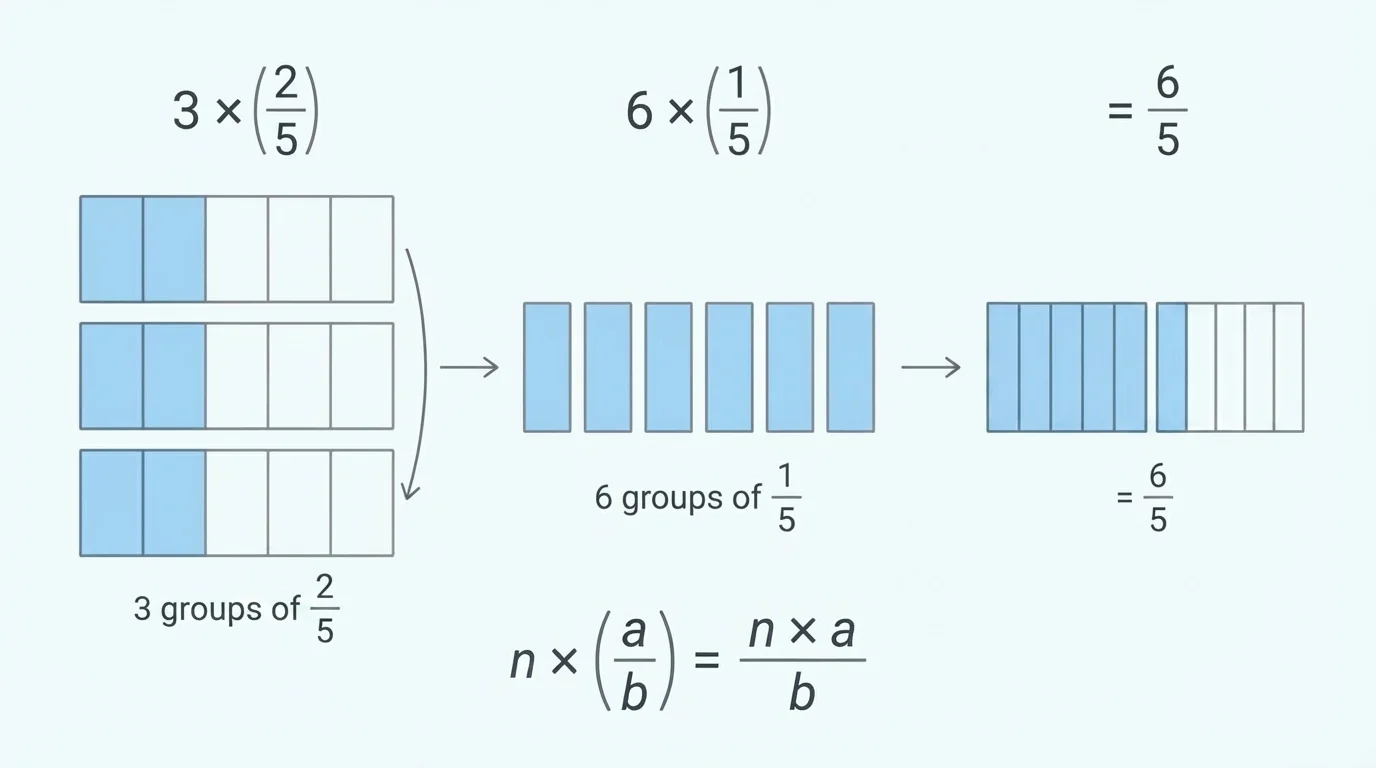
Why does this rule work? The denominator \(b\) tells the size of the pieces. The numerator \(a\) tells how many of those pieces are in one group. Multiplying by \(n\) makes more groups, so the number of pieces becomes \(n \times a\), but the size of each piece still stays \(\dfrac{1}{b}\).
For example, \(4 \times \dfrac{3}{8} = \dfrac{4 \times 3}{8} = \dfrac{12}{8}\). This means \(12\) pieces of size \(\dfrac{1}{8}\).
Why only the numerator is multiplied
When multiplying a fraction by a whole number, we are making more copies of the same fraction. The number of parts changes, but the size of each part does not. That is why the numerator is multiplied and the denominator stays the same.
Let's work through several examples carefully. Watch how each one can be thought of as repeated addition and as counting unit fractions.
Worked example 1
Find \(4 \times \dfrac{2}{3}\).
Step 1: Write the fraction as unit fractions.
\(\dfrac{2}{3} = \dfrac{1}{3} + \dfrac{1}{3}\).
Step 2: Make \(4\) groups.
\(4 \times \dfrac{2}{3}\) means \(4\) groups of \(\dfrac{2}{3}\), so there are \(4 \times 2 = 8\) copies of \(\dfrac{1}{3}\).
Step 3: Write the product as a fraction.
\(8\) copies of \(\dfrac{1}{3}\) make \(\dfrac{8}{3}\).
Final answer: \[4 \times \frac{2}{3} = \frac{8}{3}\]
This answer is greater than \(1\). In fact, \(\dfrac{8}{3} = 2\dfrac{2}{3}\).
Worked example 2
Find \(3 \times \dfrac{1}{6}\).
Step 1: Recognize the fraction as a unit fraction.
\(\dfrac{1}{6}\) already means one sixth.
Step 2: Make \(3\) groups.
\(3 \times \dfrac{1}{6}\) means \(3\) copies of \(\dfrac{1}{6}\): \(\dfrac{1}{6} + \dfrac{1}{6} + \dfrac{1}{6}\).
Step 3: Count the sixths.
There are \(3\) sixths, so the product is \(\dfrac{3}{6}\).
Final answer: \[3 \times \frac{1}{6} = \frac{3}{6}\]
This fraction can be simplified to \(\dfrac{1}{2}\), but the important idea is that we counted \(3\) pieces of size \(\dfrac{1}{6}\).
Worked example 3
Find \(5 \times \dfrac{3}{10}\).
Step 1: Use the rule.
Multiply the whole number by the numerator: \(5 \times 3 = 15\).
Step 2: Keep the denominator the same.
The denominator stays \(10\), so the product is \(\dfrac{15}{10}\).
Step 3: Interpret the result.
\(\dfrac{15}{10}\) means \(15\) tenths. Since \(10\) tenths make one whole, the answer is also \(1\dfrac{5}{10}\), or \(1\dfrac{1}{2}\).
Final answer: \[5 \times \frac{3}{10} = \frac{15}{10}\]
In each example, the same pattern appears: count more copies of the same fractional part.
Worked example 4
Find \(2 \times \dfrac{7}{8}\).
Step 1: Think of repeated addition.
\(2 \times \dfrac{7}{8} = \dfrac{7}{8} + \dfrac{7}{8}\).
Step 2: Count the eighths.
\(7\) eighths plus \(7\) eighths equals \(14\) eighths.
Step 3: Write the answer.
\(\dfrac{14}{8}\).
Final answer: \[2 \times \frac{7}{8} = \frac{14}{8}\]
Sometimes the answer is less than \(1\). For example, \(2 \times \dfrac{1}{4} = \dfrac{2}{4}\), which is only half of a whole.
Sometimes the answer is exactly \(1\). For example, \(3 \times \dfrac{1}{3} = \dfrac{3}{3} = 1\).
Sometimes the answer is greater than \(1\). For example, \(3 \times \dfrac{2}{3} = \dfrac{6}{3} = 2\). This happens when the total number of equal parts is enough to make one or more whole objects.
An improper fraction is a fraction with a numerator greater than or equal to the denominator, such as \(\dfrac{6}{5}\) or \(\dfrac{12}{8}\). Improper fractions are not wrong. They simply show that the amount is at least one whole, and maybe more.
Looking again at [Figure 2], you can see that a large number of unit fractions can pass one whole and keep going. That is why multiplication by a whole number can create an improper fraction.
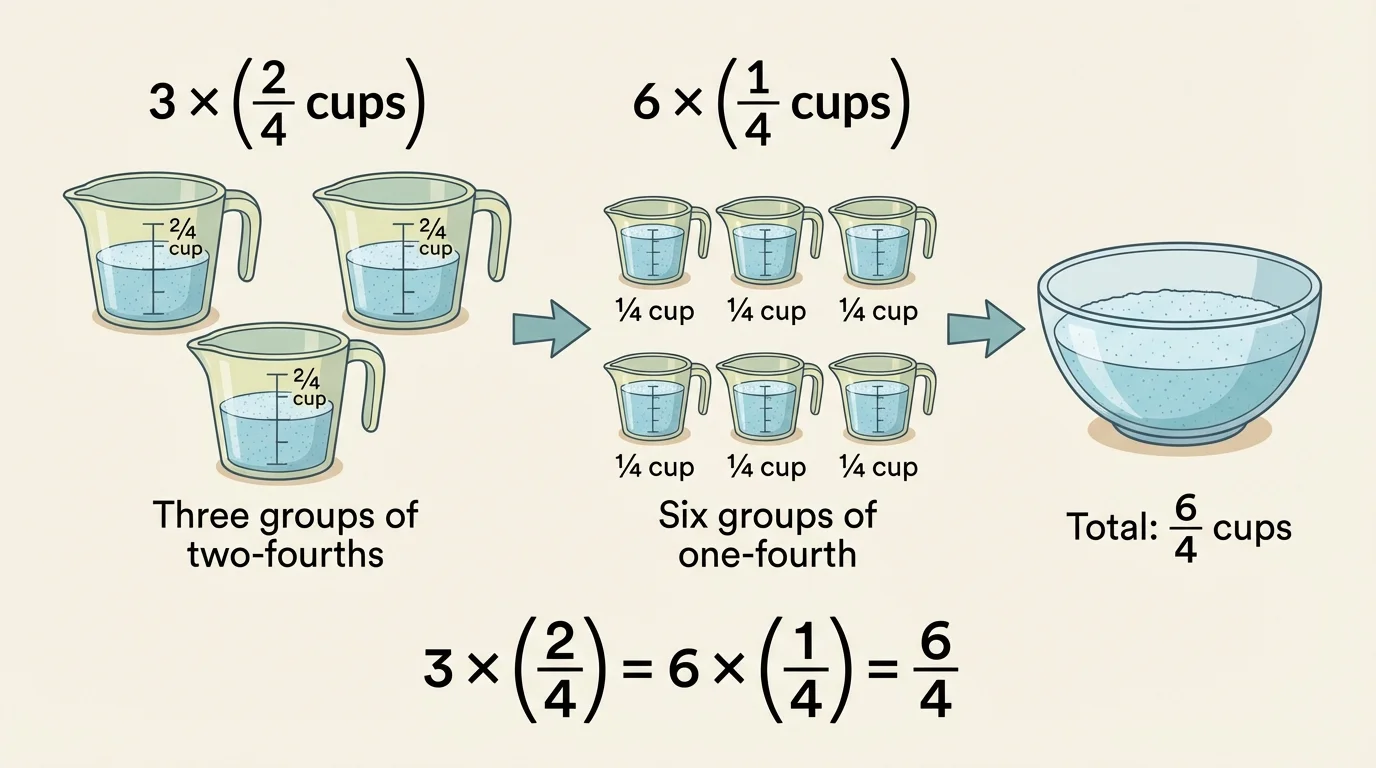
Fractions appear in everyday life more often than many people notice. [Figure 3] In cooking, for example, a recipe might use \(\dfrac{2}{4}\) cup of oats for one batch.
If you make \(3\) batches, you need \(3 \times \dfrac{2}{4} = \dfrac{6}{4}\) cups of oats.
That means \(6\) quarter-cups altogether. Since \(4\) quarter-cups make one whole cup, \(\dfrac{6}{4} = 1\dfrac{2}{4}\), or \(1\dfrac{1}{2}\) cups.
Distance is another example. If a student walks \(\dfrac{3}{5}\) mile to school each day, then in \(4\) days the student walks \(4 \times \dfrac{3}{5} = \dfrac{12}{5}\) miles.
Music also uses repeated fractions. If one rhythm pattern lasts \(\dfrac{1}{4}\) of a measure and it repeats \(4\) times, then the total is \(4 \times \dfrac{1}{4} = 1\) whole measure.
Sports can use this idea too. If a runner completes \(\dfrac{2}{3}\) of a lap during each warm-up interval and does \(3\) intervals, the runner covers \(3 \times \dfrac{2}{3} = \dfrac{6}{3} = 2\) laps. When you return to [Figure 3], the repeated scoops work the same way as repeated laps: equal fractional amounts are being added again and again.
One common mistake is multiplying both the numerator and denominator by the whole number. For example, someone might think \(3 \times \dfrac{2}{5} = \dfrac{6}{15}\). That is not correct for this kind of multiplication.
Why not? Because the size of the pieces stays as fifths. We are counting more fifths, not making the pieces smaller. So the correct answer is \(\dfrac{6}{5}\), not \(\dfrac{6}{15}\).
Another mistake is forgetting that multiplication by a whole number means repeated addition. If \(2 \times \dfrac{3}{4}\) feels confusing, rewrite it as \(\dfrac{3}{4} + \dfrac{3}{4}\). Then count the fourths: \(\dfrac{6}{4}\).
Fractions and multiplication connect in a powerful way: once you understand unit fractions, many later ideas in math become easier, including multiplying fractions by fractions and working with ratios.
A fraction like \(\dfrac{a}{b}\) is made from \(a\) copies of \(\dfrac{1}{b}\). So \(n\) groups of \(\dfrac{a}{b}\) contain \(n \times a\) copies of \(\dfrac{1}{b}\). That is why \(n \times \dfrac{a}{b} = \dfrac{n \times a}{b}\).
When you see a problem such as \(6 \times \dfrac{2}{7}\), you can think, "One group has \(2\) sevenths. Six groups have \(12\) sevenths." So the answer is \(\dfrac{12}{7}\).
This way of thinking is stronger than just memorizing a rule. It helps you understand what the numbers mean, what the pieces are, and why the denominator stays the same.
