If you have \(\$0.30\) and then get \(\$0.07\) more, you probably know the total is \(\$0.37\). That is a money problem, but it is also a fraction problem. You are really adding \(\dfrac{30}{100}\) and \(\dfrac{7}{100}\). Fractions with tenths and hundredths appear in money, measurements, and decimals all the time, so learning how to rename and add them is a powerful skill.
A tenth means one out of \(10\) equal parts. A hundredth means one out of \(100\) equal parts. These fractions are closely connected because \(100\) is \(10\) times as large as \(10\).
For example, if a whole is split into \(10\) equal parts, each part is \(\dfrac{1}{10}\). If the same whole is split into \(100\) equal parts, each smaller part is \(\dfrac{1}{100}\). Since \(10\) hundredths make the same amount as \(1\) tenth, we can write \(\dfrac{1}{10} = \dfrac{10}{100}\).
This idea helps us add fractions. Fractions are easiest to add when they have the same denominator. When one fraction is in tenths and the other is in hundredths, we can rename the tenths as hundredths first.
You already know that fractions can be equivalent. For example, \(\dfrac{1}{2} = \dfrac{2}{4}\) because both name the same amount. The same idea works with tenths and hundredths.
Equivalent fractions are like different names for the same number. Just as one person can be called by a nickname and a full name, one amount can have more than one fraction name.
An equivalent fraction is a fraction that has the same value as another fraction, even though the numbers look different. For example, \(\dfrac{2}{10}\) and \(\dfrac{20}{100}\) are equivalent fractions.
To make an equivalent fraction, multiply or divide the numerator and denominator by the same number. This keeps the value the same.
Equivalent fractions are fractions that name the same amount. If you multiply the numerator and denominator by the same number, the fraction stays equal to the original fraction.
Here is the important pattern for this lesson:
\[\frac{a}{10} = \frac{a \times 10}{10 \times 10} = \frac{10a}{100}\]
That means every fraction with denominator \(10\) can be changed into an equivalent fraction with denominator \(100\) by multiplying the numerator by \(10\).
When we rename tenths as hundredths, we are cutting each tenth into \(10\) smaller equal parts. The amount does not change; only the name changes. This is easier to picture with a model when the same shaded part appears on both a tenths strip and a hundredths grid.
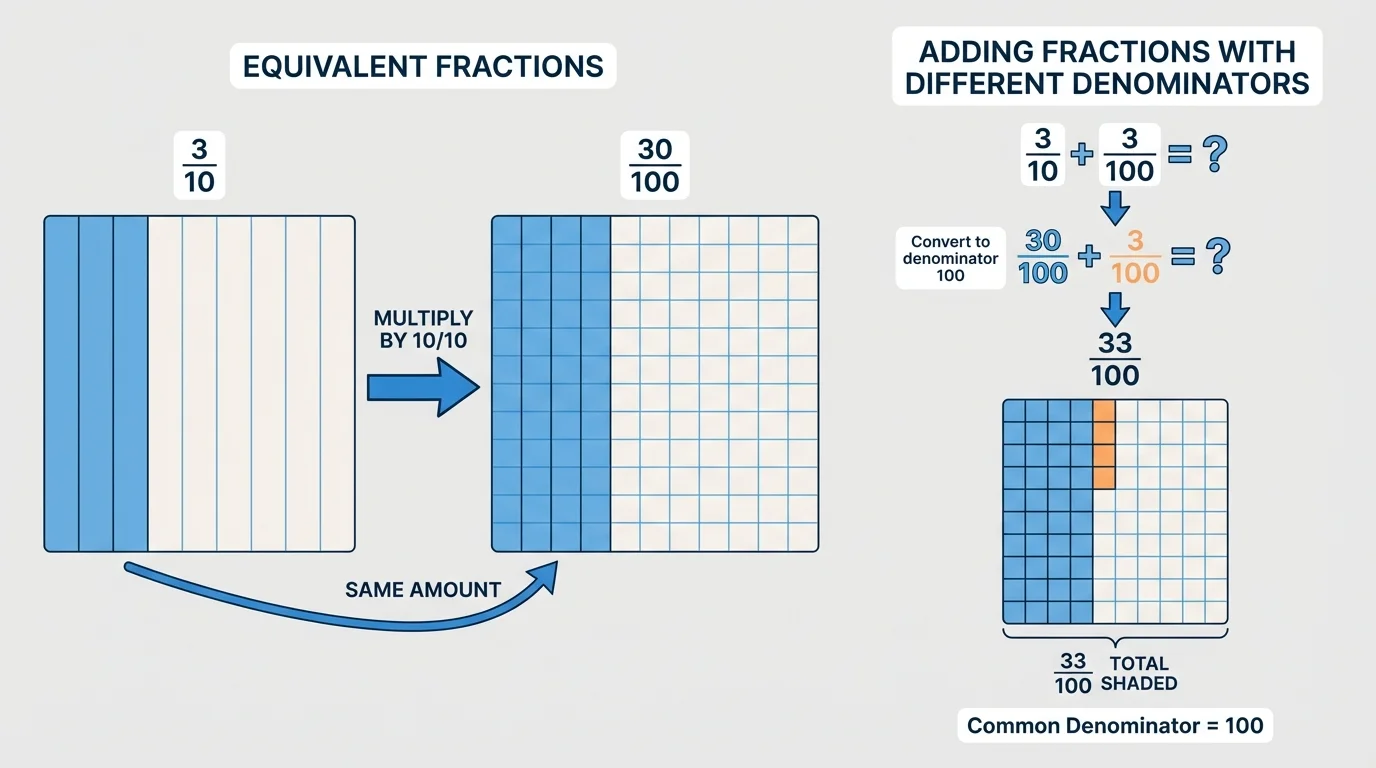
[Figure 1] Suppose we start with \(\dfrac{3}{10}\). To get a denominator of \(100\), multiply the denominator by \(10\). But if we multiply the denominator by \(10\), we must also multiply the numerator by \(10\).
So:
\[\frac{3}{10} = \frac{3 \times 10}{10 \times 10} = \frac{30}{100}\]
This means \(3\) tenths is the same as \(30\) hundredths.
Here are more examples:
\(\dfrac{1}{10} = \dfrac{10}{100}\)
\(\dfrac{4}{10} = \dfrac{40}{100}\)
\(\dfrac{9}{10} = \dfrac{90}{100}\)
Notice the pattern: the numerator gets \(10\) times larger because each tenth becomes \(10\) hundredths.
Why the value stays the same
Multiplying both the numerator and denominator by \(10\) does not make the fraction larger. It just changes the size of the parts. Tenths are larger parts; hundredths are smaller parts. Since there are more smaller parts, the numerator must also increase to show the same amount.
This is exactly like saying one dime is the same value as \(10\) pennies. The number of coins changes, but the total value stays the same.
To add fractions, the parts must be the same size. If one fraction has tenths and the other has hundredths, the parts are not the same size yet. We solve that by renaming the tenths as hundredths, as [Figure 2] illustrates with a hundredths grid built from tenths and extra hundredths.
The strategy is simple:
Step 1: Change the fraction with denominator \(10\) into an equivalent fraction with denominator \(100\).
Step 2: Add the numerators.
Step 3: Keep the denominator \(100\).
For example, to add \(\dfrac{4}{10} + \dfrac{7}{100}\), first rename \(\dfrac{4}{10}\) as hundredths:
\(\dfrac{4}{10} = \dfrac{40}{100}\)
Now add:
\[\frac{40}{100} + \frac{7}{100} = \frac{47}{100}\]
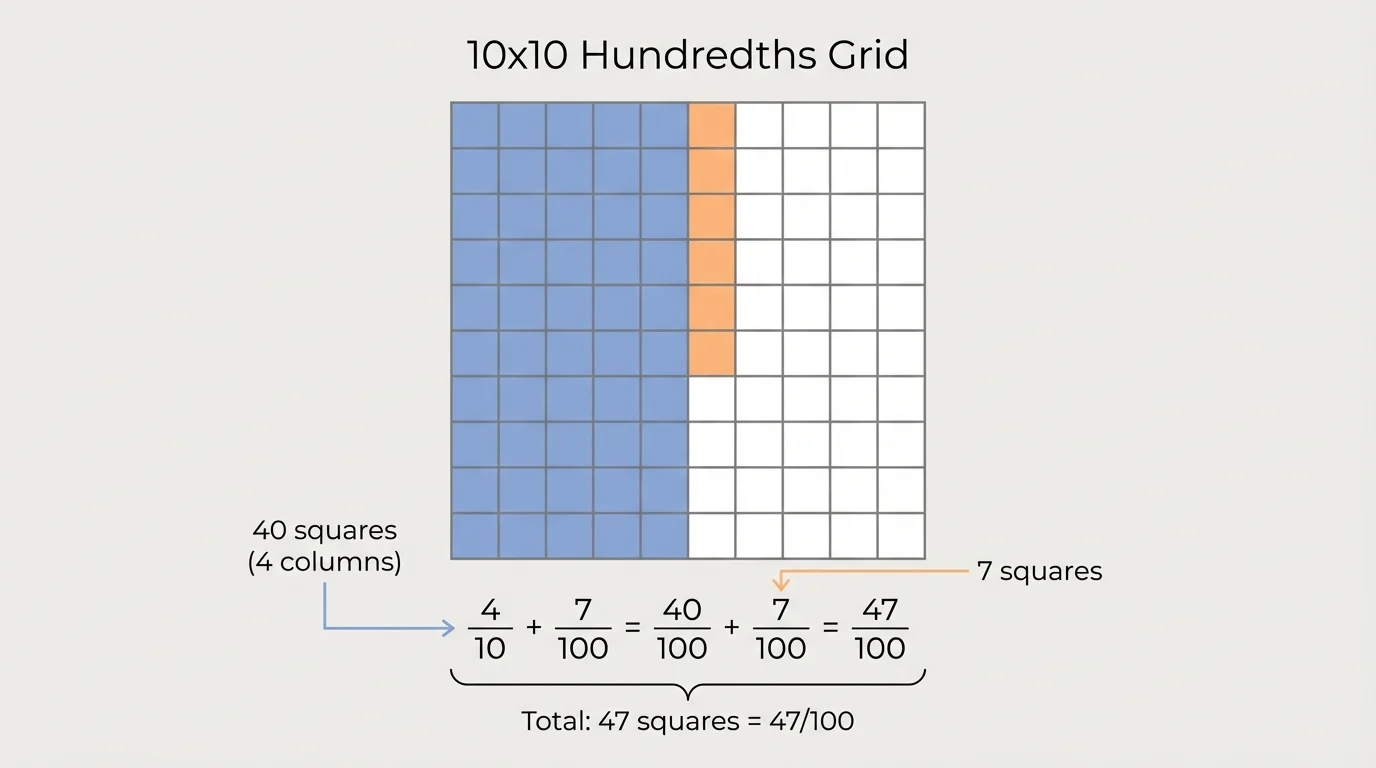
Because both fractions are now in hundredths, the pieces match. We are adding pieces of the same size.
You can think of it as adding \(40\) little hundredths and \(7\) little hundredths to get \(47\) little hundredths.
Let's work through several examples carefully.
Worked example 1
Find \(\dfrac{2}{10} + \dfrac{5}{100}\).
Step 1: Rename the tenths fraction as hundredths.
\(\dfrac{2}{10} = \dfrac{20}{100}\)
Step 2: Add the numerators because the denominators now match.
\(\dfrac{20}{100} + \dfrac{5}{100} = \dfrac{25}{100}\)
Step 3: State the answer.
\[\frac{2}{10} + \frac{5}{100} = \frac{25}{100}\]
The sum is \(\dfrac{25}{100}\).
This example shows the basic method: rename first, then add.
Worked example 2
Find \(\dfrac{6}{10} + \dfrac{18}{100}\).
Step 1: Change \(\dfrac{6}{10}\) to hundredths.
\(\dfrac{6}{10} = \dfrac{60}{100}\)
Step 2: Add the hundredths.
\(\dfrac{60}{100} + \dfrac{18}{100} = \dfrac{78}{100}\)
Step 3: Write the final answer.
\[\frac{6}{10} + \frac{18}{100} = \frac{78}{100}\]
The sum is \(\dfrac{78}{100}\).
Notice that only one fraction had to change. The fraction with denominator \(100\) was already ready to use.
Worked example 3
Find \(\dfrac{9}{10} + \dfrac{3}{100}\).
Step 1: Rename \(\dfrac{9}{10}\) as hundredths.
\(\dfrac{9}{10} = \dfrac{90}{100}\)
Step 2: Add.
\(\dfrac{90}{100} + \dfrac{3}{100} = \dfrac{93}{100}\)
Step 3: Write the answer.
\[\frac{9}{10} + \frac{3}{100} = \frac{93}{100}\]
The sum is \(\dfrac{93}{100}\).
Since \(\dfrac{93}{100}\) is also a decimal, we can write it as \(0.93\).
Worked example 4
Find \(\dfrac{1}{10} + \dfrac{27}{100}\).
Step 1: Change the tenth to hundredths.
\(\dfrac{1}{10} = \dfrac{10}{100}\)
Step 2: Add the numerators.
\(\dfrac{10}{100} + \dfrac{27}{100} = \dfrac{37}{100}\)
Step 3: Final answer.
\[\frac{1}{10} + \frac{27}{100} = \frac{37}{100}\]
The sum is \(\dfrac{37}{100}\).
These examples all follow the same pattern, and that is a good sign in math. A repeated pattern means you have found a dependable method.
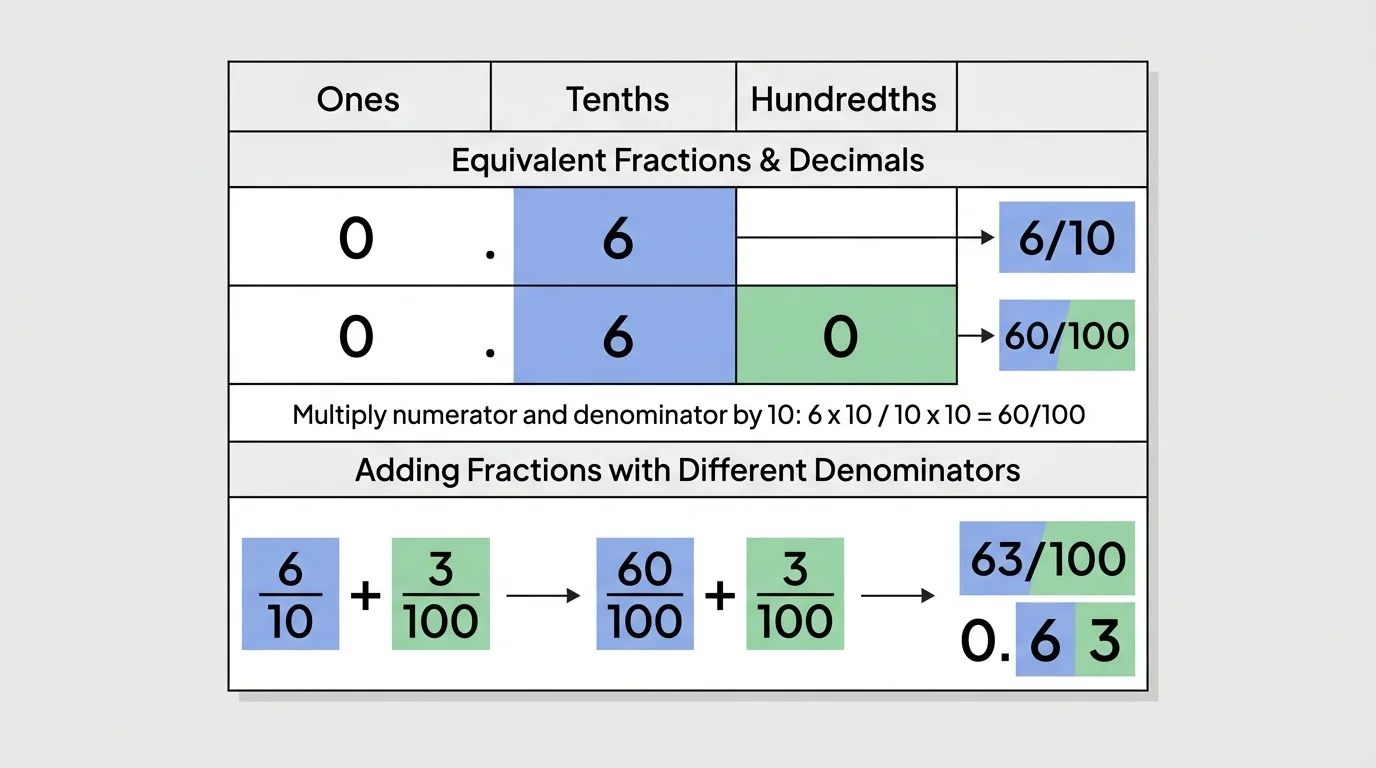
[Figure 3] Fractions with tenths and hundredths connect directly to decimals, as a place-value chart shows. A denominator of \(10\) matches the tenths place, and a denominator of \(100\) matches the hundredths place.
For example:
\(\dfrac{3}{10} = 0.3\)
\(\dfrac{30}{100} = 0.30\)
These decimals look a little different, but they are equal:
\(0.3 = 0.30\)
That means \(\dfrac{3}{10}\) and \(\dfrac{30}{100}\) are equal too.
Here are some matching fraction and decimal pairs:
| Fraction | Equivalent Fraction | Decimal |
|---|---|---|
| \(\dfrac{2}{10}\) | \(\dfrac{20}{100}\) | \(0.2\) |
| \(\dfrac{5}{10}\) | \(\dfrac{50}{100}\) | \(0.5\) |
| \(\dfrac{7}{10}\) | \(\dfrac{70}{100}\) | \(0.7\) |
| \(\dfrac{8}{10}\) | \(\dfrac{80}{100}\) | \(0.8\) |
Table 1. Fractions with denominator \(10\), their equivalent fractions with denominator \(100\), and matching decimals.
Later, when you add decimals such as \(0.4 + 0.07\), you are using the same idea as \(\dfrac{4}{10} + \dfrac{7}{100}\). In both cases, you are combining tenths and hundredths carefully.
A trailing zero in a decimal does not change the value. That is why \(0.4\) and \(0.40\) are equal, just like \(\dfrac{4}{10}\) and \(\dfrac{40}{100}\) are equal.
The picture of equivalent fractions from [Figure 1] also helps explain why these decimals are equal: the shaded amount stays the same even when the whole is divided into more pieces.
One common mistake is adding the denominators. For example, someone might think:
\(\dfrac{4}{10} + \dfrac{7}{100} = \dfrac{11}{110}\)
That is not correct. When adding fractions, we do not add denominators this way. We first make the denominators the same.
The correct work is:
\(\dfrac{4}{10} = \dfrac{40}{100}\)
Then:
\[\frac{40}{100} + \frac{7}{100} = \frac{47}{100}\]
Another mistake is changing only the denominator. For example, writing \(\dfrac{3}{10} = \dfrac{3}{100}\) is wrong. If the denominator becomes \(10\) times larger, the numerator must also become \(10\) times larger to keep the value equal.
So the correct equivalent fraction is:
\[\frac{3}{10} = \frac{30}{100}\]
The hundredths model we used earlier, like the one in [Figure 2], makes this clear because \(40\) hundredths and \(7\) hundredths are easy to count and combine.
These fraction skills are useful in everyday life. Money is one clear example. A dime is \(\dfrac{1}{10}\) of a dollar, and a penny is \(\dfrac{1}{100}\) of a dollar. So if you have \(\dfrac{3}{10}\) of a dollar and add \(\dfrac{4}{100}\) of a dollar, you are finding:
\(\dfrac{3}{10} = \dfrac{30}{100}\)
Then:
\[\frac{30}{100} + \frac{4}{100} = \frac{34}{100}\]
That is \(\$0.34\).
Measurements also use tenths and hundredths. A scientist might measure a length as \(\dfrac{6}{10}\) of a meter and then add \(\dfrac{9}{100}\) of a meter more. The total is:
\(\dfrac{6}{10} = \dfrac{60}{100}\)
\[\frac{60}{100} + \frac{9}{100} = \frac{69}{100}\]
So the total is \(\dfrac{69}{100}\) of a meter, or \(0.69\) meters.
Scores and data can work the same way. If one part of a game score is \(\dfrac{5}{10}\) and a bonus adds \(\dfrac{12}{100}\), the total becomes \(\dfrac{50}{100} + \dfrac{12}{100} = \dfrac{62}{100}\), which is \(0.62\).
The place-value idea in [Figure 3] helps here too, because decimals and fractions are two ways to describe the same amount.
Whenever you see a fraction with denominator \(10\) and you need denominator \(100\), multiply by \(\dfrac{10}{10}\):
\[\frac{a}{10} \times \frac{10}{10} = \frac{10a}{100}\]
Then you can add it to any fraction already written in hundredths.
For sums like \(\dfrac{a}{10} + \dfrac{b}{100}\), the pattern is:
\[\frac{a}{10} + \frac{b}{100} = \frac{10a}{100} + \frac{b}{100} = \frac{10a+b}{100}\]
You do not need to memorize that rule in letters, but it shows the math behind the process you used in every example.
