At a store, one toy costs \(\$4.35\) and another costs \(\$4.53\). Those numbers look similar, but they are not the same. In a race, one runner finishes in \(9.48\) seconds and another in \(9.51\) seconds. A tiny difference in decimals can matter a lot. Learning to compare decimals helps us make smart choices in money, measurement, and many other real-life situations.
Decimals help describe parts of a whole. When something is not a whole number, a decimal can show exactly how much there is. For example, \(0.5\) means five tenths of a whole, and \(0.25\) means twenty-five hundredths of a whole.
When we compare decimals, we decide which number is greater, which is smaller, or whether they are equal. We record the comparison with symbols: \(>\), \(<\), or \(=\). For example, \(0.8 > 0.6\), \(0.14 < 0.41\), and \(0.50 = 0.5\).
You already know how to compare whole numbers by looking from left to right. Decimal comparison uses that same idea, but now we also look at the tenths and hundredths places.
To compare decimals well, we need to understand place value very clearly.
A decimal is another way to write fractions with denominators like \(10\) and \(100\). The first place to the right of the decimal point is the tenths place. The second place is the hundredths place. [Figure 1] shows a grid model that helps us see that decimals show parts of one whole divided into equal pieces.
For example, \(0.3\) means \(3\) tenths, which is also \(\dfrac{3}{10}\). The number \(0.37\) means \(3\) tenths and \(7\) hundredths, or \(\dfrac{37}{100}\). The number \(0.09\) means \(9\) hundredths, or \(\dfrac{9}{100}\).
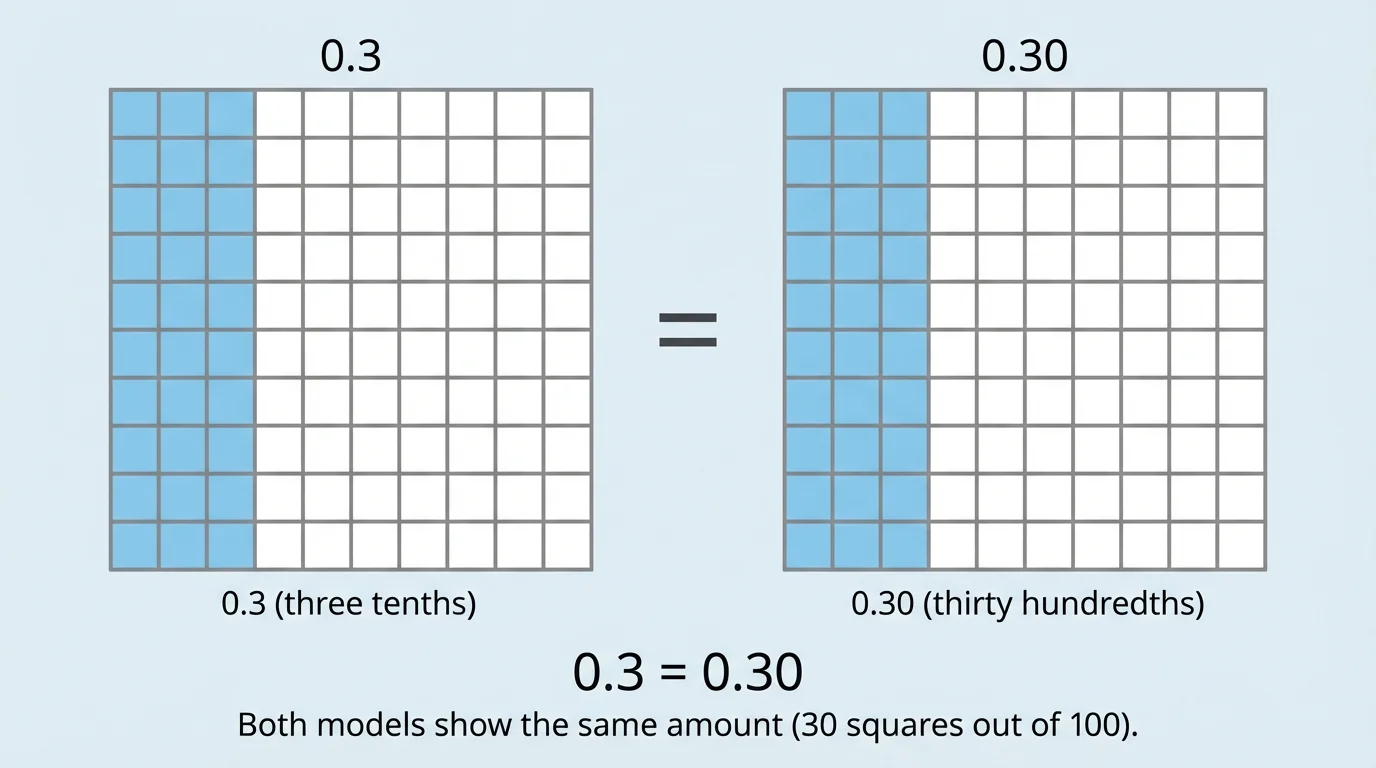
Sometimes decimals look different but have the same value. For example, \(0.3\) and \(0.30\) are equal. Adding a zero at the end of a decimal does not change the amount. That is because \(3\) tenths is the same as \(30\) hundredths.
Decimal point separates the whole number part from the part less than one whole.
Tenths are parts of a whole when the whole is divided into \(10\) equal parts.
Hundredths are parts of a whole when the whole is divided into \(100\) equal parts.
Thinking about decimals as fractions helps make comparisons easier. If one number has more tenths, it is greater. If the tenths are the same, then compare the hundredths.
The best way to compare decimals is to look at place value from left to right. Start with the whole number part. If the whole numbers are different, the comparison is easy. For example, \(2.14 > 1.99\) because \(2\) wholes is greater than \(1\) whole.
If the whole number parts are the same, compare the tenths. For example, compare \(0.7\) and \(0.4\). Both have \(0\) wholes, but \(7\) tenths is greater than \(4\) tenths, so \(0.7 > 0.4\).
If the tenths are the same, compare the hundredths. Compare \(0.46\) and \(0.43\). Both have \(0\) wholes and \(4\) tenths. Then compare the hundredths: \(6\) hundredths is greater than \(3\) hundredths, so \(0.46 > 0.43\).
How to compare decimals
Read the digits from left to right. Compare the whole numbers first, then the tenths, then the hundredths. The first place where the digits are different tells which decimal is greater.
Here are some comparisons written clearly:
| Decimal A | Decimal B | Comparison | Reason |
|---|---|---|---|
| \(0.8\) | \(0.75\) | \(0.8 > 0.75\) | \(8\) tenths is greater than \(7\) tenths |
| \(0.29\) | \(0.31\) | \(0.29 < 0.31\) | \(2\) tenths is less than \(3\) tenths |
| \(0.50\) | \(0.5\) | \(0.50 = 0.5\) | \(50\) hundredths equals \(5\) tenths |
| \(1.04\) | \(1.4\) | \(1.04 < 1.4\) | \(0\) tenths is less than \(4\) tenths |
Table 1. Examples of decimal comparisons using place value reasoning.
[Figure 2] highlights an important rule: decimal comparisons are only valid when the decimals refer to wholes of the same size. It shows why the same decimal can mean different actual amounts if the wholes are different sizes.
Suppose one chocolate bar is large and another chocolate bar is small. If you eat \(0.5\) of the large bar and your friend eats \(0.5\) of the small bar, the decimal value is the same, but the actual amount of chocolate is not. Half of a large bar is more chocolate than half of a small bar.
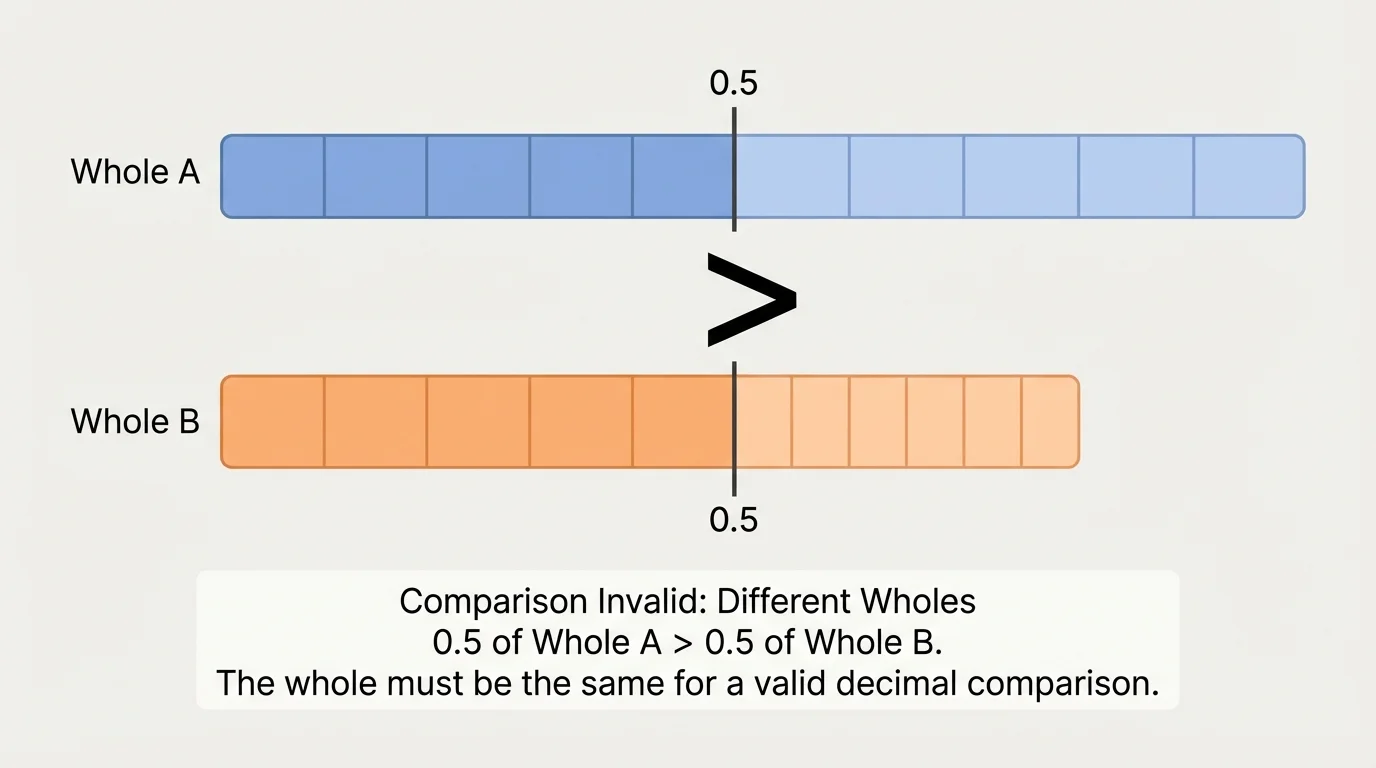
So when we compare decimals like \(0.6\) and \(0.55\), we must make sure both decimals are parts of equal-sized wholes. If they are not based on the same whole, the comparison does not make sense.
Sports records and science measurements often use decimals because even a difference of \(0.01\) can matter. But those decimals are only fair to compare when they measure the same kind of unit, such as the same race distance or the same length unit.
This idea also matters with money. Comparing \(\$0.75\) and \(\$0.80\) makes sense because both are parts of one dollar. They refer to the same whole: one dollar.
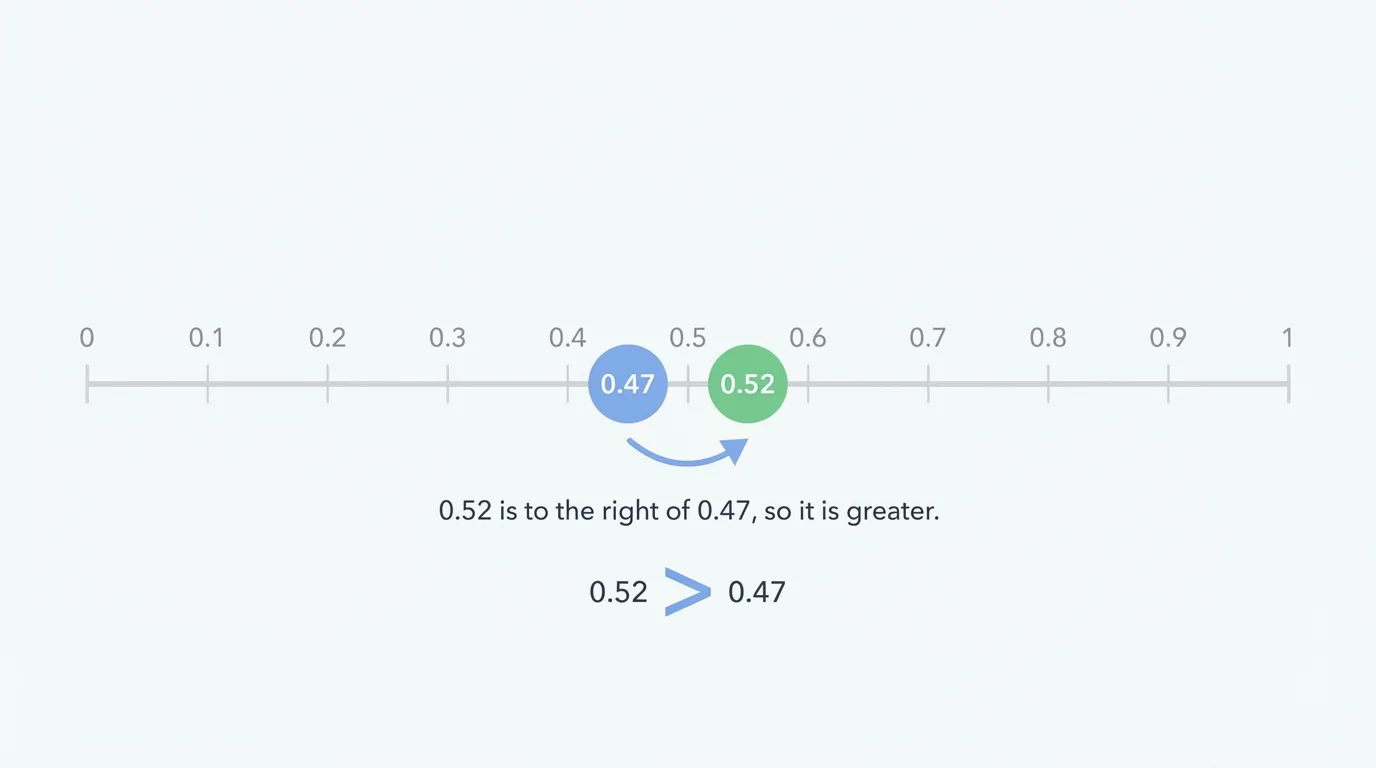
[Figure 3] shows how visual models make decimal comparisons easier to understand. On a number line, decimals farther to the right are greater when two decimals are placed between \(0\) and \(1\).
A hundred grid is another useful model. If \(47\) small squares are shaded, that represents \(0.47\). If \(52\) small squares are shaded, that represents \(0.52\). Since \(52\) shaded hundredths is more than \(47\) shaded hundredths, \(0.52 > 0.47\).
Visual models also help explain why \(0.30 = 0.3\). On a hundred grid, \(0.30\) shades \(30\) out of \(100\) small squares. On a tenths bar, \(0.3\) shades \(3\) out of \(10\) equal parts. These are the same amount of one whole.
Later, when you compare decimals again, the number line in [Figure 3] is a good reminder that the greater decimal is located farther to the right.
Let's look at several comparisons and justify each one carefully.
Worked example 1
Compare \(0.6\) and \(0.58\).
Step 1: Write both numbers to the same place value.
\(0.6 = 0.60\)
Step 2: Compare tenths.
Both numbers have \(6\) tenths? No. \(0.60\) has \(6\) tenths and \(0.58\) has \(5\) tenths.
Step 3: Decide which is greater.
Since \(6\) tenths is greater than \(5\) tenths, \(0.60 > 0.58\).
The correct comparison is \(0.6 > 0.58\)
Notice that writing \(0.6\) as \(0.60\) can help line up place values clearly.
Worked example 2
Compare \(0.34\) and \(0.39\).
Step 1: Compare the whole numbers.
Both numbers have \(0\) wholes.
Step 2: Compare the tenths.
Both numbers have \(3\) tenths.
Step 3: Compare the hundredths.
\(4\) hundredths is less than \(9\) hundredths.
Step 4: Write the comparison.
\(0.34 < 0.39\)
The correct comparison is \(0.34 < 0.39\)
This time the tenths were equal, so the hundredths decided the answer.
Worked example 3
Compare \(0.50\) and \(0.5\).
Step 1: Think about place value.
\(0.50\) means \(5\) tenths and \(0\) hundredths.
Step 2: Rewrite if helpful.
\(0.5 = 0.50\)
Step 3: Compare.
Both numbers are the same amount.
The correct comparison is \(0.50 = 0.5\)
Zeros at the end of a decimal do not change the value.
Worked example 4
Compare \(1.27\) and \(1.3\).
Step 1: Rewrite to the same place value.
\(1.3 = 1.30\)
Step 2: Compare whole numbers.
Both numbers have \(1\) whole.
Step 3: Compare tenths.
\(2\) tenths is less than \(3\) tenths.
Step 4: Write the comparison.
\(1.27 < 1.30\), so \(1.27 < 1.3\).
The correct comparison is \(1.27 < 1.3\)
Even though \(27\) is greater than \(3\) as whole numbers, that is not how decimals are compared. Place value matters.
One common mistake is comparing decimals as if they were whole numbers. A student might say \(0.8 < 0.75\) because \(8 < 75\). That is incorrect. In decimals, \(0.8\) means \(8\) tenths, and \(0.75\) means \(7\) tenths and \(5\) hundredths. Since \(8\) tenths is greater than \(7\) tenths, \(0.8 > 0.75\).
Another mistake is forgetting about the same whole. We saw in [Figure 2] that \(0.5\) of one object and \(0.5\) of another object are only truly comparable when they are parts of wholes of the same size.
A smart check is to read the decimals in words. For example, \(0.42\) is forty-two hundredths and \(0.4\) is four tenths, or forty hundredths. Then it becomes easier to see that \(42\) hundredths is greater than \(40\) hundredths, so \(0.42 > 0.4\).
Decimal comparisons are useful in many situations. In money, comparing \(\$3.45\) and \(\$3.54\) tells which item costs more. In measurement, comparing \(1.25\) meters and \(1.3\) meters tells which object is longer. In sports, comparing times like \(10.08\) seconds and \(10.11\) seconds tells which runner finished faster.
Suppose two juice bottles contain \(0.75\) liter and \(0.8\) liter. Since \(0.8 = 0.80\), we compare \(0.80\) and \(0.75\). Because \(8\) tenths is greater than \(7\) tenths, \(0.8 > 0.75\). The \(0.8\)-liter bottle holds more juice.
Suppose two boards are \(2.06\) meters and \(2.6\) meters long. Rewrite \(2.6\) as \(2.60\). Then compare \(2.06\) and \(2.60\). Both have \(2\) wholes, but \(0\) tenths is less than \(6\) tenths, so \(2.06 < 2.6\).
When comparing measured amounts, always make sure the units and the whole are the same. Comparing \(0.5\) meter and \(0.5\) of a rope picture without knowing the full rope size would not be enough information.
"The first place that is different tells the story."
— A good rule for comparing decimals
That rule is powerful because it reminds us to compare from left to right: wholes, then tenths, then hundredths.
