A basketball court, a window frame, a road sign, and a floor tile can all teach us geometry. The secret is that shapes can be sorted by what we notice about their sides and corners. When we look carefully, we can tell whether lines stay side by side, cross to make square corners, or form angles that are small, right, or wide. That is how mathematicians classify shapes.
To classify means to sort things into groups by their features. In geometry, we do not need to depend on a shape's formal name. Instead, we can describe what the shape has: parallel lines, perpendicular lines, right angles, or other kinds of angles. This makes us careful observers.
When we study shapes, we often look first at their sides. Some sides are parallel lines, which means they stay the same distance apart and never meet, as [Figure 1] shows. Other sides are perpendicular lines, which cross to make a square corner.
A square corner is very important in geometry. If two lines meet and make a square corner, they are perpendicular. If two lines never meet and always run alongside each other, they are parallel. Some shapes have both kinds of lines, some have only one kind, and some have neither.
Think about a notebook. The top and bottom edges are parallel. The left and right edges are also parallel. But the top edge and a side edge are perpendicular because they meet at a square corner.
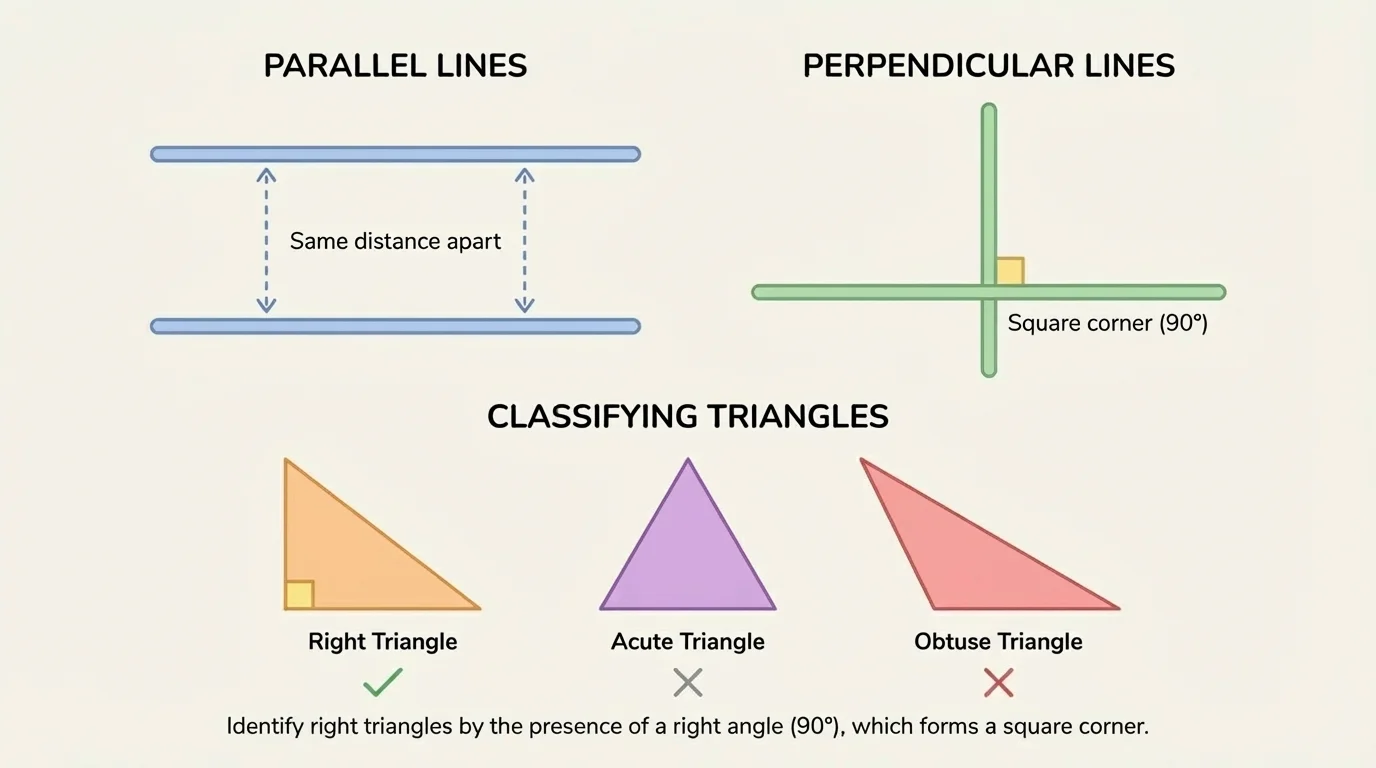
It helps to compare these ideas. Parallel lines do not cross. Perpendicular lines do cross, and they cross in a special way to make a right angle. If lines cross but do not make a square corner, they are not perpendicular.
You already know that a shape is made from line segments. A line segment is a straight path with two endpoints. The sides of polygons are line segments.
When classifying a figure, you can ask: Does it have any parallel sides? Does it have any perpendicular sides? Those two questions can tell you a lot about the figure even before you think about its angles.
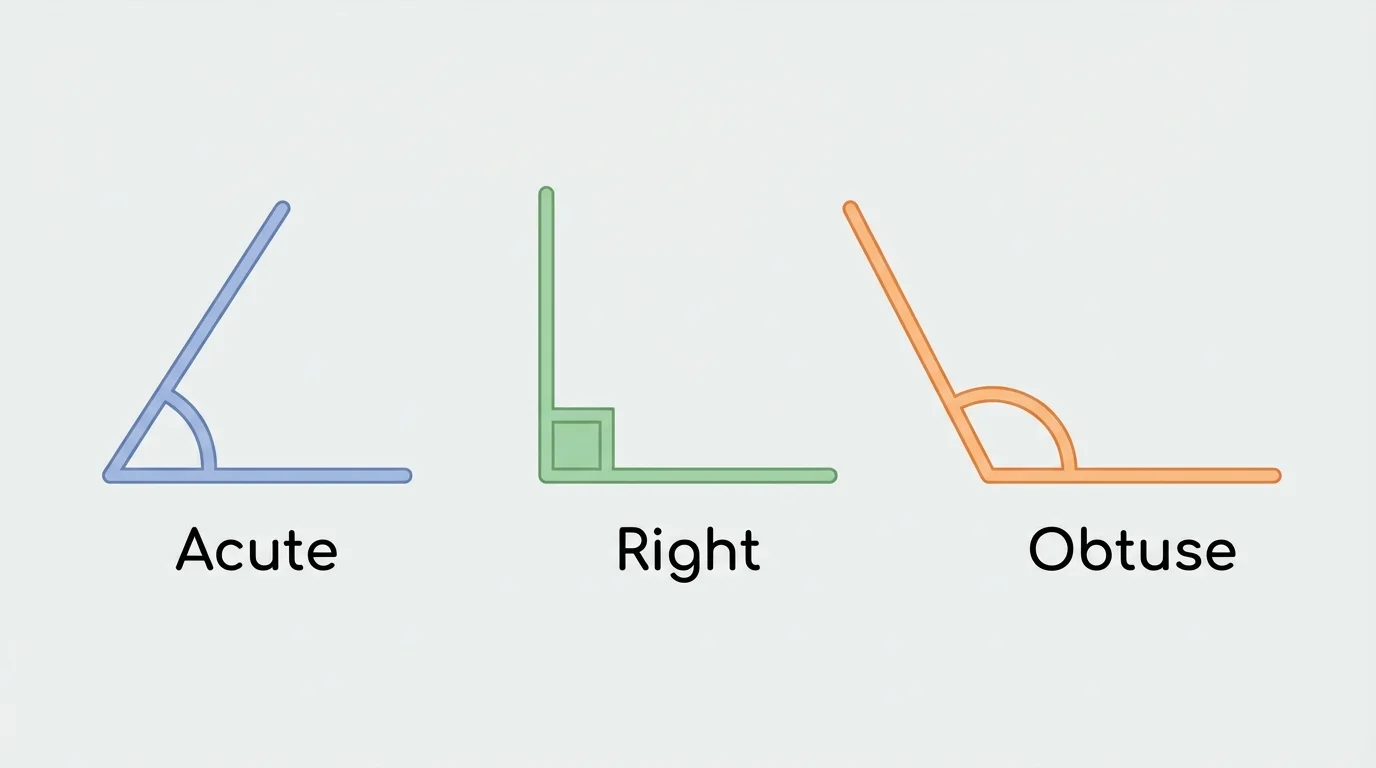
An angle is formed when two line segments meet at a point. The size of the angle depends on how open it is. In geometry, angles can be smaller than a right angle, exactly a right angle, or larger than a right angle, as [Figure 2] illustrates.
Right angle: an angle that measures exactly \(90^\circ\).
Acute angle: an angle smaller than \(90^\circ\).
Obtuse angle: an angle larger than \(90^\circ\) but smaller than \(180^\circ\).
A right angle looks like the corner of a sheet of paper. Many drawings mark a right angle with a small square in the corner. That little square tells us the angle is exactly \(90^\circ\).
An acute angle is smaller than a right angle. An obtuse angle is larger than a right angle. Even if a shape is turned or tilted, the angle type does not change. A right angle is still \(90^\circ\), whether it points up, down, or sideways.
That idea matters because sometimes students think a shape changes just because it is rotated. But turning a shape does not change its lines or angle sizes. A right angle stays a right angle.
Later, when you classify shapes, you may notice that some figures have several right angles, some have no right angles, and some have a mix of angle sizes. We can also sort shapes by asking whether they have an angle of a specified size, such as a right angle.
A rectangle on a wall and the same rectangle tilted still has the same angle sizes if nothing about the corners changes. Position does not change angle measure.
So far, we have two powerful ways to describe a shape: by the kinds of lines it has and by the kinds of angles it has. Those properties let us group shapes very clearly.
Classifying a shape means noticing its attributes. An attribute is a feature you can describe. In this topic, important attributes include whether a shape has parallel lines, perpendicular lines, right angles, acute angles, or obtuse angles.
Suppose you see a four-sided figure. You do not have to name it. You can say, "It has two pairs of parallel sides and four right angles," or "It has no parallel sides and no right angles." That is a strong mathematical description because it tells exactly what the shape is like.
This way of thinking is important because different shapes can be grouped together if they share the same attributes. For example, many different-looking figures can all belong in the group "has at least one pair of parallel sides." Other figures can belong in the group "has at least one right angle."
Classify by properties, not by names
When mathematicians classify figures, they often focus on what is true about the figure. A shape can be described by its lines and angles even if we do not use a formal shape name. This helps us see patterns and relationships between shapes.
Here are some useful classification questions:
If you answer those questions carefully, you can sort many figures into groups. This is often more useful than only memorizing names.
| Attribute to Check | What to Look For | Example Description |
|---|---|---|
| Parallel lines | Sides that stay the same distance apart and never meet | "One pair of sides is parallel" |
| Perpendicular lines | Sides that meet to form a right angle | "Two sides are perpendicular" |
| Right angle | A square corner, exactly \(90^\circ\) | "The figure has four right angles" |
| Acute angle | An angle smaller than \(90^\circ\) | "All the angles are acute" |
| Obtuse angle | An angle larger than \(90^\circ\) | "The figure has one obtuse angle" |
Table 1. A comparison of important attributes used to classify two-dimensional figures.
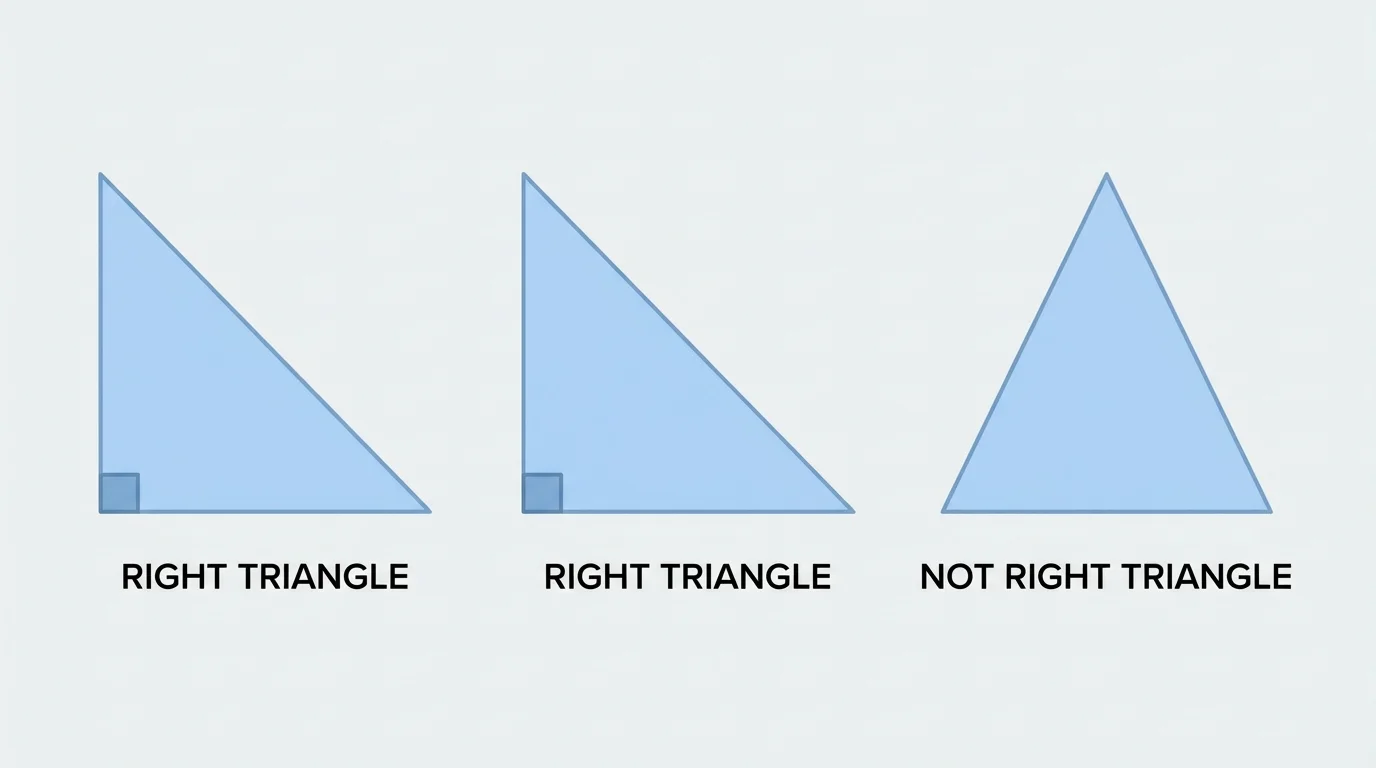
A triangle is a figure with three sides and three angles. A right triangle is any triangle that has one right angle. That right angle must measure \(90^\circ\).
[Figure 3] shows that right triangles are a special category of triangles. Not every triangle is a right triangle, but every right triangle is still a triangle because it has three sides and three angles.
Some triangles have three acute angles. Those are not right triangles because none of their angles is \(90^\circ\). Some triangles have one obtuse angle. Those are also not right triangles. To be a right triangle, the triangle must have exactly one right angle.
Why exactly one? The three angles in a triangle fit together in a special way. If a triangle had two right angles, that would already make \(90^\circ + 90^\circ = 180^\circ\), leaving no angle left for the third corner. So a triangle can have only one right angle.
When identifying a right triangle, look for the square-corner mark first. If no mark is shown, inspect the angle. Does one corner make a right angle? If yes, the triangle belongs in the right-triangle category. This idea from [Figure 3] helps even when the triangle is tilted or drawn in a different size.
Let us use what we know to classify figures by their attributes.
Worked example 1
A four-sided figure has two pairs of parallel sides. Each corner is a right angle. How can it be classified by attributes?
Step 1: Identify the line attributes.
The figure has two pairs of parallel sides.
Step 2: Identify the angle attributes.
Each corner is a right angle, so it has four right angles. Since the corners are right angles, nearby sides are perpendicular.
Step 3: Write the classification.
The figure can be described as having two pairs of parallel sides, perpendicular sides, and four right angles.
This classification uses properties, not a formal shape name.
Notice how the description tells a lot about the figure without needing a label. That is exactly what geometric classification is about.
Worked example 2
A triangle has one angle measuring \(90^\circ\). The other two angles are acute. Is it a right triangle?
Step 1: Look for the needed attribute.
A right triangle must have one right angle.
Step 2: Compare the triangle's angle.
One angle is \(90^\circ\), so the triangle has a right angle.
Step 3: Decide the category.
Yes. The triangle is a right triangle.
The key fact is simple: one right angle means the triangle is a right triangle.
Triangles can look narrow, wide, tall, or tilted, but the right angle is what decides whether they belong in this category.
Worked example 3
A shape has no parallel sides. Two sides cross to form one right angle. How can you classify it?
Step 1: Check for parallel lines.
The shape has no parallel sides.
Step 2: Check for perpendicular lines.
Two sides form one right angle, so those sides are perpendicular.
Step 3: Write the classification.
The shape can be classified as having no parallel sides and at least one pair of perpendicular sides.
Again, we used attributes to describe the figure.
Even if you do not know the shape's name, you can still classify it correctly by observing its properties.
Worked example 4
A triangle has three acute angles. Is it a right triangle?
Step 1: Recall the definition.
A right triangle must have one angle of \(90^\circ\).
Step 2: Compare with the triangle.
This triangle has three acute angles, so every angle is less than \(90^\circ\).
Step 3: Decide.
No. It is not a right triangle because it has no right angle.
The absence of a right angle means it does not belong in the right-triangle category.
Geometry is all around you. A window frame often has parallel sides and perpendicular sides. A corner of a book shows a right angle. A wheelchair ramp and the ground can form an angle that helps us think about angle size. A triangular road sign may or may not be a right triangle, depending on whether one angle is \(90^\circ\).
On a soccer field or basketball court, painted lines are often parallel. At the corners of the court, the boundary lines are perpendicular. Builders, designers, and artists all need to notice these line relationships to make structures and patterns that work well.
Floor tiles also give great examples. Some tiles make rows of parallel edges. Some tile corners form right angles. Looking at these patterns is a fun way to practice classification in everyday life.
Why this matters in the real world
People use shape properties to build safe corners, line up shelves, design screens, create maps, and lay out sports fields. Recognizing parallel and perpendicular lines helps make things straight and balanced. Recognizing right triangles helps in building supports and ramps.
When workers build a table, they want the legs and the tabletop edges to meet correctly. If the corner is supposed to be a right angle, the lines must be perpendicular. If shelves must line up evenly, edges often need to stay parallel.
One common mistake is thinking that lines are parallel just because they both slant in the same direction. To be parallel, they must stay the same distance apart and never meet. [Figure 1] helps us compare that idea with perpendicular lines.
Another mistake is thinking that any crossing lines are perpendicular. That is not true. The lines must meet to form a right angle. If the corner is not \(90^\circ\), the lines are not perpendicular.
Students also sometimes think a triangle is a right triangle only if it "looks" like one from a familiar drawing. But the position of the triangle does not matter. As long as one angle is \(90^\circ\), it is a right triangle, which is exactly what we saw earlier in [Figure 3].
A final mistake is focusing too much on names. In this topic, the important job is to describe and sort shapes by their attributes. Saying "this figure has one pair of parallel sides and one right angle" is stronger than guessing a name and getting it wrong.
"Good geometry begins with careful looking."
Careful looking means checking the sides and checking the angles. Once you do that, classification becomes much easier and much more accurate.
