Have you ever noticed that many things around you seem to have a "mirror look"? A butterfly, a leaf, a snowflake, and even the front of some buildings can look the same on one side as on the other. In geometry, that matching idea is called symmetry, and it helps us describe shapes carefully and clearly.
A line of symmetry is a line across a figure so that the figure can be folded along that line into matching parts. If the two folded parts match exactly, then the line is a line of symmetry.
When a figure has at least one line of symmetry, we say the figure is line-symmetric. The two parts do not just look close to the same. They must match exactly in shape and size when folded.
Symmetry means a figure has parts that match in a special way.
Line of symmetry means a line that divides a figure into two matching halves.
Two-dimensional figure means a flat shape, such as a triangle, rectangle, or circle.
Think about a square. If you fold it straight down the middle from top to bottom, the left half lands exactly on the right half. That fold line is a line of symmetry. But if you fold many irregular shapes, the sides will not match, so there is no line of symmetry there.
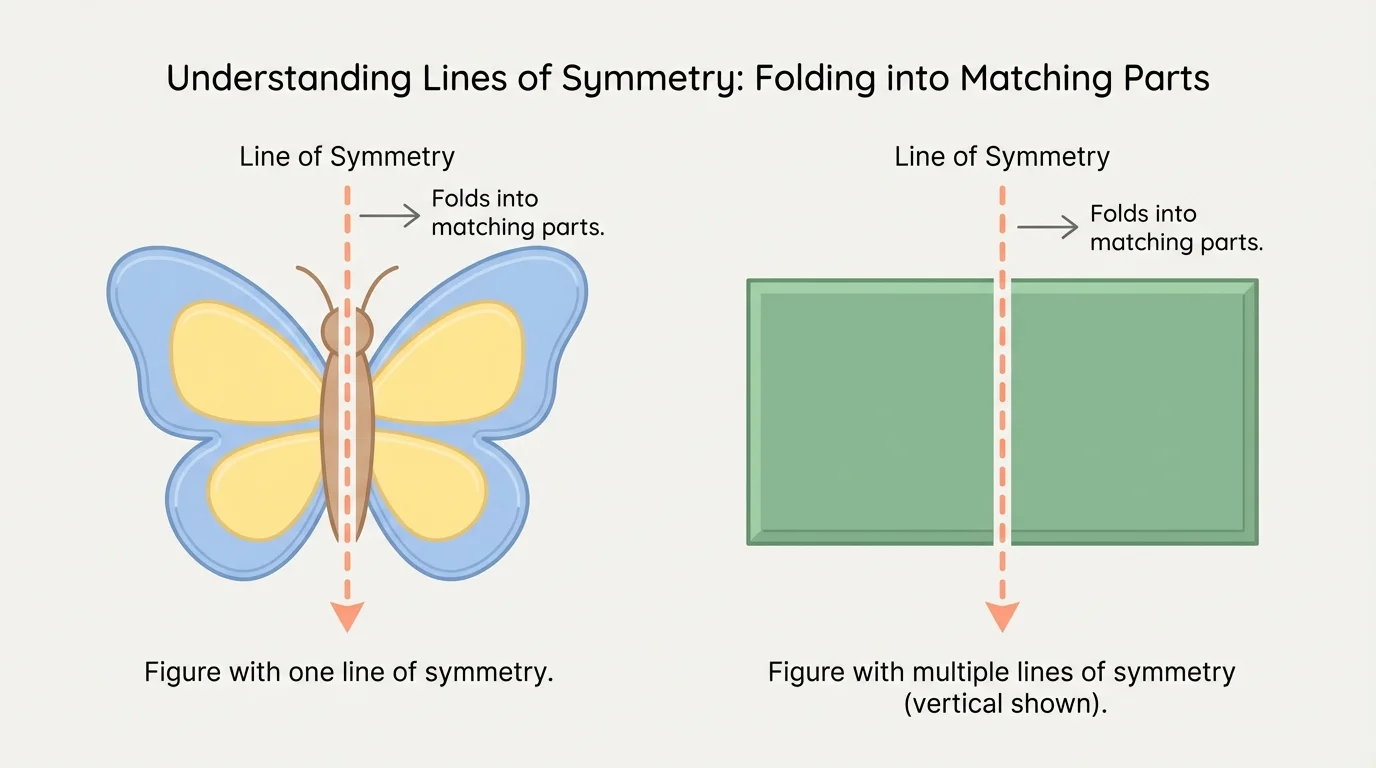
Another way to think about symmetry is with a mirror. A line of symmetry acts like a mirror. Points on one side of the line have matching points on the other side at the same distance from the line.
To decide whether a line is a line of symmetry, ask one important question: If I fold the figure on this line, will both sides match exactly? If the answer is yes, the line works. If the answer is no, it does not.
Here are some clues that help:
Suppose a rectangle is taller than it is wide. A vertical line through its center works because the left and right sides match. A horizontal line through its center also works because the top and bottom match. But a diagonal line usually does not work for a rectangle unless the rectangle is actually a square.
Matching halves
Two halves match when every part on one side has a partner on the other side. If one side has a corner, curve, or edge that the other side does not have, then the figure does not fold into matching halves along that line.
This is why symmetry is more exact than just "looking balanced." A shape may seem almost even, but in geometry, "almost" is not enough. The parts must match exactly.
Some figures have exactly one line of symmetry. That means there is only one way to fold them into matching parts.
One common example is an isosceles triangle.
An isosceles triangle has two equal sides. A line from the top vertex straight down to the middle of the base divides it into two matching parts. That is its one line of symmetry.
A heart shape often has one vertical line of symmetry. The left half matches the right half. Many simple drawings of leaves also have one line of symmetry down the center.
A non-square rectangle does not have just one line of symmetry. It actually has one horizontal line of symmetry and one vertical line of symmetry, so it has two lines of symmetry. This is a good reminder to check carefully instead of guessing from appearance.
| Figure | Number of lines of symmetry | Possible direction |
|---|---|---|
| Isosceles triangle | \(1\) | Usually vertical through the top vertex |
| Heart shape | \(1\) | Vertical |
| Regular pentagon | \(5\) | Five symmetry lines |
| Non-square rectangle | \(2\) | Vertical and horizontal |
Table 1. Examples of figures and how many lines of symmetry they have.
Some figures have several lines of symmetry. This happens when a figure can be folded in more than one way to make matching halves.
[Figure 2] A square is a great example. It has four lines of symmetry: one vertical, one horizontal, and two diagonal lines. Each of these lines divides the square into matching parts.
A rectangle that is not a square has two lines of symmetry: one vertical and one horizontal. The diagonals do not work because the halves do not match when folded.
A circle has many lines of symmetry. In fact, any line through the center of a circle is a line of symmetry. That means a circle has more lines of symmetry than we can easily count one by one.
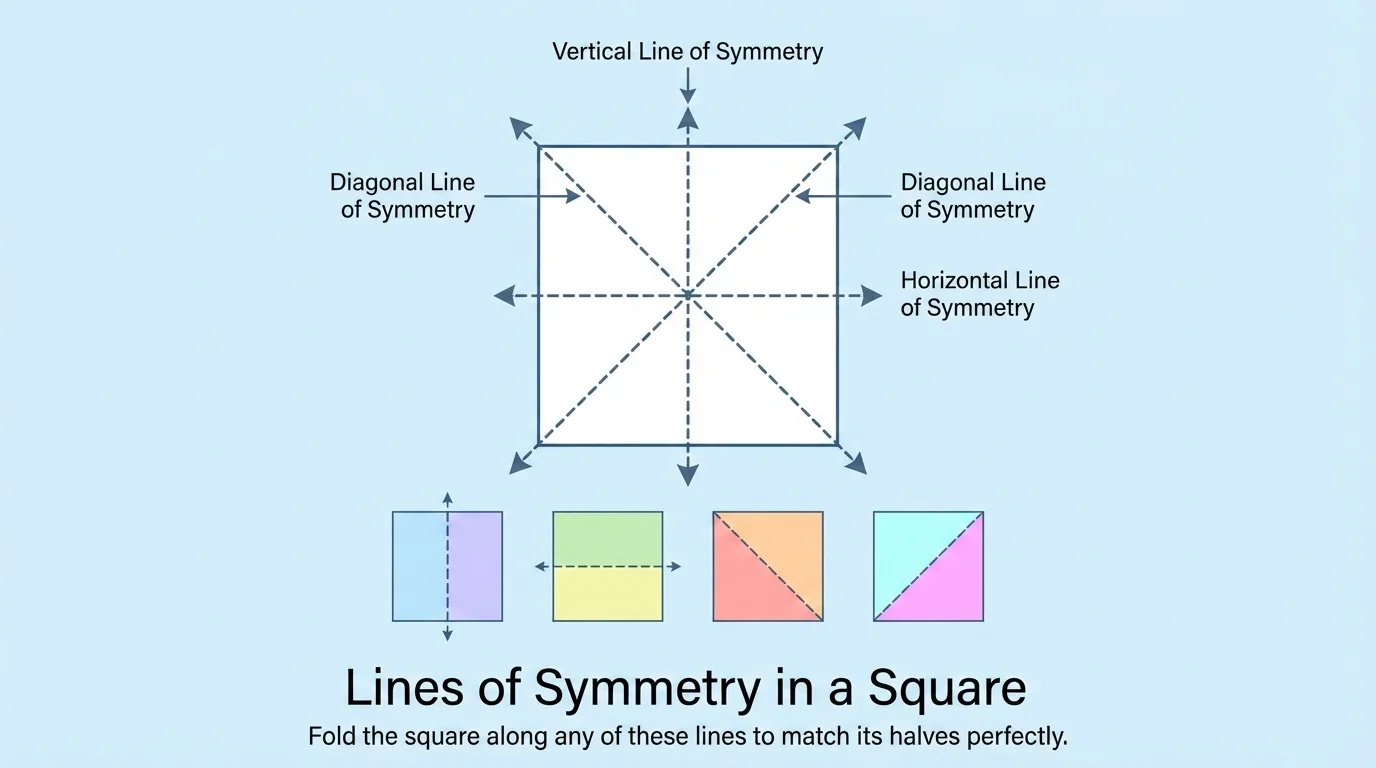
Regular polygons also have symmetry. A regular polygon is a shape with all sides equal and all angles equal. For example, a regular triangle, also called an equilateral triangle, has three lines of symmetry. A regular hexagon has six lines of symmetry.
A snowflake often looks as if it has many matching parts because its pattern grows in a balanced way. Many snowflake designs show symmetry that connects to the shape of a hexagon.
The square is a strong example of how one figure can have symmetry in different directions. This helps us see that the number of symmetry lines depends on the figure's properties, not just on whether it "looks nice."
Some figures cannot be folded into matching parts at all. These figures have no line of symmetry.
A scalene triangle is one example. A scalene triangle has no equal sides, so no fold line makes the two halves match exactly. Many irregular quadrilaterals also have no lines of symmetry.
Suppose you draw a four-sided figure with one long side, one short side, and corners that do not match. Even if one part seems close to another part, the shape is not line-symmetric unless a fold creates exact matches.
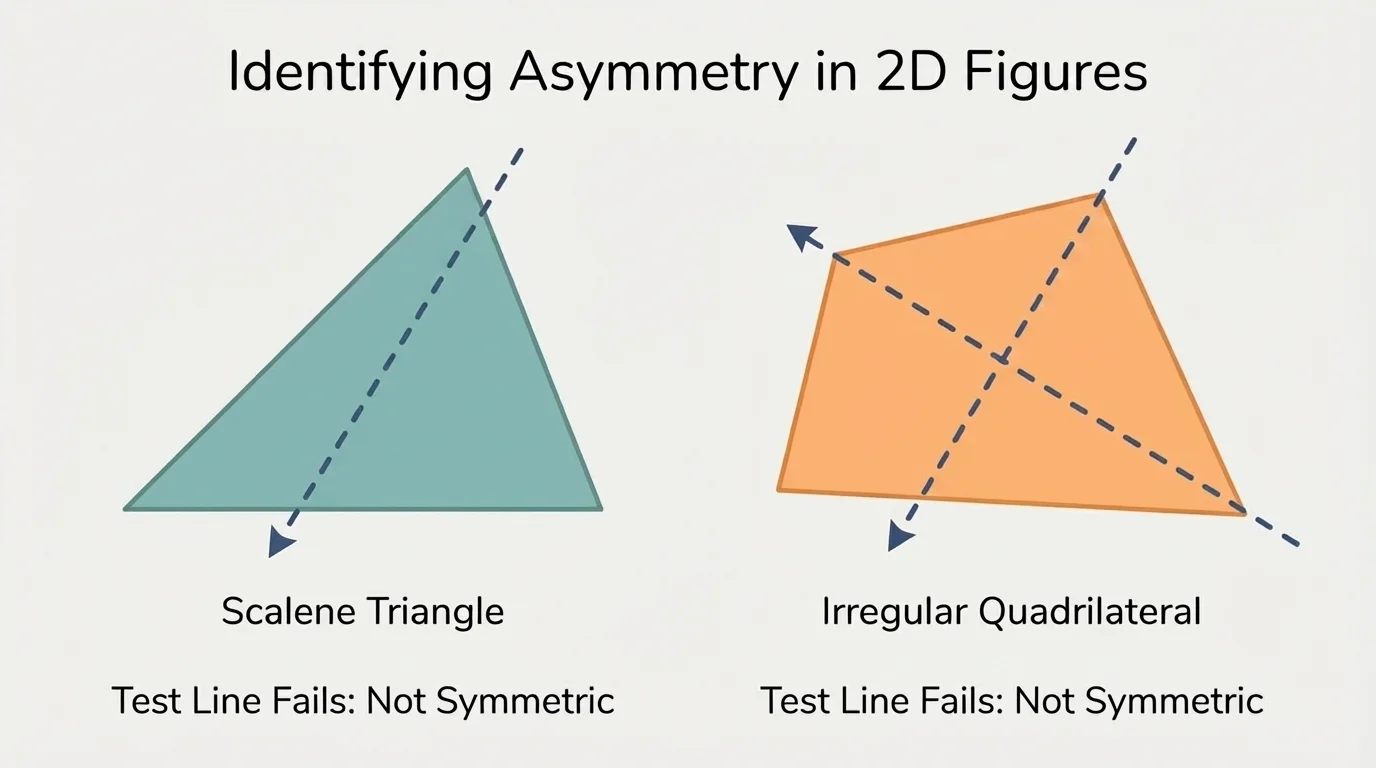
This is why checking symmetry is important. We should not rely only on quick looks. A careful fold test or mirror test helps us make the correct decision.
[Figure 4] When you need to draw a possible line of symmetry, a step-by-step method helps you look for the middle of the figure and matching parts on each side.
Use these steps:
Step 1: Look at the shape carefully and decide whether it seems to have matching sides or matching corners.
Step 2: Find a line that appears to go through the middle of the figure.
Step 3: Check whether the parts on both sides of that line would match if folded.
Step 4: Draw the line only if the parts match exactly.
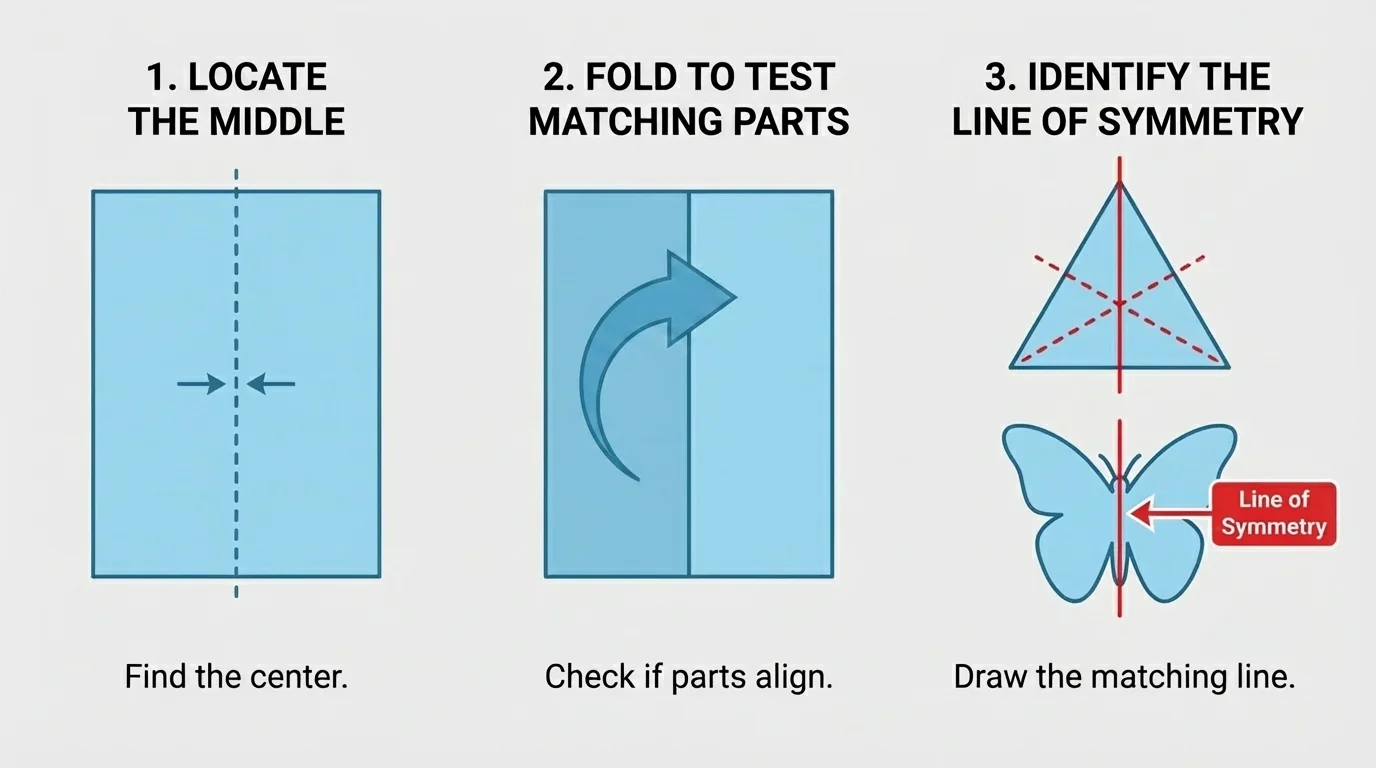
For a rectangle, you can draw one vertical line through the center and one horizontal line through the center. For an isosceles triangle, draw a line from the top vertex to the midpoint of the base. For a square, draw the vertical, horizontal, and both diagonal lines.
Later, when you check your answer, think again about folding. The drawn line must create two parts that fit exactly on top of each other.
Earlier geometry work helps here: shapes can be described by their sides, corners, and angles. Those properties often help you predict whether a figure might have symmetry.
Worked examples show how to test figures and count symmetry lines carefully.
Worked Example 1
How many lines of symmetry does a non-square rectangle have?
Step 1: Test a vertical line through the center.
If the rectangle is folded along the vertical middle line, the left side matches the right side.
Step 2: Test a horizontal line through the center.
If the rectangle is folded along the horizontal middle line, the top matches the bottom.
Step 3: Test a diagonal line.
For a non-square rectangle, folding on a diagonal does not make matching halves.
So the rectangle has \(2\) lines of symmetry.
This example shows why it is important to test more than one possible line.
Worked Example 2
Does a scalene triangle have a line of symmetry?
Step 1: Remember the property of a scalene triangle.
All three sides have different lengths.
Step 2: Think about folding.
If one side length is different from the others, the two folded parts cannot match exactly.
Step 3: Decide.
No fold line creates matching halves.
The answer is \(0\) lines of symmetry.
A shape with no symmetry is still a valid figure. It just does not have a matching fold line.
Worked Example 3
A square is shown. Draw all its lines of symmetry.
Step 1: Draw the vertical line through the center.
This makes the left and right halves match.
Step 2: Draw the horizontal line through the center.
This makes the top and bottom halves match.
Step 3: Draw one diagonal from the top left corner to the bottom right corner.
Those two halves match.
Step 4: Draw the other diagonal from the top right corner to the bottom left corner.
Those two halves also match.
The square has \(4\) lines of symmetry.
Notice that the diagonals worked here because all sides and all angles of the square are equal.
Worked Example 4
An equilateral triangle has all sides equal. How many lines of symmetry does it have?
Step 1: Think about each vertex.
A line from a vertex to the midpoint of the opposite side makes matching halves.
Step 2: Count how many vertices there are.
An equilateral triangle has \(3\) vertices.
Step 3: Match each vertex with one symmetry line.
Each vertex gives one valid line of symmetry.
So an equilateral triangle has \(3\) lines of symmetry.
Symmetry is not only for math class. It appears in art, nature, sports designs, and architecture.
A butterfly often has a body that lies along a vertical line of symmetry. The left wing and right wing are similar in shape and pattern. Some leaves also have a center line with matching sides.
Many buildings are designed with symmetry. The front entrance may be in the middle, with the same number of windows on each side. This creates a balanced look.
Logos and patterns often use symmetry because it makes designs easier to notice and remember. Quilts, tiles, and paper cutouts also use lines of symmetry.
Why symmetry matters
Symmetry helps people design objects that are pleasing to look at and easy to organize. In geometry, symmetry also helps us classify figures by their properties.
In math, recognizing symmetry can make it easier to describe a shape quickly. Instead of listing every detail of both sides, we can say the figure has a certain line or number of lines of symmetry.
One common mistake is thinking that any line through the middle of a figure must be a line of symmetry. That is not true. The line must create matching halves.
Another mistake is counting lines that only almost work. Geometry needs exact matches, not close matches.
A third mistake is forgetting that some shapes have more lines of symmetry than expected. A square has \(4\), not just \(2\). A circle has many. A non-square rectangle has \(2\), not \(4\).
| Figure | Line-symmetric? | Number of lines of symmetry |
|---|---|---|
| Square | Yes | \(4\) |
| Non-square rectangle | Yes | \(2\) |
| Equilateral triangle | Yes | \(3\) |
| Isosceles triangle | Yes | \(1\) |
| Scalene triangle | No | \(0\) |
| Circle | Yes | Many |
Table 2. A comparison of common figures and their symmetry.
By checking carefully, folding mentally, and looking for exact matches, you can identify whether a figure is line-symmetric and draw its lines of symmetry correctly.
