Have you ever noticed that some things seem to follow a secret plan? The days of the week repeat in order, floor tiles often grow in neat designs, and scores in a game can rise in regular jumps. Math patterns work the same way. A pattern may start with one simple rule, but when you look closely, you can discover extra facts hidden inside it.
Patterns are important because they help us predict what comes next, describe what we see, and explain why something keeps happening. In this lesson, you will learn how to build patterns from rules and how to notice features that the rule does not say directly. Then you will explain, in a simple way, why those features continue.
A pattern is something that follows a rule in a way that makes it predictable. In math, patterns can be made of numbers, shapes, colors, or movements. Some patterns repeat, and some patterns grow.
A growing pattern usually has a rule that tells how to get from one term to the next. Each number or shape in the pattern is called a term. If we know the starting term and the rule, we can generate more terms.
Pattern means an arrangement of numbers, shapes, or objects that follows a rule.
Rule means the instruction that tells how the pattern changes.
Term means one number or one figure in a pattern.
For example, if the starting number is \(2\) and the rule is \(+4\), the terms are \(2, 6, 10, 14, 18, ...\). The rule says to add \(4\) each time. That is the visible instruction. But maybe the pattern also has another feature, such as all terms being even. That extra idea was not stated in the rule, so we have to notice it by looking.
To generate a sequence, start with the given number and apply the rule again and again. A number line can help us see that the same-sized jump happens each time when a rule tells us to add the same amount.
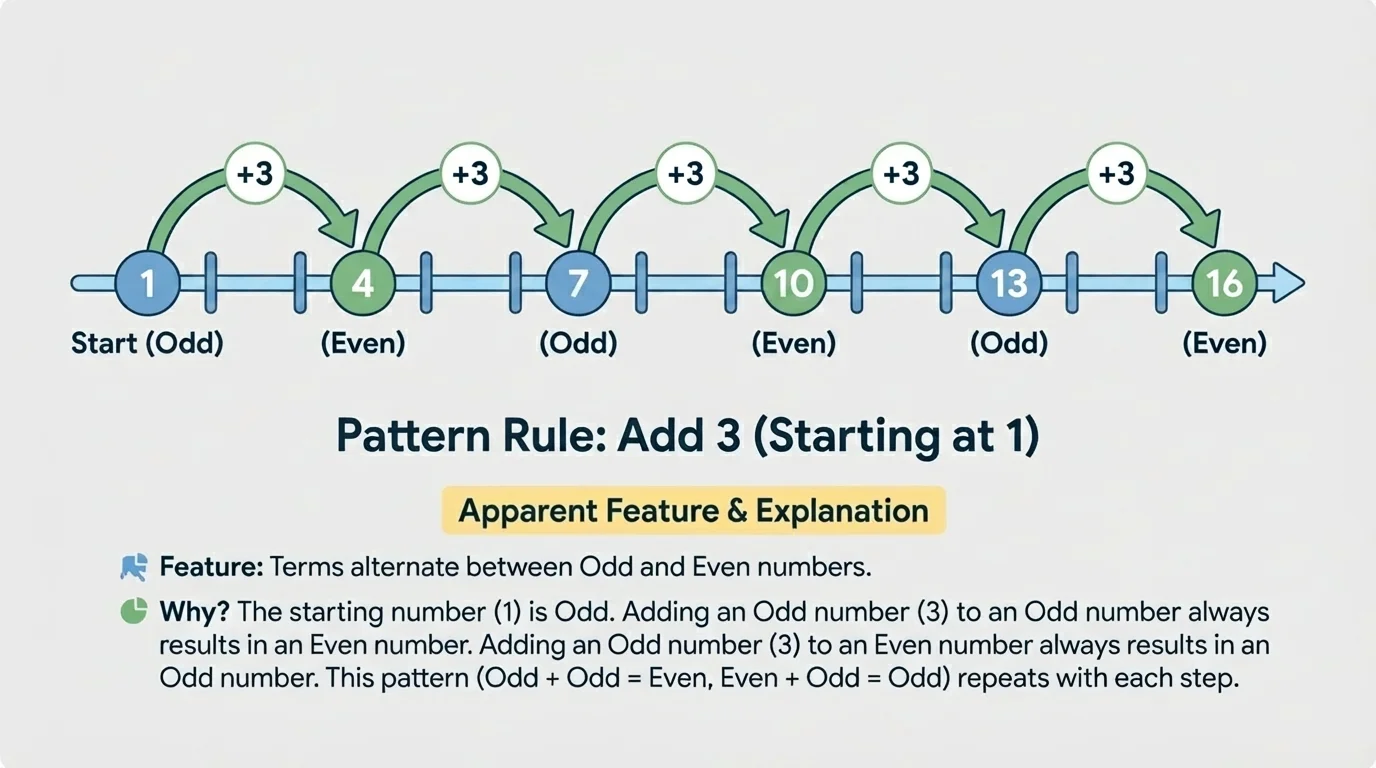
Suppose the starting number is \(5\) and the rule is "add \(2\)." Then we begin with \(5\). The next term is \(5 + 2 = 7\). The term after that is \(7 + 2 = 9\). Then \(9 + 2 = 11\). The sequence is \(5, 7, 9, 11, 13, ...\). This is shown on a number line in [Figure 1].
We can also have subtraction rules. If the starting number is \(20\) and the rule is "subtract \(3\)," the terms are \(20, 17, 14, 11, 8, ...\). The pattern still follows a rule. The numbers just move downward instead of upward.
When you generate a number pattern, it helps to work in order and check that each new term follows exactly the same rule. If one step does not match the rule, the whole pattern can go off track.
Remember that odd numbers cannot be split into two equal groups without one left over, like \(1, 3, 5, 7\). Even numbers can be split into two equal groups, like \(2, 4, 6, 8\).
Knowing odd and even numbers is very useful when studying patterns. Many hidden features involve whether terms are odd or even.
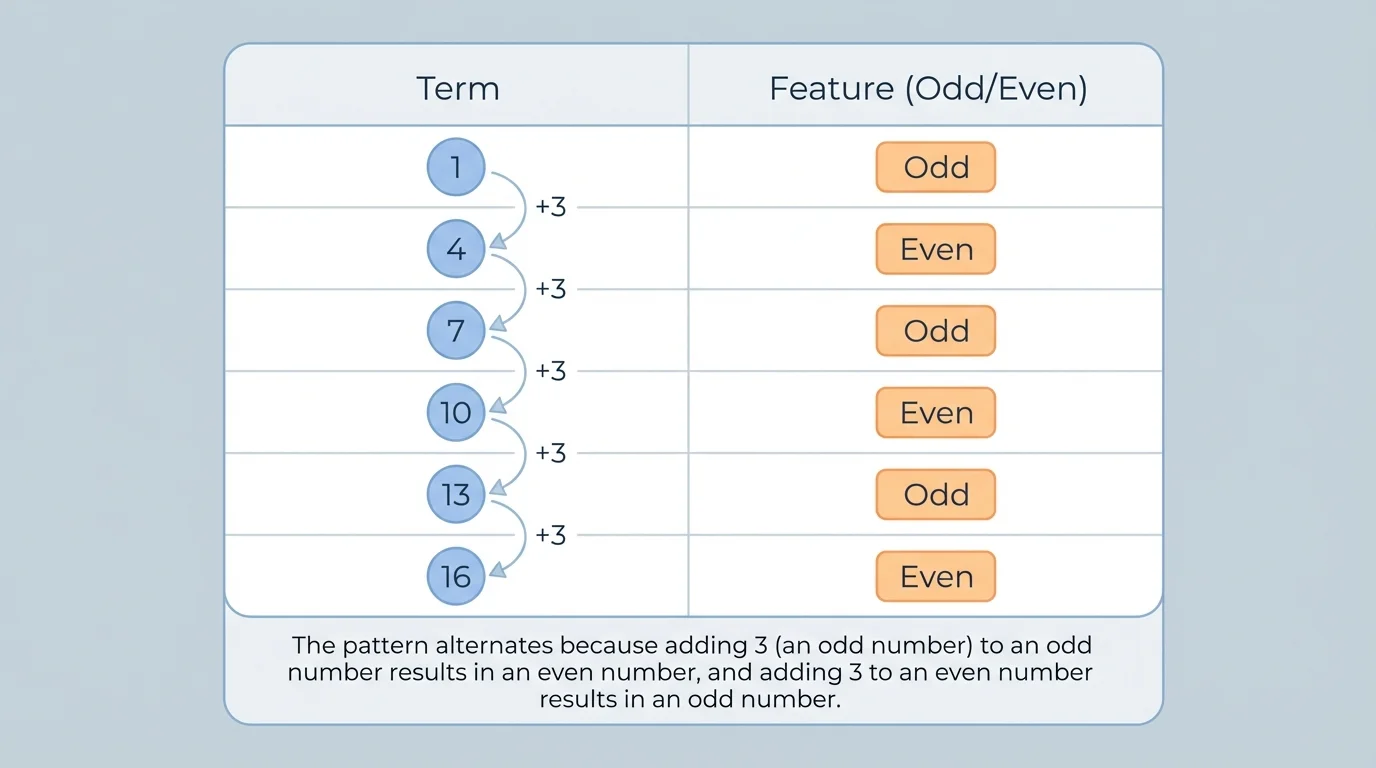
Sometimes a pattern has an extra feature that is not written in the rule. For example, if the rule is "add \(3\)" and the starting number is \(1\), the terms are \(1, 4, 7, 10, 13, 16, ...\). The rule only says to add \(3\), but when we label each term as odd or even, we notice that the terms alternate between odd and even.
[Figure 2] This kind of pattern feature is called an feature. A feature is something we observe about the pattern, even if the rule did not say it directly.
Here are some features you might notice in number patterns:
Let us look at another example. Start with \(2\) and add \(4\). The terms are \(2, 6, 10, 14, 18, ...\). The rule says nothing about odd or even, but every term is even. That is a hidden feature we can discover.
Now try starting with \(3\) and adding \(10\). The terms are \(3, 13, 23, 33, 43, ...\). One feature is that every term ends in \(3\). The rule did not say "keep the ones digit the same," but we can see it happen.
It is not enough to say, "I noticed it." In math, we also want to explain why a feature should continue. In grade \(4\), an informal explanation means using simple math ideas and clear words, not a complicated proof.
Return to the pattern \(1, 4, 7, 10, 13, 16, ...\). We started at \(1\), which is odd. Then we added \(3\), which is odd. Odd plus odd gives an even number, so \(1 + 3 = 4\) is even. Then we add \(3\) again. Even plus odd gives an odd number, so \(4 + 3 = 7\) is odd. Each time we add \(3\), the pattern switches from odd to even or from even to odd.
Why adding an odd number changes odd and even
When you add an odd number, whether a number is odd or even changes. That means an odd number becomes even, and an even number becomes odd. Since \(3\) is odd, adding \(3\) over and over makes the pattern keep switching.
This idea helps us explain the pattern. Since every step adds \(3\), and adding an odd number always changes odd to even or even to odd, the terms will continue to alternate forever. The alternation is not an accident. It comes from the rule itself.
Compare that with adding an even number. If we start with \(1\) and add \(4\), we get \(1, 5, 9, 13, 17, ...\). All the terms are odd. That happens because odd plus even stays odd. If we started with an even number and kept adding \(4\), all terms would stay even.
So there is a powerful pattern idea here: adding an odd number changes odd/even, but adding an even number keeps odd/even the same. We can use this to predict hidden features very quickly, and we can still connect that idea back to the chart in [Figure 2], where the alternation is easy to see.
Patterns are not only made of numbers. A shape pattern can grow by adding the same number of tiles, dots, sticks, or squares each time. The visual growth in a tile pattern helps us see both the rule and a hidden feature at the same time.
Suppose Figure \(1\) has \(3\) tiles, Figure \(2\) has \(5\) tiles, and Figure \(3\) has \(7\) tiles. The rule is "add \(2\) tiles each time." The number pattern is \(3, 5, 7, 9, 11, ...\). One hidden feature is that every figure has an odd number of tiles, as shown in [Figure 3].
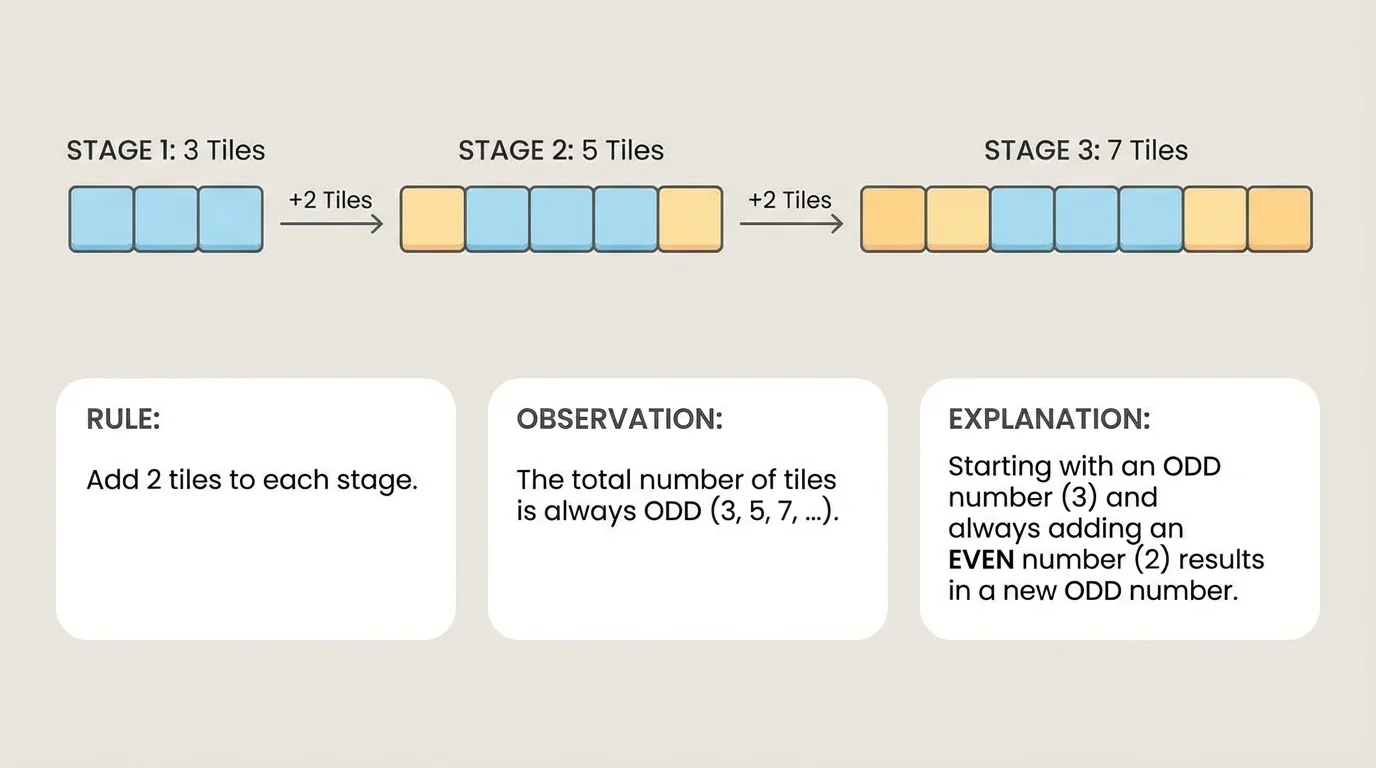
Why does that continue? The first figure has \(3\) tiles, which is odd. The rule adds \(2\) more tiles each time, and \(2\) is even. Adding an even number keeps odd/even the same. So every new figure still has an odd number of tiles.
Shape patterns can also have visual features that are not stated in the rule. Maybe the figures stay symmetrical. Maybe they make a staircase shape. Maybe one side grows while another side stays the same. These are important observations because they help you understand the structure of the pattern, not just count it.
Now let us work through several examples carefully.
Worked example 1
Generate the pattern starting at \(1\) with the rule "add \(3\)." Then identify a hidden feature and explain why it continues.
Step 1: Start with the first term.
The starting term is \(1\).
Step 2: Add \(3\) again and again.
\[1, 4, 7, 10, 13, 16\]
Step 3: Look for a feature.
The terms alternate odd, even, odd, even, odd, even.
Step 4: Explain why it continues.
Since \(3\) is odd, adding \(3\) changes odd to even and even to odd. So the terms will keep alternating.
The hidden feature is that the terms alternate between odd and even.
This example is important because it shows that one simple rule can create a second pattern inside it.
Worked example 2
Start at \(6\) and use the rule "subtract \(2\)." Generate the first \(5\) terms and identify a hidden feature.
Step 1: Write the starting term.
The first term is \(6\).
Step 2: Subtract \(2\) each time.
\[6, 4, 2, 0, -2\]
Step 3: Look for a feature.
Every term is even.
Step 4: Explain why.
We started with an even number, \(6\). Subtracting \(2\), which is even, keeps the numbers even each time.
The hidden feature is that all terms are even.
Notice that subtracting an even number works like adding an even number for odd/even behavior: it keeps odd/even the same.
Worked example 3
A shape pattern has \(4\) squares in Figure \(1\). Each new figure has \(3\) more squares than the previous figure. Find the number of squares in the first \(4\) figures and identify a hidden feature.
Step 1: Begin with Figure \(1\).
Figure \(1\) has \(4\) squares.
Step 2: Add \(3\) squares for each new figure.
Figure \(2\): \(4 + 3 = 7\)
Figure \(3\): \(7 + 3 = 10\)
Figure \(4\): \(10 + 3 = 13\)
Step 3: Write the pattern.
\[4, 7, 10, 13\]
Step 4: Look for a feature and explain it.
The terms alternate between even and odd. Since \(3\) is odd, adding \(3\) changes even to odd and odd to even each time.
The hidden feature is alternating even and odd numbers.
As we saw in [Figure 3], shape patterns can be studied with numbers too. Once we count each figure, we can analyze the number pattern behind the shapes.
Worked example 4
Start with \(8\) and use the rule "add \(10\)." Generate \(5\) terms and identify a hidden feature not stated in the rule.
Step 1: Start with \(8\).
The first term is \(8\).
Step 2: Add \(10\) each time.
\[8, 18, 28, 38, 48\]
Step 3: Look for a feature.
Each term ends in \(8\).
Step 4: Explain why.
Adding \(10\) changes the tens digit but keeps the ones digit the same, so the ones digit stays \(8\).
The hidden feature is that the ones digit stays the same.
Patterns are everywhere in real life. If a person climbs stairs and goes up \(2\) steps at a time, the step numbers they land on form a pattern. If a video game gives \(5\) extra points every round, the score follows a pattern. If a garden border uses \(2\) more tiles each section, that is a shape pattern.
Calendars also show patterns. If today is the \(4\)th of the month and you look one week at a time, the dates are \(4, 11, 18, 25, ...\). The rule is "add \(7\)." A hidden feature is that these numbers alternate odd and even, because \(7\) is odd.
Musicians use patterns too. Beats in music often repeat or grow in regular ways, and dancers may move in step patterns that can be counted and predicted.
Builders and designers pay attention to shape patterns because they need to know how many tiles, bricks, or boards each new design will use. Finding hidden features can help them predict future figures without drawing every single one.
One common mistake is changing the rule by accident. For example, if the rule is "add \(3\)," a student might write \(1, 4, 8, 11\). That does not work because \(4 + 3 = 7\), not \(8\).
Another mistake is noticing a feature but not explaining why it continues. In math, a good explanation is part of the answer. If the pattern alternates odd and even, say why: adding an odd number changes odd/even each time.
A smart check is to compare two neighboring terms. Ask, "Did I use the rule correctly?" Another smart check is to label terms as odd or even, especially when you are looking for hidden features. That is exactly what the chart in [Figure 2] helps us do.
You can also check the ones digit or count how many shapes were added from one figure to the next. These small observations often reveal a hidden pattern quickly.
When you explain a pattern, use clear math language. You might say, "The rule is to add \(3\)," or "The terms alternate odd and even," or "The feature continues because adding an odd number changes odd/even each time."
Here are some useful sentence starters:
Using careful language helps others understand your thinking, and it helps you understand the pattern more deeply too.
