A stopwatch in a race might show \(9.62\) seconds. A pencil might be \(0.17\) meter long. A bottle might hold \(0.5\) liters. Decimals are everywhere, and they help us describe parts of a whole very precisely. When you see a decimal, you are often really looking at a fraction with a denominator of \(10\), \(100\), or more. Learning how decimals and fractions connect makes numbers easier to understand.
Whole numbers count complete things, but many real objects are not measured in whole amounts. A ribbon can be shorter than \(1\) meter. A jar can be less than \(1\) liter full. A runner's time can include part of a second. For these situations, we use decimals.
Decimals are closely connected to fractions. For example, \(\dfrac{6}{10}\) and \(0.6\) name the same amount. Also, \(\dfrac{62}{100}\) and \(0.62\) name the same amount. The decimal is just another way to write the fraction.
You already know that a fraction shows equal parts of a whole. In \(\dfrac{3}{10}\), the denominator \(10\) tells how many equal parts the whole is divided into, and the numerator \(3\) tells how many of those parts are being counted.
Decimals use place value to show these same parts. The first place to the right of the decimal point shows tenths. The second place to the right shows hundredths.
A whole can be divided into \(10\) equal parts or \(100\) equal parts. When a whole is divided into \(10\) equal parts, each part is one tenth. We write one tenth as \(\dfrac{1}{10}\).
When a whole is divided into \(100\) equal parts, each part is one hundredth. We write one hundredth as \(\dfrac{1}{100}\).
Decimal point is a dot in a decimal number. It separates the whole-number part from the part that is less than one whole.
Decimal fraction is a fraction with a denominator of \(10\), \(100\), \(1{,}000\), and so on. In this lesson, we focus on fractions with denominators of \(10\) and \(100\).
Here are some matching names:
| Fraction | Decimal | How to read it |
|---|---|---|
| \(\dfrac{1}{10}\) | \(0.1\) | one tenth |
| \(\dfrac{4}{10}\) | \(0.4\) | four tenths |
| \(\dfrac{9}{10}\) | \(0.9\) | nine tenths |
| \(\dfrac{1}{100}\) | \(0.01\) | one hundredth |
| \(\dfrac{8}{100}\) | \(0.08\) | eight hundredths |
| \(\dfrac{62}{100}\) | \(0.62\) | sixty-two hundredths |
Table 1. Fractions with denominators of \(10\) and \(100\) written in decimal form.
Decimals are part of our place value system, and [Figure 1] shows how shaded parts of a whole can match tenths and hundredths. If the denominator is \(10\), write the numerator in the tenths place. If the denominator is \(100\), write the numerator in the hundredths place.
For example, \(\dfrac{7}{10}\) means seven tenths, so the decimal is \(0.7\). The \(7\) is in the tenths place. For \(\dfrac{35}{100}\), the decimal is \(0.35\). The \(3\) means \(3\) tenths, and the \(5\) means \(5\) hundredths.
Zeros are important in decimals. The fraction \(\dfrac{5}{100}\) is written as \(0.05\), not \(0.5\). The number \(0.5\) means \(\dfrac{5}{10}\), which is much larger than \(\dfrac{5}{100}\).
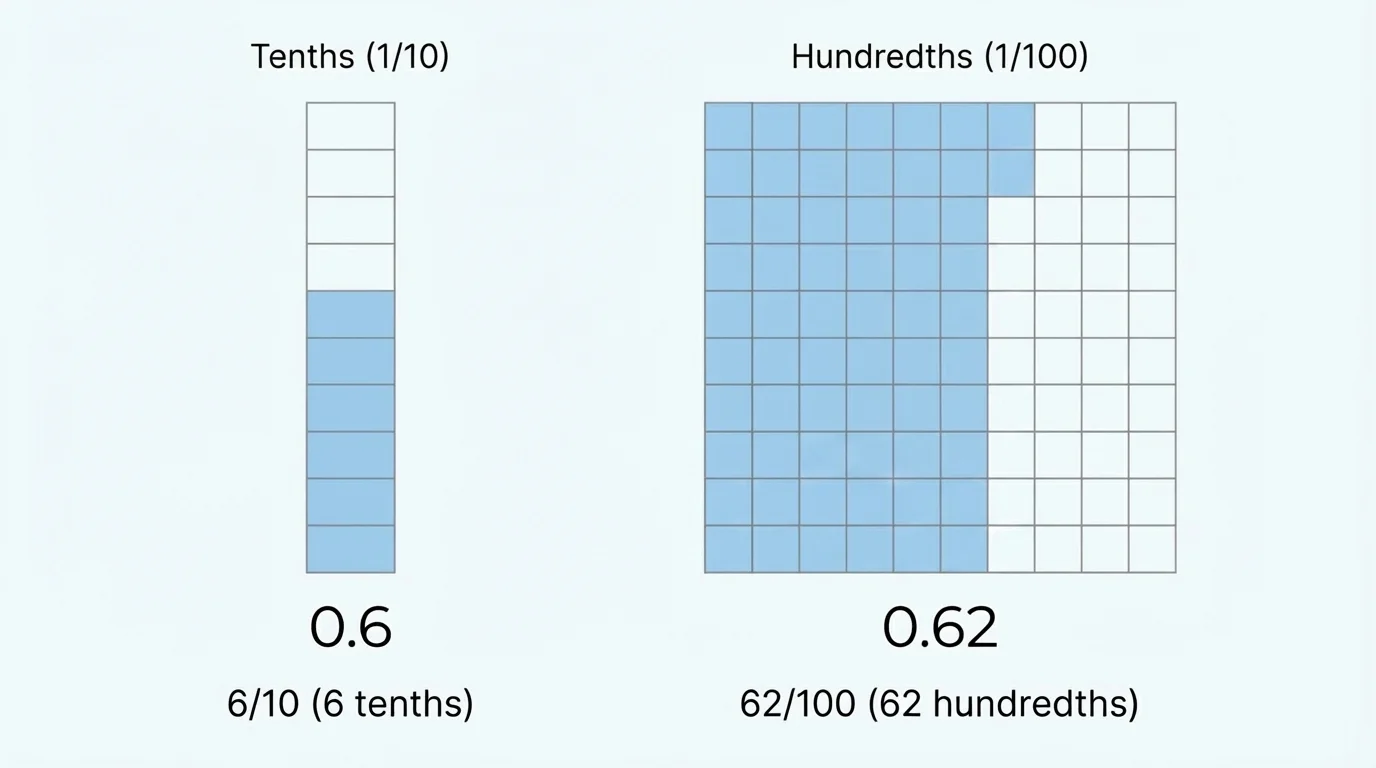
Think carefully about the number of places after the decimal point. One place after the decimal point shows tenths. Two places after the decimal point show hundredths. That is why \(\dfrac{4}{10} = 0.4\), but \(\dfrac{4}{100} = 0.04\).
Solved example 1
Write \(\dfrac{8}{10}\) as a decimal.
Step 1: Look at the denominator.
The denominator is \(10\), so the number will be written in tenths.
Step 2: Place the numerator in the tenths place.
\(\dfrac{8}{10} = 0.8\)
The decimal form is \(0.8\).
The same idea works for hundredths. When a fraction has a denominator of \(100\), write two digits to the right of the decimal point. As we saw with the shaded model in [Figure 1], \(62\) out of \(100\) equal parts is \(0.62\).
You can also go the other way. A decimal can be written as a fraction by using place value. The digit in the tenths place tells how many tenths there are. The digits in the tenths and hundredths places together tell how many hundredths there are.
For example, \(0.3\) means three tenths, so \(0.3 = \dfrac{3}{10}\). The decimal \(0.62\) means sixty-two hundredths, so \(0.62 = \dfrac{62}{100}\).
How to tell the denominator
If a decimal has one digit to the right of the decimal point, write it as a fraction with denominator \(10\). If it has two digits to the right, write it as a fraction with denominator \(100\). So \(0.9 = \dfrac{9}{10}\), \(0.14 = \dfrac{14}{100}\), and \(0.07 = \dfrac{7}{100}\).
Be careful with decimals that include zero. The decimal \(0.40\) means forty hundredths, so \(0.40 = \dfrac{40}{100}\). It is also equal to \(\dfrac{4}{10}\), because forty hundredths and four tenths are the same amount.
Solved example 2
Write \(0.62\) as a fraction.
Step 1: Count the digits to the right of the decimal point.
There are \(2\) digits: \(6\) and \(2\).
Step 2: Use denominator \(100\).
Two decimal places mean hundredths.
Step 3: Write the digits as the numerator.
\(0.62 = \dfrac{62}{100}\)
The fraction form is \(\dfrac{62}{100}\).
Another example is \(0.05\). Since there are two digits to the right of the decimal point, it is a hundredths number: \(0.05 = \dfrac{5}{100}\).
Reading decimals correctly helps you understand their size. The decimal \(0.4\) is read as four tenths. The decimal \(0.09\) is read as nine hundredths. The decimal \(0.62\) is read as sixty-two hundredths.
Notice that the last place tells the name. If the last digit is in the tenths place, use the word tenths. If the last digit is in the hundredths place, use the word hundredths.
The number \(0.5\) and the fraction \(\dfrac{1}{2}\) are equal, even though they look different. Many numbers can be written in more than one correct way.
Here are more examples: \(0.1\) is one tenth, \(0.27\) is twenty-seven hundredths, and \(0.90\) is ninety hundredths, which is the same value as \(0.9\).
[Figure 2] Measurements often use decimals because real objects are not always exact whole numbers. A desk might be \(1.2\) meters long. A small toy might be \(0.15\) meters long. A ribbon can be described as \(0.62\) meters long.
One meter can be divided into \(100\) equal parts. If \(62\) of those parts are counted, the length is \(\dfrac{62}{100}\) meters, which is the same as \(0.62\) meters.
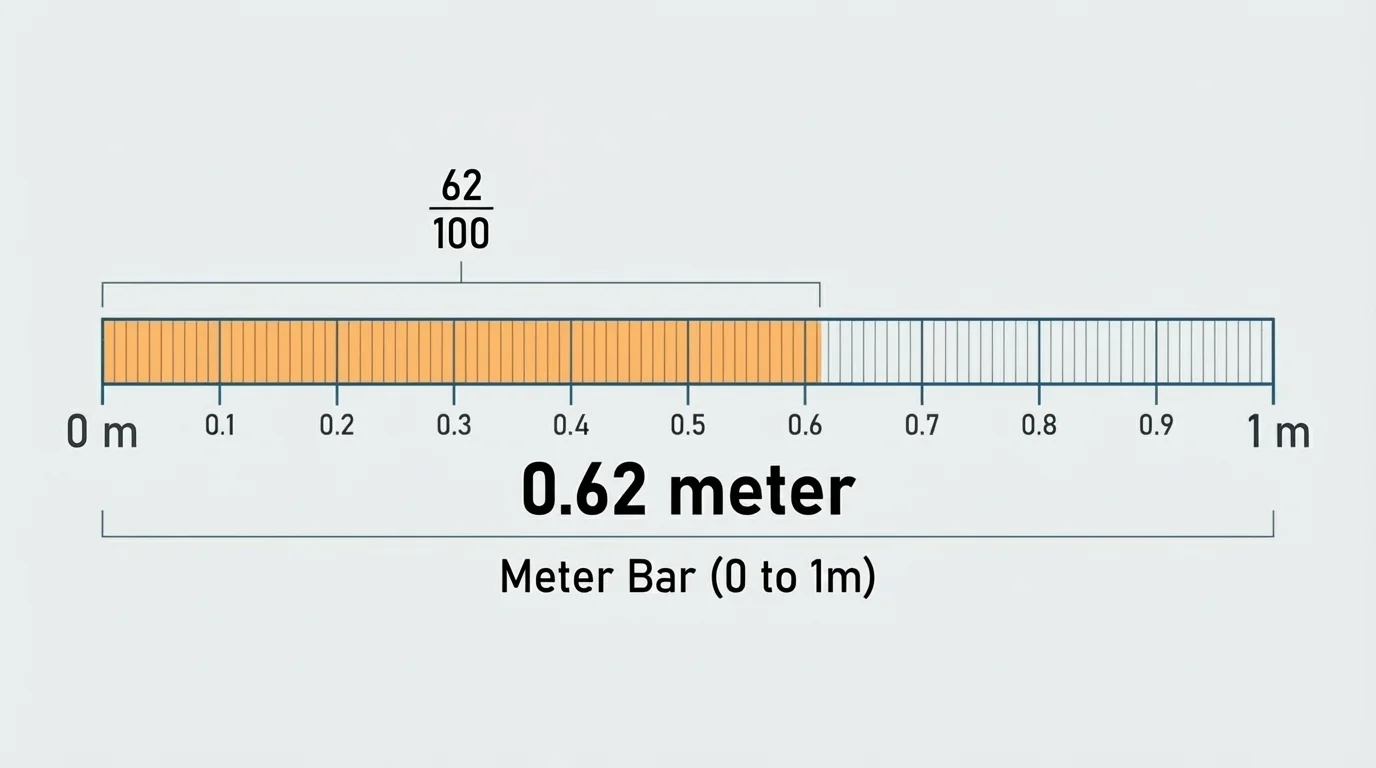
This is useful because decimal notation is compact and easy to read. Instead of always writing \(\dfrac{62}{100}\) meters, we can write \(0.62\) meters.
Solved example 3
A string is \(0.48\) meter long. Write this length as a fraction of a meter.
Step 1: Look at the decimal places.
There are \(2\) digits to the right of the decimal point, so the denominator is \(100\).
Step 2: Use the digits as the numerator.
\(0.48 = \dfrac{48}{100}\)
Step 3: Add the unit.
The string is \(\dfrac{48}{100}\) meters long.
The length can be written as \(0.48\) meters or \(\dfrac{48}{100}\) meters.
If you look back at [Figure 2], the shaded part helps show why \(0.62\) meter is less than \(1\) whole meter but more than \(0.6\) meter.
[Figure 3] A number line helps show exactly where a decimal belongs. It illustrates how tenths and hundredths can be marked between \(0\) and \(1\). Every decimal has a place on the line.
To locate \(0.62\), first find \(0.6\), which is six tenths. Then look between \(0.6\) and \(0.7\). That part can be divided into \(10\) equal spaces, each worth \(0.01\), or one hundredth. Move \(2\) hundredths past \(0.6\). That point is \(0.62\).
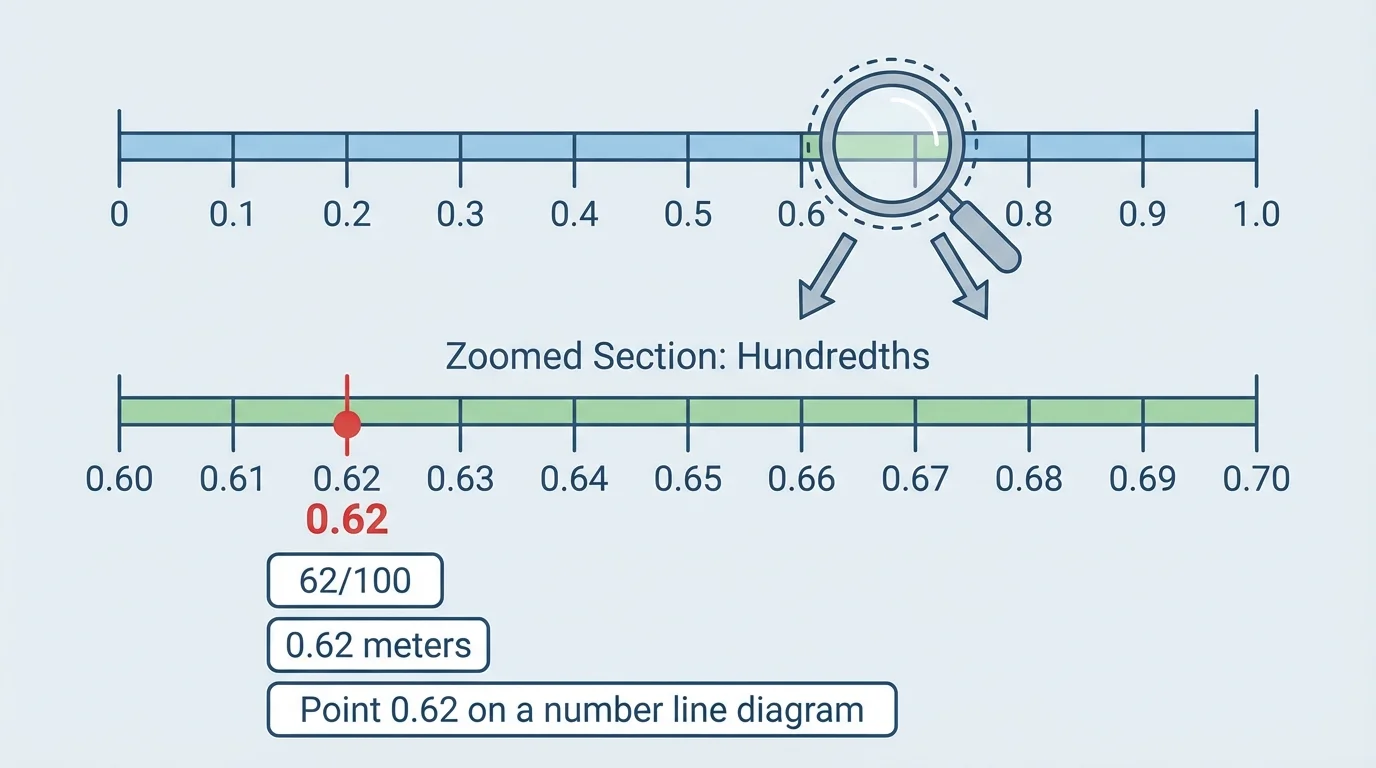
The decimal \(0.62\) is greater than \(0.6\) and less than \(0.7\). It is also greater than \(0.61\) and less than \(0.63\). Number lines help you see these relationships clearly.
Solved example 4
Explain where \(0.34\) goes on a number line from \(0\) to \(1\).
Step 1: Find the tenths.
\(0.34\) has \(3\) tenths, so start at \(0.3\).
Step 2: Count the hundredths.
\(0.34\) has \(4\) more hundredths, so move \(4\) small steps to the right of \(0.3\).
Step 3: Name the location.
The point is between \(0.3\) and \(0.4\), closer to \(0.3\).
So \(0.34\) is located four hundredths after \(0.3\).
Later, when you compare decimals, the picture from [Figure 3] also helps you decide which number is farther to the right, and therefore greater.
To compare decimals less than \(1\), compare tenths first. If the tenths are the same, compare hundredths.
For example, compare \(0.5\) and \(0.7\). Since \(5\) tenths is less than \(7\) tenths, \(0.5 < 0.7\).
Now compare \(0.62\) and \(0.67\). Both have \(6\) tenths. So compare the hundredths: \(2\) hundredths is less than \(7\) hundredths. Therefore, \(0.62 < 0.67\).
Solved example 5
Which is greater: \(0.48\) or \(0.5\)?
Step 1: Write both using hundredths.
\(0.5 = 0.50\)
Step 2: Compare the hundredths.
\(0.48\) means \(48\) hundredths. \(0.50\) means \(50\) hundredths.
Step 3: Decide which is larger.
Since \(50\) hundredths is greater than \(48\) hundredths, \(0.50 > 0.48\).
So \(0.5\) is greater than \(0.48\).
Adding a zero to the end of a decimal does not change its value. That is why \(0.5 = 0.50\). This can make comparisons easier.
Decimals help people every day. Money uses decimals, such as \(\$0.25\) or \(\$1.50\). In sports, times can be measured to hundredths of a second, like \(12.34\) seconds. In science and engineering, lengths are often measured with decimals to show accuracy.
Suppose a plant grows \(0.62\) meters tall. That means it has grown \(\dfrac{62}{100}\) of a meter. A builder might measure a board as \(0.9\) meters long, which means \(\dfrac{9}{10}\) of a meter. A runner's time of \(9.62\) seconds means nine whole seconds and sixty-two hundredths of a second.
"A decimal is another way to name a fraction."
Understanding decimals makes it easier to read rulers, timers, and data tables. It also helps you move smoothly between fractions and measurement.
