In a close race, the winner might be ahead by only \(0.001\) second. That tiny difference is just one thousandth, but it can decide first place. Decimals may look small, yet each digit matters. Learning to compare decimals carefully helps you read measurements, sports times, money amounts, and data with accuracy.
When you compare decimals, you decide which number is greater, which is less, or whether the numbers are equal. This is not just about looking at the digits. It is about understanding the place value of each digit.
For example, compare \(0.7\) and \(0.65\). Some students might think \(65\) is bigger than \(7\), so \(0.65\) must be greater. But decimal comparison does not work that way. The digit \(7\) in \(0.7\) means seven tenths, while \(6\) in \(0.65\) means six tenths. Since seven tenths is greater than six tenths, \(0.7 > 0.65\).
Remember that in whole numbers, digits to the left have greater value. In decimals, digits to the right of the decimal point get smaller as you move right: tenths, hundredths, then thousandths.
This idea is the key to comparing decimals correctly.
Every decimal has digits in places with different values, and [Figure 1] shows how the value of a number depends on where each digit is located. The places we use here are ones, tenths, hundredths, and thousandths.
Look at the decimal \(4.275\). The digit \(4\) is in the ones place. The digit \(2\) is in the tenths place. The digit \(7\) is in the hundredths place. The digit \(5\) is in the thousandths place.
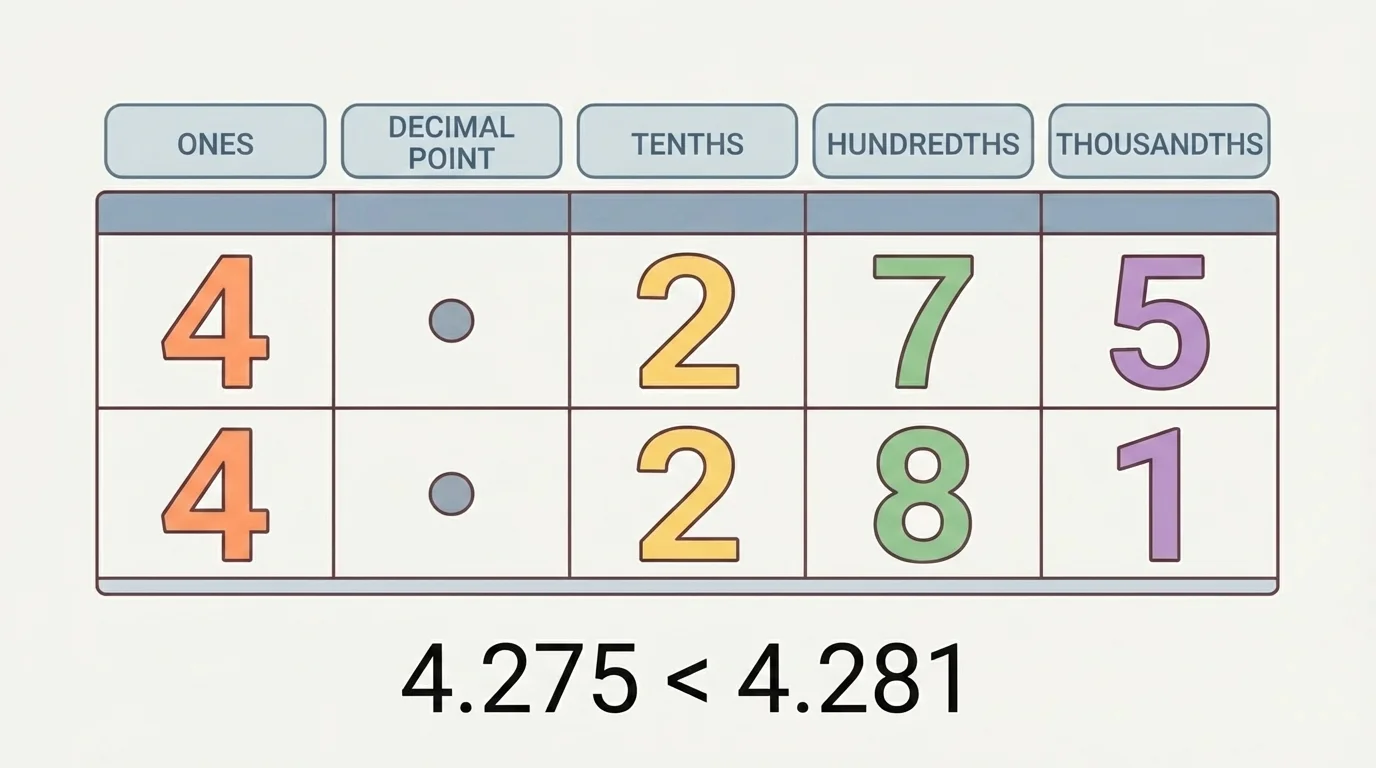
That means:
\(4.275 = 4 + 0.2 + 0.07 + 0.005\)
Another way to think about this is with fractions:
\(0.2 = \dfrac{2}{10}\), \(0.07 = \dfrac{7}{100}\), and \(0.005 = \dfrac{5}{1000}\).
Decimal point separates the whole-number part from the decimal part. Tenths are parts of a whole split into \(10\) equal parts. Hundredths are parts of a whole split into \(100\) equal parts. Thousandths are parts of a whole split into \(1{,}000\) equal parts.
When comparing decimals, always compare digits that are in the same place. A digit in the tenths place should be compared with another digit in the tenths place, not with a digit in the hundredths place.
To compare numbers, we use three symbols:
Greater than: \(>\)
Less than: \(<\)
Equal to: \(=\)
Here are examples:
\(0.8 > 0.3\) because eight tenths is greater than three tenths.
\(1.249 < 1.3\) because one whole and two hundred forty-nine thousandths is less than one whole and three tenths.
\(2.500 = 2.5\) because the extra zeros do not change the value.
Some measuring tools in science and sports record values to the thousandths place because a difference of \(0.001\) can matter a lot when results are very close.
The symbol you choose must match the true value of the decimals, not just how long the numbers look.
One of the best ways to compare decimals is to line up the decimal points, and [Figure 2] illustrates how matching place values makes the comparison clear. Then compare from left to right.
Use this method:
Step 1: Compare the whole-number parts.
Step 2: If the whole-number parts are the same, compare the tenths digits.
Step 3: If the tenths digits are the same, compare the hundredths digits.
Step 4: If needed, compare the thousandths digits.
The first place where the digits are different tells you which number is greater.
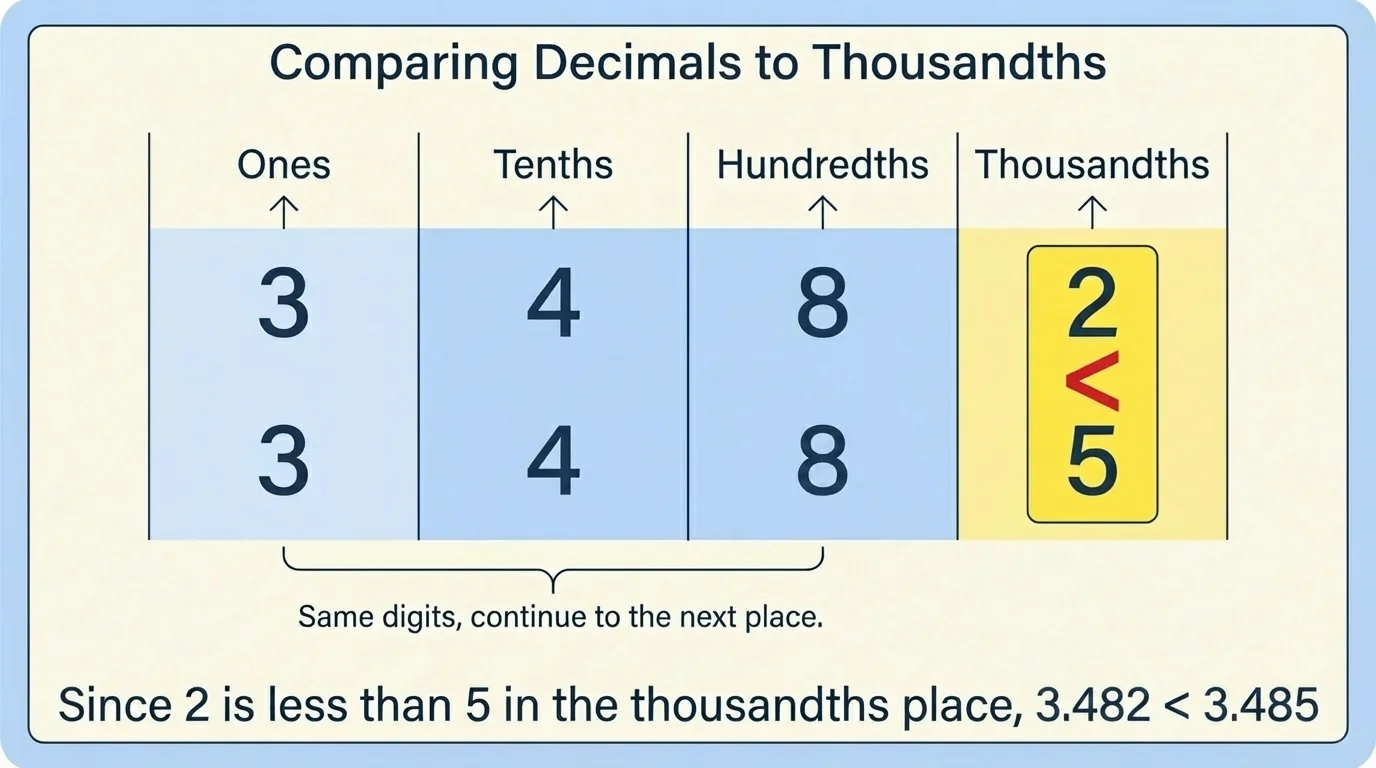
For example, compare \(3.482\) and \(3.475\).
The whole numbers are both \(3\). The tenths digits are both \(4\). The hundredths digits are \(8\) and \(7\). Since \(8 > 7\), we know right away that \(3.482 > 3.475\). We do not even need to compare the thousandths digits because the decision is already made.
The first different place decides the comparison. When two decimals begin the same way, keep moving one place at a time to the right. As soon as one digit is greater than the other in the same place, that decimal is greater. This works because each place to the left has more value than every place to the right.
This is similar to comparing whole numbers. In \(425\) and \(419\), the tens digits decide the comparison. In decimals, the same idea works with tenths, hundredths, and thousandths.
Sometimes decimals have different numbers of digits, but they still have the same value. Zeros added to the right end of a decimal do not change the amount.
[Figure 3] helps show this idea. For example:
\(2.4 = 2.40 = 2.400\)
Each of these numbers means two wholes and four tenths.
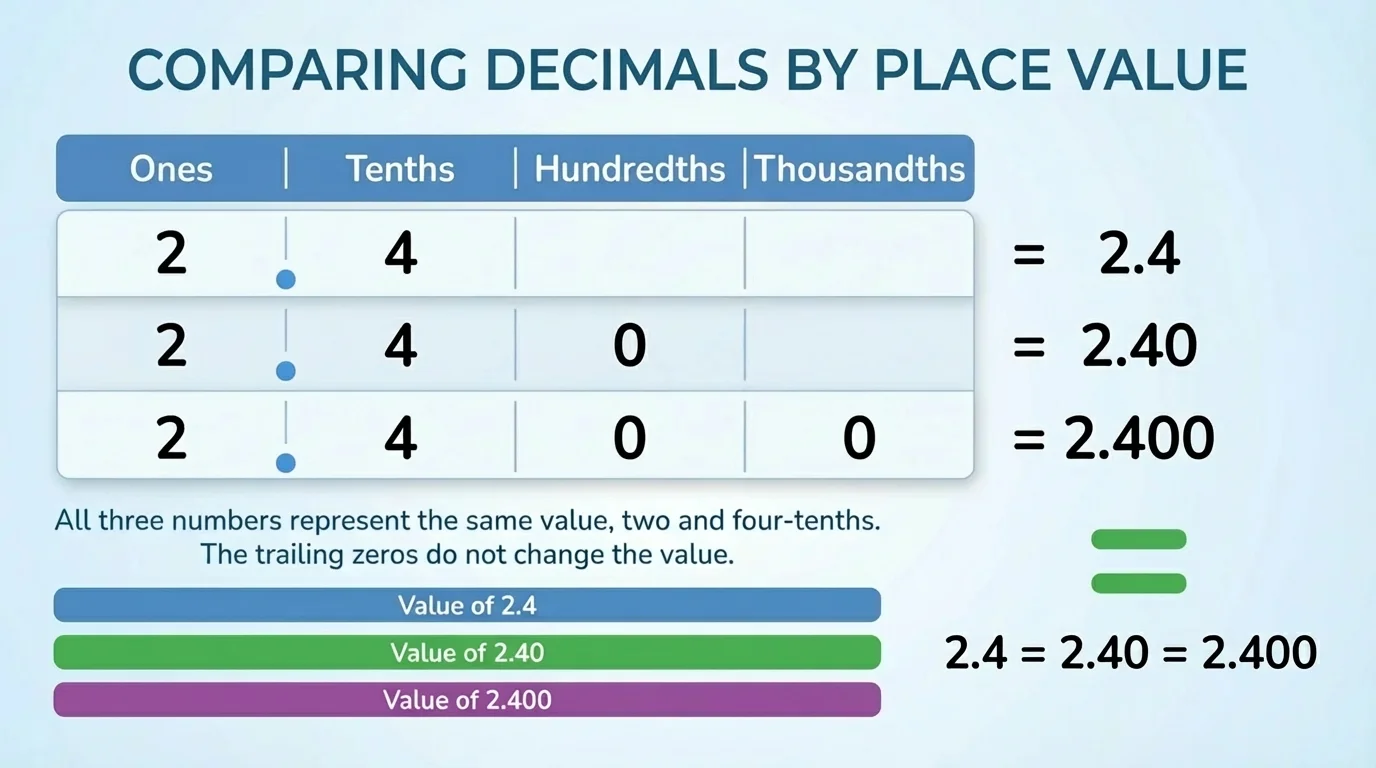
This helps when comparing decimals with different lengths. You can add zeros to make the same number of decimal places.
For example, to compare \(0.6\) and \(0.582\), rewrite \(0.6\) as \(0.600\). Now compare:
\(0.600\) and \(0.582\)
The tenths digits are \(6\) and \(5\). Since \(6 > 5\), \(0.600 > 0.582\). Writing the zeros helps you see the place values clearly.
Later, when you compare more decimals, the idea in [Figure 3] stays useful because equivalent decimals make it easier to line up digits by place.
Let's work through several decimal comparisons carefully.
Worked example 1
Compare \(4.382\) and \(4.407\).
Step 1: Compare the whole-number parts.
Both numbers have \(4\) ones.
Step 2: Compare the tenths digits.
Both tenths digits are \(3\)? No. In \(4.382\), the tenths digit is \(3\). In \(4.407\), the tenths digit is \(4\).
Step 3: Decide the comparison.
Since \(3 < 4\), we know \(4.382 < 4.407\).
The correct comparison is \[4.382 < 4.407\]
Notice that once the tenths digits were different, there was no need to compare any farther.
Worked example 2
Compare \(0.709\) and \(0.71\).
Step 1: Make the decimal places match.
Rewrite \(0.71\) as \(0.710\).
Step 2: Compare place by place.
Tenths: \(7 = 7\)
Hundredths: \(0 < 1\)
Step 3: Decide the comparison.
Since the hundredths digit in \(0.709\) is less than the hundredths digit in \(0.710\), we have \(0.709 < 0.710\).
The correct comparison is \[0.709 < 0.71\]
This example shows why equal-length decimals can make the comparison easier to see.
Worked example 3
Compare \(5.125\) and \(5.125\).
Step 1: Compare the whole-number parts.
Both are \(5\).
Step 2: Compare each decimal place.
Tenths: \(1 = 1\)
Hundredths: \(2 = 2\)
Thousandths: \(5 = 5\)
Step 3: Decide the comparison.
All matching place values are equal, so the numbers are equal.
The correct comparison is \[5.125 = 5.125\]
Equal decimals are not very exciting to look at, but they are important because sometimes the correct symbol is \(=\), not \(>\) or \(<\).
Worked example 4
Compare \(2.58\) and \(2.580\).
Step 1: Rewrite with the same number of decimal places.
Rewrite \(2.58\) as \(2.580\).
Step 2: Compare the digits.
All digits match in the ones, tenths, hundredths, and thousandths places.
Step 3: Decide the comparison.
The decimals have the same value.
The correct comparison is \[2.58 = 2.580\]
The idea of equivalent decimals from [Figure 3] helps explain why this is true: the added zero is in a place that contributes no extra value.
There are a few mistakes students often make when comparing decimals.
Mistake 1: Thinking the decimal with more digits is always greater.
This is false. For example, \(0.9 > 0.87\), even though \(0.87\) has more digits. Nine tenths is greater than eight tenths and seven hundredths.
Mistake 2: Comparing digits without place value.
For example, in \(0.43\) and \(0.5\), the digits \(43\) and \(5\) should not be compared as whole numbers. Instead, compare tenths first: \(4 < 5\), so \(0.43 < 0.5\).
Mistake 3: Forgetting that zeros at the end may not change the value.
For example, \(1.200 = 1.2\). The ending zeros do not add any extra tenths, hundredths, or thousandths.
Mistake 4: Stopping too soon.
Compare \(6.347\) and \(6.342\). The whole numbers, tenths, and hundredths are the same. You must keep going to the thousandths place. Since \(7 > 2\), \(6.347 > 6.342\). This left-to-right comparison is exactly what [Figure 2] displays.
Comparing decimals is useful in many everyday situations.
Sports: A runner finishes in \(12.438\) seconds and another in \(12.441\) seconds. Since \(12.438 < 12.441\), the first runner is faster.
Measurement: One pencil is \(14.205\) centimeters long and another is \(14.25\) centimeters long. Rewrite \(14.25\) as \(14.250\). Then compare: \(14.205 < 14.250\). The second pencil is longer.
Money: Gas prices may be written with thousandths, such as \(\$3.489\) and \(\$3.512\) per gallon. Since \(3.489 < 3.512\), \(\$3.489\) is the lower price.
Science: A liquid might measure \(7.035\) liters in one container and \(7.053\) liters in another. Compare the hundredths digits: \(3 < 5\), so \(7.035 < 7.053\).
Comparing decimals helps people make precise decisions. Whether you are checking a race result, reading a thermometer, comparing prices, or measuring ingredients, place value helps you tell which amount is greater, smaller, or the same.
Even when the difference seems tiny, such as \(0.001\), it can still matter a great deal.
| Decimal 1 | Decimal 2 | Comparison | Why |
|---|---|---|---|
| \(0.8\) | \(0.75\) | \(0.8 > 0.75\) | \(8\) tenths is greater than \(7\) tenths |
| \(1.230\) | \(1.23\) | \(1.230 = 1.23\) | Trailing zero does not change value |
| \(2.406\) | \(2.46\) | \(2.406 < 2.460\) | At the hundredths place, \(0 < 6\) |
| \(5.999\) | \(6.000\) | \(5.999 < 6.000\) | The whole-number parts decide it |
Table 1. Examples of decimal comparisons to the thousandths place.
When you compare decimals, think carefully about value, not appearance. A decimal with fewer digits can be greater, and a decimal with extra zeros can still be equal to another decimal.
