Have you ever noticed that weather reports, race times, and store prices often use decimals, but people do not always say every digit? A runner might finish in \(12.68\) seconds, but someone may say about \(12.7\) seconds. A recipe might call for \(2.36\) cups, but you may measure about \(2.4\) cups. That is rounding. Rounding helps us keep numbers close to their true value while making them easier to use.
When we round, we find a number that is close in value to the original number. We do not change the amount by a lot. We choose the nearest value at a certain place. For example, if we round \(4.782\) to the nearest tenth, we are finding which tenth it is closer to: \(4.7\) or \(4.8\).
Rounding is useful when an exact number is not needed or when an estimate makes thinking easier. Scientists round measurements. Shoppers round prices to estimate total cost. Builders round lengths when talking about measurements. Rounding is not guessing wildly. It uses rules based on place value.
In a whole number, places grow by a factor of \(10\) as you move left: ones, tens, hundreds. In a decimal, places grow by a factor of \(10\) as you move right after the decimal point: tenths, hundredths, thousandths.
A decimal point separates whole-number places from decimal places. Digits to the left show values greater than or equal to \(1\). Digits to the right show parts of a whole.
Each digit in a decimal has a value based on its position, as [Figure 1] shows. In the number \(34.276\), the \(3\) means \(3\) tens, the \(4\) means \(4\) ones, the \(2\) means \(2\) tenths, the \(7\) means \(7\) hundredths, and the \(6\) means \(6\) thousandths.
This idea is called place value. One way to think about it is that each place to the right is worth one-tenth of the place before it. So \(0.1\) is one tenth, \(0.01\) is one hundredth, and \(0.001\) is one thousandth.
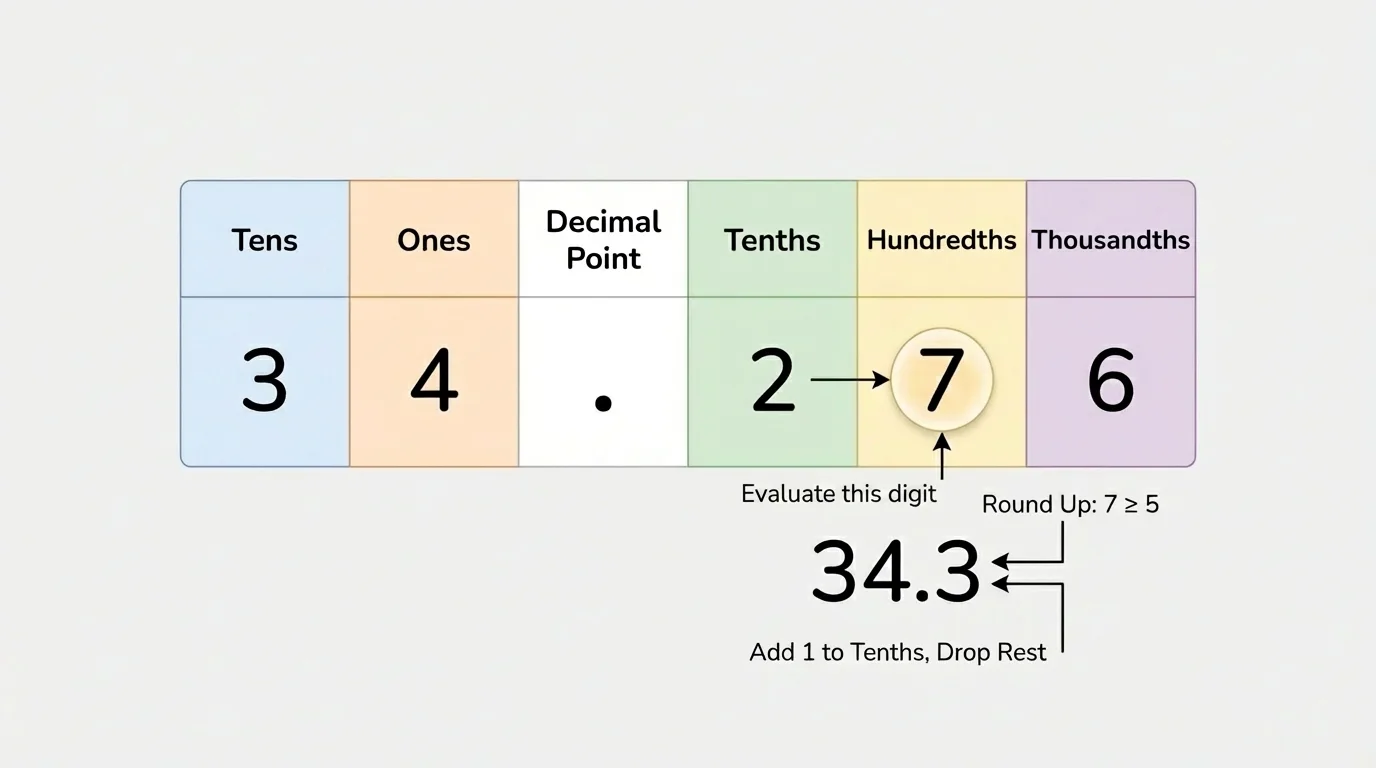
Here are some examples of the value of a digit depending on where it is placed:
| Number | Digit | Place | Value |
|---|---|---|---|
| \(5.4\) | \(4\) | tenths | \(0.4\) |
| \(5.04\) | \(4\) | hundredths | \(0.04\) |
| \(5.004\) | \(4\) | thousandths | \(0.004\) |
Table 1. The same digit can have different values depending on its place in a decimal.
Notice that the digit \(4\) is the same in each number, but its value changes. This matters when rounding, because we must know exactly which place we are rounding to.
Decimal is a number with a decimal point that shows whole numbers and parts of a whole.
Round means to replace a number with a nearby number that is easier to use at a chosen place.
Nearest means the closest value.
When a number has more digits than we need, rounding helps us decide what to keep and what to change.
To round a decimal, choose the place you want. Then look at the digit immediately to the right of that place. That digit tells whether the target digit stays the same or increases by \(1\).
The basic rule is:
If the digit to the right is \(0\), \(1\), \(2\), \(3\), or \(4\), keep the rounding digit the same.
If the digit to the right is \(5\), \(6\), \(7\), \(8\), or \(9\), increase the rounding digit by \(1\).
After that, all digits to the right of the rounded place become zeros or are dropped, depending on how the number is written. For decimals, we usually just stop at the place we rounded to. For example, rounding \(8.463\) to the nearest hundredth gives \(8.46\), and rounding \(8.467\) to the nearest hundredth gives \(8.47\).
[Figure 2] A careful method makes rounding much easier. Use the same method every time so that you do not mix up the places.
Step 1: Find the digit in the place you are rounding to.
Step 2: Look at the digit immediately to its right.
Step 3: Decide whether to keep the rounding digit the same or increase it by \(1\).
Step 4: Rewrite the number so it ends at the rounded place.
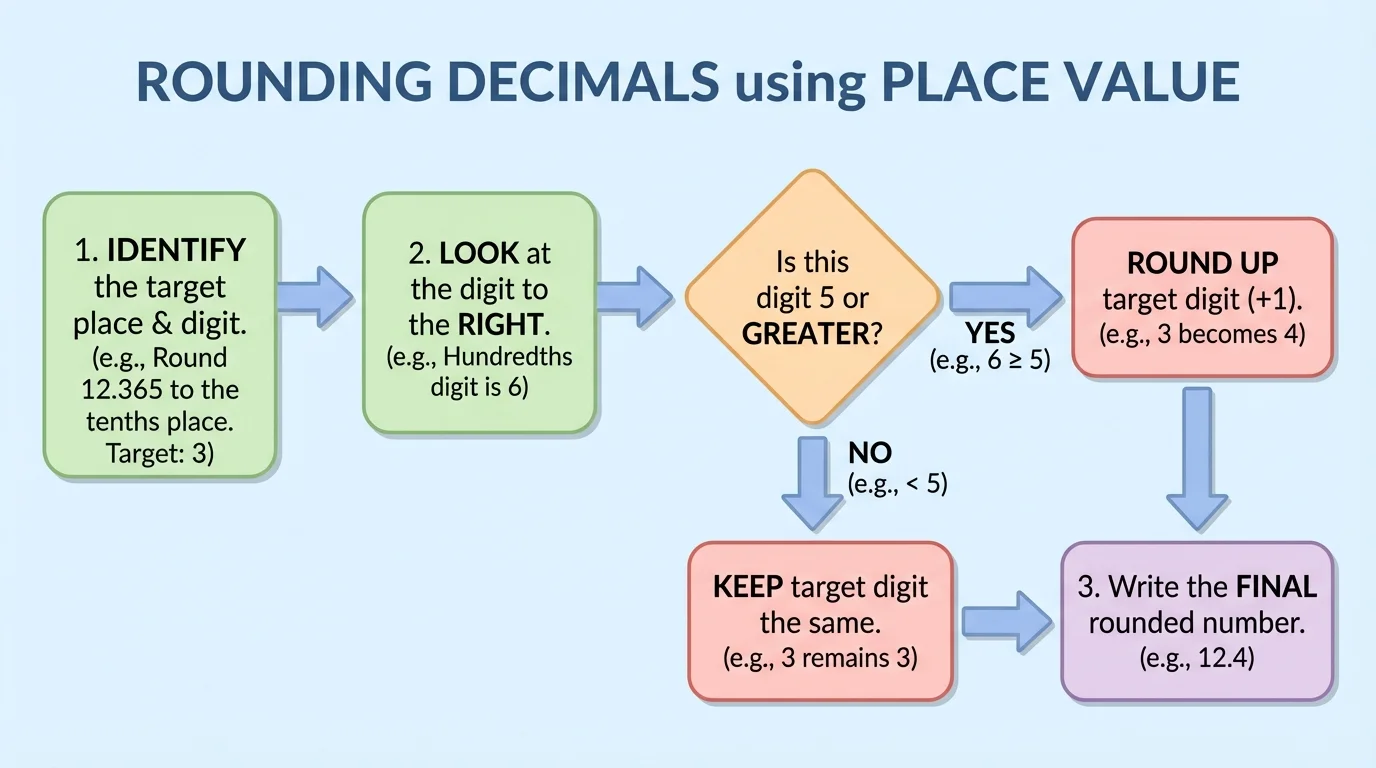
For example, if you round \(7.286\) to the nearest hundredth, the hundredths digit is \(8\). The digit to its right is \(6\). Since \(6\) is at least \(5\), increase the \(8\) to \(9\). The result is \(7.29\).
If you round \(7.281\) to the nearest hundredth, the hundredths digit is still \(8\), but the digit to the right is \(1\). Since \(1\) is less than \(5\), keep the \(8\). The result is \(7.28\).
Solved example 1: Round \(4.376\) to the nearest tenth
Step 1: Identify the rounding place.
The tenths digit is \(3\).
Step 2: Look at the digit to the right.
The hundredths digit is \(7\).
Step 3: Apply the rule.
Since \(7 \geq 5\), increase the tenths digit from \(3\) to \(4\).
Step 4: Write the rounded number.
\[4.376 \approx 4.4\]
When \(4.376\) is rounded to the nearest tenth, the result is \(4.4\).
Notice that even though there are two digits after the hundredths place, we only need to check the digit immediately to the right of the place we are rounding to.
Solved example 2: Round \(12.843\) to the nearest hundredth
Step 1: Find the hundredths digit.
In \(12.843\), the hundredths digit is \(4\).
Step 2: Check the digit to the right.
The thousandths digit is \(3\).
Step 3: Decide whether to change the hundredths digit.
Since \(3 < 5\), the hundredths digit stays \(4\).
Step 4: Write the result.
\[12.843 \approx 12.84\]
When \(12.843\) is rounded to the nearest hundredth, the result is \(12.84\).
Rounding to the nearest hundredth means stopping at two places to the right of the decimal point.
Solved example 3: Round \(56.49\) to the nearest whole number
Step 1: Find the ones digit.
The ones digit is \(6\).
Step 2: Look to the right.
The tenths digit is \(4\).
Step 3: Apply the rule.
Since \(4 < 5\), keep the ones digit as \(6\).
Step 4: Write the rounded number.
\[56.49 \approx 56\]
When \(56.49\) is rounded to the nearest whole number, the result is \(56\).
When rounding to the nearest whole number, we are rounding to the nearest one.
Solved example 4: Round \(9.98\) to the nearest tenth
Step 1: Find the tenths digit.
The tenths digit is \(9\).
Step 2: Look at the hundredths digit.
The hundredths digit is \(8\).
Step 3: Increase the tenths digit.
Since \(8 \geq 5\), the tenths digit goes up by \(1\). But \(9 + 1 = 10\), so the tenths place becomes \(0\) and the ones place increases by \(1\).
Step 4: Write the result.
\[9.98 \approx 10.0\]
When \(9.98\) is rounded to the nearest tenth, the result is \(10.0\).
This example shows that rounding can sometimes change a digit to the left, not just the digit in the target place.
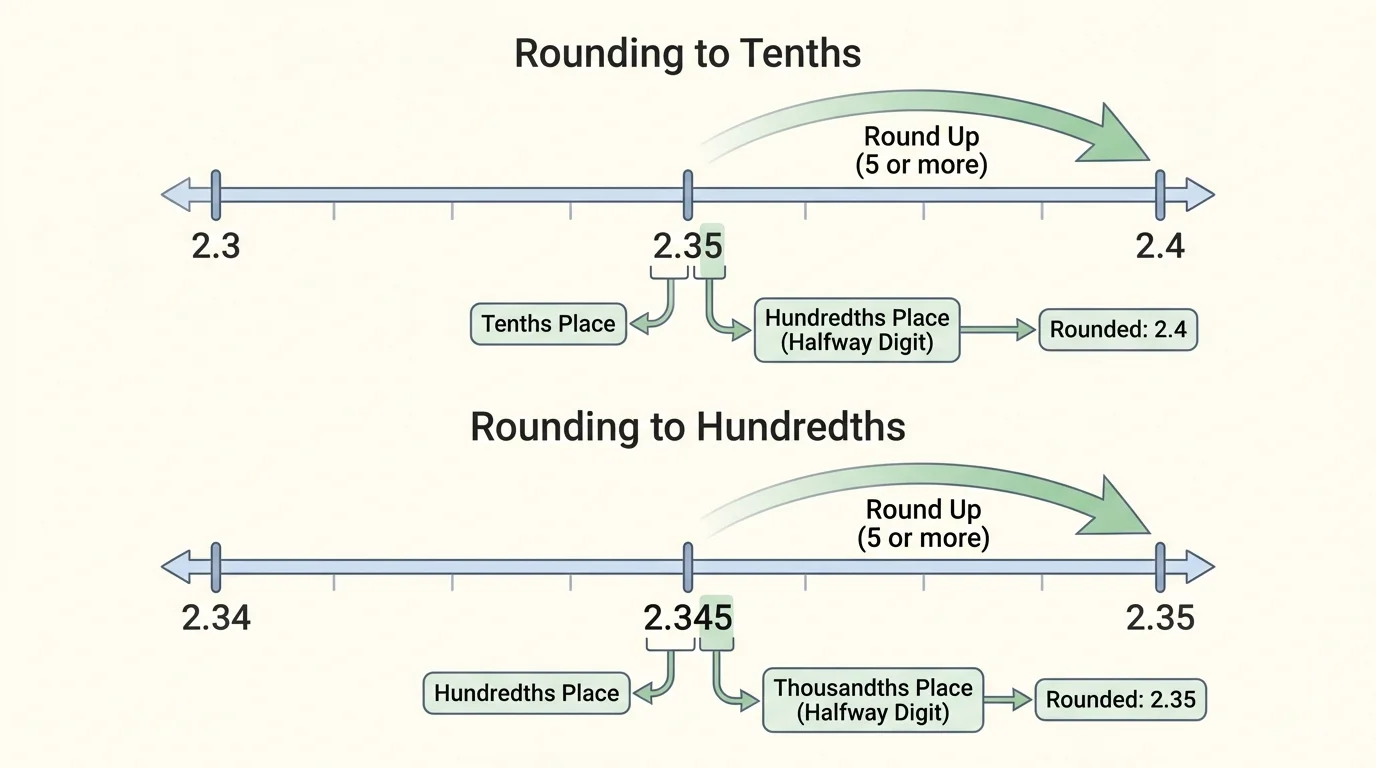
Sometimes rounding feels easy, and sometimes it can be tricky. The reason is that decimals can have many places, and we must choose the rounding digit carefully. A number line helps show which value is closest, and [Figure 3] displays how a decimal can lie between two nearby rounded values.
Consider \(6.45\) rounded to the nearest tenth. It lies between \(6.4\) and \(6.5\). Because the hundredths digit is \(5\), we round up to \(6.5\).
Consider \(2.375\) rounded to the nearest hundredth. The hundredths digit is \(7\), and the digit to the right is \(5\), so the hundredths digit increases to \(8\). The result is \(2.38\).
Zeros can also matter a lot. In \(3.204\), the digit \(0\) is in the hundredths place. If you round to the nearest hundredth, look at the thousandths digit, which is \(4\). Since \(4 < 5\), the result is \(3.20\). Writing \(3.20\) shows the number rounded to the hundredths place. The zero is a placeholder and tells which place value we mean.
Here are several common rounding situations:
| Original Number | Round To | Look At | Rounded Result |
|---|---|---|---|
| \(8.651\) | tenths | hundredths digit \(5\) | \(8.7\) |
| \(8.651\) | hundredths | thousandths digit \(1\) | \(8.65\) |
| \(3.204\) | hundredths | thousandths digit \(4\) | \(3.20\) |
| \(19.995\) | hundredths | thousandths digit \(5\) | \(20.00\) |
Table 2. Examples showing how the target place and the digit to its right determine the rounded result.
The last example is especially interesting. In \(19.995\), rounding to the nearest hundredth changes \(19.99\) into \(20.00\). The rounding moves through the hundredths, tenths, and ones places. As we saw earlier, rounding chooses the nearest value, even when that choice changes more than one digit.
Electronic devices often store and show decimal measurements such as temperatures, distances, and speeds. Rounding helps screens show useful values quickly without always displaying every tiny decimal place.
Another important idea is that a decimal can be rounded to different places, and the answers can be different depending on the place chosen.
For example, with \(7.846\):
None of these answers is wrong. They answer different questions.
Rounding decimals appears in many parts of daily life. Suppose a bottle holds \(1.87\) liters of juice. Someone might say it holds about \(1.9\) liters. That is rounding to the nearest tenth.
In sports, a time of \(15.284\) seconds may be reported as \(15.28\) seconds if the event uses hundredths of a second. In science, a length of \(4.376\) centimeters may be rounded to \(4.4\) centimeters if only tenths are needed. In shopping, a price like \(\$3.98\) may be rounded to about \(\$4.00\) to estimate a total cost quickly.
Measurements often depend on the precision needed. If a carpenter measures a board as \(2.437\) meters, rounding to the nearest hundredth gives \(2.44\) meters. If a scientist needs more detail, the number might stay at the thousandths place instead.
Rounding depends on purpose
The place you round to should match the situation. If you only need a quick estimate, rounding to the nearest whole number or tenth may be enough. If you need a more exact measurement, rounding to the nearest hundredth or thousandth may be better.
That is why the same number may be rounded in different ways in different situations. The place value tells how precise the answer is.
One common mistake is checking the wrong digit. If you round \(5.274\) to the nearest tenth, the tenths digit is \(2\), and you check the hundredths digit, which is \(7\). You do not check the thousandths digit first.
Another mistake is changing digits that should stay the same. If you round \(6.243\) to the nearest hundredth, you look at the thousandths digit, \(3\). Since \(3 < 5\), the result is \(6.24\), not \(6.20\).
A third mistake is dropping important zeros. If \(3.204\) is rounded to the nearest hundredth, writing \(3.2\) does not show the same place value as \(3.20\). The zero matters because it shows the number is rounded to hundredths.
It also helps to remember that the digit to the right decides what happens. The digits farther right do not need to be checked separately once you know that one deciding digit.
"Round to the place, check to the right."
— A useful rounding reminder
This short rule can guide you every time. First identify the place you want. Then look one place to the right. That is the key habit.
Let's compare several decimals rounded to different places:
| Number | Nearest Whole Number | Nearest Tenth | Nearest Hundredth |
|---|---|---|---|
| \(2.49\) | \(2\) | \(2.5\) | \(2.49\) |
| \(2.50\) | \(3\) | \(2.5\) | \(2.50\) |
| \(9.444\) | \(9\) | \(9.4\) | \(9.44\) |
| \(9.445\) | \(9\) | \(9.4\) | \(9.45\) |
These examples show why place value understanding is so important. A small change in the digit to the right can change the rounded result. The chart in [Figure 1] helps track which place is which, especially when a decimal has many digits.
Rounding is really about deciding which nearby value the number is closest to. If we understand tenths, hundredths, thousandths, and whole-number places, then we can round decimals to any place with confidence.
