How can a school pack exactly the right number of notebooks into boxes, or a stadium arrange hundreds of fans into equal rows? Division helps answer questions like these. When numbers get larger, you do not need to guess or memorize a long set of steps without meaning. You can use what you already know about place value and multiplication to divide big numbers in a way that makes sense.
Division is about making equal groups or finding how many of one number fit into another. If there are \(156\) stickers and each sheet holds \(12\) stickers, division tells how many full sheets are needed. If there are \(936\) pencils and each box holds \(24\), division tells how many boxes can be filled.
When you divide, you are often looking for a quotient, which is the answer to a division problem. Sometimes there is also a remainder, which is the part left over when the divisor does not go evenly into the dividend.
You already know that multiplication and division are related. If \(8 \times 6 = 48\), then \(48 \div 6 = 8\) and \(48 \div 8 = 6\). This relationship is one of the most powerful tools for dividing larger numbers.
For larger numbers, the same idea still works. If you know easy multiples of a number, you can build a division answer from those multiples. That is why multiplication facts and place value are so helpful in division.
Every division problem has important parts. The dividend is the number being divided. The divisor is the number you are dividing by. The quotient is the answer, and the remainder is any part left over.
Division vocabulary
In \(156 \div 12 = 13\), the dividend is \(156\), the divisor is \(12\), and the quotient is \(13\).
In \(398 \div 15 = 26\) remainder \(8\), the dividend is \(398\), the divisor is \(15\), the quotient is \(26\), and the remainder is \(8\).
Division can also be written as a missing-factor problem:
\[12 \times ? = 156\]
If you know that \(12 \times 13 = 156\), then you know:
\[156 \div 12 = 13\]
This way of thinking helps because many division problems become easier when you ask, "What multiple of the divisor gives the dividend, or gets close to it?"
One strong strategy is to use place value to break a large amount into smaller parts. Suppose you want to find \(192 \div 16\). Instead of trying to do it all at once, think about large chunks of \(16\).
You might notice that \(16 \times 10 = 160\). That uses most of \(192\). Then subtract:
\[192 - 160 = 32\]
Now find how many groups of \(16\) are in \(32\):
\[32 \div 16 = 2\]
So the total number of groups is:
\(10 + 2 = 12\)
Therefore,
\[192 \div 16 = 12\]
This method is often called the partial quotients method. You find part of the answer, subtract, then keep going until nothing is left or until the leftover part is smaller than the divisor.
Why partial quotients work
If you subtract \(16 \times 10\) from \(192\), you have found \(10\) groups of \(16\). If you then subtract \(16 \times 2\), you have found \(2\) more groups. Because \(10 + 2 = 12\), you have found \(12\) groups in all. This works because division can be built from repeated subtraction of equal groups.
You do not have to use only one kind of chunk. For example, with \(384 \div 12\), one student might subtract \(120\), then \(120\), then \(120\), then \(24\). Another student might notice right away that \(12 \times 30 = 360\), and then only \(24\) is left. Different correct strategies can lead to the same quotient.
A area model turns division into a rectangle problem. As [Figure 1] shows, if the area of a rectangle is \(156\) and one side is \(12\), the other side must be the quotient. By breaking the rectangle into easier parts, you can see the division clearly.
For \(156 \div 12\), think of a rectangle with one side \(12\). Break the total area \(156\) into \(120\) and \(36\). Since \(12 \times 10 = 120\) and \(12 \times 3 = 36\), the top side has lengths \(10\) and \(3\). Add them to find the total side length:
\(10 + 3 = 13\)
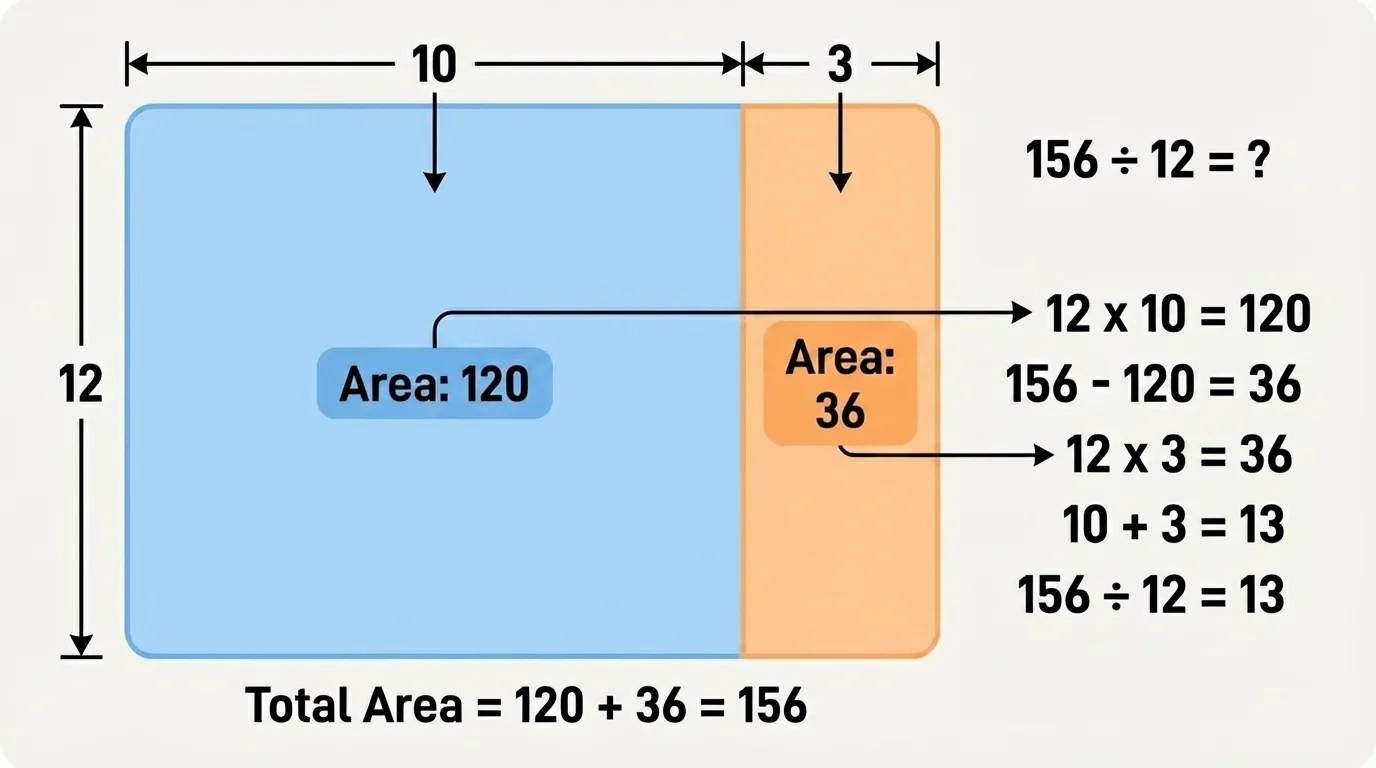
That means:
\[156 \div 12 = 13\]
A rectangular array uses the same idea. You can think of \(156\) objects arranged in \(12\) equal rows. The number in each row is the quotient. Area models and arrays make the size of the groups visible, not hidden.
Later, when you work with larger numbers, the same rectangle idea still helps. The parts may be \(24 \times 30\), \(24 \times 8\), and \(24 \times 1\), but the rectangle still shows how all the pieces fit together, just like in [Figure 1].
Let's divide \(168 \div 12\) by using place value and multiplication.
Worked example: \(168 \div 12\)
Step 1: Find a large multiple of \(12\).
\(12 \times 10 = 120\), so subtract \(120\) from \(168\).
\[168 - 120 = 48\]
Step 2: Divide the remaining part.
\(48 \div 12 = 4\), because \(12 \times 4 = 48\).
Step 3: Add the partial quotients.
\(10 + 4 = 14\)
So,
\[168 \div 12 = 14\]
You can also check: \(14 \times 12 = 168\). Since the multiplication matches the original dividend, the quotient is correct.
Now try a larger problem: \(936 \div 24\). One helpful way to organize your thinking, as [Figure 2] illustrates, is to keep track of each large chunk of the divisor that you subtract.
Start by thinking about friendly multiples of \(24\). Since \(24 \times 4 = 96\), then \(24 \times 40 = 960\), which is a little too large. So \(24 \times 30 = 720\) is a good first chunk.
Worked example: \(936 \div 24\)
Step 1: Subtract a large multiple.
\(24 \times 30 = 720\)
\[936 - 720 = 216\]
Step 2: Find another multiple.
\(24 \times 9 = 216\)
\[216 - 216 = 0\]
Step 3: Add the partial quotients.
\(30 + 9 = 39\)
So,
\[936 \div 24 = 39\]
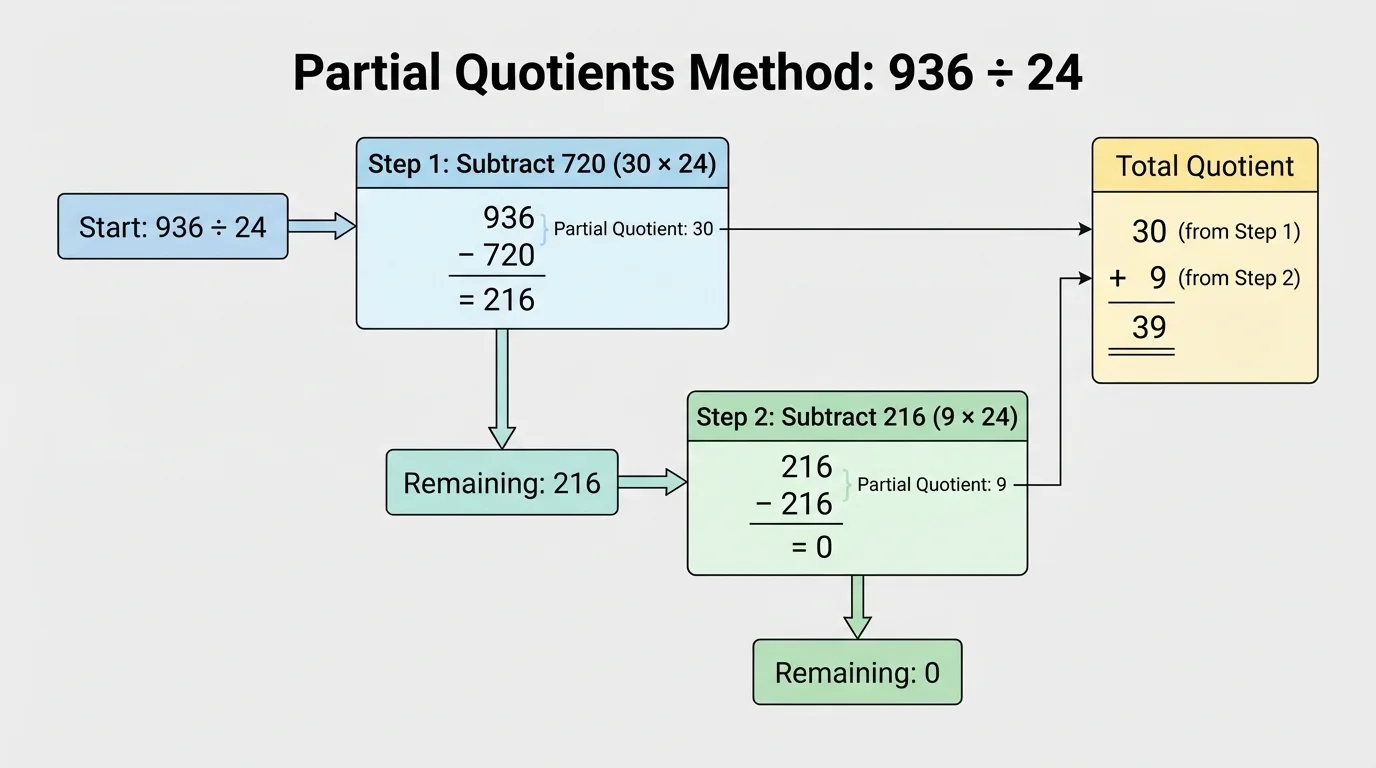
You can also think about this with an area model. If one side of a rectangle is \(24\) and the area is \(936\), then side lengths \(30\) and \(9\) make areas \(720\) and \(216\). Together they make \(936\), so the missing side is \(39\).
This example shows an important idea: you do not need to subtract one group at a time. You can subtract many equal groups at once. That makes dividing large numbers much faster and still keeps the meaning clear.
Not every division problem ends with no leftovers. Sometimes you get a remainder. That means the divisor does not fit into the dividend an exact whole number of times.
Worked example: \(398 \div 15\)
Step 1: Find a large multiple of \(15\).
\(15 \times 20 = 300\)
\[398 - 300 = 98\]
Step 2: Find another multiple.
\(15 \times 6 = 90\)
\(98 - 90 = 8\)
Step 3: Decide whether you can keep dividing.
The leftover \(8\) is less than \(15\), so no more full groups of \(15\) can be made.
Step 4: Add the partial quotients.
\(20 + 6 = 26\)
So,
\[398 \div 15 = 26 \textrm{ remainder } 8\]
This answer means there are \(26\) full groups of \(15\), with \(8\) left over. In some real situations, that remainder matters a lot. If \(398\) students travel in vans that hold \(15\) students each, \(26\) full vans hold only \(390\) students, so \(8\) students still need seats. You would need \(27\) vans altogether.
Remainders do not always mean the same thing in real life. Sometimes you keep the remainder, sometimes you ignore it, and sometimes you use it to decide that you need one more group.
For example, if \(52\) cookies are packed into bags of \(10\), then \(52 \div 10 = 5 \textrm{ remainder } 2\). That means \(5\) full bags and \(2\) extra cookies. But if \(52\) students need rides in cars that hold \(10\), you need \(6\) cars, not \(5\) remainder \(2\) cars.
You can always test a division answer with multiplication. As [Figure 3] shows, the rule is: multiply the divisor by the quotient, then add the remainder if there is one. The result should be the dividend.
Here is the checking equation:
\[\textrm{divisor} \times \textrm{quotient} + \textrm{remainder} = \textrm{dividend}\]
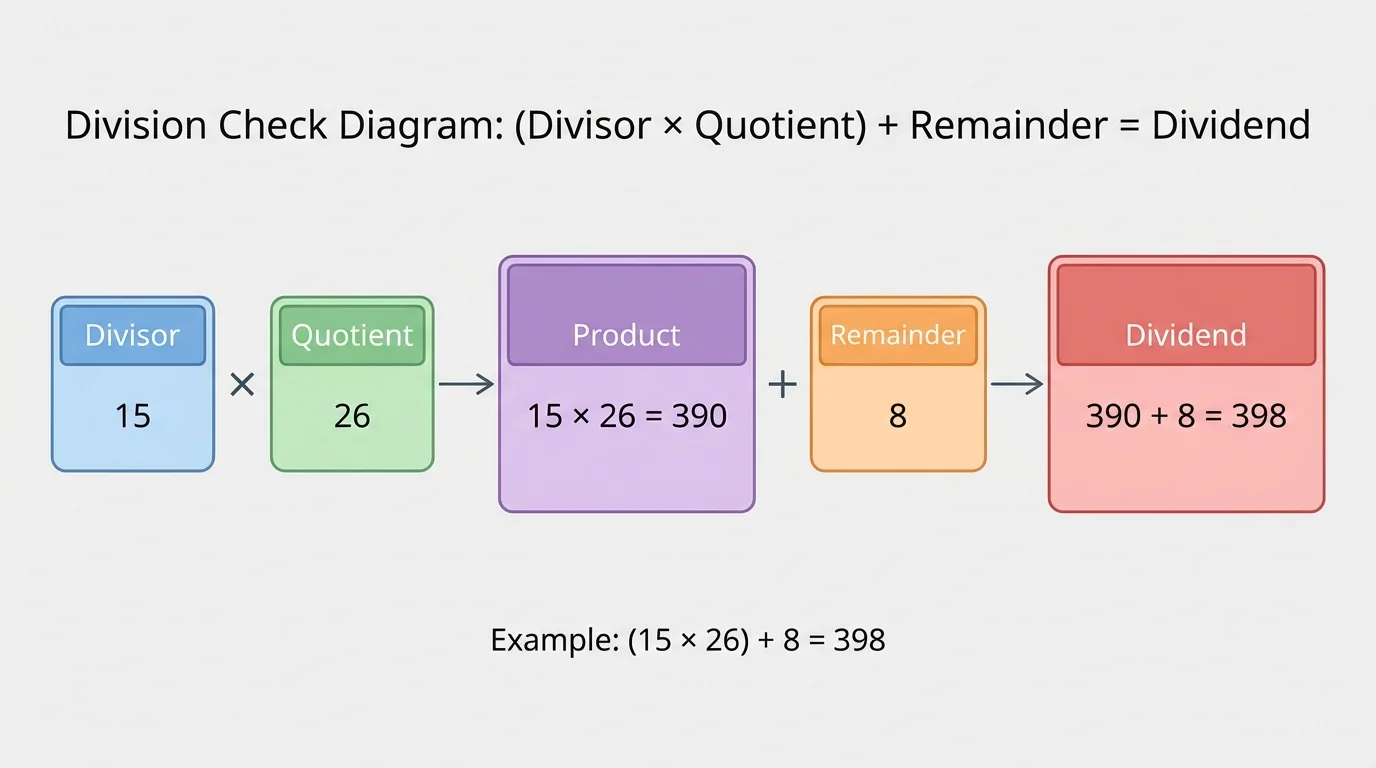
Check \(398 \div 15 = 26 \textrm{ remainder } 8\):
\[15 \times 26 + 8 = 390 + 8 = 398\]
The result matches the dividend, so the answer is correct.
Check \(936 \div 24 = 39\):
\[24 \times 39 = 936\]
There is no remainder, so multiplication alone is enough. This same checking method works every time, and it connects directly to the relationship between multiplication and division shown in [Figure 3].
Good division is not just about getting an answer. It is also about making wise choices along the way. Estimating first helps you know what kind of answer to expect. For instance, in \(824 \div 21\), since \(21\) is close to \(20\), and \(824 \div 20\) is about \(41\), the quotient should be around \(40\).
Then you can test nearby multiples:
\[21 \times 40 = 840\]
That is too large. Try:
\[21 \times 39 = 819\]
Now subtract:
\[824 - 819 = 5\]
So,
\[824 \div 21 = 39 \textrm{ remainder } 5\]
Estimation helps prevent mistakes. If someone says \(824 \div 21 = 14\), you can see right away that the answer is far too small.
Useful multiples to build quickly
When dividing by a two-digit number, it helps to know \(1\) group, \(2\) groups, \(5\) groups, \(10\) groups, and sometimes \(20\) or \(30\) groups. For a divisor of \(18\), useful multiples include \(18\), \(36\), \(90\), \(180\), and \(360\). These make it easier to subtract large chunks instead of counting one group at a time.
Here are some common mistakes to avoid:
Different strategies can solve the same problem. What matters is that the method makes mathematical sense.
| Method | How it works | Best use |
|---|---|---|
Partial quotients | Subtract large multiples of the divisor and add the groups. | When you want a flexible method based on place value. |
Area model | Use a rectangle to show the dividend as parts built from the divisor. | When a visual model helps you see why division works. |
Multiplication relationship | Think of division as a missing-factor problem. | When you know helpful multiples of the divisor. |
Table 1. Comparison of three useful strategies for dividing large whole numbers.
These methods are connected. In an area model, each rectangle part is really a partial quotient. In a missing-factor problem, each multiple you test is part of the multiplication-division relationship.
Division with larger numbers appears in many everyday situations. A store manager might divide \(1{,}248\) juice boxes into cartons of \(24\). A teacher might divide \(672\) pages into packets of \(16\). A coach might arrange \(396\) participants into groups of \(18\).
For example, to find \(1{,}248 \div 24\), you might notice:
\(24 \times 50 = 1{,}200\), leaving \(48\). Then \(48 \div 24 = 2\), so the quotient is \(52\).
So,
\[1{,}248 \div 24 = 52\]
This means \(1{,}248\) juice boxes fill \(52\) cartons of \(24\) each.
Or suppose a library has \(725\) books to place on shelves that hold \(32\) books each. Since \(32 \times 20 = 640\), there are \(85\) books left. Then \(32 \times 2 = 64\), leaving \(21\). So:
\[725 \div 32 = 22 \textrm{ remainder } 21\]
That means \(22\) shelves can be filled completely, and \(21\) books remain for another shelf.
Whether you are packing, grouping, seating, storing, or sharing, division helps turn a large amount into equal groups. Place value, multiplication, and visual models all work together to make the thinking clear.
