Have you ever checked a game score, a batting average, or a video game stat like 0.89 accuracy and wondered what those digits after the decimal really mean? 🏀 Those tiny numbers can decide who wins a contest, how much you pay at a store, or whether a science experiment works correctly.
To work confidently with money, measurements, and data, you need to be able to add, subtract, multiply, and divide decimals, especially to the hundredths place. This lesson shows how to use visual models and place-value strategies so that every step makes sense, not just memorized rules.
The first step in mastering decimal operations is understanding decimals and place value.
A decimal number has two main parts: a whole-number part and a fractional part. The decimal point separates them. For example, in the number \(47.36\):
We can show this in a place-value table:
| Tens | Ones | Decimal point | Tenths | Hundredths |
|---|---|---|---|---|
| 4 | 7 | . | 3 | 6 |
Table 1. Place-value positions for the decimal 47.36.
The tenths place represents parts of a whole divided into 10 equal pieces. The hundredths place represents parts of a whole divided into 100 equal pieces.
So \(0.36\) means \(3\) tenths and \(6\) hundredths, which is the same as \(\dfrac{36}{100}\).
To really see decimals, we can use a 10 by 10 grid called a hundreds grid. As shown in [Figure 1], the whole grid has 100 small squares. Each square is \(0.01\) (one hundredth), each full row of 10 squares is \(0.1\) (one tenth), and the whole grid is \(1.00\).
To represent \(0.37\):
Together that makes \(0.37\), or \(37\) hundredths.
This kind of model helps a lot when you are adding, subtracting, multiplying, or dividing decimals, because you can see the pieces you are working with.
To compare decimals like \(0.4\) and \(0.37\), always look at the largest place first. \(0.4\) has 4 tenths, which is more than 3 tenths, so \(0.4 > 0.37\), even though \(37\) is bigger than \(4\) as whole numbers.
When we use operations with decimals, we are really combining, separating, or resizing these tenths and hundredths.
Adding decimals is a lot like adding whole numbers, but we must pay close attention to place value and the decimal point. A sum is the result of an addition problem.
We can think about adding decimals with models (like hundreds grids) or with a written vertical method. In the written method, the decimal points line up in a straight column, as shown in [Figure 2].
Key idea: Add digits in the same place-value column: hundredths with hundredths, tenths with tenths, ones with ones, and so on.
Worked example 1: Adding decimals with models and the written method
Compute \(23.47 + 5.80\).
Step 1: Line up the decimals.
Write the numbers in a vertical addition setup, making sure the decimal points are directly above each other:
\[\begin{array}{r} 23.47 \\ +\;5.80 \\ \hline \end{array}\]
Step 2: Add from right to left by place value.
Your vertical work looks like this:
\[\begin{array}{r} 23.47 \\ +\;5.80 \\ \hline 29.27 \end{array}\]
Step 3: Explain with place value.
We are adding \(23\) ones, \(4\) tenths, and \(7\) hundredths to \(5\) ones and \(8\) tenths. Altogether that is \(29\) ones, \(2\) tenths, and \(7\) hundredths, or \(29.27\).
The answer is \(23.47 + 5.80 = 29.27\).
In a hundreds-grid model, you would shade \(23.47\) using 23 full grids plus 47 squares, and \(5.80\) using 5 full grids plus 80 squares. Then you would count up all the shaded parts to get \(29.27\).
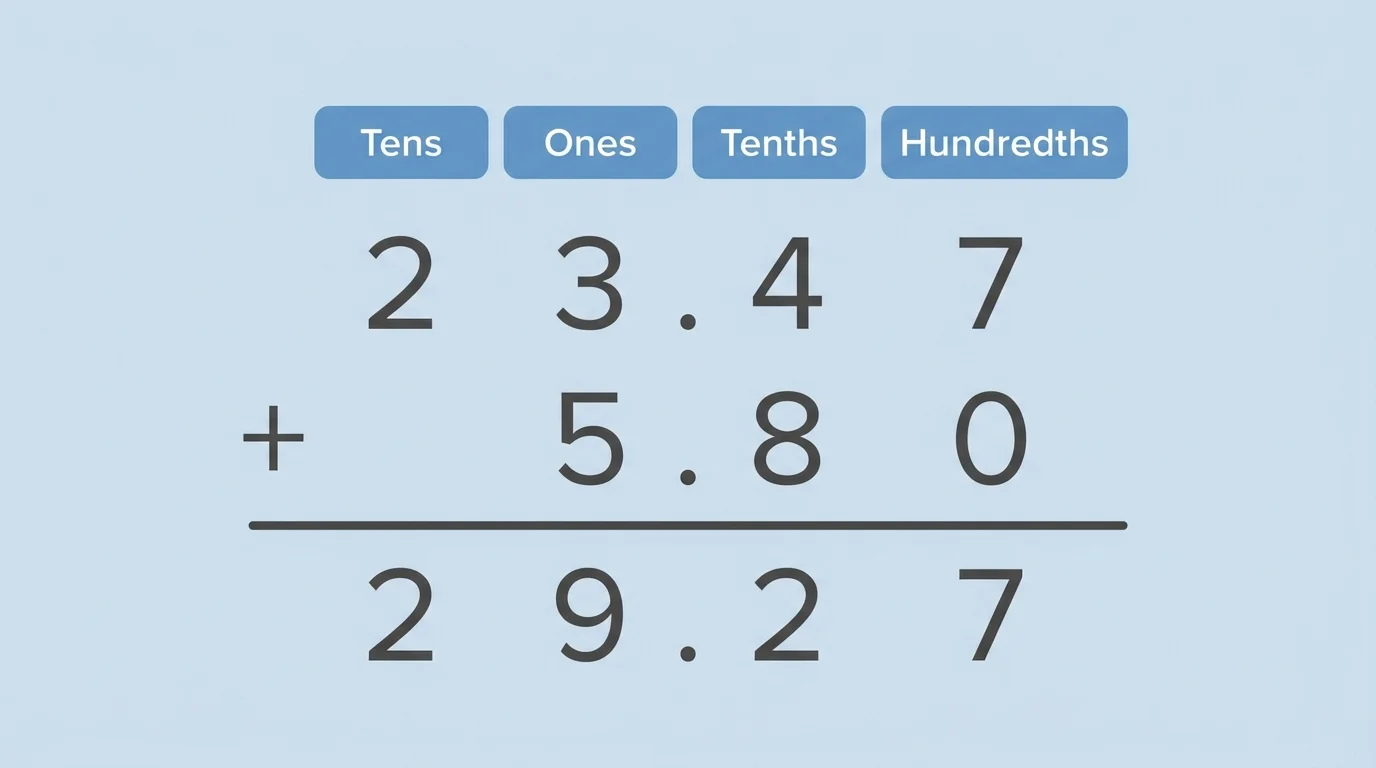
As you can see in [Figure 2], keeping the decimal points lined up makes sure we are adding matching places correctly.
Sometimes people write a trailing zero after a decimal, like \(0.5\) and \(0.50\). These are equal because both mean \(\dfrac{5}{10}\) or \(\dfrac{50}{100}\). Adding zeros to the right of the last digit in a decimal does not change its value.
Subtraction with decimals is closely related to addition. The difference is the result of subtraction. Subtraction can be thought of as "taking away" or "finding how much more" one number is than another.
We still line up the decimal points and subtract by place value, sometimes regrouping (borrowing) just like with whole numbers.
Worked example 2: Subtracting decimals with regrouping
Compute \(15.03 - 7.58\).
Step 1: Line up decimals in a vertical setup.
\[\begin{array}{r} 15.03 \\ -\;7.58 \\ \hline \end{array}\]
Step 2: Subtract hundredths.
We need to do \(3 - 8\) in the hundredths place, but \(3\) is too small. So we regroup:
Now subtract: \(13 - 8 = 5\) hundredths.
Step 3: Subtract tenths and ones.
The final result is:
\[\begin{array}{r} 15.03 \\ -\;7.58 \\ \hline 7.45 \end{array}\]
The answer is \(15.03 - 7.58 = 7.45\).
On a model, \(15.03\) is 15 wholes and 3 hundredths. Taking away \(7.58\) means removing 7 wholes, 5 tenths, and 8 hundredths. When we do not have enough tenths or hundredths, we break (regroup) a whole or a tenth into smaller pieces, just as we did in the written method.
Subtraction and addition are inverse operations. This means if \(a + b = c\), then \(c - b = a\) and \(c - a = b\). That relationship helps you check your work: you can add the difference to the smaller number to see if you get the larger number.
Multiplying decimals tells us how many we get when we take a number a certain number of times or find a part of a part. The result of multiplication is called the product. We use place value to decide where the decimal point goes in the answer.
There are two helpful ways to think about decimal multiplication:
Consider \(0.3 \times 0.4\). We can think of this as "3 tenths of 4 tenths." The grid model in [Figure 3] helps us see this.
Worked example 3: Multiplying two decimals with an area model
Compute \(0.3 \times 0.4\).
Step 1: Draw a 10 by 10 grid to represent 1 whole.
Shade 3 tenths vertically to represent \(0.3\). Shade 4 tenths horizontally (a different color) to represent \(0.4\).
Step 2: Count the overlap.
The overlapping squares show "3 tenths of 4 tenths." You should see \(12\) overlapping squares out of \(100\) squares.
That is \(\dfrac{12}{100} = 0.12\).
Step 3: Connect to place value.
Multiply as whole numbers: \(3 \times 4 = 12\). Count the total number of decimal places in the factors: \(0.3\) has 1 decimal place, \(0.4\) has 1 decimal place, so together that makes 2 decimal places. Place the decimal so the product has 2 decimal places: \(0.12\).
The product is \(0.3 \times 0.4 = 0.12\).
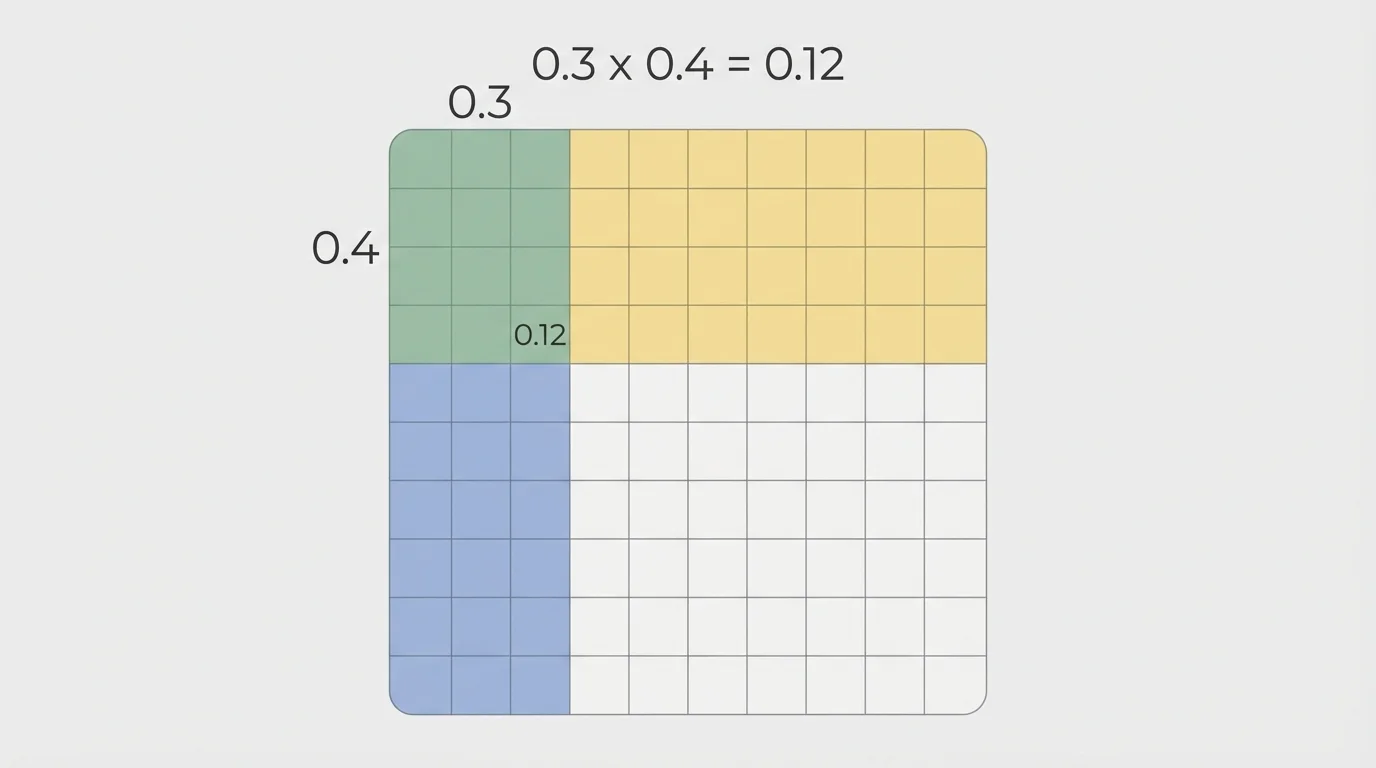
In [Figure 3], the overlapping shaded region visually confirms that the product \(0.12\) is less than both \(0.3\) and \(0.4\), which makes sense: a part of a part is smaller than each part.
For longer decimals, we usually skip drawing the grid and rely on place value.
Worked example 4: Multiplying a whole number by a decimal
Compute \(6 \times 0.25\).
Step 1: Ignore the decimal and multiply the whole numbers.
Think of \(0.25\) as \(25\) hundredths. Multiply: \(6 \times 25 = 150\).
Step 2: Count decimal places.
\(0.25\) has 2 decimal places. The number \(6\) has 0 decimal places. So the product must have 2 decimal places.
Step 3: Place the decimal point.
Start with \(150\) and move the decimal 2 places to the left: \(1.50\). So \(6 \times 0.25 = 1.50\), which we usually write as \(1.5\).
This matches the idea that 0.25 is \(\dfrac{1}{4}\). Six quarters of a whole is one and a half wholes.
Division with decimals answers questions like "How many equal groups?" or "How much in each group?" The result of division is called the quotient. We can use a place-value shift idea to make division with decimals easier.
When dividing by a whole number, the main challenge is placing the decimal point in the quotient. When dividing by a decimal, we often change the divisor into a whole number by shifting the decimal point in both the divisor and the dividend.
Worked example 5: Dividing a decimal by a whole number
Compute \(4.8 \div 3\).
Step 1: Think about place value.
\(4.8\) is 4 and 8 tenths. We want to share \(4.8\) into 3 equal groups.
Step 2: Use long division.
We set it up as \(4.8 \div 3\). First, \(3\) goes into \(4\) one time (\(1\) whole). That uses up \(3\), leaving \(1\) whole.
Bring down the tenths: the remaining \(1\) whole becomes \(10\) tenths, plus the \(8\) tenths we already had makes \(18\) tenths. \(18 \div 3 = 6\).
Step 3: Place the decimal point.
We write the decimal point in the quotient (answer) directly above the decimal point in the dividend. The quotient is \(1.6\).
So \(4.8 \div 3 = 1.6\). Each group gets 1 and 6 tenths.
Worked example 6: Dividing a decimal by a decimal
Compute \(3.75 \div 0.25\).
Step 1: Make the divisor a whole number.
\(0.25\) has 2 decimal places. Multiply both numbers by \(100\) (move the decimal point 2 places to the right):
This keeps the quotient the same because we changed both numbers in the same way.
Step 2: Divide the new numbers.
Now compute \(375 \div 25\). We know that \(25 \times 15 = 375\) (because \(25 \times 10 = 250\) and \(25 \times 5 = 125\), and \(250 + 125 = 375\)).
Step 3: Write the quotient.
The answer is \(15\). So \(3.75 \div 0.25 = 15\). That means 3.75 contains 0.25 exactly 15 times.
This method of shifting the decimal in both numbers uses place value to turn a decimal division into a whole-number division.
To work flexibly with decimals, it helps to know some properties of operations. 💡 These are rules that always hold true for addition and multiplication (and help explain subtraction and division too).
These properties still work with decimals because decimals follow the same place-value rules as whole numbers.
Worked example 7: Using the distributive property with decimals
Compute \(1.5 \times 7\) by breaking apart 7.
Step 1: Break 7 into an easier sum.
Write \(7 = 5 + 2\).
Step 2: Distribute 1.5.
Use the distributive property: \(1.5 \times 7 = 1.5 \times (5 + 2) = 1.5 \times 5 + 1.5 \times 2\).
Step 3: Multiply and add.
Add: \(7.5 + 3.0 = 10.5\).
So \(1.5 \times 7 = 10.5\). The distributive property helped us break a harder problem into easier parts.
We can also use the relationship between addition and subtraction to check answers. If you find that \(2.65 + 1.9 = 4.55\), you can check by subtracting: \(4.55 - 1.9 = 2.65\). If this is true, your original addition is likely correct. 🎯
Decimals show up all over daily life. 🧮 Here are some ways we use each operation.
In science, decimals help us measure things like mass, length, and time very precisely, such as 1.23 meters or 0.56 seconds. Accurate decimal operations keep experiments and data analysis correct.
Here are some frequent errors students make with decimal operations and tips to avoid them:
| Mistake | Example | Why it is wrong | Fix |
|---|---|---|---|
| Not lining up decimal points when adding or subtracting | Adding \(1.2\) and \(0.35\) as if they were whole numbers | Places do not match, so tenths and hundredths are mixed up | Always write numbers so decimal points are in a vertical line |
| Dropping or adding extra zeros | Thinking \(0.5\) and \(0.50\) are different amounts | Zeros to the right of the last digit do not change the value | Remember, \(0.5 = 0.50 = 0.500\) |
| Putting the decimal in the wrong place in a product | \(0.4 \times 0.3 = 1.2\) | Forgot to count total decimal places (2 places needed) | Multiply as whole numbers, then count decimal places from both factors |
| Not shifting both numbers in decimal division | Changing only the divisor in \(3.75 \div 0.25\) | Changes the value of the quotient | Shift decimal in both divisor and dividend by the same number of places |
Table 2. Common decimal-operation mistakes and how to correct them.
"Mathematics is not about numbers, equations, computations, or algorithms: it is about understanding."
— William Paul Thurston
When you connect models, place value, and written methods, decimal operations become something you truly understand, not just steps to memorize. 🌟
