Here is a surprising fact: a cheetah can run about \(100\) meters in only a few seconds, but if you measured that same distance in centimeters, the number would suddenly become much larger. The distance did not change at all, but the unit did. That is the big idea in this lesson: when we change units, we are changing how we describe a measurement, not the amount itself.
Being able to convert units helps in many everyday situations. A recipe might use cups and pints. A race might be measured in meters and kilometers. A piece of ribbon might be measured in inches or feet. Builders, athletes, cooks, doctors, and scientists all need to compare measurements and change them into useful units.
When you measure something, you are answering two questions: How much? and Using what unit? For example, saying a pencil is \(15\) centimeters long gives both the number and the unit. If you say the same pencil is \(0.15\) meters long, the measurement still describes the same pencil.
A measurement system is a group of units that belong together. In grade \(5\), you work with the two most common measurement systems: the metric system and the customary system. We convert within one system at a time. For example, centimeters can convert to meters because both are metric units. Inches can convert to feet because both are customary units.
You already know how to multiply and divide whole numbers and decimals. Unit conversion uses those same skills. The new part is deciding which operation to use and keeping track of the units carefully.
Think of units as different-sized containers for the same amount. A larger unit needs fewer pieces. A smaller unit needs more pieces. For example, it takes many centimeters to equal \(1\) meter, because a centimeter is much smaller than a meter.
The metric system includes units such as millimeters, centimeters, meters, kilometers, grams, kilograms, milliliters, and liters. These units are connected by powers of \(10\), which often makes conversions easier.
The customary system includes units such as inches, feet, yards, miles, ounces, pounds, cups, pints, quarts, and gallons. These conversions do not all use \(10\), so students often memorize the most common facts.
Time is also part of measurement. Seconds, minutes, hours, days, and weeks are all units of time. Time conversions are important in schedules, travel, sports, and planning events.
It helps to compare unit sizes visually. In metric length, as [Figure 1] shows, a kilometer is much larger than a meter, and a meter is much larger than a centimeter. When you move from a larger unit to a smaller unit, the number gets larger because you need more small parts to make the same whole amount.
For example, \(1\) meter equals \(100\) centimeters. That means a length of \(2\) meters is \(200\) centimeters. The object did not get longer. We just counted it in smaller pieces.
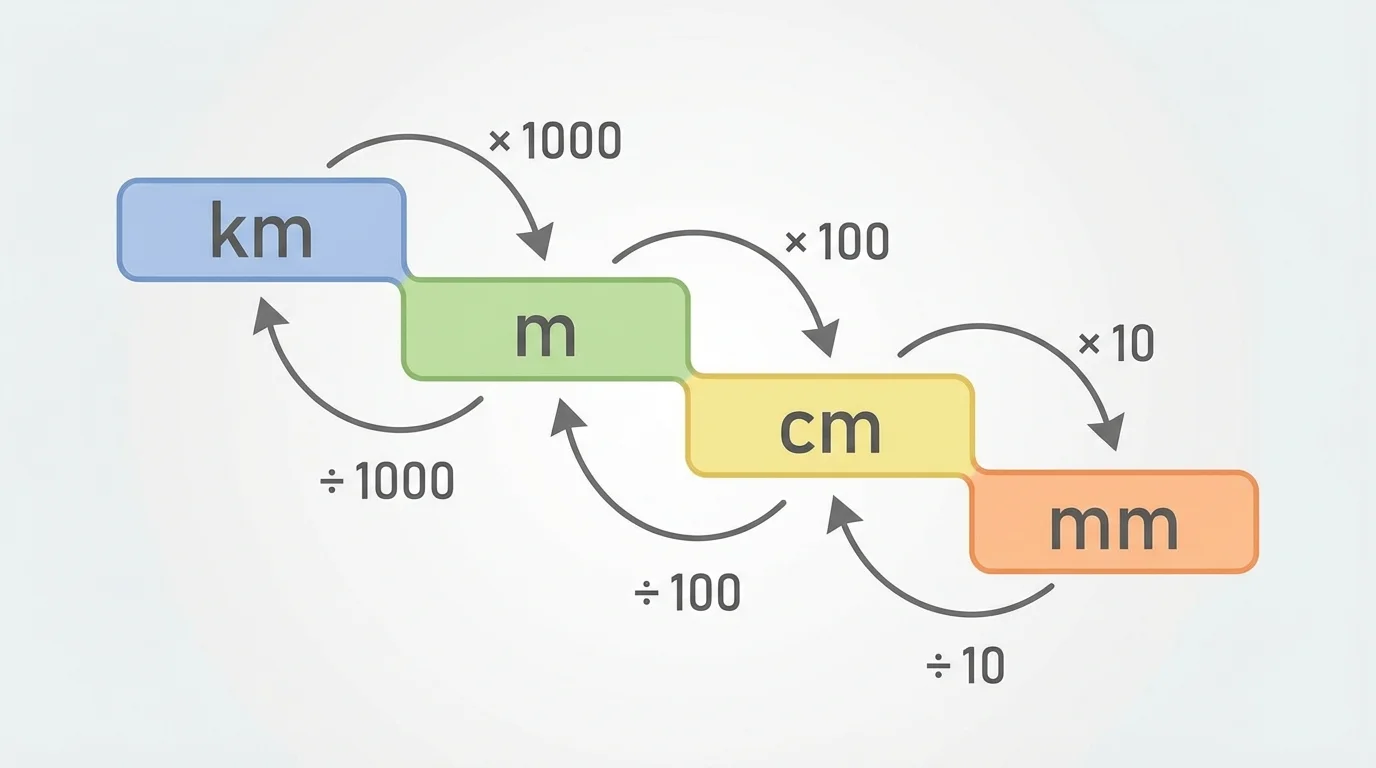
Going the other direction works too. When you move from a smaller unit to a larger unit, the number gets smaller because fewer large units are needed. Since \(100\) centimeters make \(1\) meter, \(5\) centimeters is only a small part of a meter:
\[5 \textrm{ cm} = 0.05 \textrm{ m}\]
Convert means to change a measurement from one unit to another without changing the actual amount. A conversion factor, or conversion fact, is a true relationship such as \(1\) foot equals \(12\) inches or \(1\) liter equals \(1{,}000\) milliliters.
This idea is true in every measurement category. For capacity, \(1\) gallon is larger than \(1\) quart, so the same amount written in quarts will have a larger number. For mass, \(1\) kilogram is larger than \(1\) gram, so the number of grams is much larger than the number of kilograms for the same mass.
You do not need to memorize every conversion ever made, but you should know the common facts that help with grade-level problems.
| Measurement Type | Larger Unit | Smaller Unit | Conversion Fact |
|---|---|---|---|
| Length | \(1\) foot | \(12\) inches | \(1 \textrm{ ft} = 12 \textrm{ in}\) |
| Length | \(1\) yard | \(3\) feet | \(1 \textrm{ yd} = 3 \textrm{ ft}\) |
| Length | \(1\) mile | \(5{,}280\) feet | \(1 \textrm{ mi} = 5{,}280 \textrm{ ft}\) |
| Length | \(1\) meter | \(100\) centimeters | \(1 \textrm{ m} = 100 \textrm{ cm}\) |
| Length | \(1\) centimeter | \(10\) millimeters | \(1 \textrm{ cm} = 10 \textrm{ mm}\) |
| Mass | \(1\) kilogram | \(1{,}000\) grams | \(1 \textrm{ kg} = 1{,}000 \textrm{ g}\) |
| Capacity | \(1\) liter | \(1{,}000\) milliliters | \(1 \textrm{ L} = 1{,}000 \textrm{ mL}\) |
| Capacity | \(1\) pint | \(2\) cups | \(1 \textrm{ pt} = 2 \textrm{ c}\) |
| Capacity | \(1\) quart | \(2\) pints | \(1 \textrm{ qt} = 2 \textrm{ pt}\) |
| Capacity | \(1\) gallon | \(4\) quarts | \(1 \textrm{ gal} = 4 \textrm{ qt}\) |
| Time | \(1\) hour | \(60\) minutes | \(1 \textrm{ hr} = 60 \textrm{ min}\) |
| Time | \(1\) minute | \(60\) seconds | \(1 \textrm{ min} = 60 \textrm{ s}\) |
Table 1. Common conversion facts for length, mass, capacity, and time.
As you work, ask yourself one powerful question: Am I changing to a smaller unit or a larger unit? That question often tells you what to do next.
[Figure 2] shows a simple pattern for unit conversion. A conversion factor is the relationship that tells how many of one unit equal another. You can picture the decision process, as shown in [Figure 2], before you even start calculating.
Step 1: Identify the starting unit and the target unit.
Step 2: Decide which unit is larger and which is smaller.
Step 3: Use the known conversion fact.
Step 4: Multiply when changing to a smaller unit, because you need more pieces.
Step 5: Divide when changing to a larger unit, because you need fewer pieces.
Step 6: Check whether the answer makes sense.
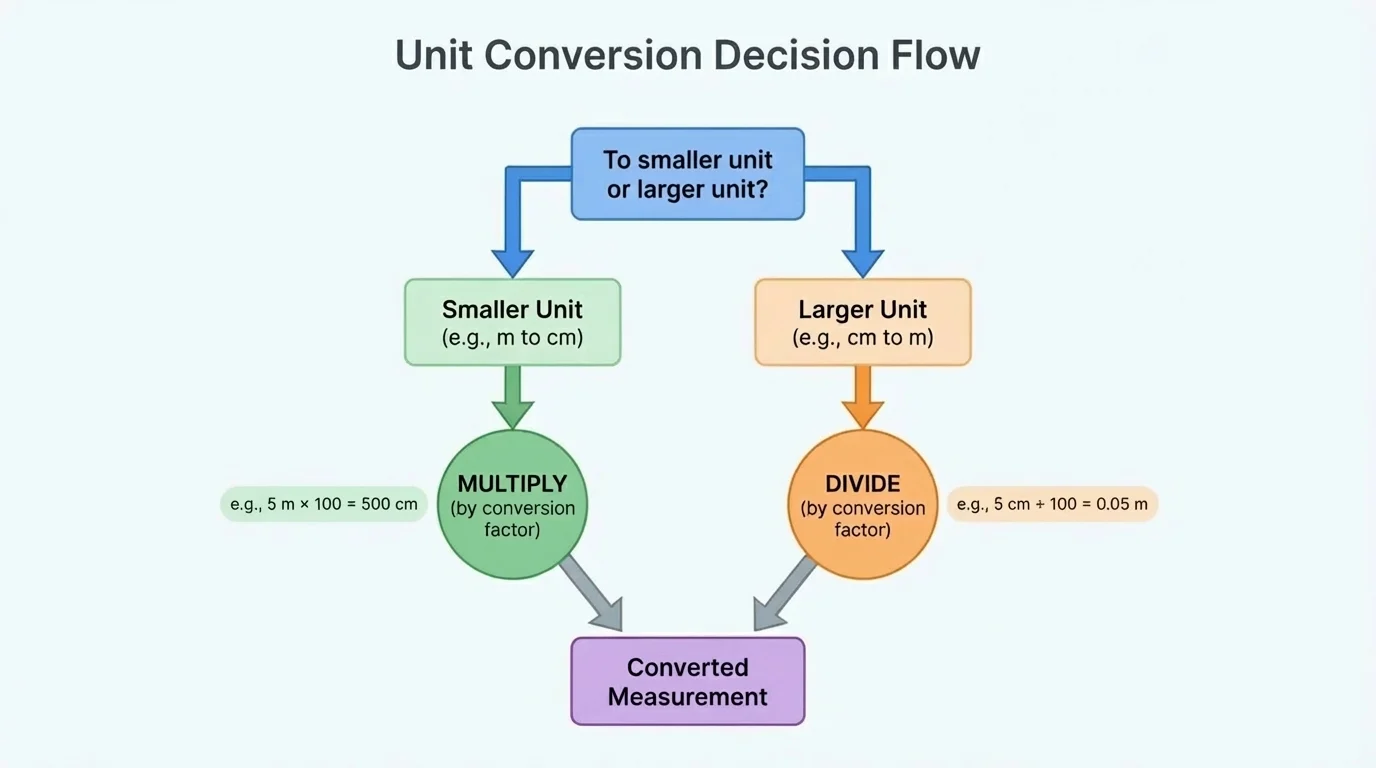
For example, changing \(3\) feet to inches means changing to a smaller unit. Since \(1\) foot equals \(12\) inches, multiply: \(3 \times 12 = 36\). So \(3\) feet equals \(36\) inches.
Changing \(250\) centimeters to meters means changing to a larger unit. Since \(100\) centimeters equals \(1\) meter, divide: \(250 \div 100 = 2.5\). So \(250\) centimeters equals \(2.5\) meters. This matches the unit-size idea from [Figure 1]: larger units lead to smaller numbers.
Why multiplying and dividing both appear in conversions
Suppose you have the same ribbon length. If you count it in centimeters, you use many small pieces, so the number is large. If you count it in meters, you use fewer large pieces, so the number is smaller. That is why converting to a smaller unit usually means multiply, while converting to a larger unit usually means divide.
Convert \(5\) centimeters to meters.
Worked example: metric length
Step 1: Identify the conversion fact.
We know that \(1 \textrm{ m} = 100 \textrm{ cm}\).
Step 2: Decide whether to multiply or divide.
We are changing from centimeters to meters. Meters are larger than centimeters, so we divide by \(100\).
Step 3: Calculate.
\(5 \div 100 = 0.05\)
So,
\[5 \textrm{ cm} = 0.05 \textrm{ m}\]
This example is important because it shows that answers do not always stay whole numbers. A very short length in a larger unit may be written as a decimal.
A board is \(4\) feet long. How many inches long is it?
Worked example: customary length
Step 1: Use the conversion fact.
\(1 \textrm{ ft} = 12 \textrm{ in}\)
Step 2: Decide on the operation.
Inches are smaller than feet, so multiply.
Step 3: Calculate.
\(4 \times 12 = 48\)
Therefore,
\[4 \textrm{ ft} = 48 \textrm{ in}\]
You can check by asking whether \(48\) seems reasonable. Since each foot contains \(12\) inches, \(4\) feet should definitely be more than \(12\) inches. The answer makes sense.
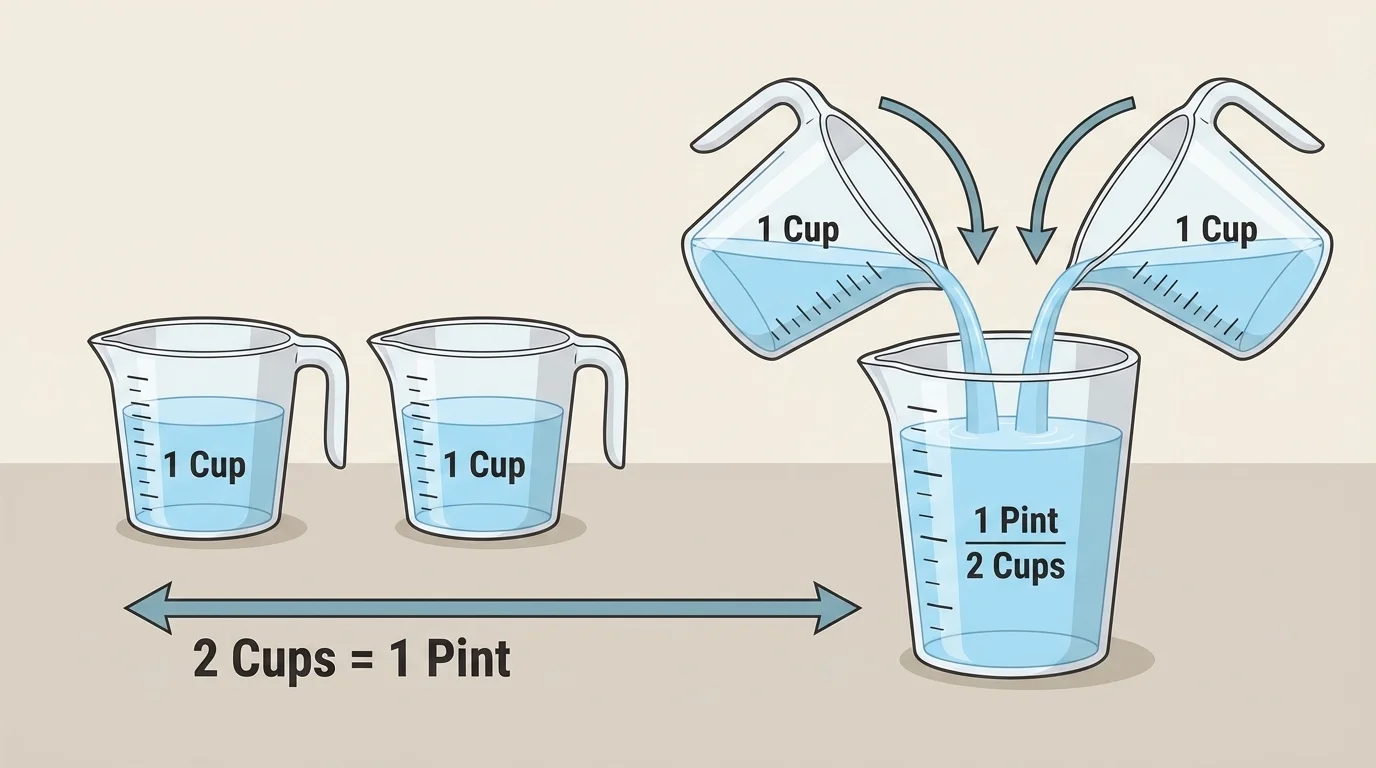
[Figure 3] helps show how equal groups combine in this problem.
A class is making fruit punch. They pour \(4\) containers, and each container holds \(2\) cups. How many pints of punch do they have in all? This kind of situation is easier to understand when you picture equal groups being combined.
This is a multi-step problem because you must first find the total number of cups and then convert cups to pints.
Worked example: multi-step capacity
Step 1: Find the total amount in cups.
There are \(4\) containers with \(2\) cups each.
\(4 \times 2 = 8\)
So the class has \(8\) cups.
Step 2: Convert cups to pints.
Use the fact \(1 \textrm{ pt} = 2 \textrm{ c}\).
Since pints are larger than cups, divide by \(2\).
\(8 \div 2 = 4\)
So,
\[8 \textrm{ c} = 4 \textrm{ pt}\]
The class has \(4\) pints of punch.
In this problem, a student who converted before finding the total would probably get confused. In many real problems, the order of the steps matters.
Real-world problems often mix operations and conversions. A good plan helps you stay organized.
First, read carefully and decide what the question is asking for. Second, underline or note the units given. Third, find the total, difference, or other amount if needed. Fourth, convert to the requested unit. Fifth, check whether the unit and number make sense.
Consider this problem: Maya walks \(3\) laps around a path that is \(400\) meters long. How many kilometers does she walk? First find the total distance: \(3 \times 400 = 1{,}200\) meters. Then convert meters to kilometers. Since \(1\) kilometer equals \(1{,}000\) meters, \(1{,}200 \div 1{,}000 = 1.2\). Maya walks \(1.2\) kilometers.
Here is another one: A movie lasts \(2\) hours and \(35\) minutes. How many minutes is that altogether? First convert hours to minutes: \(2 \times 60 = 120\) minutes. Then add the extra \(35\) minutes: \(120 + 35 = 155\). The movie lasts \(155\) minutes.
Track races are often listed in meters, but longer road races are usually listed in kilometers or miles. The unit changes because different distances are easier to describe with different-sized units.
Now think about a craft project. A student has \(2\) yards of string and cuts it into pieces that are each \(18\) inches long. First convert \(2\) yards to inches. Since \(1\) yard equals \(3\) feet and \(1\) foot equals \(12\) inches, \(2\) yards equals \(2 \times 3 \times 12 = 72\) inches. Then divide by \(18\): \(72 \div 18 = 4\). The student can make \(4\) pieces.
Notice that some problems need more than one conversion fact. In the string problem, yards changed to feet and then feet changed to inches. In the punch problem, the grouped containers in [Figure 3] help show why finding the total first is such a useful strategy.
One common mistake is using the wrong operation. If you convert \(6\) feet to inches and divide by \(12\), you would get a smaller number, but that cannot be right because inches are smaller units. There should be more inches than feet.
Another common mistake is forgetting the unit label. Writing only \(48\) is incomplete if the answer should be \(48\) inches. The number and the unit belong together.
A third mistake is mixing systems. You should not directly convert feet to centimeters unless the problem gives you a relationship between the systems. In this lesson, the focus is converting units within the same system.
"A correct number with the wrong unit is still a wrong answer."
It also helps to estimate. If a bottle holds \(1\) liter, it cannot suddenly become \(10\) milliliters after conversion, because milliliters are smaller units. The number should become larger, not smaller. This same pattern appears in the metric ladder from [Figure 1].
Conversions appear in many parts of life. In cooking, a recipe may call for \(2\) pints of soup, but you may only have a measuring cup. Since \(1\) pint equals \(2\) cups, you would need \(4\) cups.
In sports, runners may train in miles while track events are measured in meters. If a student runs \(800\) meters and wants to compare that distance to kilometers, dividing by \(1{,}000\) gives \(0.8\) kilometers.
In construction and design, small differences matter. A shelf that is \(36\) inches long is the same as \(3\) feet long. A builder chooses the unit that makes the measurement easiest to use.
In science and medicine, liquids are often measured in liters and milliliters because the metric system is precise and easy to scale by powers of \(10\). The multiply-or-divide decision shown in [Figure 2] works especially well in metric conversions.
Strong mathematicians do more than compute. They also ask whether an answer is reasonable. If you convert to a smaller unit, the number should usually increase. If you convert to a larger unit, the number should usually decrease. That quick check catches many mistakes before they become final answers.
When a problem has several steps, do not rush. Find what is needed first, then convert if necessary, and always read the question again at the end. Sometimes the problem asks for total inches, but a student stops after finding feet. Sometimes the problem asks for hours and minutes, but a student answers only in minutes.
Unit conversion is really about understanding size. Whether you are measuring ribbon, water, distance, mass, or time, the amount stays the same even when the unit changes. What changes is the way you count that amount.
