A cereal box, a toy chest, and even a small room all have something in common: each one takes up space in three dimensions. That amount of space is called volume. When mathematicians measure volume, they do not flatten an object like they do for area. Instead, they think about how many tiny cubes can fill the space inside it.
Volume is the amount of space inside a solid figure. A solid figure is a shape that has length, width, and height. That makes volume different from area. Area measures a flat surface in two dimensions, but volume measures space in three dimensions.
Volume is the number of cubic units needed to fill a solid figure without gaps or overlaps.
Unit cube is a cube with side lengths of exactly one unit.
Cubic unit is the unit used to measure volume, such as cubic centimeters, cubic inches, or cubic feet.
If you cover the top of a desk, you are thinking about area. If you fill a box with small cubes, you are thinking about volume. Because a solid figure has three dimensions, the units for volume are also three-dimensional.
When we measure volume, we imagine filling the shape completely. The cubes must fit neatly, with no empty spaces and no cubes sticking through each other. That idea will matter every time we count volume.
A unit cube has side lengths of exactly \(1\) unit, and [Figure 1] shows why this matters. If each edge of the cube is \(1\) centimeter long, then the cube is a cubic centimeter. If each edge is \(1\) inch long, then the cube is a cubic inch. The unit tells the size of the cube we are using to measure.
A cubic centimeter is written as \(1\textrm{ cm}^3\). A cubic inch is written as \(1\textrm{ in}^3\). A cubic foot is written as \(1\textrm{ ft}^3\). The little \(3\) means the unit has length, width, and height.
You can think of a cubic centimeter as a tiny cube that is \(1\textrm{ cm}\) long, \(1\textrm{ cm}\) wide, and \(1\textrm{ cm}\) high. A cubic foot is much larger because each edge is \(1\textrm{ ft}\) long. So even though both are unit cubes, they are not the same size.
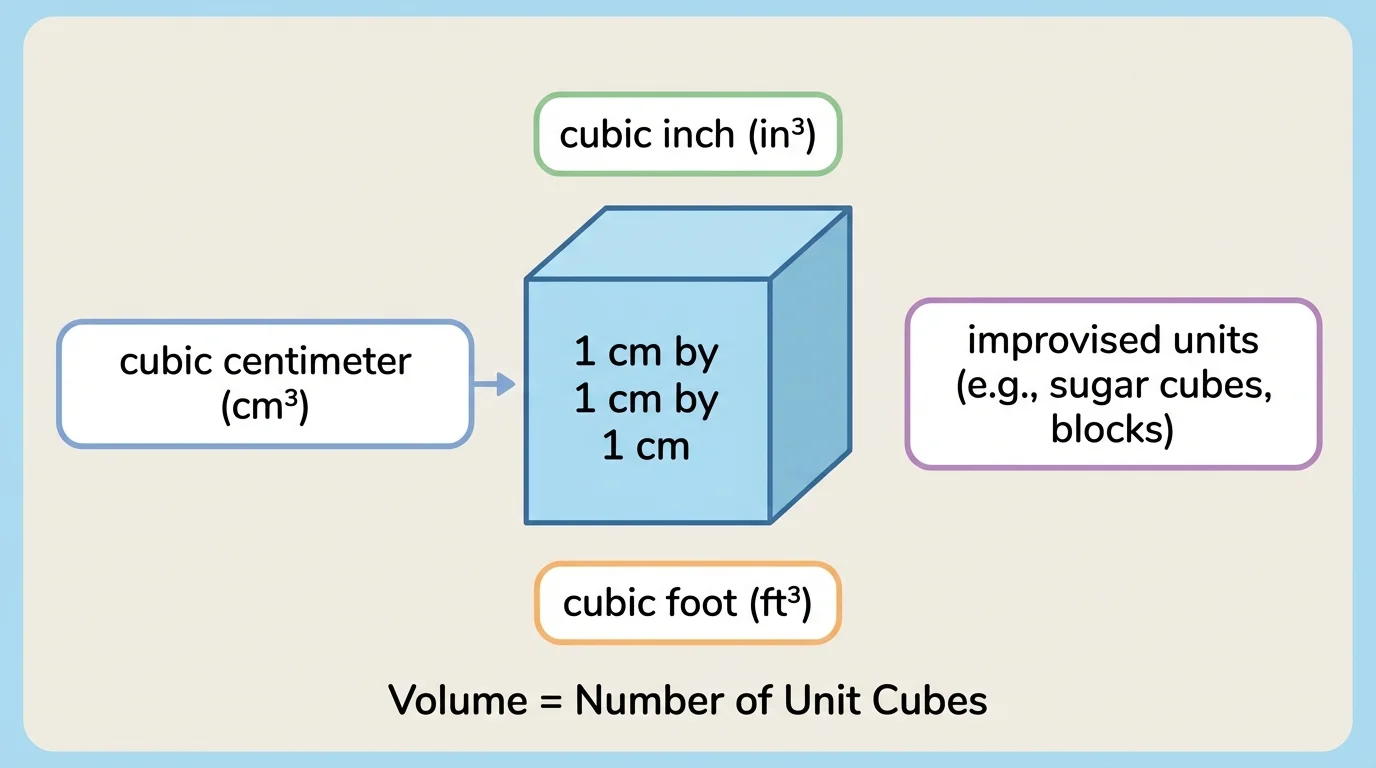
The size of the unit matters a lot. A box might hold many cubic centimeters but only a few cubic inches. It is similar to measuring length with inches or feet: the number changes when the unit changes.
A cubic foot is large enough to describe spaces like storage boxes or parts of a room, while a cubic centimeter is better for tiny objects like small blocks or little containers.
Sometimes people also use improvised units. These are nonstandard units made from objects that act like equal-sized cubes, such as building blocks, small gift boxes, or sugar cubes. Improvised units can help us understand the idea of volume, even if they are not official measurement units.
One of the easiest solids to measure is a rectangular prism, and [Figure 2] illustrates why. A rectangular prism is a box-shaped solid with flat rectangular faces. If it is built from equal-sized cubes, we can find its volume by counting the cubes.
Suppose a small prism has \(3\) cubes in one row, \(2\) rows in one layer, and \(4\) layers stacked up. We could count each cube one by one, but that would take time. A better way is to count one layer first.
In one layer, there are \(3 \times 2 = 6\) cubes. Since there are \(4\) layers, the total number of cubes is \(6 \times 4 = 24\). So the volume is \(24\) cubic units.
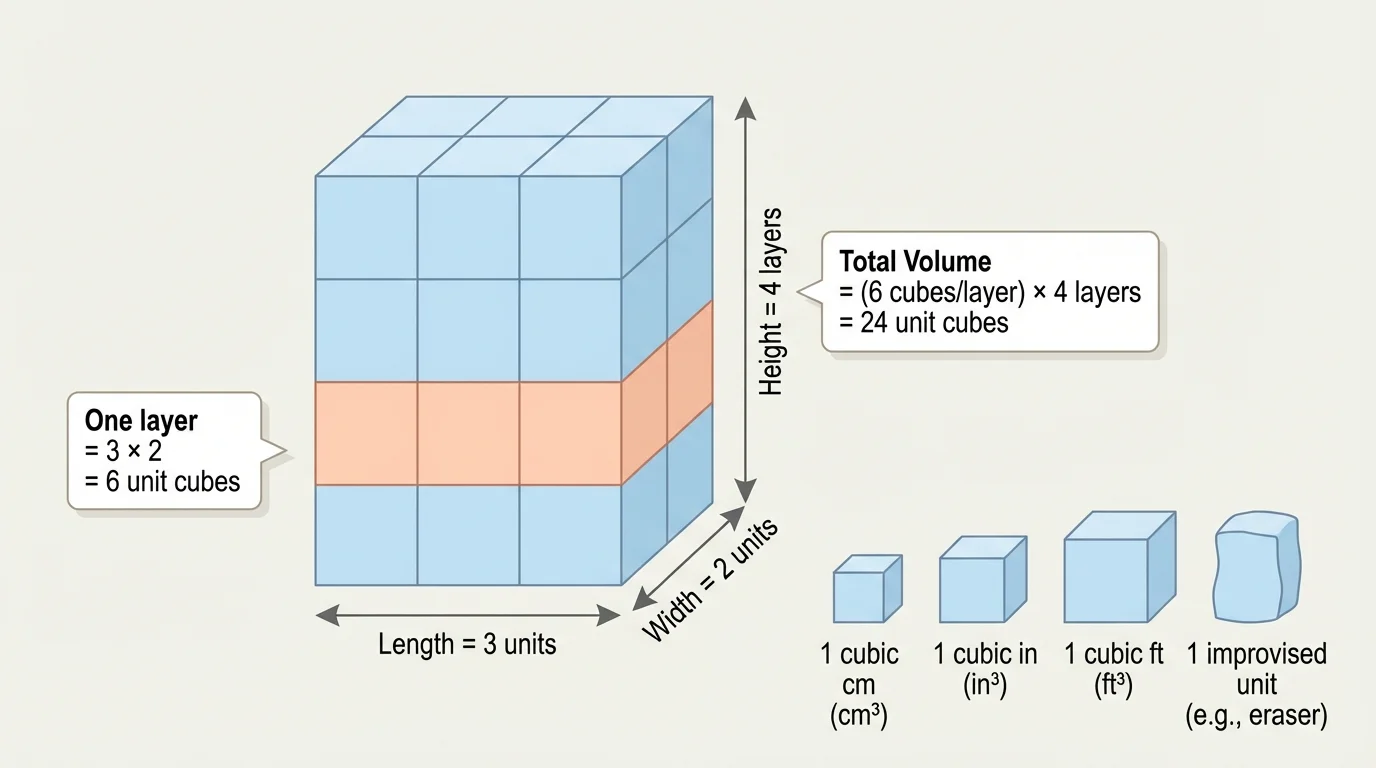
This shows an important idea: volume can be found by counting cubes in layers. Each layer has the same number of cubes, so repeated addition becomes multiplication.
If a prism has dimensions \(l\), \(w\), and \(h\), then the number of cubes in one layer is \(l \times w\), and the number of layers is \(h\). That leads to the volume rule:
\[V = l \times w \times h\]
Here, \(V\) stands for volume. This rule works when the prism is completely filled with unit cubes and there are no gaps or overlaps.
Volume is closely connected to multiplication because counting every cube one at a time is often the same as counting equal groups. If one layer has \(8\) cubes and there are \(5\) layers, then the total is \(8 + 8 + 8 + 8 + 8 = 40\), which is the same as \(8 \times 5 = 40\).
Volume also connects to addition. If a solid is made of two smaller rectangular prisms, you can find the volume of each part and then add them. For example, if one part has volume \(12\textrm{ cm}^3\) and another has volume \(9\textrm{ cm}^3\), then the total volume is \(12 + 9 = 21\textrm{ cm}^3\).
Layers, rows, and columns help organize cube counting. A layer is one flat arrangement of cubes. Inside a layer, cubes can be arranged in rows and columns. Counting rows and columns gives the number of cubes in one layer, and multiplying by the number of layers gives the full volume.
This is why volume is more than just memorizing a formula. The multiplication rule comes from the structure of the cubes. As we saw with [Figure 2], one shaded layer can represent an equal group, and stacking layers shows repeated multiplication.
Worked examples help make the idea of volume clear. Notice how each solution uses cubes, layers, multiplication, or addition.
Worked Example 1
A rectangular prism is built from unit cubes. It has \(4\) cubes across, \(3\) cubes deep, and \(2\) layers high. Find the volume.
Step 1: Find the number of cubes in one layer.
One layer has \(4 \times 3 = 12\) cubes.
Step 2: Multiply by the number of layers.
There are \(2\) layers, so the total is \(12 \times 2 = 24\).
Step 3: Write the answer with cubic units.
\[V = 24\textrm{ cubic units}\]
The prism has a volume of \(24\) cubic units.
In this example, the cubes were not counted one by one. Instead, the layer structure made the counting faster and more organized.
Worked Example 2
A box is filled with cubes that are each \(1\textrm{ cm}\) on every edge. The box fits \(5\) cubes along the length, \(2\) along the width, and \(3\) along the height. Find the volume in cubic centimeters.
Step 1: Use the dimensions to count cubes in a layer.
One layer has \(5 \times 2 = 10\) cubes.
Step 2: Count all layers.
There are \(3\) layers, so \(10 \times 3 = 30\).
Step 3: Name the unit correctly.
Because each cube is \(1\textrm{ cm} \times 1\textrm{ cm} \times 1\textrm{ cm}\), the unit is cubic centimeters.
\[V = 30\textrm{ cm}^3\]
The box has volume \(30\textrm{ cm}^3\).
The unit in the answer must match the size of the cube used. Since the box was filled with centimeter cubes, the answer is in cubic centimeters, not just centimeters.
Worked Example 3
A storage crate can be thought of as two rectangular prisms put together. One part has volume \(18\textrm{ ft}^3\), and the other part has volume \(7\textrm{ ft}^3\). What is the total volume?
Step 1: Add the two volumes.
\(18 + 7 = 25\)
Step 2: Keep the same unit.
Both parts are measured in cubic feet, so the total is also in cubic feet.
Step 3: State the result.
\[V = 25\textrm{ ft}^3\]
The total volume is \(25\textrm{ ft}^3\).
This example shows that volume can also be found by addition when a solid is made from separate parts.
Worked Example 4
A toy container is measured using improvised cube units. It holds exactly \(12\) identical small blocks, each used as one unit cube. What is the volume?
Step 1: Count the equal units.
The container holds \(12\) equal cube-like blocks.
Step 2: Express the answer in improvised units.
\[V = 12\textrm{ improvised cubic units}\]
The volume is \(12\) nonstandard cubic units.
Even though these are not standard units like centimeters or inches, they still measure volume as long as all the units are equal in size.
The same space can have different volume numbers depending on the size of the cubes used, and [Figure 3] makes this comparison clear. Small cubes give a larger count. Large cubes give a smaller count. That does not mean the space changed; only the measuring unit changed.
For example, a container might hold \(64\) small centimeter cubes but only \(4\) larger inch cubes. Both measurements describe the same space, but the unit cubes are different sizes.
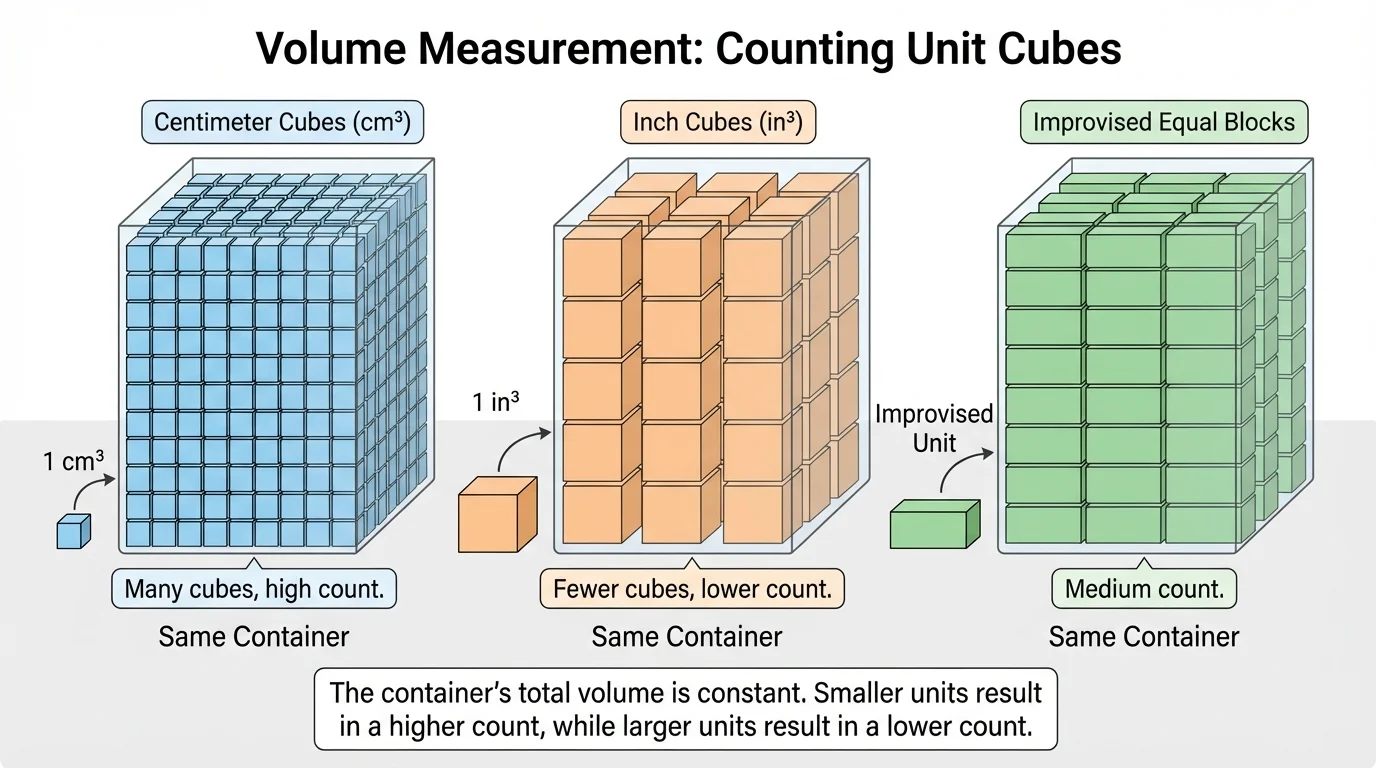
Improvised units are helpful in classrooms or at home when standard cubes are not available. You might use linking cubes, little boxes, or other equal objects. The important rule is that the improvised units must all be the same size and shape if you want a fair measurement.
When people need exact, shared measurements, they use standard units such as cubic centimeters, cubic inches, or cubic feet. These units let everyone understand the measurement the same way.
| Unit | Best used for | Example |
|---|---|---|
| \(\textrm{cm}^3\) | Small objects | Small box, tiny container |
| \(\textrm{in}^3\) | Objects measured in inches | Small package, toolbox section |
| \(\textrm{ft}^3\) | Larger spaces | Storage crate, part of a room |
| Improvised cubic units | Estimating or learning | Building blocks, sugar cubes |
Table 1. Common cubic units and examples of when each is useful.
As shown earlier in [Figure 1], every cubic unit is based on a cube with edge length \(1\) unit. The only difference is whether that unit is a centimeter, an inch, a foot, or an improvised measure.
Volume matters whenever people need to know how much a container can hold or how much space an object takes up. Delivery companies think about the volume of boxes. Builders think about the volume of rooms or containers. Store workers think about how many smaller packages fit inside a larger carton.
If a company packs sports balls into a shipping box, they need to know whether the box has enough volume. If a family buys a storage bin, they want to know how much it can hold. If a classroom has a cubby shelf, students may compare which cubby has the greater volume.
Standard units are especially important in real life. A manufacturer cannot simply say a box has volume \(20\) units. The company must say whether the volume is \(20\textrm{ in}^3\), \(20\textrm{ cm}^3\), or something else. Without the unit, the number alone is incomplete.
Length is measured in units like centimeters, inches, and feet. Area is measured in square units like \(\textrm{cm}^2\). Volume is measured in cubic units like \(\textrm{cm}^3\). As measurements move from one dimension to two and then three, the units also change.
This is why a room might be described in cubic feet, while a jewelry box might be described in cubic inches. The unit should match the size of the space being measured.
One common mistake is confusing square units with cubic units. Square units measure flat surfaces, but cubic units measure solid space. For volume, the answer must use units like \(\textrm{cm}^3\), not \(\textrm{cm}^2\).
Another mistake is forgetting that the cubes must fit without gaps or overlaps. If the cubes are not packed evenly, the count does not represent the real volume. This is why unit cubes are imagined as neat, equal blocks.
Students also sometimes count only the cubes they can see on the outside. But volume includes all the cubes inside the solid too. In a prism, some cubes may be hidden from view. Counting by layers or using multiplication helps include every cube.
The comparison in [Figure 3] also reminds us that a larger measuring cube produces a smaller count. So when two volume numbers are different, check the units before deciding which space is bigger.
